
Terror Tourist … Traps!
Prefer to listen to this post? (It’s really me, not AI!)
Greetings, travelers! Today we’re going to do something a little different in the interest of keeping everyone safe and happy. Think of it like the pre-flight briefing when you get on an airplane: the journey will begin just after we tell you how not to die. My subject today is not quite so grim, though the movies which exemplify it certainly are, but it is just as important. Now, if I said just the word “tourist” to you what would naturally be the next term that comes to mind? Guide, destination, bus? NO. Today, my friends, we’re re-titling this segment entirely as we cover Terror Tourist .. Traps!
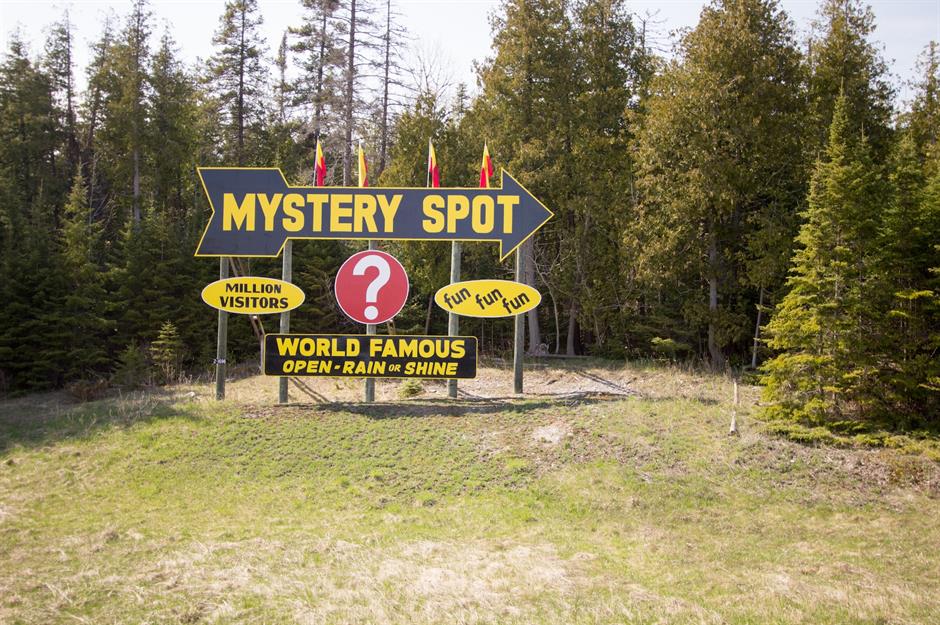
Like obscenity you know a tourist trap when you seen one, but the most common types of traps — restaurants, shops, and attractions — are often perfectly lovely and non-trappy. So we should define the term more specifically. An economist would describe a tourist trap as an opportunity (or threat, depending on who you are) that derives from information asymmetry — that is, a situation where one party has more information than the other. In every case that’s relevant today the two parties here are tourists (us!) and the establishments that grow up around or on the way to major destinations and sights that tourists desire. What this means in practice — how the trap is laid — is when restaurants, shops, and attractions prey upon the lack of information the tourist possesses of a product’s or service’s true quality, actual value, or local authenticity. Statistically speaking as a visitor to a new place you as a tourist will not have the contextual information that the seller does. Add to this imbalance that tourists are often tired, hungry, and/or unfamiliar with local currency, language, and culture. This only increases the precarity of the imbalance.
Why, you may be asking yourself, are we using economists’ definition here? Seems so boring and academic, right? Well we sorta have to use it because — and here’s the twist — like any market-driven phenomenon tourist traps only survive if people pay for their products and services. And survive they do. PEOPLE LOVE TOURIST TRAPS. In fact, many people would not rate a destination highly if they did not come festooned with souvenir shops and familiar chain eateries. Las Vegas for example is what happens when an entire town becomes a tourist trap, but that may be a subject for another itinerary. Travelers, may our companions never include people like this, but they most certainly do exist, I am sorry to say.
Usually it isn’t the major sight or attraction that is the trap, but the ecosystem of hucksters that grow up around it, so many slimy-sharp barnacles on an otherwise beautiful ship hull. (I say usually because of course there are counterexamples. Plymouth Rock, for instance, is both the destination and the trap. Spoiler: this is not where the pilgrims landed. If you believe it is boy do I have a story to tell you about Thanksgiving.) But more often than not the sight or destination is just that, a sight: Mount Rushmore isn’t a trap in itself (that is, if you like white imperialist aspirations defacing native land and natural beauty); the intersection of Broadway, Seventh, and 42nd Street in New York City isn’t any more of a trap than the numerous other confusing intersections in the metropolis; The Hollywood Walk of fame is, well, it’s just a sidewalk. In each of these cases it isn’t the thing you’re coming to see that’s the problem; it’s all the ancillary operations that set up adjacent to or on top of it expressly to take your money. Put another way: it isn’t the cheese that makes the mouse-trap it’s the spring-loaded metal hammer bar.
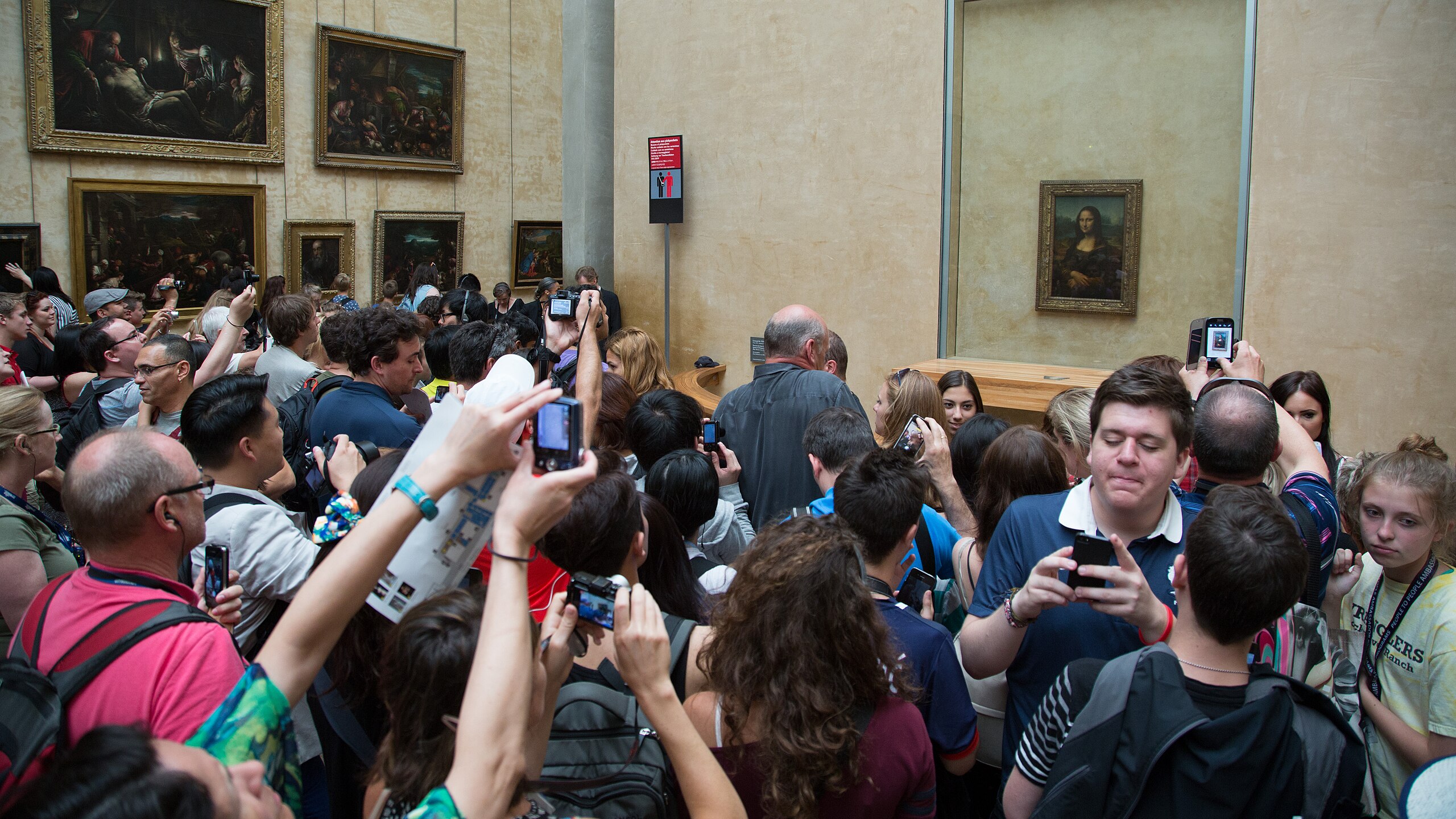
But another way to define a tourist trap — and frankly the one that troubles me most — is to look at destinations where the tourists themselves congeal to form the “trap”. This is the phenomenon of over-tourism, supercharged during the era of social media. Think of the Trevi Fountain in Rome, the Red Light District of Amsterdam, or even the geysers of Yellowstone National Park. While many of these will be accompanied by certain kinds of trappy vendors, the biggest trap is the other people there just like you. Too many of us. Babies crying, elderly moving too slowly, jerks not staying on marked paths, weird eddies in the flow of humanity caused by people trying to frame the perfect photo, and just the sheer amount of people burdening infrastructure that was never intended for the swarm of people. To smoosh together insights from Dorothy in Oz and Jean-Paul Sartre: hell is not where you’re go, it’s who you meet along the way.
Tourist traps are a global phenomenon. Like so many things gross things, America did not invent tourist traps, but hoo boy have we perfected them. And that I think is because we figured out how to spring traps at any scale and, frankly, anywhere. Sure, there are the obvious places for traps — scenic overlooks of natural grandeur (like The Grand Canyon), or sites associated with conspiracy or mystery (like Roswell, NM) or sites that promote a kind of shared national or regional myth-making (like The Alamo). But the real tourism innovation in the United States — and the set-up of so many horror movies — is that we figured out how to lay traps along the way in the middle of nowhere. America invented roadside attractions, places that make you stop on a journey and literally become a tourist even if you were not one when you set out. Because how could you not stop to see a collection of taxidermied two-headed calves? Especially when there’s been no other thing to see (or place to relieve yourself) in the previous 100 miles or will be in the next 100. The informal marketplace of oddities and discarded Americana may be the most important evolution of tourist traps in the 20th century. And this could not have happened without three things that make the US unique: 1) an insatiably consumerist public; 2) a love of the automobile; 3) vast distances — especially in the middle of the country — where there is nothing of note to see along the journey.

In planning the swerve to talk about movies in this segment I considered many paths. Even casual horror movie audiences could point to the sub-genre of trap-based films like the Saw series, the Cube series and the dozens of films inspired by escape rooms or even Halloween haunt attractions. But these aren’t tourist traps exactly. Going the other direction there’s the path that simply features tourists being dumb or naive. These are the subjects of films like Midsommar, Hostel, The Hills Have Eyes, or even The Rocky Horror Picture Show.
While not exactly traps gas stations, especially when there’s nothing else around, are central to so much of the horror canon, being featured prominently in the best and worst of the genre: The Texas Chain Saw Massacre, Maximum Overdrive, Friday the 13th, and countless films where a grizzled eccentric grumbles to teenagers that they shouldn’t go down whatever road. This feels close to tourist trap horror, but it isn’t exactly. In the same way films like Motel Hell and Hell Fest are adjacent by featuring things you find associated with tourist traps — in this case seedy hotels and carnivals. But, again, not exactly tourist trap films per se.
There are certainly films that whose settings are literally roadside attractions where kitsch turns deadly. For example, the main characters in House of 1000 Corpses are on a mission to write a book about offbeat roadside attractions when they are forced by a flat tire to visit a particularly gruesome one, falling right into the trap of Captain Spaulding.
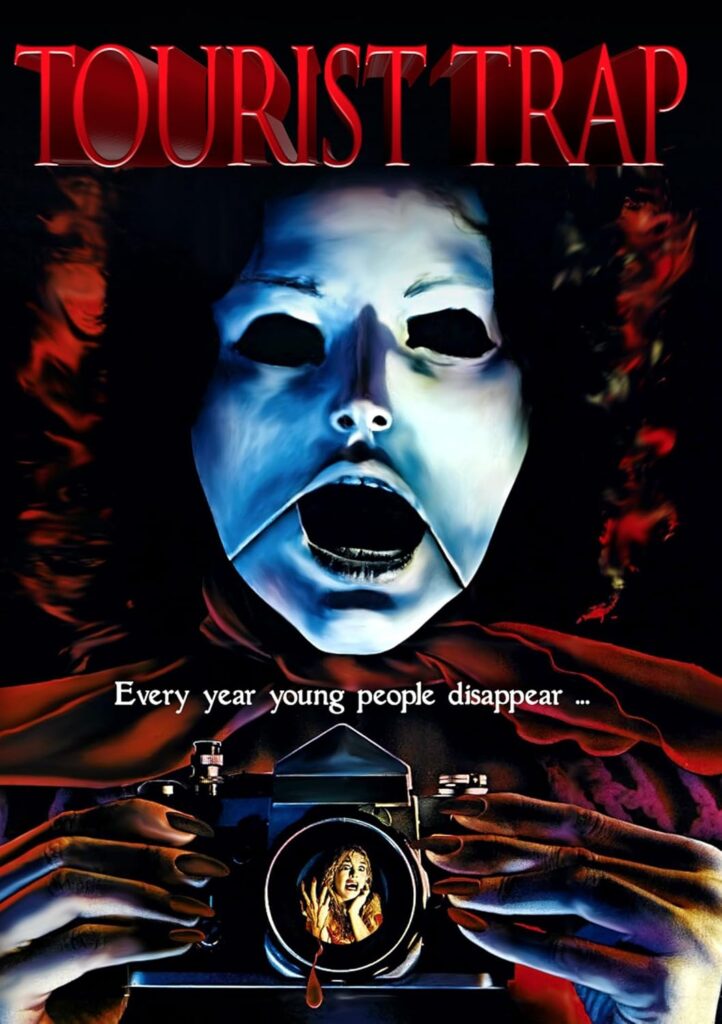
Luckily, we have a film from 1979 that must certainly fit the bill: David Schmoeller’s Tourist Trap. Known largely because it somehow received a PG rating and could be shown more widely than other films of its ilk (and also because of its striking VHS cover art), Tourist Trap continues many themes and tropes sealed up in earlier decades by the numerous remakes of House of Wax. Our teenagers here stop with a broken-down car at Slausen’s Lost Oasis, a roadside museum (and also gas station) full of animated mannequins run by the miscast but still decent Chuck Connors as Mr. Slausen. He’s welcoming enough, explaining how his brother created all the mannequins but that he went to pursue his career in the big city. He also relates that the creation of the interstate system basically bypassed his tourist attraction (a theme you’ll remember from Psycho) which is why it is so run-down. As Slausen offers help with the car various of course eventual victims discover that the mannequins are animated by more than gears and levers. There’s something supernatural going on, as objects move by themselves and the mannequins off the crew one by one. But there’s also a masked human killer stalking around killing some by plastering them alive, creating mannequin corpses for display. Slausen thinks it must be his brother. Travelers, it is not Slausen’s brother … which is why he wears a mask. Tourist Trap gives us a closing shot of a final girl, gone completely insane and continuing on her roadtrip with her original set of friends now rotting beneath their mannequin dressing. This is decent film for its time, calling back to classics of the horror genre but also firmly a part of the slasher renaissance. It even throws in some psychokinetics, a sub-theme of the 80s. But if we’re being honest, it’s not a tourist trap — even if our tourists become trapped. The protagonists of this tale stop because their car breaks down. And other than claiming the Lost Oasis was once a museum that’s not the nature of the destination anymore. He’s just a crazy old man with a gruesome collection. Cool title though!
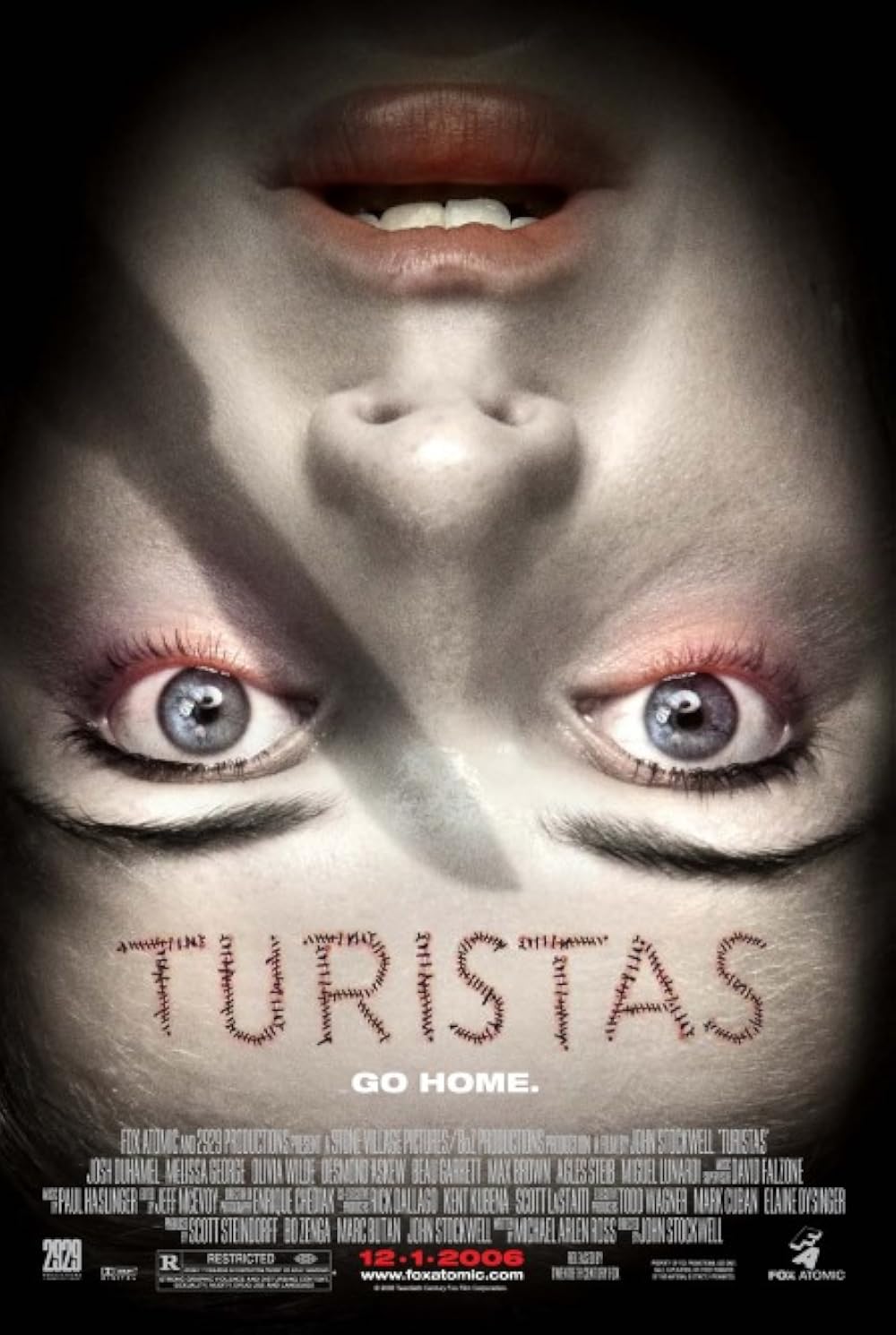
Leaving the US briefly we come up Turistas from 2006. Part of a spate of films seeking to capitalize on the formula of 2005’s Hostel, this film is about a bunch of American and British tourists vacationing in Brazil when their bus swerves off the road and careens down a mountainside. Everyone survives, but they sure are stranded. The backpacking turistas we mainly follow here are Olivia Wilde as the adventurous little sister of the overprotective Josh Duhamel and the world-wise Melissa George who teams up with them. While they initially find beachside fun to pass the time waiting for the next bus, the film quickly turns dark when they wake up after a night’s revelry with all their possessions and money stolen. Wandering around looking for help our crew eventually finds a young local with passable English who commits to take them to his uncle’s house in the woods for help. Red flag, tourists. This is a red flag. You might even call it a landing flare because shortly a helicopter — and the organ harvesting crew it carries — find them. You see this is all part of an organized criminal enterprise which, it is explained, seeks to provide transplants for needy Brazilians from the organs of exploitative gringos. They literally describe it as tourist “give back”. So we finally have souvenirs, except that it is the tourists who give them for one hell of a price. Turistas is a better film than it should be. It’s remarkably nuanced about the mistakes Americans make abroad and contains a pretty compelling sequence in the jungle where our backpackers try to outsmart the marauding surgeons in underground cenotes. Also it contains the classic line “Do you guys mind if I go topless?” By the prudish standards of early 2000’s horror this is a welcome wink to earlier eras — and it does not disappoint.
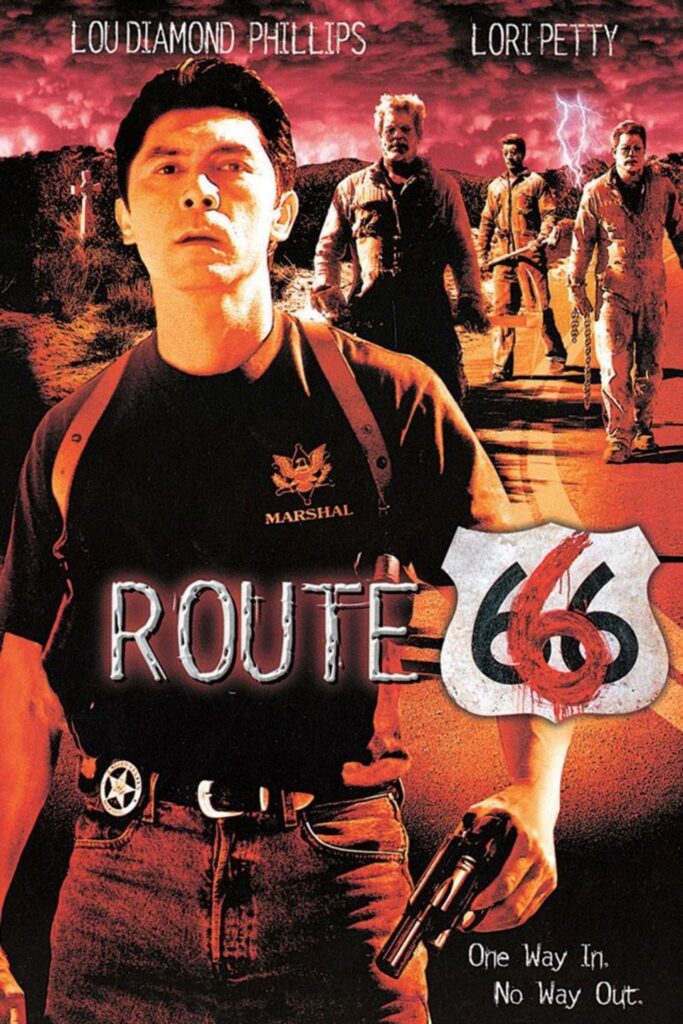
The last stop on our journey/lesson today is the 2001 action-horror Route 666. Starring Lou Diamond Phillips and Lori Petty as federal marshals transporting an informant across the American southwest to a trial date in LA. Fending off hitmen and having to deal with very unhelpful local authorities, the marshals learn of and eventually take a condemned road called Route 666, an offshoot of the famous Route 66, mostly now replaced by interstate highway (though which still exists in places). Route 666, we learn, was closed to travel after a prison road crew accident in the 1960s. This road crew of now-dead convicts haunts the road, manifesting as part ghost, part zombie and wielding all their old tools. There are only so many ways to be killed by a jackhammer or a steamroller, but tourists let me tell you, every one of these ways is a delight to watch. As a subplot we learn that one of the undead convicts is actually the father of Lou Diamond Phillips marshal character. It’s a warming father-son storyline that actually involves them helping each other out, wrestle match tag-in style. Oh also these convicts didn’t have an accident; they were murdered by the corrupt local authorities. There is comeuppance, naturally. It’s all ridiculous and very low-budget, but this film nails the setting — clearly it was filmed onsite in one of the myriad deserted roads that dot the American southwest. That’s half the spooky factor right there. I’d call this an action movie with horror elements rather than the other way around. But it’s also not really a tourist trap movie, despite its obvious nod to Route 66, the origin of so many traps in the first part of the 20th century. There are no tourists in this movie and the only thing trapped are the souls of the convicts from this cursed side-road.
Here’s the thing, my travelers. I would love to be proven wrong, but I don’t know that there is a horror movie that is precisely about tourist traps as we conceive of them. Such an opportunity! Imagine taking either of the definitions — a world of overpriced tschotkes and bland food as the setting for a film or a setting where there are just too many damn people trying to get at a singular sight. Except scary or gory or creepy. I would like to watch this movie, should it ever exist.
So consider yourself warned, travelers. You now know as much as I do about the perils of tourist traps. We will do our best to avoid them, but … hey wait is that a collection of rusty mufflers made into vaguely human shapes in that farm field? Only $40 to view? I’ll be right back.
Thanks for joining. Until our next itinerary!
A full list of the movies mentioned above can be found at Letterboxd. Find out where to watch there.
The Terror Tourist is my occasional segment on the Heavy Leather Horror Show, a weekly podcast about all things horror out of Salem, Massachusetts. These segments are also available as an email newsletter. Sign up here, if interested. The segment begins at 3:20 in this episode:
Mission Elapsed Time: 20:00:21:06:42:40

I went back through it this blog (and my Flickr account) on its 20th anniversary, retracing digital footprints made on what feels like a different planet. Here are some highlights.
The Terror Tourist

A roughly monthly exploration of places in horror fiction — real or imagined, geographical or psychological — culled from The Heavy Leather Horror Show.
Subscribe to the podcast or the email newsletter or just read through the archives posted here.
The Ampcamper

How I hauled myself, two teens, an 80 lb dog, and a whole load of crap 4000+ miles across six states in twenty days using an electric vehicle. And survived to tell the tale.


