
Phobos Ex Machina
Prefer to listen to this post? (It’s really me, not AI!)
Greetings, my travel buddies! I was reviewing our pre-trip paperwork and I notice that not all of you have filled out your required forms. Specifically, please reference the sheet where you’re asked to list your phobias. This is important, especially when traveling in new places. Those of you suffering from any of the following phobias are advised to contact me personally to discuss: claustrophobia (fear of enclosed spaces), acrophobia (fear of heights), amaxophobia (fear of being a passenger), or emetophobia (fear of getting sick abroad). So many phobias. So much to fear.
To thank for all this, at least linguistically, we have Phobos, son of the Greek god of war Ares and the goddess of love Aphrodite. Lion-headed Phobos is the personification of fear and panic, emotions felt in both love and war. My tourists, this week we’re picking up where we left our last overseas adventure on the Mediterranean. We’re headed from Albania southeast to the land of Greece, both ancient and modern, in a segment I call Phobos Ex Machina.
It cannot be overstated how much the history of drama is rooted in ancient Greece. Dante, Shakespeare, Mary Shelley, T.S. Eliot, Arthur Miller — all indisputably geniuses, but even they would admit to reworking tropes hammered on the anvils of Greek dramaturgy. Themes like hubris, where a character’s excessive pride becomes their undoing; or the question of whether we can act of free will or if our lives are fated to happen a certain way; or the idea of supernatural retribution for human transgression; even family curses, that bedrock of so much 19th century American fiction, come from Greek myth.
Look, the Greek civilization invented tragedy. And I can’t think of a single tragedy that does not involve death in some important way. It’s an inevitability. This doesn’t make all Greek tragedy horror, at least by our modern definition, but there is a lot that is straight-up horrific in the stories passed down through the millennia.
Let’s see some sights before we journey to film.
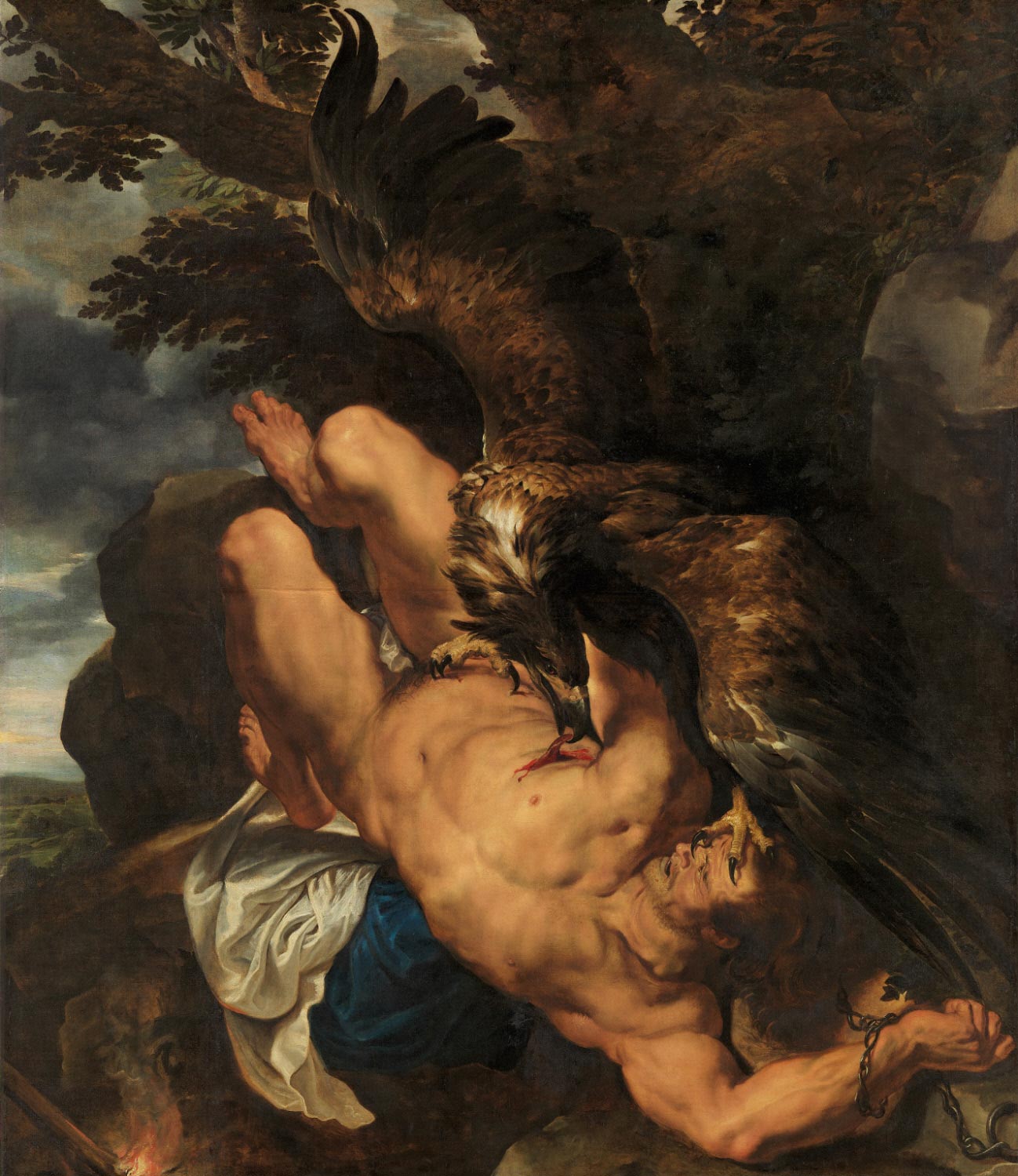
Some versions of Greek myth attribute the creation of humans to the Titan Prometheus. As if making inferior beings weren’t enough of an affront to the Olympian gods he then steals their fire so that humans may be warmed by and cook with it. This pisses off ol’ Zeus who decides not to kill Prometheus, but to lash him to a rock where an eagle comes daily to rip out his liver (the locus of emotion in the thinking of ancient Greeks). You’d think this disembowelment would soon lead to Prometheus’s death and an end to the torture. But Zeus thought of this and condemns Prometheus to re-grow his liver each night so that it may be pecked out again the next day. Guy just wanted to give humans a little heat and light. It’s brutal.
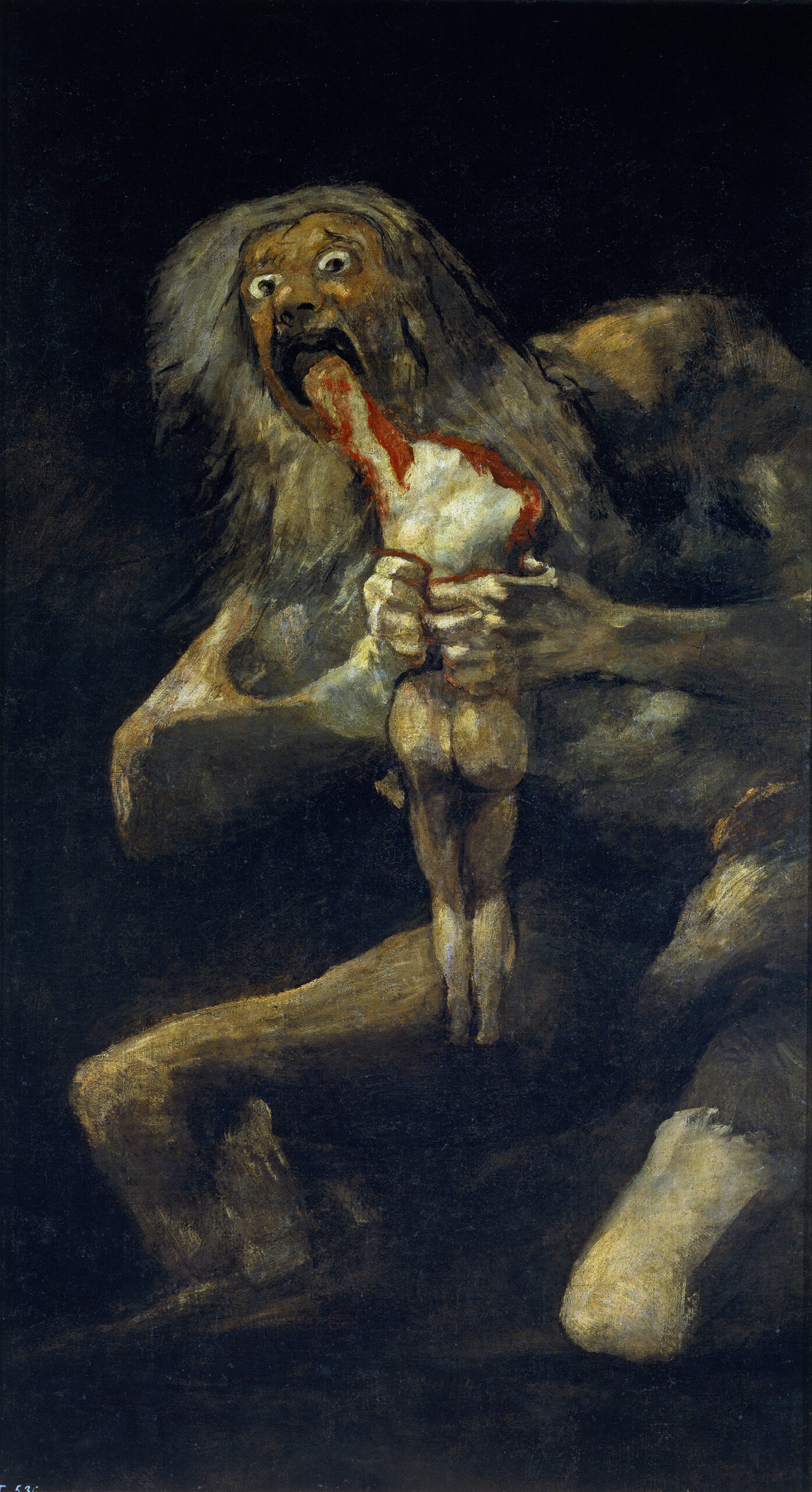
OK step off this liver-stained rock over here and let’s talk about Cronus, youngest of the Titans, who upon overthrowing his parents, Uranus and Gaia, learned that his children would also become patricidal maniacs. Cronus sires most of the cool Olympian gods — Demeter, Hera, Hades, Poseidon — but fearing for his life he swallows them all whole at birth to prevent their possible future actions. His baby-mama Rhea eventually decides she’s had enough and decides to deliver her last child, a kid named Zeus, and secretly on the island of Crete, swaddling a stone — and in some versions “nursing” it to prove it is a baby, which sprays milk all over the place creating The Milky Way — and presenting it to Cronus who promptly swallows it. Zeus grows up in secret, eventually confronts Cronus with an emetic which makes him disgorge all the sibling gods (and the rock), and ends up overthrown per prophecy to be imprisoned in Tartarus. The lesson here: cannibalizing your family is a bad idea in almost all circumstances. Write that down.
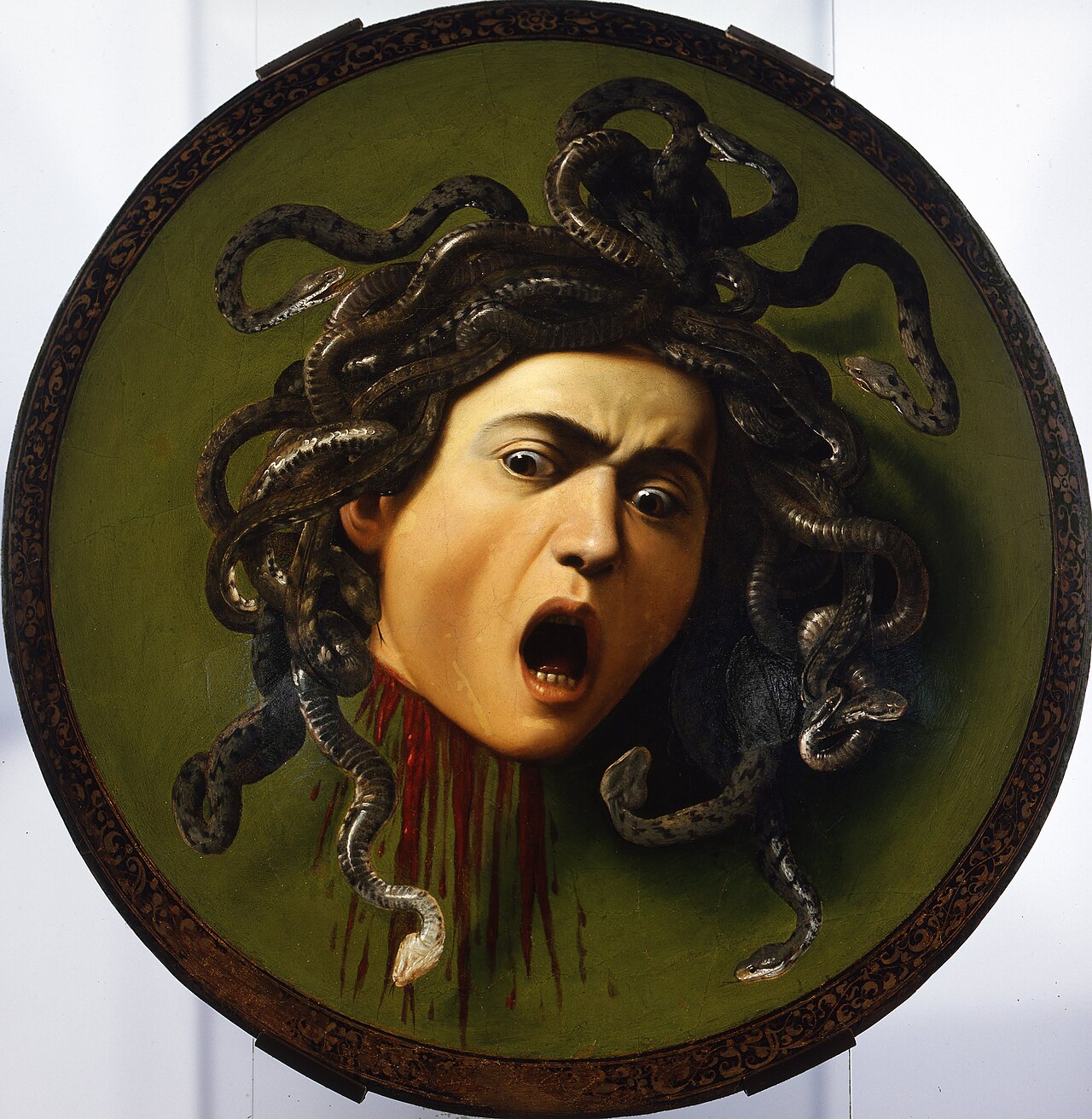
Avert your gaze this-a-way for the story of Medusa — horrific in a bunch of different ways. Maybe more troubling than her eventual snaky form is that she really didn’t do anything to deserve her fate. Medusa was just a beautiful Greek human, minding her own business, who attracts the attention of Poseidon, who rapes her. He does this for some reason in Athena’s temple. Athena is enraged at this desecration and, in an act of incredible injustice, blames Medusa and punishes her by transforming her into a hideous Gorgon: hair replaced by writhing serpents, skin turned green, and a gaze that turns any who look upon her to stone. Even in death she suffers indignity with Perseus using her severed head as a weapon before embedding it directly on the shield of Athena. And you know who suffers not at all for any of this? That sex pest Poseidon. It’s no wonder Medusa is a modern feminist icon.
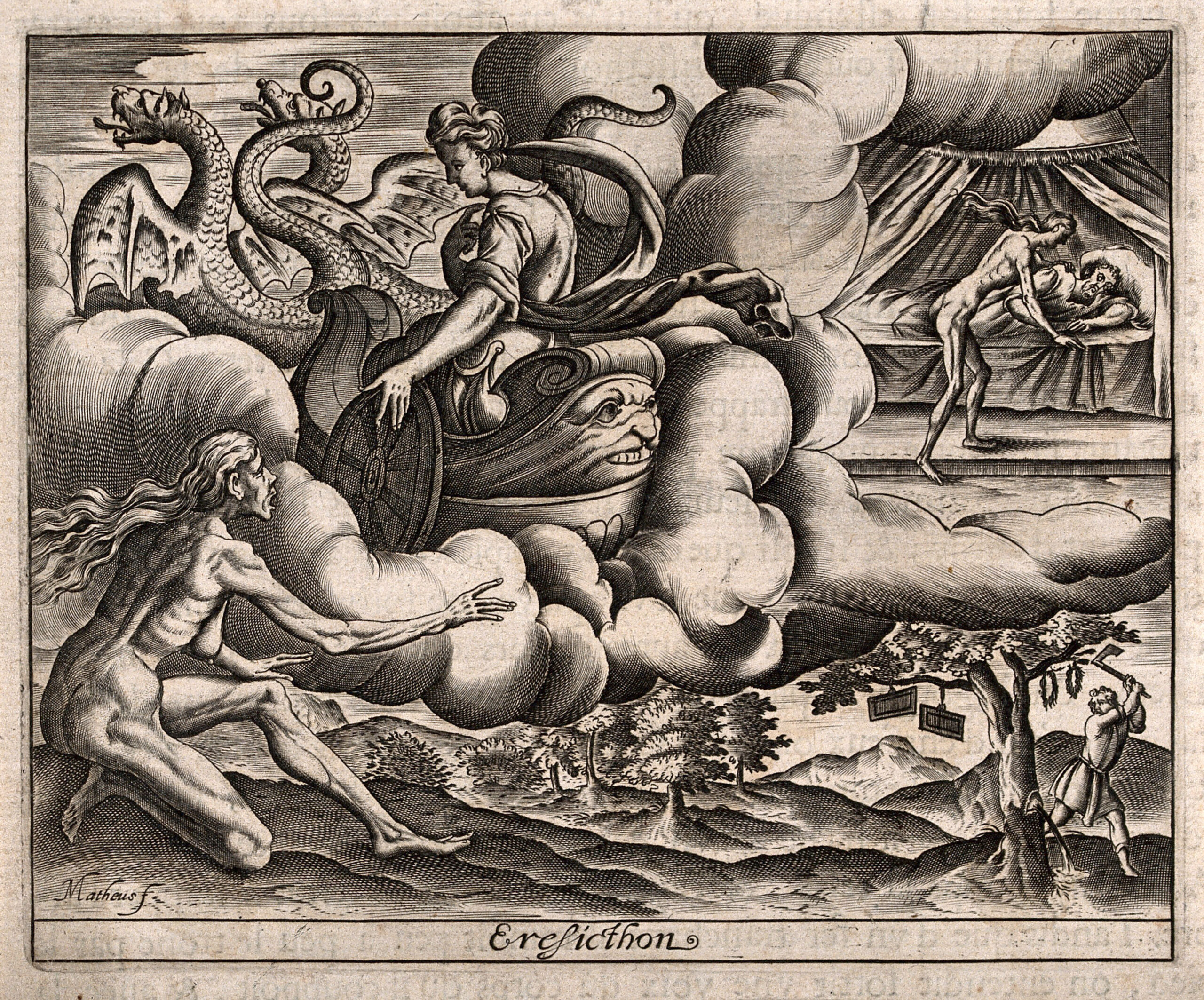
Travelers, it’s possible you don’t know the story of King Erysichthon. Arrogant, greedy, and not at all an environmentalist, Erysichthon ordered his men to chop down trees all over his kingdom. They comply but refuse to cut down one tree covered with offerings to Demeter. So Erysichthon grabs the ax and does it himself. Bad idea, for this tree is a wood nymph, who in her dying breath curses Erysichthon to a life of eternal hunger. The more he eats, the hungrier he becomes. He eats through all the kingdom’s resources, eventually selling his daughter for food. Finally, with nothing left to eat, he begins to devour his own flesh. If you’re hearing both J.R.R. Tolkien and Stephen King in this tale, well, that’s the seemingly endless echo of Greek horror.
It would be difficult to find a modern horror movie that doesn’t have some precedent, conscious or not, in Greek mythology. This week’s group watch film, Pig Hill, for instance, brings to mind the sorceress Circe and her transformation of Odysseus’s men into swine for invading her home. You could argue that these echoes are a function of there only being so many stories and allegories of the human condition — and that the Greek’s got there first, at least in the Western canon. Though these are not sequels in any narrative sense tracing the evolution of ideas, like pig-men, through the centuries is itself an insight into how human behavior changes or doesn’t. Circe turned men to pigs because they were acting like pigs.
Given this lineage it might be a fool’s errand even to talk about Greek horror films. It’s all Greek to us in some ways, but there are some films in the last century which are especially so. Let’s sprint through this marathon, shall we?
I would be kicked off this podcast if I did not begin this race with The Gorgon from 1964. Directed by Terence Fisher, starring Christopher Lee, Peter Cushing, and Barbara Shelley, The Gorgon tells the story of a village in pre-war Germany terrorized by a series of murders that result in victims turned to stone. What it is not is a retelling of the Medusa myth per se, merely using her petrifying power/curse as the killer. And what a great killer she is. A threat that cannot be viewed — which kills simply by being seen — is almost postmodern in its symbolic freight. I’m pretty sure Fisher understood what he was working with. The film opens with a man painting his nude girlfriend literally sitting motionless under his male gaze. The gorgon possesses the reversal of this power, the ability to stop male desire and action. One major difference between the myth and this film is that the gorgon can somehow revert to her human form, making her all the more elusive and dangerous. This film is everything you’d want from a Hammer production in full gothic mode. Except maybe the actual gorgon, called Megaera here, whose snake-filled wig is underwhelming even for the effects of the time. Christopher Lee is noted as saying “The only thing wrong with ‘The Gorgon’ is The Gorgon!”
1976 brought us good campy Greek horror in the film Island of Death, written and directed by Nico Mastorakis, is called one of the most widely banned films in the world — and I now understand why. Its tagline is “The lucky ones got their brains blown out!” Two British sexual perverts travel to the island of Mykonos for a killing spree. This film starts with the rape of a goat, proceeds to a crucifixion, dangling a man from an airplane and flying it into the sea, decapitation by bulldozer, a toilet drowning, a death in a pit of lye … and to top it all off, an incestuous twist. Wow this film. 50 years later it still seems outrageous.
Taking our journey slightly closer to the actual country of Greece is the Video Nasty usually known as Anthropophagus from 1980, an Italian production from Joe D’Amato and George Eastman. Anthropophagus is the story of a group of tourists stranded on a small Greek island and stalked by an especially hungry and especially gory cannibal. Said cannibal, the titular anthropophage, is himself a shipwreck survivor who years ago was forced to eat his son and wife to stay alive. Though this movie is a pacing train wreck it is an important film in the evolution of gross films as it features an infamous scene where the killer strangles a pregnant woman then feasts on her fetus. You have to give this guy one thing, like Erysichthon, he’s ravenous to the end eventually eating his own entrails when he takes a pickaxe to the gut.
Greek horror in the 80s went creature feature with Blood Tide, featuring James Earl Jones, and full slasher in The Wind starring Meg Foster. How about underground Greek art horror? Got that in 1990 with Singapore Sling: The Man Who Loved a Corpse. This movie basically is every genre all at once, though from this description you’d be forgiven for not believing it was a comedy.
Evil, the first Greek zombie film from 2005, is known to film nerds as “My Big Fat Greek Zombie Apocalypse”. And that’s pretty much all it is known for. We also have Guilt from 2009, a Cypriot fusion of historical horror (mostly about the invasion and division of Cyprus in the 70s) with psychological horror. Greece seems a perfect setting for folk horror and we finally get that in 2019 with the slow, too-long Entwined. The final stop on our tour is the recent Its Name Was Mormo from 2024, a Cypriot found footage tale of a family bedeviled by an ancient demon and presented through a police reconstruction of events.
So basically, though Greek horror films are not many, the industry has experimented in most of the major sub-genres. There are some omissions: as central as the Mediterranean is to the culture and history of Greece you’d think there would be be more sea-based horror. (Only Blood Tide makes this central.) Also, being so close to Italy you’d think there would be a lot more Greek gialli, which does not seem to be the case. As far as I can tell there is no endemic or particular Grecian flavor of horror. But then again, so many of our modern monsters, themes, and even methods of killing were presaged eons ago in Greek drama. So maybe they are just taking a well-deserved break.
And now it is time for us to take a break, travelers. I hope this did not trigger any of your latent, undocumented phobias. But if it did you now know who to blame. Until next time!
A full list of the movies mentioned above can be found at Letterboxd. Find out where to watch there.
The Terror Tourist is my occasional segment on the Heavy Leather Horror Show, a weekly podcast about all things horror out of Salem, Massachusetts. These segments are also available as an email newsletter. Sign up here, if interested. The segment begins at 9:22 in this episode:
Mission Elapsed Time: 20:00:21:06:42:40

I went back through it this blog (and my Flickr account) on its 20th anniversary, retracing digital footprints made on what feels like a different planet. Here are some highlights.
The Terror Tourist

A roughly monthly exploration of places in horror fiction — real or imagined, geographical or psychological — culled from The Heavy Leather Horror Show.
Subscribe to the podcast or the email newsletter or just read through the archives posted here.
The Ampcamper

How I hauled myself, two teens, an 80 lb dog, and a whole load of crap 4000+ miles across six states in twenty days using an electric vehicle. And survived to tell the tale.


