
The kind of Innovation Chicago is
The economist Edward Glaeser has called Chicago “a city built upon corn in porcine form”. He’s referring to the city’s remarkable 19th century transmutation of the natural bounty of prairie agriculture into a higher value form of commerce, pigs. The innovation necessary for the cold storage and transportation of which would help Chicago become the central node in a nation-spanning rail network. It was the beginning of greatness.
We can effect this transformation again. Our natural bounty today is data, knowledge, and ideas — their “form” the establishment of new businesses and a more livable Chicago.
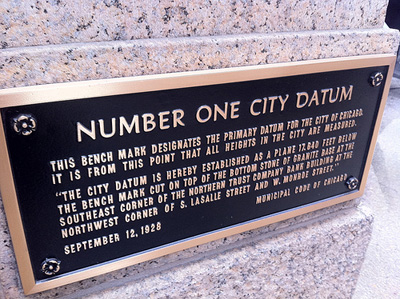
Standard for height measurement in Chicago, NW corner of LaSalle and Monroe.
Today Chicago gets a new mayor and a new administration. I’m proud to be its Chief Technology Officer, a role I took for a single, simple reason. For the last three years I have traveled the world consulting with cities on strategies for making them smarter, more efficient, and more responsive to citizens. Many of these talks and projects were fruitful, but none of them mattered to me personally. None of them, in short, mattered to the city I love most.
The coming of the web, you may recall, was cause for all kinds of pronouncements that we’d move away from each other, tied only by network communications, happily introverted in electronic cocoons. This has not happened (indeed the reverse is happening). If anything the ubiquity of network technologies has proven that place matters. Mobile computing and “checking-in”-style apps are ascendant because we are creatures of place. And my place, the place of four generations of my family, is Chicago. It’s time to focus my effort here.
The transition report published last week is a roadmap for the change the Emanuel administration will undertake. All of the initiatives are exciting and important, but one speaks directly to remaking Chicago as a hub of information that leads to insight and growth.
Set high standards for open, participatory government to involve all Chicagoans
Why do this?
Without access to information, Chicagoans cannot effectively find services, build businesses, or understand how well City government is performing and hold it accountable for results.How will we do this?
The City will post on-line and in easy-to-use formats the information that Chicagoans need most. For example, complete budget documents – currently only retrievable as massive PDF documents – will be available in straightforward and searchable formats. The City’s web site will allow anyone to track and find information on lobbyists and what they are lobbying for as well as which government officials they have lobbied. The City will out-perform the requirements of the Freedom of Information Act and publicly report delays and denials in providing access to public records.The City will also place on-line information about permitting, zoning, and business licenses, including status of applications and requests. And Chicagoans will be asked to participate in Open311, an easy and transparent means for all residents to submit and monitor service requests, such as potholes and broken street lights. Chicagoans will be invited to develop their own “apps” to interpret and use City data in ways that most help the public.
Participatory government isn’t the only use of the wealth of information the city can publish. We intend data-driven decision-making, powered by deep analytics of our services and city vital signs, to be central to the day-to-day business of running Chicago.
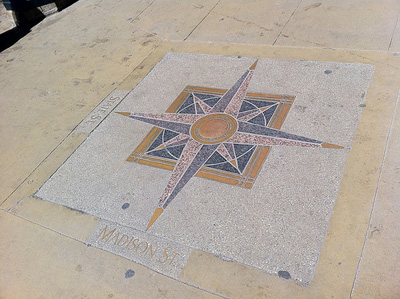
0,0 on the X-Y axis that is the Chicago street grid. Madison and State.
A data-centric philosophy is more than transparency and efficiency, too. It is about fostering innovation. Business is built on local resources. Where once we transformed grain into pigs into commodities, we can now provide data that serves as a kind of raw material for new business and new markets.
(One example of this — and proof that the talent to do great things is right here, right now — is the design of a “smart intersection” by the students from George Aye’s Living In A Smart City class at the School of the Art Institute this semester.)
There’s plenty more in store for technology to assist in Chicago’s growth and livability. It’s suffused throughout the transition report: promoting entrepreneurship, increasing access to broadband, treating the street as a platform for interaction itself (more of which on all these in future posts). But the foundation is data. Access is an important first step, followed quickly by the tools and policies for taking action on it.
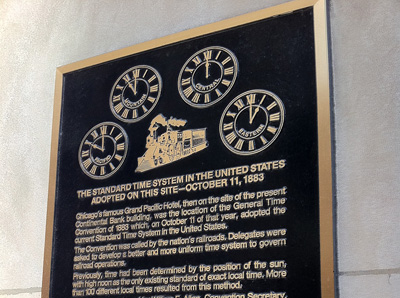
A network of moving things prompts the establishment of a national standard time.
Chicago knows how to do all this. We’ve been doing it for over a century. We have the talent in the private sector, in academia, and in our non-profits to capitalize on any impetus city government can give. Let’s get going.
On Leaving IBM
Today, May 12, is my last working day with IBM, my employer for the last 13 years. It’s tough to adequately express how many opportunities IBM has afforded me and how difficult it was to make the decision to depart.
What follows is my shot at the first. I’ll let you guess at the second. (Hint: If you’re looking for a juicy exposé or vindictive exit letter, this ain’t it.)
1998, Georgia Tech: I was finishing up a masters degree that didn’t exist three years prior. The tech bubble had not burst and everyone in the circles I moved in was decamping for the world of stock options, foosball tables, and the promise of becoming the next Netscape.
I had two offers on the table, one from a classic dotcom agency, and one fromIBM, a classic old person company. I struggled mightily with the decision and frankly I still don’t know exactly why I chose IBM. Might have been the I in the acronym — the suggestion of a career spent globetrotting and doing business in different cultures. But I do know that the other company ceased to exist only a few years later.
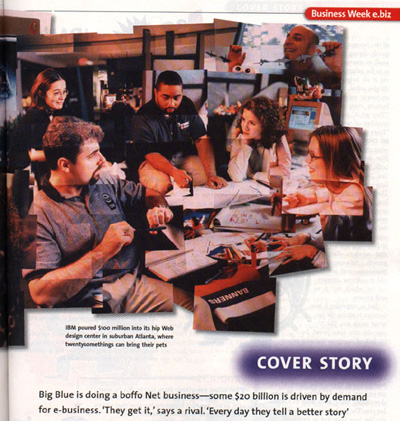
IBM then was a resurgent corporation back from the brink of death. Atlanta was the home to its Interactive Media organization, a kind of skunkworks dotcom agency — which I joined as a producer. (We had so few models internally for the web work we were doing that we borrowed titles from flim: producer, executive producer, even continuity director.) It was frenetic, design-oriented, and full of lots of people who very definitely were not old. (And neither was I. Dig the hair!)
I lucked into the part of Interactive Media that was building systems for live event coverage of the sports properties that IBM sponsored, primarily pro tennis, golf, and the Olympics. This was the world before cacheing and the cloud and so a certain amount of terror accompanied the task of running websites that could handle the load of sports fans worldwide checking scores covertly from work.
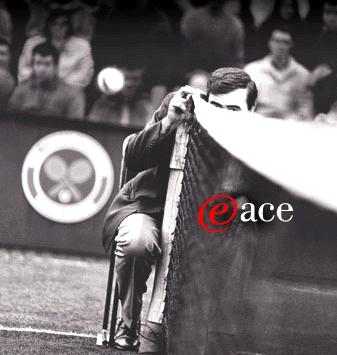
We were “webcasting,” crammed into windowless rooms or awful rented trailers, but let’s face it, I was onsite at Wimbledon, the US Open, and the Ryder Cup. And loving it. The stories and friendships from those days are some of the most cherished of my career. (Someday ask me about a sopping-wet Brooke Shields hiding out in our nerd bunker during a rain delay at Flushing Meadows.)
The moment that established the trajectory that would basically define my career at IBM — diving way deep, obsessively even, into the subject matter surrounding my projects — arrived with the State Hermitage Museum in St. Petersburg, Russia. I had been tagged by colleagues as “the guy who likes books” given my undergraduate pursuits, so I suppose it is not surprising that I would be given the lead on a cultural project. It was a massive undertaking, digitizing thousands of works of art, presenting it on a still-nascent web, and working across cultural and linguistic differences. It was, in short, a template for much of the work to follow.

With one interlude. In 2000 I somehow finagled my way onto the cruise shipIBM had rented as living quarters for its guests to the Sydney Olympics. A pal and I provided tech support in the computer lab for IBM customers to check e-mail and download digital photos. (It was the era before ubiquitous laptops and connectivity, you see.) It was also, perhaps, the greatest gig of all time.
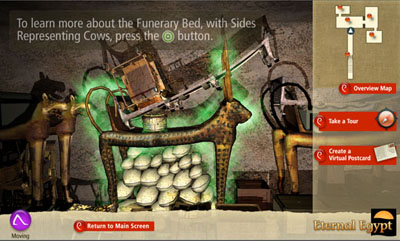
Over the course of the next many years I had the privilege of leading a number of increasingly complex projects in cultural heritage. Eternal Egyptapplied the concept of an online museum to an entire country, across multiple institutions, and nearly all historical eras. Add in mobile phone and PDAaccess (hey, it was 2003!) and a History Channel documentary and you had the making of something great.
Moving away from material culture and into the realm of society and history, I was honored to lead the team that built the website for the newest Smithsonian museum, the National Museum of African American History and Culture, something not set to open on the mall for several years. TheNMAAHC Memory Book was one of the first citizen-curated content projects for the Smithsonian and is a great foundation for the museum’s bottom-up presentation of the African-American experience.
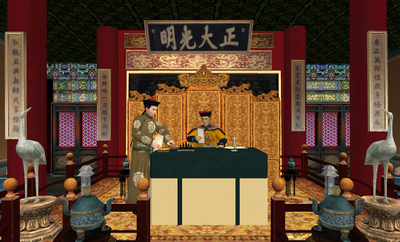
More directly in the lineage of the Hermitage and Eternal Egypt, The Forbidden City: Beyond Space and Time took IBM’s cultural heritage work away from the web and into multi-user 3D space. Modeling the square kilometer of the Ming-Qing era complex was my first taste of city design and crafting spatial interactions, a foreshadowing of relatively great import.
Interspersed among the cultural work were a few important projects that were both responses to world events. The Katrina disaster mobilized a crack team in IBM to develop Jobs4Recovery, a site that aggregated and geo-located employment opportunity in the states hit by the hurricane. This was particularly meaningful to me as my wife’s family was directly, sadly affectedby the disaster and its aftermath.
Working in Egypt before and after the 9/11 attacks gave me a perspective (and friendships) for which I am eternally grateful. So it was a real pleasure to work on Meedan, a news aggregrator/social network for current events in the Middle East and North Africa. Working with the non-profit of the same name, Meedan was built to use IBM machine translation and human volunteer editors and curators to provide English and Arabic translations of news stories and comments. I had worked much of my career presenting the treasures of the world’s material culture to broader audiences; Meedan was my opportunity to widen the definition of culture that we were hoping to bridge to others.
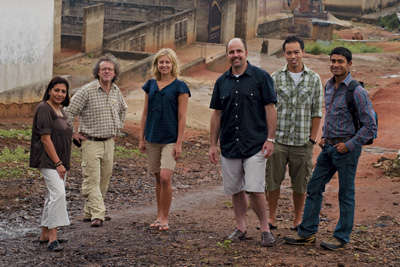
Perhaps the most transformative moment of my career came upon being accepted to the fledgling Corporate Service Corps, IBM’s internal “peace corps”, a hybrid leadership development and philanthropic program that sent small teams of IBM’ers to areas of the world that IBM does not currently do business. I joined the first team to West Africa and was thrilled to head to Kumasi, Ghana with nine other IBM’ers from around the world. We worked with small businesses to help them on all manner of problems. Being jolted out of a comfortable office setting to find common ground with colleagues from different lines of business and other countries was amazing enough, but I had the great fortune of our former nanny in Chicago, a native of Kumasi, returning to her family there and ensuring that I not only worked in Ghana but felt a part of the community there. It changed my life.
I got my first dose of what would become a full-on obsession in modeling complex systems for better decision-making when I inherited Rivers for Tomorrow from a retiring colleague. Rivers, a partnership with The Nature Conservancy, permits users to simulate different land use scenarios in river watersheds to see what the effects are downstream, so to speak, on water quality. It was a fun set of systems to model, but much hairier problems came shortly.

The project that I end on, whose roots I trace to the Forbidden City project, isCity Forward. I consider it a kind of simulator of cities using data in the same way that the Virtual Forbidden City was one in 3D graphics. You can read all about the project — heaven knows I have talked about it enough here and elsewhere, but the key thing is the world of urbanism that it opened to me. City Forward set me on a path to relationships with people making real change in cities around the world and showed me the promise of technology embedded in the everyday lives of city-dwellers. It is, in a word, the springboard that has launched me into my new role.
I realize that’s a pretty me-focused list of experiences and I will admit that this blog post is as much a personal retrospective as anything else. But I think it does a good job of making it clear how important IBM has been to my professional development, personal growth, and intellectual satisfaction. I could not have asked for a more fulfilling past 13 years and I leave with nothing but respect and thanks for what the company has done for my family and me.
And yet the list above glaringly lacks the most important thing that I am leaving. My colleagues in IBM have, to the person, been the most meaningful aspect of my career. To list everyone who made me a smarter person, a better colleague, a more understanding manager, a more collaborative partner, or better world citizen would take several blog posts, but suffice to say that I met some of my very best friends, a few mentors, and even a few professional idols in my time with IBM. My gratitude for my colleagues at IBM exceeds my capacity to express. Thank you.
So what now? I am off to the role of Chief Technology Officer for the City of Chicago under our new mayor, Rahm Emanuel. That’s a post for another time, but it’s fair to say now that it was an offer I could not pass up. I have been preaching smarter cities for a very long time; to let an opportunity go by to take real action in the city I love most would have filled me with regret. It is time to put my money where my mouth is.
IBM turns 100 years old this summer — a fairly amazing accomplishment for any company, let alone an IT company. I’m proud of what IBM has achieved, but even more proud of the people who have done the work. I’ll leave you with this extraordinary video, the best portrait of the people of IBM that I know. And the very essence of what I will miss most.
Mission Elapsed Time: 20:00:21:06:42:40

I went back through it this blog (and my Flickr account) on its 20th anniversary, retracing digital footprints made on what feels like a different planet. Here are some highlights.
The Terror Tourist

Explorations of place in horror fiction — real or imagined, geographical or psychological — culled from my time on The Heavy Leather Horror Show 2023-2026.
Subscribe to the podcast or the email newsletter or just read through the archives posted here.
The Ampcamper

How I hauled myself, two teens, an 80 lb dog, and a whole load of crap 4000+ miles across six states in twenty days using an electric vehicle. And survived to tell the tale.


