etc., recall the word
resoldered here
in a pane of sand.
— R. Kenney

Ascent Stage
a life-in-progress

Tags: , ,

Posted at 2:49 PM | Permalink | Comments (2)

February 6, 2007

Today's forecast in Beijing

Smoke

Not smog, not haze. Smoke.

Last night on the flight in from Shanghai the flight attendant announced that it was pleasant and sunny in Beijing. It was 10:30 PM.

Tags:

Posted at 6:58 PM | Permalink | Comments (0)

November 10, 2006

Spot the wall

While the debate rages about whether The Great Wall of China can or cannot be seen from orbit, I can confirm that it can at least be seen from an airplane on a clear day. What a treat on my approach to Beijing.

IMG_7103m.jpg

Posted at 9:50 AM | Permalink | Comments (0)

September 25, 2006

Moving images

A co-worker lent me his slick hard-disk camcorder for the most recent visit to China. I've posted a few scenes from the B-grade horror movie known as the Night Market.


See also Night Market Parts Two and Three, a funky physics-defying aquarium/fishbowl hybrid, and this nifty digital book interaction.

Posted at 8:15 AM | Permalink | Comments (0)

September 18, 2006

A stroll through the Night Market in Beijing

America's Chinatowns have plenty of crittermeat, but they just don't offer the diversity of skewered (and fried!) insects that you can find in China proper, you know?

silkwoms.jpg

I'd advise you to put down that snack you're munching at your desk and view the full set of yummies!

Posted at 4:36 PM | Permalink | Comments (1)

July 10, 2006

Isn't that spatial?

main.jpeg
Nothing left to accomplish now that I'm the subject of a podcast, I guess.

VerySpatial - Episode 51 [16.2 MB, MP3 format]

VerySpatial is the work of three really interesting folks at West Virginia University who focus on geospatial technologies. Sue (pictured right), Jesse, and Frank interviewed me last week after they came across the press hoopla for The Forbidden City: Beyond Space and Time project.

Beware: none of my prolixity or verbal stutters have been edited out. Massive rambling dead ahead!

Posted at 11:23 AM | Permalink | Comments (0)

June 17, 2006

The Forbidden City: Beyond Space and Time

Yesterday in Beijing, China's Palace Museum and IBM jointly announced The Forbidden City: Beyond Space and Time, the project that I've been working on for over a year. Consistent readers of this blog (yes, you three) know that I spend a lot of time in China and so it is a great relief that the cat is officially out of the bag. Not that I'll be diving into excruciating detail in future posts -- gotta save some surprises for the actual launch in 2008, right? -- but it should give a bit more context to my musings.

So, what's the project? Well there's the official press release and the Palace Museum's statement (in Chinese). The Chicago Sun-Times decided to take the local angle on the announcement and ran a flattering piece on me and my team. The paper even gave Ascent Stage some love.

But what is Beyond Space and Time? Well, announcements like this at the beginning of a project are always tricky since it is the nature of multi-year, first-of-a-kind efforts to change drastically from vision to implementation. But you have to start somewhere, so here's the vision.

The heart of Beyond Space and Time is a virtual online replica of the Forbidden City. This is not a set of traditional webpages but rather a fully immersive, spatial, populated world that corresponds architecturally and historically to the vast grounds of the current Palace Museum. And not just pretty building models to ogle at. We call it a Participatory Cultural Environment to stress the importance of a space alive with people -- other visitors who you can interact with and, if possible, computer-controlled representations of historic persons. Though 3D representation is widespread in the field of cultural heritage (primarily for preservation), this kind of multi-user, education-focused cultural worlds does not exist.

If you know Second Life, you're familiar with non-game-based 3D virtual communities. Second Life is an inspiration and even a development sandbox for us (no SLURL, we're on a private island for now -- but we did recently take a SL team portait), but we're evaluating many platform possibilities. It is sometimes said that people who visit the real Forbidden City leave thinking that they've missed the actual Palace Museum. In fact, the buildings and grounds (and of course the artifacts therein) are the Palace Museum; it is not a single building with nice glass cases and wall placards. This is the primary reason that our virtual version is a spatial world rather than a more traditional web front end (however tricked out) for a database of media, as we did with the Hermitage and Eternal Egypt. The museum is a city and the best way to experience a city is by moving through it and interacting with others in it. Call it the sidewalk approach to cultural heritage.

There's an historical aspect too: that's the beyond time part. We envision being able to move between a few discrete historical moments in the centuries-long evolution of the city. The environment will morph architecturally and of course the storylines embedded in the world will correspond to the historical moment. System design verges on science fiction here as we move through the implications of a community space that exists on different timelines. For example what happens to the field trip group when some of your classmates decide to peel off for the 16th century?

Of course, a virtual simulacrum of a physical space isn't much fun if it doesn't have points of tangency with the real world, now is it? We're working with our museum partners to identify places inside the Forbidden City where visitors who are physically there can interact with the virtual version of the space. We're evaluating different location-based services -- from projection in the palace halls to mobile device interaction. The idea is to break down the strict distinction between the real world and the virtual world, to let one enhance the other. Challenges like this are one of the many reasons IBM undertakes and funds projects such as Beyond Space and Time.

There's an aspect to the project that is personally very exciting and not yet reported in the press. Modelling 800 buildings to a level of appropriate detail isn't something that can realistically be achieved by 2008. We realize this and actually think it is a blessing in disguise. Inspired by the Ancient Spaces project which itself takes a Wikipedia-like approach to collaborative content development, we propose to open the modelling effort to the global community of developers. When exactly this will happen and certainly how it will work is still to be defined, but if you are interested in being part of the distributed virtual construction crew drop me a line at .

In North America I am working with some very talented designers and developers, many of whom have years of experience from earlier museum projects. In China we're working with specialists from IBM's research lab in Beijing as well as a team at the Palace Museum who are as technically-savvy as they are informed about the history and culture inside the Forbidden City walls.

So, then, back to work.

[Note to those of you who read this site's feeds: I've played with a kind of spatial hyperlink that adds some extra information to this post. The content, alas, is not part of the RSS feeds. Drop on by the site if you'd like the extra morsels.]

Posted at 8:09 PM | Permalink | Comments (6)

May 7, 2006

Culinary turntablism

Does anyone remember the scene in The Golden Child -- maybe I should first ask, does anyone remember the movie The Golden Child? From 1986, with Eddie Murphy? Not one of his best. There's this scene where he enters a Nepalese temple and encounters a ceremonial pillar that rotates around its vertical axis. Not knowing what to do, he scrubs it like a turntable DJ, making a scratching noise. Laughter ensues.

meal.jpg

I think of that scene when I eat out in China because of the mechanism known as the zhuan pan at the center of the table. Known in the west as a lazy susan, this rotating platter is a fixture at traditional tables in China. It is both an efficient delivery mechanism and a wonderful social lubricant. Everything is communal and by definition participatory as the platter rotates forth and back. You just reach in with your chopsticks as a dish you like comes by. If you can get beyond the sanitary issues of this particular disease vector it becomes clear that the zhuan pan is a marvelous thing.

There's something musical about the whole process. The zhuan pan is a DJ turntable set up.

zhuanpan.jpg
The central rotating platter known as a lazy susan in the west. (My first foray in Google Sketchup.)

Consider it this way. The dishes are notes/chords/samples -- discrete musical units of some kind. They appear at a point in time on the platter and rotate more or less consistently until they are removed or moved (more on this in a moment). So you have discrete units repeating in time from the perspective of a fixed point which in this case is me, the eater, but metaphorically is the armature of the phonograph. Units are added in time, layered in so to speak, and repeat at the same interval. Dishes leave the table periodically -- their particular musical loops end. But the dishes return, smaller this time (the waitstaff transfers uneaten portions to smaller plates to make more room on the table) and they are placed closer in to the center of the rotating platter, allowing people easier access to the newer, fuller dishes at the periphery. In other words, the loops return in a changed state and with new, quicker intervals (rotating more quickly since their radial distances are now shorter). The zhuan pan rotates backwards too, but only quickly, a "scrub" if you will, to let someone grab a morsel that made its way by too quickly. The overall motion is forward.

Data visualization geek that I am I started considering the possibilities -- which of course weren't visual at all but more like data sonification (a field to be sure but not one much popularized). What would this meal sound like if the zhuan pan were a recording?

tracks.jpg

zhuanpan.mp3 | 1.4MB | 1 min, 1 sec

So I recorded each dish as a separate track in GarageBand. Each measure corresponded to one minute of the meal starting with the arrival of tea, which is the downbeat bass drum that remains constant throughout, the engine of the entire affair. Each new dish comes in more or less as I recorded it on a timeline in my notebook during the meal. (My hosts graciously obliged my notetaking as the curiosity of a unaccustomed Westerner.) Some dishes are single notes, some are short phrases, and at least one, the fish "flower," is a constant note modulating in time with the rotation of the table. Each unit repeats with a period of five minutes. This is an average based on the number of revolutions of the table, but it is almost exact for at least the first two rotations of the 50 minute-long meal. With the exception of the tea-beat, volumes fade out for each track based on the consumption of the dishes. As noted above, the period of at least one dish, West Lake soup (represented by the piano), speeds up midway through the meal as it was transferred to a smaller plate and move closer to the center of the table, rotating faster. The two vinyl scratches correspond to an extended counter-rotation of the table. At 60 BPM one second correponds to roughly one minute of elapsed meal time. I think the time signature is 5/4, but I'm rusty on my Brubeck so who knows.

It is not what I'd call a chart-topper, but it isn't cacophonous, though at quicker BPM's it does get a bit muddy. I clearly could have done more. Instrumentation could be made to correspond more closely to the food type. (But what does "silver agaric" sound like?) Discord could be used to suggest tastes I did not care for. But the general idea is clear. Maybe on the next trip I can videotape the whole thing for the time-lapse music video this cries out to be.

bi2.jpg

In China you often encounter a circular jade plate known as a bi. It is ancient in origin and its purpose is not completely understood. The bi is flat and usually has a circular hole at the center. Movable type, gunpowder, paper. The recordable disc?

Posted at 12:21 PM | Permalink | Comments (1)

May 1, 2006

8 days (crammed into less than) a week

That's pretty much how I feel as I recuperate from an exhausting four days in Beijing.

This was the first trip to China where I truly experienced Wikipedia withdrawal. You really don't know what you've got until it is blacklisted by a state government. I worry about the larger implications of this.

I always chuckle at the Chinese entry document when you are asked to check the box corresponding to your intention: Business, Conference, Official, Other (huh?), etc. There's a box that says Settle Down. I'm tempted to check it. What does that mean? Give me your poor, your tired, your crazed Westerners looking to just settle down? I imagine the schoolmarm at passport control looking at me stoically and saying "You just need to relax, hmmm?"

I've realized now, after my seventh trip to the Far East, that the timeshift is truly diabolical. I suppose it is my own fault. When working in Europe and the Middle East you basically have an elongated work day. Do your thing there, return to the hotel, log on, work with your colleagues back home for a few hours at the start of their work day. In China, it is like this but with about a five hour gap between the end of the Chinese work day and waking Americans. After a few days of this the only reasonable thing to do is sleep during this period. Which completely destroys any hope of a sustainable schedule. The day becomes split: awake 6am-6pm, sleep 6pm-10pm, awake 10pm - 2am, sleep, etc. Awful. Maybe I should just treat it like a vacation from work back home.

That said, I can't complain. Working at the Forbidden City is a special treat. IT geeks are almost always housed in basements, dungeons, or worse -- and when I work there I am in a temporary trailer -- but how bad can it be when you step out to this?

pmit.jpg

The Forbidden City is surrounded by a wide moat on all four sides. It is stagnant and forboding, as a defensive moat should be, I suppose. Yet, there are always a few dozen people fishing in it. I've never seen anyone pull anything living out of it, but from the size of the poles they use (without reels) I am pretty sure they are angling for some sort of slithering leviathan the size of a bus.

Our colleagues at the Forbidden City again hosted a ping pong tournament. I should have learned from the first drubbing last year. I think I lost 11-7, 11-8 which sounds way closer than it was. Yes, my opponent held his paddle upside-down, yes he stood way the hell back and played many of my shots after the ball had dropped below the plane of the table on his side, but what really threw me off was his serving ritual. He'd pet the table up by the net, move back, bounce the ball slowly on his paddle held parallel to the table, tuck it all back in close to his body (so I could not see it clearly), then whip out a serve that never went where I thought it would. If I managed to return it the shot was so lame that I was shortly searching for the ball ricocheting between server cabinets way behind me. Still, it was good fun and I really love that Chinese television always has professional ping pong coverage on. Taunting, yelling, sweating, injuries -- the way ping pong should be.

Posted at 5:00 AM | Permalink | Comments (0)

April 30, 2006

Regeneration

137324680_88fe11614f.jpg

In The Future of the Past, Alexander Stille expands on a comment by Italian conservator Michele Cordaro:

"The Chinese, like the Japanese and some other Asian nations, have a tradition of conserving by copying, or rebuilding."

Conserving by rebuilding made considerable sense in China, where, until recently, virtually everything -- palaces, temples, and houses -- was built of wood. Paradoxically, in architecture, working in perishable materals could potentially offer a superior conversation strategy: rotting wooden parts could simply be replaced as needed so that, just as our bodies replace their old cells with new ones while we remain "ourselves," the buildings would be constantly regenerated, remaining forever new and forever ancient.

Seems logical, but in practice Western conservation is based on a philosophy of repair rather than replacement. This stems from the West's long privileging of permanence and originality in art (even when what we praise isn't in fact permanent or exceptionally original). Copies are considered at best qualitatively lesser; at worst, acts of piracy.

These conflicting attitudes toward monuments are related to profound cultural differences. China and Japan have traditionally had a cyclical view of time. Dynasties would rise and fall, be replaced by new ones, but, like the Forbidden City, reemerging from its latest fire, remain fundamentally the same: each ruling group held the "mandate of heaven" .... In a world that was both eternal and ever-changing, rebuilding monuments made perfect sense.

This past week I had the good fortune to be invited on a tour of the renovation of the roof of the Hall of Supreme Harmony at the Forbidden City in Beijing. This is the most important of the hundreds of buildings at the Forbidden City, now known also as the Palace Museum. The whole museum is being upgraded (as is all of Beijing, for that matter), but the work is most intense at the Hall of Supreme Harmony where a giant scaffolding and tent covers the swarm of workers who are in the process of removing the thousands of decaying terracotta tiles to get at the wooden infrastructure of the roof. The tiles are being meticulously removed and remade. The roof itself is imperceptibly sagging and this will be repaired too. The intricately painted outer beams will be repainted, resulting in stunning before and after comparisons. (Full photoset tour at Flickr.)

terracotta.jpg

This is a less extreme version of wholesale rebuilding of cultural sites that Stille details in his study of Chinese conservation, but it is an example nonetheless. Only a specialist could point to what is original to the hall's 1406 construction and what parts are copies installed since. This happens in the West too, of course, but the difference as I've experienced it in China is that it doesn't matter. The originality of the building is the idea of it, what it represents.

The Palace Museum has a partnership with the Japanese printing company Toppan to create a detailed, high-resolution virtual replica of the Forbidden City. Right now only three of the main halls, including Supreme Harmony, are complete. The effect of moving about the virtual grounds in the wrapround-style theater is powerful, though in the people-free virtual model the awe created by the buildings' scale is missing. There's little aura to the simulacrum. The model will improve, of course, as the technologies of virtuality improve.

virtual-real.gif
Comparison of a photograph and a still from the virtual model

No one claims that the model is the Forbidden City, but then you don't get the usual quasi-apologies about its not being the "real" thing either. Most 3D modelling in cultural heritage is done for a specific purpose -- reconstruction of what has been lost, for instance -- and is treated as a teaching tool or a research resource. Not so at the Palace Museum. It will be interesting to see how this copy evolves.

Posted at 1:21 PM | Permalink | Comments (0)

April 23, 2006

Chinese Labor Day

You know that scene in Father of the Bride II where Steve Martin has the route to the hospital intricately plotted out in the event that his daughter (or was it wife) goes into labor? I laughed when I first saw that, pre-kids. Now it makes me laugh for a different reason, since that kind of detailed plan is bound to go awry. You're almost asking for it to, taunting the due date gods to throw you a curveball. Short of scheduling an induction -- and even that can be unpredictable -- there's really no way of knowing what is going to happen or, more specifically, when it will happen.

Which is why there's palpable concern in my house over my departure today for China. With flights leaving for the US only during a certain window of time and the jaunt taking somewhere in the neighborhood of 14 hours, there's almost no conceivable way I could make it back if my wife suddenly went into labor. Sure, this is highly unlikely. She's neither dilated nor effaced. But then, our second son was three weeks early -- and week 37 begins precisely as I am arriving home. So does the Chinese May Day week-long holiday.

Let's hope China's celebration of labor and mine happen half a world apart.

Posted at 7:18 AM | Permalink | Comments (0)

March 28, 2006

Taikographs

My pal Victor in Beijing presented me with this set of signed commemorative postcards from China's first two manned spaceflights. The outer envelope, pictured here, contains the signatures of Yang Liwei, China's first man in space, and Fei Junlong and Nie Haisheng, the occupants of the second ship up. Inside are three separate cards corresponding to the individual taikonauts, also signed.

JNT001_sm.jpg

Victor got the autographs because he works closely with accessibility organizations in China and so he knows the head of the China Disabled Persons' Federation, Deng Pufang, the son of Deng Xiaoping. With a dad like that Deng Pufang of course has friends in high places and thus were Victor and the spacemen at the same reception. Deng Pufang, by the way, became a paraplegic during the Cultural Revolution as the result of falling from a fourth floor window to escape torture.

Posted at 4:11 PM | Permalink | Comments (0)

March 17, 2006

View > Show > Grid

viewgrid.jpg

The Palace of Supreme Harmony at the Forbidden City in Beijing under renovation. The pace and quality of the upgrade is staggering.

See also my helpful guide to Chinese toilet iconography on Flickr.

Posted at 7:38 PM | Permalink | Comments (0)

January 29, 2006

Spring Fest

yearofthedog2.jpg

Chinese around the world today welcome the Year of the Dog during Lunar New Year festivities. By some accounts the transit of people inside the PRC to see loved ones for the long holiday is the largest migration of people on the planet. If the density of human bodies in airports and rail stations when it isn't Chinese New Year is any indication, these accounts are to be believed.

I'll be in China frequently this year with dispatches posted here accordingly. Here's hoping Year 4703 is a prosperous and happy one!

Posted at 4:08 AM | Permalink | Comments (0)

November 23, 2005

Meet the Friendlies

China recently unveiled the sporting event pictograms for the 2008 Olympics. I've been a fan of these little icons since Australia somewhat amazingly created one for each sport using little more than boomerang imagery. Athens continued the trend of using culturally-specific imagery in the pictograms by styling each event icon as if it were found etched on the side of an ancient amphora. (What, Plato never played ping pong?)

But China has gone further, entering the realm of the awesome and bizarre. Meet the Friendlies. The five main mascots -- Beibei, Jingjing, Huanhuan, Yingying and Nini -- are endearing and meaningful (spelling out "Welcome to Beijing" among other things). It can't erase the horror that is the Whatzit mascot from the Atlanta games, but it helps.

Their cuddliness is deceiving, though. The actual sport pictograms truly kick ass.

picto.jpg

From left to right that's the Modern Pentathlon, Taekwondo, and Shooting, also known as Plunder, Uppercut, and Make My Day.

More on Olympic pictograms and logoing:
The Graphic Design Olympics
A Mini History of Olympic Pictograms
Logos and Mascots

Posted at 11:00 AM | Permalink | Comments (0)

July 19, 2005

Blown home

Typhoon Haitang has blown through Taiwan and buried itself on the mainland. As category 5 hurricanes go this one was surprisingly mild, I'm told. The eye skirted Taipei to the south so we missed the worst, though it did get damn windy there for a few hours. Trees that were individually lashed down were uprooted and rows of parked scooters were scattered like Matchbox cars, but there was very little flooding and no broken windows that I could see. Frankly, it was anticlimactic -- which is probably exactly how extreme weather should be. From my hotel window I could see a lone 7-11 convenience store. It was my little measure of how bad things were getting. It never closed.

Unrelated. If a cell phone company can know enough about your whereabouts on the global network to charge you international roaming rates then surely the technology exists to warn callers that a call recipient is in a radically different time zone, no? It would be great to receive an alert like "Are you sure you want to dial [name]? It is 3 AM in his timezone right now." Oh, and to the person who called for a password in the middle of the night: I have virtually no recollection of our conversation. How's that for password security?

Time to go home.

Posted at 5:29 PM | Permalink | Comments (0)

July 17, 2005

It's a long march to the melon

The meals in China have truly been great. We've commented repeatedly on how the communal Lazy Susan-style delivery of multiple dishes is the perfect way for Westerners to encounter new foods. Take a bit, leave a bit, or just keep on spinning the wheel if you don't like black jellied mystery meat. The only difficulty is that it is hard to know where you are in a meal. The number of dishes is sometimes unknown even to our hosts. Watermelon is always the last dish, but, as you learn quickly, it can be a long march to the melon.

Thanks to Jack Blanchard for this exquisite piece of gastronomical propaganda. Gastroprop?

Posted at 8:55 PM | Permalink | Comments (0)

July 16, 2005

The beast approacheth

Haitang is now a Category 5 Super Typhoon. And it is headed straight for the island of Taiwan. The eye will likely make landfall on Monday night. The red arrow helps you locate me. If you look closely I'm the one inadvisably standing in front of a big plate glass window.

Who would have guessed my first hurricane would be in the Pacific? Batten down the hatches!

Posted at 7:22 PM | Permalink | Comments (1)

July 15, 2005

Typhooey!

I'm headed to Taiwan tomorrow.

So is Haitang.

Lovely.

Posted at 6:57 AM | Permalink | Comments (0)

July 14, 2005

Yin to the yang

The amazing growth of Beijing continues. Construction cranes everywhere, miserable traffic, mundane and mind-bending architecture all mixed together. In some far-future time when urban archaeologists are excavating the once-mighty Chinese capital they will be able to date it like a tree merely by counting the number of ring roads.

I haven't given Chinese public toilets -- and by that I mean putrid holes in the ground -- much consideration, but then this is the first real working trip I've had here with a female teammate -- and she ain't happy. Doing the right-angle levitation thing seems tricky indeed. I suggest two innovations:

(1) How about a belt-like waist harness that attaches to the door of the stall (if there is a door) which allows you to lean back, almost as though you were sitting throneward? Heaven help you if the harness breaks, but would be a lot easier on the calves.

(2) Disposable plastic heel protectors, like reverse sandals, in case your bombadier skills are lacking.

It did occur to me that Westerners must seem like the dirty ones to Chinese accustomed to hole-squatting. A skilled squatter never touches his/her skin to any surface whereas we occidental types must actually come in contact with germ-laden toilet seats. While it has been noted that levitating over a toilet is easier than levitating over a hole, I think this might be psychological. (My co-worker's blog Why We Work has much more on this.)

Speaking of excrement, I climbed the Great Wall again a few days ago. On my descent from the top I encountered a small child being urged to take a crap in a plastic bag. (See photo.) Gross, but that's about all you could do up there. When he finished the mother packaged up the bag like an urban dog-walker -- and then proceeded to pitch it over the wall! But the wind caught it and blew it right back on to the poor kid! The gods of the Wall had the last laugh. But I had the second-to-last laugh.

On a brighter note, I haven't yet been barfed at on this trip. (Hey, it happens.) Still some time to go though.

Much of meal conversation has been about language. (Thought I'd say excrement or something, didn't you?) We were talking about regional differences and the difficulty of using idioms when the topic of sun showers came up. Specifically, the ways different cultures refer to the phenomenon of rain when the sun is shining. I always called them sun showers but was recently intrigued to learn that some people in the American South refer to this as "the devil is beating his wife". The Chinese loved this euphemism. In China a sun shower is known as "love-not love" or unrequited love. I like that a lot. In Russian (according to a Moldovan teammate) this phenonmemon is known as "blind rain" because the rain cannot see that it is also sunny out. See, conversation like this is good when you're not in the mood for the duck tongue that's just been served.

I played in a small ping pong tournament at the Forbidden City a few days ago. Me and three colleagues -- two Chinese, one American -- took on the best that the Palace Museum could offer. We got killed. I mean, these people had ping pong shoes on, for god's sake. Scary part was that after the whomping they brought out two "professionals" who they clearly had waiting in the wings in case by some miracle we didn't suck as bad as they figured we would (and did). They played an exhibition match and it was exactly what you'd expect: standing ten feet back from the table, paddles upside-down, smacking the hell out of the ball, forty-hit rallies. My neck was sore from watching.

See also new phonecam pics at Flickr.

Posted at 6:52 PM | Permalink | Comments (1)

July 11, 2005

Hey, what's the food like in China?

Here's a partial dissection of a truly wonderful lunch in the Imperial Kitchen of the Forbidden City. (Click for notes.)

Today was a scorcher full of meetings in Beijing. I started the day in a coat and tie and ended in an undershirt and sweaty socks. Fill in what you like.

Posted at 8:10 AM | Permalink | Comments (1)

May 15, 2005

Laughter, horror, frustration

CCTV had a professional badmitton tournament on the other day. It was about the funniest thing I have seen in months. So serious, so intense, so ... badmitton. I'm sorry, people, I know you are athletes, but you simply cannot look cool smashing a shuttlecock. And lest you think this is a comment on Chinese culture I'll note that the combatants were Euro of some flavor. (Implicit comment on Chinese viewing habits, I s'pose.)

Today in the antiques market I came within inches of slicing off a parabola of projectile vomit with my chest. Luckily this happened to me in Shanghai, also in a market -- not kidding -- so I was more than normally alert to being barfed on and I was able to leap out of the way. Shoes got a bit, though. What the hell?

Back in early 1996 in Atlanta people decried the traffic paralysis that would acommpany the Olympics. This never happened. People took public transport (which of course caused all kinds of other problems) and I-75/85 was no more sclerotic than usual. So maybe things will be OK in 2008, but I fear so much worse. Beijing is six rings of traffic hell. Rush hour does not exist. It just is. Arrrrrghhh!

Posted at 5:04 AM | Permalink | Comments (0)

May 14, 2005

Some thoughts on translation

Presenting/demonstrating to an audience who does not speak your language and without real-time translation is not easy. Having a translator in non-real time requires you to think in complete, self-contained chunks -- something I do not do. My thought-process (which is reflected in my presentation style) does loop-dee-loops, dithers in cognitive cul-de-sacs, and lurches forward without notice. This doesn't mesh so well with the discrete communicational quanta required by the translator.

Translations of food descriptions into English rarely help and often make the dish far less appetizing. I'd rather be left to my ignorance of the original Chinese and take my chances. Just guessing at the Pinyin would be so much safer than actually reading "brown sauce from duck entrails," for example.

There has to be a point at which signage translation into English crosses the line from useful to being more effort than it is worth to make sense of the grammar. I don't have a ready example, but sometimes signage translations here are so muddled that you'd spend your time better looking for non-textual clues than trying to decipher the English. (Of course, sometimes it is worth it to read.)

Hyphenated translations from a culture whose language never needs hyphenation reminds you how strange it is to see hyphenation done improperly. To native speakers, the hyphen can only intrude at certain places in a word and certainly never to begin a line. Here, the hyphen is much bolder, splitting words wherever it damn well pleases. I like this. Punctuation with chutzpah.

See also: Words Are Pretty. (Seems to have stagnated of late, but I am banking on it revving back up.)

Posted at 10:43 PM | Permalink | Comments (1)

Chengde

My colleagues and I made a 4-hour trek to Chengde today. A summer palace of the Qing-era emperors in the mountains northeast of Beijing, Chengde is now a secondary tourist destination. It's distance from the capital is great enough that you avoid most of the Great Wall tourist fly-bys that clog Badaling. In fact, en route to Chengde you pass some lovely half-ruined sections of the wall (at Simatai, I believe). Problem is, the wall was as interesting as Chengde itself. I wasn't all that impressed. The grounds of the summer resort verge on dilapidation and the palaces themselves -- like those in the Forbidden City -- could only be peered into from behind glass. The interiors, also as in Beijing, were dust-draped Imperial still lifes, static and moribund. The rooms felt like tombs to me. Still, the vastness of the resort was sublime and the pagoda-lined lakes lovely. Verdict: not worth 8 hours in the car.

Posted at 8:14 PM | Permalink | Comments (0)

May 10, 2005

Shang High

Well this is certainly an amazing city. I figured it would be difficult for Shanghai to live up to the hype it has received of late, but I'm unable to really refute things after having spent the better part of the day wandering around the city. Shanghai is comprised of three fairly distinct urban experiences. The newest area, Pudong, is straight out of Blade Runner, all dizzyingly vertical, clad in neon and LCD. The Oriental Pearl TV Tower looks ready for its encounter with the monolith from 2001 while the Jin Mao Tower sports the highest hotel (which I am in) in the world. Looking out my window I stare at three or four skyscraper-topping helipads and half-expect to see early-morning Tai Chi exercises atop them.

The Huangpu river divides Pudong from the main areas of Shanghai. A constant armada of barges and support craft ply the wide river making obvious that commerce is the lifeblood of this city. On foot you cross the river via a futuristic subterranean tunnel that uses four-man pods on electric rails to whisk you through what can only be described as the bastard child of the United Airlines terminal pedway at O'Hare and EPCOT Center. Cheesy, but fun to look at -- once.

The Bund, as Europeans called the corniche promenade in the early part of last century, is a striking colonial contrast to the pomo Pudong. You'd almost think you were in pre-war Europe. Actually the opening scene from Indiana Jones and the Temple of Doom comes to mind. Beautiful, yes, but it stares across the river at the gleaming otherworldiness of Pudong and seems anachronistic and mildly pathetic. Architectural evidence of the years between colonialism and China's recent resurgence is, thankfully, missing -- at least here.

Proceeding south into Old Shanghai, you quickly find yourself in a tangled knot of vendor-strewn alleys, meaty odors, and hidden gardens. It is enchanting, actually. A tea house built atop stilts in the middle of a small lake. Rock grottos perfect for forgetting you are in a city of 16 million people. Ponds dense with koi and tourists staring back at them.

First impressions. But clearly the intersection of these diverse urban experiences is the engine (or at least one of the cylinders) powering Shanghai's stunning vitality.

All Flickrlicious photos here.

See also Dan Washburn's Shanghai Diaries. Excellent blog.

Posted at 9:03 AM | Permalink | Comments (0)

February 23, 2005

Umbrella locker in Nanjing

Note the drip runoff troughs. Nice design.

Posted at 12:36 PM | Permalink | Comments (0)

February 3, 2005

Remade in Taiwan

So, a few days into my China trip my laptop died -- motherboard fried. You see, my machine prefers to crap out when I am half a globe away from my local tech support, having most recently decided to spin its hard disk platters into the drive armature when I was in Egypt in October. Yeah, I needed that. What's worse this time is that I had only recently achieved the goal of getting rid of individual power cords for my camera, iPod, and phone, instead charging them all via USB through the laptop. You see where I am going with this, no doubt. With a dead machine, nothing would charge. Single point of failure. Nice design, John. My technology world came crashing down in a single heap of powerless gadgets. And it was a weekend with little hope of tech support in China. How did I manage? My trusty moleskine of course! Eventually on the last day before coming home, some colleagues of mine in Taipei were able to repair my machine with one of only four motherboards for my laptop model on the island. Nicely solved!

A couple of assorted things before this China travelogue comes to an end.

  • Cathay Pacific is everything that United as an airline is not. I could get used to that level of service. They even titillate you with onboard e-mail access, but it turns out the e-mail is queued locally on a server and sent out in batches. Not exactly Lufthansa-style in-flight access, but hey, they did treat me like royalty.
  • Taipei 101, the current world's tallest building, has a pressurized express elevator that moves you faster than your inner ear cares to admit. It also has a massive vibration damper tuned to the frequency of the building itself. It is open to public inspection and looks like something straight out of a sci-fi film. Bow down to the spherical power core!
  • I never did get sick. My family continued to suffer, though, as a bout of pink eye and double ear infections added themselves to the compendium of maladies that afflicted the already-miserable.
  • I ate a caffeinated egg and gelatinous coffee. Not sure which was worse.
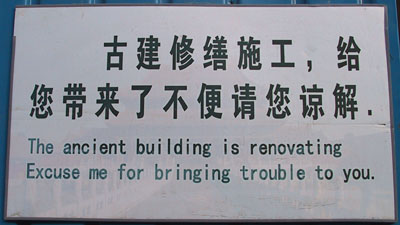
Finally, some more polite signage from the Forbidden City. Really, no problem at all.

excuseme.jpg

And then this:

Fine, but everyone knows there's no such thing as a five-star crapper. Simply ridiculous. The scale just doesn't go that high.

Posted at 3:34 AM | Permalink | Comments (0)

February 1, 2005

Replicants

Today I spent many hours of hell braving the Ya Show market in central Beijing. Armed with printouts of fine handbags from my wife I was there to acquire as many name-brand knock-off purses as I could afford and carry back to the hotel without undue strain or attention being drawn. It was misery, since I'm not a big shopper anyway and have no innate sense of what a Prada purse should cost, but I made it out relatively unscathed. Two things made me laugh repeatedly, though. The English of the stall-keepers was uniformly horrible, unless it related directly to the act of selling or keeping you from walking away. Phrases such as "make me a smarter offer" or "where will you find such quality elsewhere?" were syntactically correct and enunciated flawlessly. It was fun to test the boundaries, to probe the limits of vendors who were really just human phrase-recall databases.

Input: potential buyer walking away.
Output: "Sir, please enter your price into my calculator."

Input: Shopper says "Do you take US dollars?"
Output: "Why yes, sir, as well as RMB and Hong Kong dollars, thank you."

Input: Shopper says "Excuse me, do you know the closet subway line to the market?"
Output: Blank stare, no keywords triggered. Abort, retry, fail?

The other thing I loved were the signs placed everywhere imploring shoppers to report any fake products. It was all so earnestly ridiculous. There wasn't anything real in the whole place. (Not that I could have spotted a real Gucci purse, mind you.) Sure, I'll dial the police right up. Just let me know if the American embassy will pay for my funeral after the shopkeepers -- and their customers! -- lynch me with so many faux leather belts.

True, in advance of the Olympics and as part of playing nicely with their trading partners, the Chinese authorities are starting to crack down on the product replica business, but I think this may not ultimately be as much an economic practice as a cultural one.

In his fascinating book The Future of the Past, Alexander Stille notes how China and other Asian countries do not consider a copy to be less real or less significant than the original it represents. Like a digital copy of a file that has no more claim to authenticity than its "source" file, high-quality copies in China are consider artforms in their own right. This is borne out in the field of cultural artifact conservation. For the Chinese, copying is conservation, a concept completely foreign to Western conservators. Because most Chinese architecture had traditionally been wood-based (rather than stone-based) there has never been a strong notion of permanence in art. To keep a work of art alive you had to replicate it and, in the process, were showing a reverence for the skill of the artisan that came before you. Still, this approach flies in the face of nearly every precept of Western cultural conservation. Can you imagine the Italians throwing out the David and creating a new, cleaner one as a solution to the recent conversation problems they have had?

It will be a shame if the fake product industry (or the skills upon which it thrives) does not survive in the face of globalization and homogenizing markets. In a way, the closure of the fake product markets is just the latest assault on the "culture of the copy," as Stille terms it. Just as the Cultural Revolution decimated sites of historical value throughout China -- effectively severing the centuries-old artisanal traditions that permitted the cycle of upkeep and re-creation to persist -- the closure of markets like the famous Silk Alley represents the triumph of one concept, in this case the inviolability of global trademarks, over another, much older one: the exultation of the replica.

Posted at 2:34 AM | Permalink | Comments (0)

January 31, 2005

Physicalized words

I can't read Chinese, though I am able to at least distinguish it from Korean and Japanese scripts. (Cut me some slack, that's progress! But don't even ask about distinguishing Traditional from Simplified. I'll have to be content in my ignorance on that one.) What this means is that, since I have no idea what idea is being conveyed, my growing love for Chinese characters is almost purely visual. A reverse ekphrasis, the strokes of even the most mundane lines are painterly, evocative of an artform more fully engaged with the space around it than Western writing. Chinese calligraphy, such as I have seen it, is more akin to dance or yoga than it is to other scribal arts. It is all very physical.

Consider the "calendar" in the image above. Called the 81 Days of Winter, it is a single phrase that evolves slowly over the course of the winter. Each day the author/painter adds one stroke to the characters; a total of 81 comprise all nine characters. Ticking off the days like an Advent calendar, the phrase is complete by the end of winter:

The weeping willow of the pavillion waits for the warm breath of spring.

But it isn't just script that is spatialized.

The item on the left is called a Ruyi. Long ago it was an imperial backscratcher, but it eventually lost that function altogether and merely became a royal symbol. The item to the right is a spitoon shaped like a persimmon flower. Together they form a visual pun. The word "ruyi" also means (or sounds like) "whatever you wish" in Chinese. The word for persimmon also means "everything". So, taken together, the two completely symbolic objects mean "everything you wish for". You see these objects conspicuously placed together on furniture throughout the Forbidden City, a portmanteau resting amongst the other objects of daily life.

Posted at 2:04 AM | Permalink | Comments (0)

January 30, 2005

The Pavilion of Literary Profundity

Now that's the way to name a library! Or, more specifically, a book depository. We braved the bitter cold at the Forbidden City in Beijing for a unique tour of this Ming-era building deep inside the palace complex. It isn't open to the public as it is still used as storage for what looked like textbooks and promotional materials. Dust clogged the air and draped everything; if I were alone it would have been exceptionally creepy.

The upper floors were empty -- much of the original corpus is in the National Palace Museum in Taipei, but they offered close inspection of some fancy stacking technology. (Ever since reading Henry Petroski's Book on the Bookshelf I've had a low-level interest in the technologies of physically storing books.) Each section in the stacks are composed of two-ply shelves. The top shelf is a grid, to allow ample airflow in and around the volumes and scrolls. A second shelf immediately underneath the first is filled with sand. In the event of fire, this shelf would burn through (the theory goes) and dump fire-extinguising sand onto the level below. Rather ingenious.

Those Ming and Qing certainly were committed to fire abatement. Some 300 bronze vats were spread throughout the grounds for ready access to water (heated by fire in winter to keep it liquid). Protection was sought symbolically as well. The roof of the Pavilion of Literary Profundity is colored black, an atypical choice in the Forbidden City, but one that connotes water in the Chinese spectrum. Dragons spew water at the corners of the building and a huge lighting rod and cable snakes across the spine of the roof into the ground. All combined, an admirable long-term data preservation strategy. (More photos at Flickr.)

Posted at 1:20 AM | Permalink | Comments (0)

January 27, 2005

Forboding signs

I mentioned being disinfected on the approach into China. Maybe I spoke too soon. Turns out my entire family back home has been completely waylaid by some Stephen King strain of influenza. Fevers, painful coughing, locusts, general pestilence -- all coming down at once. The disease vector this time was -- surprise -- my kids. My father-in-law calls children "poison dwarves" and he ain't kidding. Sometimes I think my son's school is a front for a biological weapons laboratory.

So here I am on the other side of the planet worrying that a time-release virus is waiting for the most inopportune time to blossom into full-blown misery for me. I'm OK now, but I just know I'm doomed. So I get the name of some potent flu-prevention meds from back home and think, what the hell, I'll see if I can get them here. I slip the bellboy a note and some RMB and ask him to find me the best Oseltamivir Phosphate he could find. He scurries off and only then does it occur to me that I'm probably going to be hauled off to SARS quarantine or something. Then I recall that the newspapers on the plane mentioned the latest bird flu outbreak in Vietnam and Thailand and the steps China is taking to keep it out. So, if the virus doesn't get me, the anti-virus police will. Nice going, John. We'll see what happens tomorrow.

What luck that I should discover that my hotel room is actually outfitted with dual gas masks, should I develop symptoms of influenza (or bird flu!) and not care to infect my co-workers. The best part of these beauties: pop-top lids. Like they should be in the minibar or something.

Here are two of my favorite pieces of signage today. The first is a gem from the Forbidden City in central Beijing. Apparently, it wants to be loved just like everyone else.

And lastly, this pictogram. To many people this says "squat toilet ahead." To some it says "impossible feats of human levitation ahead." To most Westerners, however, it simply says "run away, run away fast ... and clench!"

IMG_6511.JPG

Posted at 5:34 AM | Permalink | Comments (1)

January 26, 2005

ORD -> PEK

Last week I was in China for work. Here's the first in a series of posts that didn't quite make it up in real time.

This is my third time to China in the past year, but only my first time doing it via a "normal" route. The first time was by going east from Chicago for work in Europe then continuing onward to the Far East and eastward still across the Pacific home. That was awful. Destroyed me. This past summer because of scheduling conflicts I had to take some godforsaken cattle-hauler out of LA at midnight. How pleased was I to be booked on a direct, non-stop flight from Chicago to Beijing this time!

You know, it still sucked. No matter how you slice it, 14 hours on an airplane is just brutal. And it does not help that United personnel appear to be defending their 2004 title of World's Snippiest Flight Crews. Man, those people are just bitter. If they were half as chipper as their discount-fare faux persona Ted it would be bearable, but as it is now you feel like you're imposing on the airline itself just occupying a seat that needs to be served a cold beverage.

Chinese law requires the occupants of inbound airplanes to be disinfected just prior to landing by flight attendants who run up and down the aisles with something like a cannister of Right Guard. But it ain't deodorant. I don't know what it is, or what exactly it does, but it is an endearing little welcome ritual. Like we're being perfumed for entry into the presence of royalty or something.

More endearing still, in an odd way, is the mural of the Great Wall painted behind the stalls of the passport control agents that greet you upon arrival. Is it me or is the depiction of a massive rampart meant to keep foreigners out of your country (and ineffectually at that!) the best welcome mat for visitors? Welcome to China ... it could be worse.

And the construction cranes! I have never seen quite so many in such density. Yes, I've heard that something like 60% of the world's cranes are in Shanghai right now, but I figured that was exaggeration -- probably is. But the Beijing airport is a veritable forest o' cranes. Perhaps this is where they grow them? Perhaps they are prepping a new terminal for the Airbus A380 flying casino/health club/theater/plane?

One last thing before I nod off. The greeting of guests by name as they walk in the door of the hotel and the escorting of these guests straight to their rooms without stopping at the front desk and the checking in of these guests in the room itself -- yes, all that, I love it. Wish all hotels would do that.

Posted at 8:40 AM | Permalink | Comments (0)