etc., recall the word
resoldered here
in a pane of sand.
— R. Kenney

Ascent Stage
a life-in-progress

Italy

March 4, 2009

1903

Departure

On the train to Naples the old ladies in black thought she was menstruating when she asked them for help disposing the bloody cloth. She let them think so. The train was cramped when they left Barile, but when it picked up passengers in Potenza it filled so full you merely leaned into others to maintain balance. It was not the place to make a public fuss over a choleric baby.

Living in a big, old city like Chicago is a four-dimensional experience. You move around the street grid, up high into skyscrapers, down into the underbelly of subway tubes, but time too is layered into the built things, seen only if you are looking, meshed into the streetscape like a discolored piece of gum that's just another part of the sidewalk. Until you look more closely at it.

The baby hadn't made a noise since they arrived at the port. He was swaddled up against Grazia tight enough that she'd feel it if his shallow breaths stopped. She sat down on the steamer trunk. Giuseppe, unsure which ship was theirs, barreled chest-first into the noisy confusion of Neapolitan seamen, stevedores, travelers, and common thieves. Grazia attempted to nurse, but she couldn't let down. The baby had not taken milk in eight days.

I knew that my great-grandparents had come to live in Chicago in the same way I know Mrs. O'Leary and Al Capone and Saul Bellow lived here -- and with about as much tangible connection to same. Certainly I had occasion to think of their lives. Three times in 14 years I had trekked to their village in poor, arid southern Italy, learning a bit more each time, eventually being welcomed by their hometown as one of their own. And that was part of the problem. I could connect with them in Italy, but not here, in the town where they started a new life and became American.

Gibraltar was still in sight when baby Michele died. There were no facilities to keep his body on board. An Arbëreshë steward who heard his own strange accent echoed in the parents' sobbing drew Giuseppe close, felt the bitter waft of Amaro Lucano on the big man's breath, and told him that he could not emigrate with a corpse. Michele, tightly bound and ballasted, was lowered gently into the waves. Grazia heaved somewhere in a mass of ladies in black and rosaries. Giuseppe changed some of his dollars for lire and drank it away.

I had gone searching before, just before the last trip to Italy. I started at the end, hunting with my kids for a nondescript tomb marker. We found Giuseppe, buried Joseph Tolva, on a sweltering summer day that gave way to a torrential storm just as we found the house he lived in when he registered for World War I in 1915. But these were milestones only. Markers of events, not the experience of a life. I had the records from Italy, the scraps of US government documents from the period, even a few photographs, but what most eluded me was Giuseppe's connection to my city.

They had argued about taking the baby to America as sick as he was, but the passage was paid, the job was arranged, and the padrone was waiting in Chicago. There would not be a second chance. On July 28, 1903, nine days after they lost the only thing of importance they brought from Italy, Giuseppe and Grazie Tolve arrived in New York City. Three lines, one of them crossed out, on the ship manifest marked their entry. Giuseppe admitted to carrying $25 and told the agent they were bound for one Rocco Calandriello Jr. at 50 Blue Island Ave., Chicago.

1903_manifest.jpg


Arrival

That name and that address have perplexed me for years. None of my living relatives had heard of Rocco Calandriello, Ancestry.com had too many records to be useful, and 50 Blue Island Ave wasn't an address that existed anymore. I considered it a dead end.

A few weeks ago at a conference I met Dennis McClendon, a professional mapmaker from Chicago. I casually mentioned that I knew that streets had been renumbered earlier last century but that I had gotten no further. Dennis cleared up my confusion in the span of about 15 minutes. On his laptop he brought up a scan of the 1909 document detailing all the renumbered buildings. Six years after Giuseppe and Grazia arrived 50 became 707 Blue Island Ave.

blue_island_ave.jpg
Blue Island Avenue covered in snow, with stores on either side, pedestrians on the sidewalk and horse drawn vehicles in the street, 1907 [source: Chicago Historical Society]

But I wanted to know what that address was. Who was Rocco, the "relative or friend" that Giuseppe had listed on the manifest? Dennis drew my attention to two amazing resources, Robinson's Map of Chicago from 1886 and the Sanborn Fire Insurance Maps 1894 - 1951. Both of them list in great detail what was where, building by building, at two distinct points in the city's history, thanks mostly to a chance to start fresh from (and insure against another) Chicago Fire.

sanborn_707blueislandave_1917.jpg

In 1917 the building housed a glass and mirror factory, though there's no evidence that Giuseppe was a glassworker.

707_blue_island_ave_1928.jpg

In 1928, the year after Giuseppe died, the building housed an electric company and some plumbers and bore names of distinctly non-Italian lineage.

Of course, the building could have been something vastly different in 1903, though it is marked as a business rather than a residence from as early as 1886. My guess is that Rocco Calandriello really was Giuseppe's uncle, though an uncle through marriage, but what he did and why he did it at 50 Blue Island Ave. is not something the documents tell us.

Before I could inform Dennis that Google Maps still couldn't locate 707 Blue Island Ave. he noted that part of that street had been demolished in the 60's to make space for the University of Illinois at Chicago campus -- the very campus the conference we were attending was being held on!

We overlaid the pre-destruction map on current satellite photography of the area and had a lock. I was out the door with my camera before I could even say thanks.

Blue Island Avenue is one of a handful of diagonal streets in Chicago, cutting southwest to northeast into the city center. Before the university was built it ended at Harrison Street; now it stops at Roosevelt Rd. Interestingly -- and helpfully -- the campus layout largely preserves the outline of the original thoroughfare. The gum you notice on the sidewalk only when you step in it.

uic-birdseye.jpg

I'm pretty sure this is where 50 Blue Island Avenue once stood. Coincidentally, this spot is a few hundred feet from where Jane Adams' Hull House now resides, having been moved from its original location during the UIC construction. Given that recently-arrived Italians constituted a major slice of the neighborhood that Hull House served it is almost impossible to think that Giuseppe and Grazia did not receive assistance from Adams.

uic_campus.jpg

I didn't find Rocco and of course the building is gone, but I tramped around the Near West Side on a few Saturdays and came to know the area of town my great-grandparents called home. It grounded something for me, fleshed out another dimension of my personal relationship to the urban space. And set the stage for 1909.

Posted at 12:03 AM | Permalink | Comments (9)

January 28, 2008

Cities of stone

Been on a serious Lord of the Rings bender lately as my four-year-old has really taken to the film trilogy. (He can't read yet. At least not Tolkien.)

The mythos is clearly penetrating my subconscious because the other night I woke up with a single, clear thought -- so clear, in fact, that I had to write it down immediately. My insight? The city of Matera, Italy is a real world version of the vertiginous, stacked city of Minas Tirith, capital of Gondor in the Tolkien legendarium. Matera is one of the oldest cities in the world and was one stop on my Italian odyssey last year.

I imagine the two cities all but indistinguishable from street-level, but can you tell which of these is Matera and which Minas Tirith?

matera_tirith.jpg

The fictional city was filmed from a very large model. Interestingly, there seems to be a at least a few complete miniatures of Matera.

Answers (highlight to reveal): Row 1: Minas Tirith, Matera; Row 2: Minas Tirith, Matera; Row 3: Matera, Minas Tirith; Row 4: Matera, Minas Tirith

Posted at 4:09 PM | Permalink | Comments (0)

July 4, 2007

“Sometimes the spaghetti likes to be alone.”

If you've seen the movie Big Night you'll recognize that quote from the irascible chef Primo as he deals with 1950's American restaurant-goers who think Italian food is spaghetti with red sauce and meatballs and nothing more.

Today of course Italian eateries are big business -- from gourmet to fast food to just sucky (I worked there in college, trust me). In such a crowded space often the simplicity of homemade Italian food can be hard to find.

App

Anna Maria Pasteria, a small trattoria in Wrigleyville, serves uncomplicated, traditional Italian dishes. No fusion, nothing exotic. Just amazing homemade pasta, veggies, and meats. Two sisters, Maria Spinelli and Anna Picciolini, run the place and pervade it with a warmth that really is the closest thing I've found to the way restaurants feel in Italy. Close, comfortable, happy. And the service matches the food. Not showy, but ample.

Anna and Maria are originally from Ripacandida, Italy a small, hill-topping down about 15 minutes from Barile, my destination on Friday. Though the menu runs the gamut of Italian dishes that just about anyone would recognize, the sisters do make southern fare. These plates are invariably simple: pasta, a light sauce with herbs, and a meat. (Try the Pollo ai pignoli or the Capellini carrettiera.) Anna Maria Pasteria also serves a heavenly Tiramisu. Lighter than air.

A great send-off dinner before we embark for Italy. Highly recommended.

Tags: , , ,

Posted at 10:52 AM | Permalink | Comments (0)

March 25, 2007

Italy calling

In 2003, my father and brother and I travelled to Barile, Italy, birthplace of my great-grandparents and the town they emigrated to the USA from 100 years before. The trip marked the beginning of my foray in blogging (on a private family site). It is also the prologue to what promises to be an amazing return trip this summer.
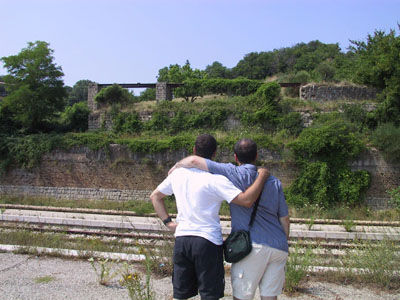
Img 3795

At the Barile train station

For years my family discussed our great-grandparents, Giuseppe Tolve and Grazia Botte, who had come to America. We knew little because they both died relatively young after having a bunch of children (one of whom was my grandfather), so there was no one with first-hand knowledge to ask about their roots. We came to believe that my great-grandfather himself was an orphan and that he was from a small town in southern Italy called Barile. My grandfather's and parent's generation was far more interested in the American dream than in mining the past -- especially a past in rural, poverty-stricken southern Italy. But my siblings and cousins were curious and adamant, and as the older generation left us, my father also realized the family history that was slowly slipping away.

So we went back. And what we learned was life-changing. If you're interested in the details, e-mail me and I will point you to the private site with a dual travelogue from my father and I. Suffice to say that many family myths were debunked, much new information was uncovered, new family we didn't know we had were found, and a love affair with the region of Basilicata was begun. Here's an excerpt:

Basically the rest of the day became a person-by-person, cafe-by-cafe hunt for Roberto's cousin Anita Di Tolve. He had never met her, but he knew she lived there and that her family owned a gelateria. It was like a scavenger hunt. We'd go from place to place gathering new information. At each place word of our presence had preceded us. “Oh, Di Tolve! Yes, yes, we heard you were here.”
Finally we found her. She was in her late 70's and wearing all black because her husband passed away last year. Once she figured out what was happening she invited all seven of us into her tiny cave-like home and started balling. It was extremely emotional. She insisted that we let her take us to her wine cave (there's a much a longer story about why most Barilesi have caves), the local cemetery, and to cook us dinner that night. We let her do all of the above. She had to put on black stockings before we went out because if the fellow townspeople saw her without them there would be gossip. She was, after all, a recent widow.
In the cave -- a good 25 degrees cooler -- we sipped homemade spumante that her husband had bottled five years ago. At the cemetery we searched the above-ground tombs just like we searched the yellowing church records for evidence of Tolve, Botte, Urbano, Paternoster, and Schiro families. Anita could not get in to her father's tomb because she and her sister were having a dispute and her sister had changed the lock. Typical Italian family bickering.

About a year ago I got an e-mail from a Michele Brucoli, part of the external communications department of the regional government of Basilicata. He had come across my infrequent postings on Barile and was interested in learning more about my perspective on his region as a descendant. We've stayed in touch over the past year and he's sent me plenty of information. Basilicata is eager to promote tourism and investment and, independent of Michele, I've long supported this. Basilicata could easily be the next Tuscany or Amalfi Coast. The region boasts two separate coast lines (one on the Tyrrhenian Sea and one on the Ionian Sea), mountains, and dense forests. Like Sicily and Cyprus, Basilicata was a waypoint for whatever conquering empires were traversing the Mediterranean so there's a diverse ethnic and cultural fabric that you don't often find in Roman northern Italy. In short, I agree wholeheartedly with Michele that the region is ripe for discovery.

Recently Michele mentioned that the city government of Barile had discovered my blog, including the private diary from 2003, and that they were preparing to give me an award and a “day of celebration” this summer, if I could return. I was floored. I don't exactly know what the award is, but I assume it has something to do with promoting the Lucani nel Mondo (or people of Basilicatan descent -- also known as Lucanians -- who live outside of the region). So, it looks like my family is ready to head back with me. I'm excited. Details are somewhat scarce right now, but it is obviously an experience I could not pass up. An award for being intersted in my roots! Hard to believe, really. I may even bring my five-year-old son.

As a sidenote, if you live in or near Chicago and want to get a taste of Basilicata there is actually a restaurant on the north side called Anna Maria Pasteria run by two sisters from Ripacandida, a small town near Barile in Potenza. The menu itself is fairly broadly Italian, but the place feels like the rustic kitchens of Basilicata, and if you ask Anna or Maria specifically they will cook you up real local dishes. Recently, as my father, uncle, cousin and I were leaving from dinner there, I mentioned my name to Anna. She grew up with my grandparents and extended family on the south side and seemingly knew more about them than we did. It is a small world when you are from Basilicata.

Tags: , ,

Posted at 12:41 PM | Permalink | Comments (9)

August 26, 2006

Grappa power!

I'm a fan of the liqueur known as grappa. This pungent drink is literally the bottom of the barrel, the end of the line for wine. Once winemakers have sucked all the juice from the stems, skins, and seeds at the bottom of the tub there's left a goopy sludge (called the lees). Someone somewhere was the first person to think hmmm, maybe I can distill that crud and make a drink. Hence grappa.

I remember when my wife and I first tried our hand at winemaking in 1996. I wanted to make grappa also, but didn't quite remember that personal distillation was, well, illegal until I posted openly on Usenet asking where I might obtain a still. Ah, the folly of ignorance. A few backchannel e-mails later I was fully informed that I was a dumbass for posting this request publicly. The wine itself ended up a hellish swill, not alcoholic enough to compensate for its lack of taste. I should have made grappa, you see.

Many people think grappa is jet fuel. Like tequila, there's a vast chasm of drinkability between the bad stuff and the good stuff and, true enough, the smell of grappa can singe the nasal passage. It is an acquired taste.

It turns out I can no longer precisely counter the argument that grappa tastes like gasoline. For grappa, I have learned, can be turned into ethanol without much effort. Wired mag reports:

From October until June, backhoes pick apart a pile [of lees] and feed the mulch onto a series of conveyors, which carry it to a series of presses and kettles. The resulting solution is further fermented to make both grappa, a potable (to some, anyway) alcohol, at one end of the distillery and biofuel at the other. Caviro [an Italian distillery] produces a relatively small amount of grappa compared with its nearly 793,000 gallons of ethyl alcohol. The potent fuel is sold throughout Europe.

Naturally most Italians are aghast at the thought of using precious wine grapes to power their cars. But I bet they'd have no problem mulching a few French vineyards for it.

[Tip: for a real kick in the pants add grappa to espresso to make a Caffè corretto, literally, corrected coffee. Ah, yes, now the coffee is correct! That'll get you going in the morning.]

Posted at 2:34 PM | Permalink | Comments (1)

July 10, 2006

Azzurri per sempre!

vivaitalia.jpg

They should bronze this pose, Iwojima-like, and plop it out in front of the Colosseum.

Update: if they can make a fresco why not a sculpture?

Posted at 9:19 AM | Permalink | Comments (0)

July 6, 2006

Today in Italian news ...

it-lgflag.gif

Well, it looks like my daughter will have to be the second woman of Italian-American descent to go into space. Crap! (Congratulations to Lisa Caputo Nowak.)

In other news, the battle of the European viticultural powerhouses will be staged on Sunday. Viva Italia! Screw France like they were the Gaul-toys of the Roman Empire!

Eleven months ago I received the results of my participation in The Genographic Project, the National Geographic-IBM partnership to help complete the map of genetic diversity that accounts for humankind's migration around the world. Since then I've been contacted by lots of people also involved in the project who, presumably, are googling M172, the name of mutation that we share. My patrilineal genealogical line intersects the genetic data in southern Italy. But the members of my extended "family" (according to comments on this site and private e-mail) live in Iran, Hungary, India, and Croatia. Amazing to even feel a shred of familial relation to these perfect strangers.

And lastly, the Little Italy, Chicago entry on Wikipedia is but a stub. This is criminal. Or rather, the fact that I don't have time enough to flesh it out is criminal. I owe it to my grandfather's stomping ground to edit this, no? Must do this. Must.

Posted at 9:11 PM | Permalink | Comments (0)

March 30, 2006

Missionary ambition

During my junior year in college I fled my home institution of Vanderbilt for a semester abroad in Rome with Loyola University. It was an experience that changed my life. About a year ago I was asked to serve on the board of the Rome Center or LURC as we used to call it. This position has allowed me to get to know Father Mike Garanzini, the charistmatic relatively-new president of the university in Chicago. (This past weekend Garanzini’s turnaround of Loyola was the cover story of the Chicago Tribune Magazine.) Father Mike has big plans for LURC. One idea is really appealing to me. He’s interested in creating something called the Ricci Scholarship, a funded full-year of study abroad for exceptionally talented undergraduates. It would place them in Rome for a semester of study and then, through a partnership with Fordham University, move them to Beijing to finish the year. The goal would be a comparative assessment of business, art, mathematics, history, you-name-it and the outcome would be a senior year thesis on the same. It is a bold idea, but one that will likely work given the long history of respect in China that Jesuits enjoy in the country. Named for the missionary Matteo Ricci and undertaken in the spirit of synthesis of East and West the program may begin as early as 2007. With the western world so eager to crack the nut that is Chinese culture and business and with China determined to spread Mandarin around the world this seems very timely.

Unrelated but personally interesting is an exhibit at the Loyola Museum of Art, which I only learned of today. It presents works of Caravaggio as digital replicas per se in a darkened gallery using high-res display monitors. This is the first that I know of bringing the virtual inside the physical so literally. I haven’t seen it yet, but I’m eager to know what happens to the sense of aura that standing in front of a tangible artwork produces when you’re once removed from it. I can’t imagine it is any less real than standing 30 people back gazing at the diminuitive Mona Lisa encased behind bulletproof glass.

Posted at 1:51 PM | Permalink | Comments (0)

January 16, 2006

I caffè dei sorrisi

Smile, you're drinking authentic Italian capuccino. (Rionero in Vulture, Italy, 2003)

smilecaffe.jpg

(The site was getting too text-heavy, OK? Had to break it up a bit.)

Posted at 11:09 PM | Permalink | Comments (0)

January 8, 2006

La Befana

oldbefana.jpg

Today the main Catholic church in Chicago's Little Italy celebrated La Befana, the good witch of the epiphany. The story goes that Befana was a little old lady who took the three kings in for a meal and rest on their way to Christ's birth in Bethlehem. They asked her to join them but being too busy with housework she declined, only later realizing that she had missed an opportunity to witness the birth of the savior. So she packed up some gifts and set out to find them and the baby, but she never did and continues wandering the earth (a bit creepy, no?) depositing gifts in children's stockings to make up for missing Christ's birth. Typically the gifts are treats of some kind. Even the coal is sweet.

For our family, La Befana marks the end of exactly one month of gift-giving mayhem. It starts on Dec. 6. with the Dutch tradition of putting out shoes for St. Nicholas moves through the pagan-Christian-consumerist Christmas festivities and ends with the Italian tradition of La Befana. Phew. Multiculturalism is tiring.

See also: The Legend of Old Befana by Tomie De Paolo, a great kid's book.

Posted at 10:19 AM | Permalink | Comments (0)

December 20, 2005

Winter dreaming

Holy mackeral it was cold today! Not a day for Christmas shopping up and down State Street. ('Course, when is?) I'm going to my happy place. Right. Now. Damnit.

Here's me in 2003 outside Barile, Italy, where Horace composed part of his Odes, excerpted below. In the background is the extinct (yeah, right) volcano Vulture. In the foreground is my belly filled with lovely Aglianico del Vulture wine.

IMG_3968.jpg

In childhood's days, on trackless Vultur,
beyond the borders of old nurse Apulia,
when I was tired with play and overcome
with sleep,

the doves of story covered me o'er with
freshly fallen leaves, to be a marvel to all who
dwell in lofty Acherontia's nest and Bantia's
glades, and the rich fields of Forentum in the dale --

how I slept safe from bears and black
serpents, how I was overspread with sacred
bay and gathered myrtle, with the gods' help a
fearless child.

Posted at 10:12 PM | Permalink | Comments (1)

September 29, 2005

Teatro di Marcello

A few years ago the city of Rome opened the renovated Capitoline Museums on its most famous hill. The "Grande Campidoglio" project featured a number of improvements, including the stunning underground Tabularium gallery that lies under the piazza and connects the palazzi via an ancient street. The Tabularium also provides the most stunning views of the Forum obtainable, in my opinion, since you basically can peer out from an opening in the sheer face of the Capitoline Hill over the sunken ruins. In addition, the roof of the Musei dei Conservatori is open as a restaurant and has some great views looking the other way -- in this case towards the Janiculum Hill with the Theater of Marcellus, still my favorite example of ancient/medieval layering in the whole city, in the foreground.

Posted at 4:17 PM | Permalink | Comments (0)

September 28, 2005

Laughs in Rome

Today in Rome I was chatting with the bellhop at the hotel, waiting for a cab. Actually that sounds a lot like we were having a conversation. Edit: I was fracturing his native language as we talked at each other in Italian. Anyway, he asked where I was from. I said Chicago. Oh Chicago, he exclaimed! Then he grabbed himself and said in an absolutely perfect impersonation of half my family "Eh, how you doin'?" Phonetically: ha yo doan? Three syllables, stress on the middle one. I laughed a lot louder than I probably should have, but it was such an odd thing. Here was an Italian impersonating what I have always regarded as an Italian-inflected mangling of English like you hear in many urban areas. I didn't have the vocabulary to note the irony to him.

My second laugh was today at a coffee shop watching an American try to order a cafe mocha like she clearly does at Starbucks back home. The barista was utterly befuddled. And here she thought she was so cultured. They both left that transaction disappointed I think.

Posted at 3:03 AM | Permalink | Comments (0)

April 3, 2005

The pope thought my Italian sucked

I studied in Rome in 1993. My roommate was a seminarian who made it his job to get to know people at the Vatican. He ended up arranging a papal audience for us -- nothing private, just part of the larger scheduled audiences -- and he was able to situate himself (and me) right on the aisle down which the pope would stroll. Sure enough, il papa came right over to me and asked me where I was from. I responded in Italian (since he asked in Italian) that I was from Chicago. Smirking, he responded in English -- presumably because my Italian was so atrocious -- that he had visited Chicago many times. Then the stream of outstretched hands pulled him further along the aisle and my encounter with Pope John Paul II was over.

When I heard that the pope had died on Saturday I was preparing to attend the wedding of a friend. The radio broadcast I was listening to mentioned that a special service in Chicago would be held by Cardinal George at Holy Name Cathedral, the main Catholic church in the city, at 5:15pm. The wedding I was going to was scheduled for 4pm at that same church.

What a spectacle. Even as the wedding started a steady flow of mourners was filtering into the church, somewhat befuddled that a celebration was taking place therein. Once they figured out that the wedding would end soon enough they seemed not to notice it at all, filling in every open seat all the way to the front of the church. Meanwhile row after row of news cameras were sprouting up along the aisles. Seemingly entire orders of nuns marched solemnly in and took up seats very close to the bride's and groom's parents. A lone bridal party usher -- normally a role whose most difficult task is figuring out which side of the church arriving guests should sit on -- literally had to body-block churchgoers from entering the church down the center aisle. It was all somewhat surreal.

By the time the newlyweds turned around to face their family and friends, the vast cathedral was packed to overflow capacity -- something I'd wager only the most regal weddings even come close to achieving in that space. The bride was completely dumbstruck at the sight. (And I bet the groom was thinking "I hope they don't think they're all coming to the reception.") I have to admit that the bishop presiding over the wedding did a good job steering clear of what could have been a maudlin matrimonial ceremony, choosing rather to focus on the bride and groom almost exclusively. But the swell of silent, mourning Catholics into a space of such joy created one of the most unintentionally bizarre atmospheres I think I have ever witnessed. I'm having trouble dreaming up anything more ridiculous than the sight of weeping nuns pushed aside by a reporter from People Magazine (yes, People -- huh?) trying to intercept the departing bride for an interview.

Posted at 9:12 PM | Permalink | Comments (2)

February 19, 2005

Barile

My great-grandparents came to America in 1903 from a small town called Barile in the region of Basilicata, Italy -- basically the "instep" of the boot. I've visited Basilicata twice -- more on that in an upcoming series of posts -- and, though it has made much progress in the last ten years, I often find myself calling it the West Virginia of Italy. Rustic and mostly arid, many of the towns in the region are built on top of or straight out from sassi, the caves carved into soft rock that have formed the homes of inhabitants since well before Roman settlement of the peninsula.

Mel Gibson's The Passion of the Christ was shot mainly in Matera, Basilicata, the town with the most striking sassi in the region. Shortly after seeing The Passion I learned that Gibson was merely following the Italian filmmaker Pier Paolo Pasolini in shooting a life of Christ in the region. In 1964, Pasolini released Il Vangelo secondo Matteo, a cinema vérité treatment of the gospel of Matthew using non-actors from Basilicata. I've read that Italian audiences actually demanded subtitles because the Albanian dialect of the "actors" was too difficult to understand. There's absolutely no dramatic flourish in the film (a path Gibson diverged from in minute one of his film). This is Christ-as-peasant-among-peasants, seen from ground level. Call it Reality Hagiography.

The sassi of Barile form the backdrop of the "slaughter of the innocents" scene. It is hard not to laugh at the centurions as they scamper up and down the hillside slashing at mothers and babies (some of whom fly out of embraces a little too easily). The film is likely to irritate modern viewing sensibilities for one reason or another, especially since the English dubbing is just awful. But I applaud the effort in the context of when and where it was made. If you're going to shoot Christ as a man of humble origin you'll not err in choosing Barile as a home town.

Compare the shot from the film above to a panorama of the same caves, now private wine cellars, taken last year.

Posted at 9:50 AM | Permalink | Comments (0)

December 24, 2004

Carbone Dolce

Here's an easy way to remind the kids that they've been bad this year without scarring them for life. There's a super-simple, traditional Italian dessert called Carbone Dolce, literally "sweet coal", presumably a confectionary joke, but possibly pre-dating the whole stockings for bad kids thing. In any event, it could not be easier. You melt 400 grams of chocolate then mix in about half that in crushed Rice Crispies, form into coal-like clumps, and let cool. Voila! All the recipes I've come across are in Italian and I know they call for white chocolate, but I cannot figure out how or why you'd make something look like coal with white chocolate. Any ideas? Anyway, add a few pretzel sticks to the mix and you've got yer sticks and coal for the holidays. Better than pre-packaged, I'll say.

Merry Christmas, dear readers!

Here's the crew of Apollo 8 sending a Christmas Eve wish (Quicktime) to Earth as they orbited the moon, the first humans to do so, 36 years ago.

Posted at 8:43 AM | Permalink | Comments (0)