etc., recall the word
resoldered here
in a pane of sand.
— R. Kenney

Ascent Stage
a life-in-progress

« March 2006 | Main | May 2006 »

April 30, 2006

Regeneration

137324680_88fe11614f.jpg

In The Future of the Past, Alexander Stille expands on a comment by Italian conservator Michele Cordaro:

"The Chinese, like the Japanese and some other Asian nations, have a tradition of conserving by copying, or rebuilding."

Conserving by rebuilding made considerable sense in China, where, until recently, virtually everything -- palaces, temples, and houses -- was built of wood. Paradoxically, in architecture, working in perishable materals could potentially offer a superior conversation strategy: rotting wooden parts could simply be replaced as needed so that, just as our bodies replace their old cells with new ones while we remain "ourselves," the buildings would be constantly regenerated, remaining forever new and forever ancient.

Seems logical, but in practice Western conservation is based on a philosophy of repair rather than replacement. This stems from the West's long privileging of permanence and originality in art (even when what we praise isn't in fact permanent or exceptionally original). Copies are considered at best qualitatively lesser; at worst, acts of piracy.

These conflicting attitudes toward monuments are related to profound cultural differences. China and Japan have traditionally had a cyclical view of time. Dynasties would rise and fall, be replaced by new ones, but, like the Forbidden City, reemerging from its latest fire, remain fundamentally the same: each ruling group held the "mandate of heaven" .... In a world that was both eternal and ever-changing, rebuilding monuments made perfect sense.

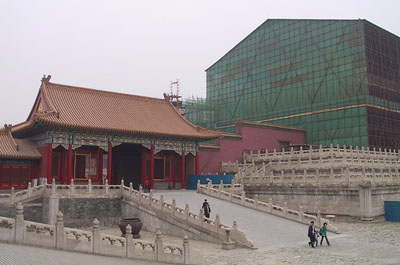
This past week I had the good fortune to be invited on a tour of the renovation of the roof of the Hall of Supreme Harmony at the Forbidden City in Beijing. This is the most important of the hundreds of buildings at the Forbidden City, now known also as the Palace Museum. The whole museum is being upgraded (as is all of Beijing, for that matter), but the work is most intense at the Hall of Supreme Harmony where a giant scaffolding and tent covers the swarm of workers who are in the process of removing the thousands of decaying terracotta tiles to get at the wooden infrastructure of the roof. The tiles are being meticulously removed and remade. The roof itself is imperceptibly sagging and this will be repaired too. The intricately painted outer beams will be repainted, resulting in stunning before and after comparisons. (Full photoset tour at Flickr.)
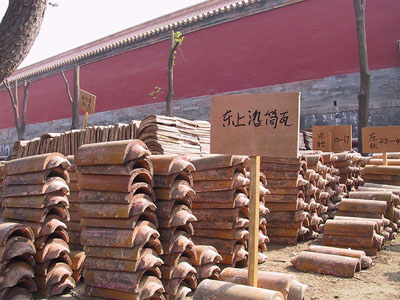
terracotta.jpg

This is a less extreme version of wholesale rebuilding of cultural sites that Stille details in his study of Chinese conservation, but it is an example nonetheless. Only a specialist could point to what is original to the hall's 1406 construction and what parts are copies installed since. This happens in the West too, of course, but the difference as I've experienced it in China is that it doesn't matter. The originality of the building is the idea of it, what it represents.

The Palace Museum has a partnership with the Japanese printing company Toppan to create a detailed, high-resolution virtual replica of the Forbidden City. Right now only three of the main halls, including Supreme Harmony, are complete. The effect of moving about the virtual grounds in the wrapround-style theater is powerful, though in the people-free virtual model the awe created by the buildings' scale is missing. There's little aura to the simulacrum. The model will improve, of course, as the technologies of virtuality improve.
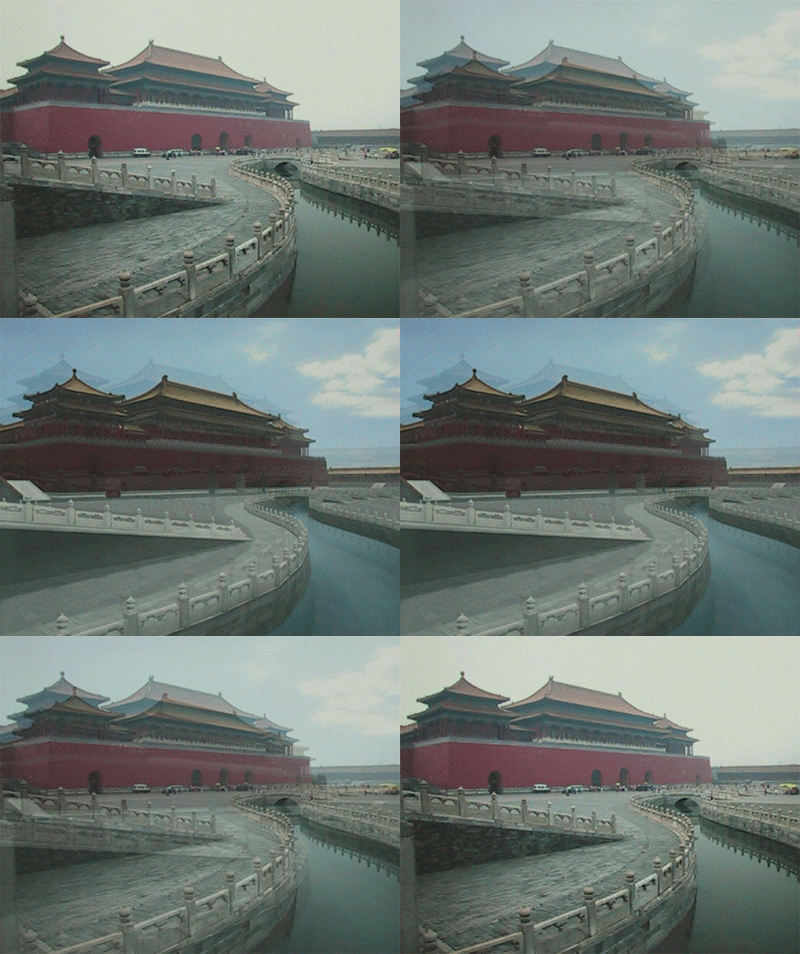
virtual-real.gif
Comparison of a photograph and a still from the virtual model

No one claims that the model is the Forbidden City, but then you don't get the usual quasi-apologies about its not being the "real" thing either. Most 3D modelling in cultural heritage is done for a specific purpose -- reconstruction of what has been lost, for instance -- and is treated as a teaching tool or a research resource. Not so at the Palace Museum. It will be interesting to see how this copy evolves.

Posted at 1:21 PM | Permalink | Comments (0) | Topic: China

April 29, 2006

What a smile 'round my face

Yikes, it has been a silent week 'round these parts. My travels in China have been crushing: a full work day on Beijing time plus 75% of a work day on US time. While this makes for a lot of time in front of the computer it does not produce much of a clear head for blogging. And this is why I am writing now from my flight 35,000 feet above the Pacific. This is my first flight with WiFi broadband and I just need to geek out a bit and say this changes everything. Time was, international flights were like day-long technology isolation chambers, but now that I have a connection (and a pretty fast one at that -- 802.11g) it gets all screwy. I'm adapting my already nutty sleep schedule to Chicago time so that I can Skype with my wife. And the beauty of that, of course, is that we just leave it on the entire flight. She hears me; I hear all the goings-on at home. -- for 10 hours. Just like ignoring each other at our own computers when we are under the same roof. Seriously though. This changes so much. I've watched streaming video, listened to iTunes radio, videoconferenced with a pal, Skyped my wife, and obviously e-mailed and surfed. Am I overdoing it this time? Absolutely. Will this go down as the best thing to happen to me before my baby arrives in a few weeks. Absolutely.
smiletet.jpg

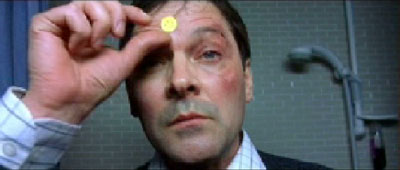
International travel alone is rough, but for some reason Four Tet's "Smile Round the Face" cheers me up every time I watch it. It took me a few viewings to realize what seems so obvious: being a daddy is it's own reward. Thanks, Kieran, for the cheer.

More China double happiness soon ...

Posted at 3:28 AM | Permalink | Comments (1) | Topic: I Like

April 24, 2006

Story witch doctor

Recently I've been working with a really smart researcher in computational linguistics and, as is happening with increasing frequency with my colleagues, he happened upon my blog. The Icelandic connection with my last name (Tolva = "number witch doctor" = computer) was particularly interesting to him. He writes:

You're right about the aversion to foreign words in Icelandic. I observed that there. The Icelandic "tala" for "number" appears to be related to the words "tal" in Danish and "Zahl" in German for "number". "Tala" may also be related to "tell" and "tale" in English, because these English words go back to an Indoeuropean word "del" that means "count" or "recount". There seems to be a semantic etymological connection between telling (a story) and counting. German "zählen" means "count", and "erzählen" means "tell". Danish "tælle" is "count", and "tale" is "speak". In English we can "recount" a story or give an "account" of some event(s). Maybe the semantic connection is that as you're telling a story, you're counting off the events?

So not only is my surname the made-up word for computer, but it has etymological connections to storytelling. Computers and narrative. Counting and recounting. It's all so clear to me now. I suppose I am doing what I was destined to do.

(Of course, I'm not Icelandic at all.)

Posted at 12:46 AM | Permalink | Comments (0) | Topic: Words

April 23, 2006

Chinese Labor Day

You know that scene in Father of the Bride II where Steve Martin has the route to the hospital intricately plotted out in the event that his daughter (or was it wife) goes into labor? I laughed when I first saw that, pre-kids. Now it makes me laugh for a different reason, since that kind of detailed plan is bound to go awry. You're almost asking for it to, taunting the due date gods to throw you a curveball. Short of scheduling an induction -- and even that can be unpredictable -- there's really no way of knowing what is going to happen or, more specifically, when it will happen.

Which is why there's palpable concern in my house over my departure today for China. With flights leaving for the US only during a certain window of time and the jaunt taking somewhere in the neighborhood of 14 hours, there's almost no conceivable way I could make it back if my wife suddenly went into labor. Sure, this is highly unlikely. She's neither dilated nor effaced. But then, our second son was three weeks early -- and week 37 begins precisely as I am arriving home. So does the Chinese May Day week-long holiday.

Let's hope China's celebration of labor and mine happen half a world apart.

Posted at 7:18 AM | Permalink | Comments (0) | Topic: China

April 22, 2006

Over spilt milk

My almost-five-year-old son passed a real milestone this week. It wasn't what you'd consider a typical development milestone. He laughed at himself. That's all. But not at a stupid joke he told or at an act of preschooler physical comedy. He accidentally tripped over my feet with a full glass of milk and spilled it all over the floor, me, and himself. One look at him sodden with milk made me break out laughing. Usually this sort of thing makes him deeply embarrassed and he usually cries. But this time, despite a touch-and-go moment of upper lip quavering, he actually burst out laughing too. Laughing at himself, at his act. This is huge, I think. Being able to laugh at yourself is critical to self-awareness and coping with life.

Hell, if I couldn't laugh at my own idiocy half my life would be spent weeping.

Posted at 6:19 PM | Permalink | Comments (0) | Topic: The Darnedest Things

April 21, 2006

Corporate lingo watch

Ever since I first heard someone ask to "take this conversation offline" I've had a biochemical aversion to corporate parlance, especially when technical terms are used unironically to describe non-technical things. Today's morsel went something like this:

"Thanks, Bob, I really like those ideas. One that I'd particularly like to double-click on was ..."

Shouldn't it be "click"? I mean, isn't the implication here that this is an idea that should be followed, like one follows a link? Or is he double-clicking it to run it like an application? Start it up?

You know, if you're going to lace discussions with technical metaphors that are already a minefield of business-specific terms you could at least strive not to sound like you've just discovered the mouse and GUI. Oooh, the pretty icons make my copy of WordPerfect come alive!

Two bitter posts in a row. Feels good.

Posted at 10:42 AM | Permalink | Comments (2) | Topic: Work

April 19, 2006

Let's hear it for the [child of unknown gender]

As my wife begins week 35 of her pregnancy with child #3 I have almost perfected the ability to guess the age and/or social upbringing of any person (typically a woman) who says "Oh, you have two boys? You must be trying for a girl."

Trying for a girl? How about hoping not to have a child with Down's Syndrome? Or hoping not to deliver a baby with the cord wrapped around its neck? How about getting a clue, people? I know that parents sometimes decide to have another child simply because they want a certain gender, but this is perverse. Unless you're centrifuging semen, that's a recipe for disappointment half the time.

Yet, you see this attitude in older people all the time. Have a girl? Oh, you must be trying for a boy. And it is of course worse when you're having a third child. As if no one in their right minds would attempt three without striving for a specific gender. I really don't get it. Oh and I am so looking forward to calling people (including family) from the hospital to announce our new son and receiving a dramatic pause and limp "Oh, wonderful. Will you try for a girl next time?"

Posted at 7:46 AM | Permalink | Comments (0) | Topic: The Darnedest Things

April 18, 2006

Online calendars get serious

ical.jpg

Last year I went through Outlook detox and successfully created cross-platform, web-synched versions of my mail and contacts. The calendar part was tougher, since there was no really good online app for the task. In the last couple of months this has changed. Kiko retooled, 30 Boxes launched, and Google Calendar cannonballed right into the pool.

I've spent some time really working with 30 Boxes and Google Calendar (Kiko, not so much). Google is the one to bet on, I think, because of their momentum in the space and track record. Also, as Web 2.0ish as 30 Boxes is I've come to agree with others that a duration view of events by day and week is crucial (and kinda pretty too) in that you can squint your eyes, find some white space, and simply know that you're open during that period. The views on 30 Boxes are all list-based and make this kind of spatial reading of your calendar impossible. 30 Boxes does have the edge on integration of non-calendar data, though. You can pop in online web calendars, of course, but you can also read in any RSS feed imaginable. This is very useful for blog posts, weather, and anything else that makes sense to see in a calendar layout. Right now Google only does webcal, no RSS. (Anyone know of an online converter of an RSS feed to webcal?) Integrating specialized calendar feeds (such as those from Basecamp) is especially nice.

30 Boxes also has taken the tagging angle which allows you to filter and syndicate just about any slice of your calendar. Google only allows syndication of whole calendars. They'll need finer granularity eventually. Google does repeating events and specifically modifications to repeating events much better than 30 Boxes. This becomes a huge deal when you want to skip or modify a particular instance of a repeating event. Obviously Google is well-integrated with GMail.

The glaring omission from all online calendars -- and the reason they are not yet on par with mail and contacts -- is synching. I can view my calendars in desktop apps (iCal and Sunbird) but I cannot modify them there for synching back to the server. You have to imagine that they are working on this, but from what I read the CalDAV spec is anything but ready for primetime. Also, the PC desktop apps that read iCal are godawful right now. That's not Google's or 30 Boxes problem, but it is a hindrance. MozCalendar/Sunbird is way behind Thunderbird and Firefox for sure.

Happy calendaring!

Posted at 10:16 AM | Permalink | Comments (0) | Topic: Web

April 13, 2006

Misanthropomorphism

The elevators in our building have a curious recorded floor announcement. The female voice has an unplaceable accent: nasal, snooty-almost-schoolmarmish, vaguely Canadian. Probably the result of a focus group on pleasing intonation gone wrong.

I rode the elevator down today with a construction worker. We didn't speak. As we emerged from the car I heard him mutter to himself "damn foreign elevators." And he clomped off.

I'm really not sure he was kidding.

Posted at 9:39 PM | Permalink | Comments (0) | Topic: Words

Converge this

If you've ever asked --

How does digital convergence transform the creative world of designers, developers, inventors, and entrepreneurs? How can we spot trends and practices that will prepare us for the future in a world of accelerating change?

-- perhaps you should get Googling. Chances are, the panel I was on at SxSW will leave you more confused than enlightened*. But if you must know, the podcast of the panel is now available.

[*] Through no fault of my co-panelists I hasten to add.

Posted at 6:16 PM | Permalink | Comments (0) | Topic: Science/Tech

April 12, 2006

Z

Got a new laptop, the Thinkpad Z60m. It is one of the first Thinkpads since Lenovo took over PC operations from IBM and you can definitely see the new direction (though one wonders if this was already in the planning pipeline in IBM before the sale): widescreen aspect ratio, Firewire, no parallel port (welcome to the late 1990's!), media card reader, fingerprint reader. The screen is brilliant, so much so that the dragged-window transition to my second (external, old) monitor actually hurts my eyes. And the video card is a dream. The battery's nice too. One unexpected problem is that Lenovo switched the nearly decade-old power coupling so my half-dozen AC units are utterly useless. I like the fingerprint reader, but its utility seems so far short of what it could do if it integrated with saved passwords in Firefox., etc. Logging on with your finger is fine, but how about addressing the awfulness that is system-wide user authentication?

Oh, it also has a titanium cover which makes it look at least different from most Thinkpads (and somewhat striking), but one wonders if that's just a symptom of Powerbook envy. Truth to be told, with the new dual-boot Intel MacBooks and IBM no longer producing PC's the issue may be moot. Maybe my next work laptop will be Mac. There is already a supported suite of internal applications for the Mac. One can dream.

Posted at 7:02 AM | Permalink | Comments (1) | Topic: Science/Tech

April 9, 2006

Two worlds come to life

hippo.jpg

This past Sunday Chicagoans emerged from their winter bunkers to embrace the first Spring-like weather we've had. They did it enthusiastically. Perhaps too much so: it really wasn't that warm. But goodness what a difference it made. The city was seething with happiness. Everyone was outside, walking, running, playing, being seen, having brunch with friends, perched on stoops, meeting neighbors. If the city is a living organism and sidewalks are the circulatory system then this specimen was near the peak of its cardiovasicular capacity.

I have said it before and I will say it again: there is no city on Earth that does summer as well as Chicago does. The most deliberately savored 90 days anywhere. This past weekend was but a warmup.

Another world came alive this weekend, to me at least. I've mentioned my interest in the virtual world known as Second Life. Now, you're probably thinking, this guy has two kids with a third on the way -- of course he needs a second life. Har. Actually I find it fascinating, like I've just discovered the web or something (which I remember vividly, thank you Mosaic!) Some colleagues of mine in the UK actually use Second Life for team meetings, an idea that makes a ton of sense since it merges the textual immediacy of chat with the gestural and multimedia capacity of videoconferencing.

My sister and father and I have a bookclub. We rotate selection of the book and it gives us a great excuse to to take a break from our own families and have a lunch together. We usually select a place to eat that has some relationship to the book. (For instance, for one of my Dad's selections about the Manhattan Project we met near the site of the first successful fission of an atom at the University of Chicago.) The book we read this time was Cast of Shadows, a story about a doctor working at a human cloning clinic (like a reproduction clinic) whose daughter is raped and killed and whose murderer is never caught. The doctor, using semen from the crime scene, clones his daughter's killer and arranges for him to be raised by a couple out of fertility options. He follows the boy as he grows in hopes of getting a clue to the man -- the boy's genetic clone, of course -- who killed his daughter. A significant portion of the book occurs in a virtual environment called Shadow World, furthering the notion of cloning. Well, Second Life is a lot like Shadow World. So we had our bookclub in there, virtually, as avatars in Second Life.

What made this experiment more interesting is that my dad, sis, and I were all physically together in my basement on different computers interacting more or less interchangeably inside and outside of the world. Once we got past the normal new-user issues with my father (forgotten password, all thumbs on the keyboard, etc.) we were off and running -- or flying, the mode of transport most useful in SL. It was probably the most enjoyable bookclub we've had. I was the tour guide, showing my family around my favorite parts of Second Life like a museum docent. Most of the club meeting was spent looking for somewhere out of earshot of others where we could quietly discuss the book. This was probably a mistake since all we'd really have to do is IM each other in-world, but I found it interesting that we desperately wanted to find some real-world analog (like a coffee shop) to have our conversation.

My father, true to real life, kept getting lost. Luckily I could always offer to teleport him to where my sister and I were. If only we had this ability in real life. Body modification also occupied much of my father's and sister's time. My sister -- a petite, conservative lawyer in real life -- was obsessed with being, well, slutty. She gave herself the biggest boobs allowable, pants that literally were painted on, and lips that were comically oversized. I could hardly look at her for fear of the disturbing possibility of being turned on by a virtual depiction of my own sister. My father, on the other hand, looked like a lifelong beer drinker who focused exclusively on upper-chest muscle toning. We were a motley crew. My sister was deathly afraid of interaction with the other residents of Second Life. (Well, she should have been, dressed like that!) In her mind she had a specific reason for being in SL whereas all these other people were clearly miscreant do-nothings simply prowling about. (This is definitely not the case. In fact it is probably the opposite right now, akin to the early days of the Internet when it was populated only with a certain intelligent stratum of tech-savvy adventurers. Give it time, though. I predict we'll see the same diversified spamification of Second Life as we've seen in e-mail and on the web.)

The session ended, rather poetically, with us all astride a statue of a hippopotamus in a park we stumbled into somewhere. That's the beauty of SL. Like a second box of chocolates, you still never know what you're going to get.

Posted at 11:03 PM | Permalink | Comments (1) | Topic: Science/Tech

April 8, 2006

Brown, I'd prefer you didn't

I just remembered something that made me laugh a while back. I was talking to a friend of a friend who works for UPS. We were joking about the tagline "What can brown do for you?" when he told me about an internal effort to galvanize support for the new campaign. The execs were trying to think of something catchy when someone suggested "Operation Brownstorm." This stuck. As a storm of brown might.

The teams, I was told, couldn't believe that management would go with such a blatantly scatological reference. Not only that but employees were encouraged to "Get behind Operation Brownstorm!" Um, no thank you. I'll stay right out here in front. A safe distance from the squall.

Lesson: when Googling for name inspiration be sure to deselect the mature content filter.

UPDATE: If you want to mount an awareness effort on the color brown, you might have a look at the Chicago Transit Authority's Countdown to a New Brown. There's built-in potty humor there too, of course, but no storming as far as I can tell.

Posted at 11:05 AM | Permalink | Comments (0) | Topic: Fun

April 6, 2006

In which I offer a series of exciting thoughts on punctuation in the 21st century

Just finished a delightful little book on punctuation. No, really I did. The central theme of the book -- hey, you should care about punctuation because, if you don't, what you mean to say can run off the rails -- is made through a variety of humorous reflections on individual punctuation marks. (The author, Lynne Truss, would have a real problem with my use of the dashes above, for instance. And probably my love affair with the parenthesis for that matter.)

The final chapter deals with the effects of computer-mediated communication and the Internet on punctuation usage. As you'd guess, she's not impressed.

Anyone interested in punctuation has a dual reason to feel aggrieved about smileys, because not only are they a paltry substitute for expressing oneself properly; they are also designed by people who evidently thought the punctuation marks on the standard keyboard cried out for an ornamental function. What's this dot-on-top-of-a-dot thing for? What earthly good is it? Well, if you look at it sideways, it could be a pair of eyes.

Clearly the emoticon is less like punctuation and more a crude surrogate for emotive language. But I think there is one aspect of computer-based writing that does deserve consideration as a new kind of punctuation: the hyperlink. By those who love the link it is usually treated as a technical feature or a design aspect. To those decrying the end of the book (and thus the end of critical thinking and thus the end of civilization) it is seen as a roadblock to sustained argument and reason. But people get too hung up on the fact that the link leads somewhere. In fact, the hyperlink really does act like punctuation, regardless of where the link takes you.

Consider how many links you encounter in prose that you do not click. Hundreds if not thousands daily. Clearly they change the structure of the sentence, whether you click on them or not. So what is the effect, from a punctuation perspective, of the unclicked link? Well, it isn't a pause or a full stop so that means it isn't like a comma, semi-colon, or period. (Stay with me people, this is interesting.) Assuming it is visually different from normal text, the unclicked link is more akin to a colon whose job it is to introduce some thought clearly related to what precedes it. Truss describes it so:

... [the colon] rather theatrically annoucnes what is to come. Like a well-trained magician's assistant, it pauses slightly to give you time to get a bit worried, and then efficiently whisks away the cloth and reveals the trick complete.

The link is a multi-dimensional colon. Oh, it announces what's to come alright, but what's to come doesn't exist on the same plane as what you were just reading.

The link also performs a role similar to parentheses, brackets, em-dashes, and even quotation marks. The unclicked link, in short, suggests structured meaning in prose without actually conveying an idea the way words do -- which of course is exactly what punctuation does. You might say, well the link is just a fancy kind of footnote. But that too focuses too much on the function of the footnote after you've followed it where it leads and not on how it operates semantically in the context of the sentence. The footnote superscript is punctuative (whoa, Googlewhack candidate alert) in that it says "hey, this is important enough to require commentary." Even if you don't travel down the page or to the endnotes this extra bit of meaning has been conveyed by the superscript. Same with the link. It is a call-out, evidence however slight that there's elaboration, example, or extra material nearby.

In his book Interface Culture, Steven Johnson noted the unique use of links by the now-defunct Suck site. I'd argue that the best linking on the web today has mostly caught up with the style pioneered by Suck.

The rest of the Web saw hypertext as an electrified table of contents, or a supply of steroid-addled footnotes. The Sucksters saw it as a way of phrasing a thought. They stitched links into the fabric of their sentence, like an adjective vamping up a noun, or a parenthetical clause that conveys a sense of unease with the main premise of the sentence. They didn't bother with the usual conventions of "further reading"; they weren't linking to the interactive discussions among their readers; and they certainly weren't building hypertext "environments". ... Instead, they used links like modifiers, like punctuation - something hardwired into the sentence itself.

What it comes down to is only this: I am getting to the point where I don't trust online writing that does not contain links. Just like you're wary of the grocer who sells "apple's" or the the writer whose sentences run on for miles without a period, I'm increasingly uncomfortable with writing that's link-free. I may never click the links I encounter, but their presence indicates a structuring of thought that subtly affects how I approach what I am reading. Just like punctuation.

Posted at 4:57 PM | Permalink | Comments (2) | Topic: Words

April 5, 2006

What not to say to a pregnant, exhausted Mom at the end of a day of wrangling two young children

Son: "Mom, what planet has a hurricane on it?"
Mom: (Oh shit.) "Um, Saturn?"
Son: "No mom (duh), Jupiter."
Mom: "Who taught you that son?"
Son: "Daddy."
Mom: "Good thing you have such a smart Daddy."
Son: "Mommy, why aren't you smart?"
Mom: [...]

Update: Hold the presses, Saturn does have hurricanes. Mommy really is smart!

Posted at 5:32 PM | Permalink | Comments (0) | Topic: The Darnedest Things

Everyone stand back, I'm a chef

This morning on the L train a woman collapsed at my feet. In my iPod-cocoon I admit I only realized this as I saw commuters' faces looking at the floor near me. I've seen other people faint on the train before (must have something to do with the motion), but this time I was impressed by the reaction of the bystanders. Almost immediately and without a leader to delegate, individual tasks were assumed by the commuters in the immediate vicinity. An off-duty CTA worker jumped on his cell to contact the line operator, the person nearest the intercom alerted the conductor, the woman next to me stooped down to hold the woman's hand and comfort her, and a doctor knelt down to figure out what was going on.

At least, we thought he was a doctor. I mean, he had a white coat and a badge and looked very authoritative. As I looked closer I saw that the white coat was the double-breasted kind that chefs wear. (He had it unbuttoned which made it look more like a lab coat.) His profession was confirmed by the kooky pants chefs (and bodybuilders and MC Hammer) sometimes wear. What was I going to do, interject "Hey wait a minute this guy's a chef! And probably a line chef too! Back off, pal!" Would he take her vital signs with his meat thermometer? Dab her sweat with his toque? I just stood back, mentally blogging (hey, I needed a role too) and thought about how both wonderful and somewhat frightening it is that initiative counts for more than expertise in matters of leadership.

We transferred the woman, who we learned was pregnant and probably suffering a blood sugar dip, to trained medical personnel at the next platform.

Posted at 10:32 AM | Permalink | Comments (2) | Topic: Chicago

April 4, 2006

Vanity googling

One of my resolutions in January was to find my roommate from study abroad in Rome in 1993. I listed his name hoping that it'd get indexed and that at some time in the future he'd Google himself and find that I was looking for him. This is exactly what happened. Some people feel self-conscious about Googling themselves, which is crazy. It is the one sure bet you can make: people will Google their own names (and download naughty things, I suppose). This behavior is so natural that if you have your name on a page with another's name you can be fairly certain the other will see it at some point in the future. Sort of like posting a note for a person to find out in the wilderness. But found it will be, eventually.

Can you tell what photos of a fan-powered Santa, a stumped computer-user, a truckload of anchovies, and middle-aged Swedes dancing the night away have in common?

tolva.jpg

They are all returned as image results when Googling my last name. Now, I've known for a while that my last name is Icelandic for 'computer,' but a majority of the images are of construction equipment or bizarre machinery. The Santa hoverpack? No idea.

Think of it as visual tagging or reverse-steganography. Instead of embedding a secret word in images, you deduce the word from the images themselves. What would be great is a Google image upload feature (akin to typing a keyword) that matched submissions against the database and provided you with shared keyword terms.

Flickr has a tag game sorta like this.

Posted at 2:51 PM | Permalink | Comments (3) | Topic: Words

April 3, 2006

Bathroom ethnography

One of the best things about not travelling is settling back into the warm embrace of routine. There I said it. Though the over-routinized make up a huge part of the IT geek pool and though they suffer my lighthearted mockery for it, I will admit here, now, that there is something to be said positively for having a bit of routine in one's life. For example, going to the bathroom. Now, this may have something to do with my work in China where toilets aren't -- how to say -- well, they aren't toilets at all. Being back in my office in Chicago reminds me how much I love the facilities here. So, having spent some time getting to know them again, I am reminded that others too have very predictable behaviors, especially as they relate to Human Bathroom Interaction (HBI). Here, then, are the gross (ahem) categories into which I put my colleagues, all male, obviously:

The Bold Enterer - This is the guy who slams the bathroom door open and forcefully strides in as though he were The Law come to confront some poker-playing desperado in a dusty saloon. Or perhaps he's just being strong and willful in case some executive is washing his hands and might take notice of his initiative.

The Stall Jiggler - This is the guy who won't take no for an answer when he encounters a locked stall door. Buddy, if the door doesn't give way on the first pull that means there is someone in there. To continue to try to obtain entrance suggests that you know the throne is occupied and causes one to worry about your motives. Back off.

The Spy - Perhaps the opposite of the Jiggler is this guy, who stealths about in the bathroom peering through cracks, looking under stall walls, and generally thinking he is a lot more sly than he is as he seeks to ascertain availability. What's needed maybe is a red light-green light availability indicator, ala airplane lavatories and old-time Catholic confessionals. And speaking of confessions ...

The Chatter - I'm sorry, but I simply don't approve of cell phone conversations while you are relieving yourself. Do you think the other party can't hear? Do you think I can't hear? The sad part is that most of the discussions aren't personal in nature at all. This guy is carrying on business. While crapping. This is not right.

Mr. Efficient - This is the guy who speeds into the bathroom (not boldy, just hastily), targets the first open stall, and has performed his transaction and washed up in not more than 90 seconds. This man has a goal and he accomplishes it. Task checked off the list. He's most likely a project manager.

The Turnabout - This is the guy who seeks privacy above all else. He's related to The Spy but the moment he learns that the stalls are not completely empty he turns on his heel and heads out or, amusingly, stops to wash his hands -- surely a communication to the other fellow in the stall saying "you think I left because you were here, but in fact I came in only to stretch my legs and wash up." Yeah, right.

Any others that I'm missing?

Posted at 10:42 AM | Permalink | Comments (3) | Topic: Notes

April 1, 2006

(Life)

immerito_foley.jpg

I've recently become part of the Second Life universe. Second Life is a true alternate reality where 3D avatars of real people do nearly all the things you'd expect in a real world community. It isn't a game per se, unless you consider life itself a kind of game. Live, communicate, buy, sell, interact, build, be. You can pretty much do whatever you want. As with any reality, the happenings are being blogged. There's even an online architecture review of buildings inside Second Life and a police blotter detailing in-world malfeasance.

Look for me as Immerito Foley. My bald spot flickers as I move around. Presumably this is due to some problem with the graphic texture but I rather like it. Might try that in the real world.

More on Second Life soon, I'd wager.

Posted at 11:29 AM | Permalink | Comments (0) | Topic: I Like