
Cooking as ancestor worship
My wife comes from a long line of exemplary cooks. She works the kitchen by instinct, mixing, matching, improvising. She’s economical, mindful of but not enslaved to kids’ eating schedules, and treats recipes as inspiration rather than prescription. When life gives her lemons she makes lemon meringue tart.
This is no way describes my approach to cooking.
For one, I have no sense of proportion or timing. When I get it in my head that I am going to cook I can rarely tolerate not cooking — from scratch — every last damn thing. Call it a sense of cheating. If it can be made rather than poured from a can, I want to make it. It’s such a problem that there’s even a mild irritation that I can’t actually provision the milk or beef or rare vegetables from my backyard.
Which of course means that dinner is rarely served before 10 PM on the nights I cook.
Normally this little mania takes the form of Italian cooking, specifically Southern Italian, usually from the region of Basilicata. Lots of reasons for this, mostly having to do with family heritage (copiously covered previously).
Last week, we made ravioli, with a twist. The particular recipe comes from my great-grandparents’ hometown of Barile, a village long-steeped in Albanian tradition. Ravioli alla albanese has been described as “dessert and dinner all in one” because the ricotta filling, called gyuz, is sweetened with sugar and cinnamon. Full ingredients and recipe.
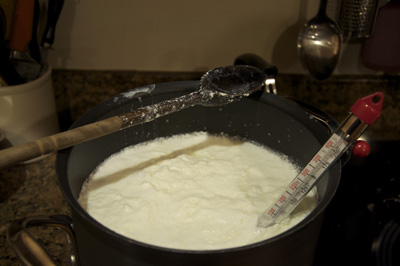
The ricotta was fun and surprisingly easy. One gallon of whole milk plus one quart of buttermilk, heated to 175° until the curds start to separate. You then ladle the curds into cheesecloth and drain. Add your chosen seasoning and the fluffy warm filling is ready to go.

Hand-making ravioli, on the other hand, was an extraordinarily laborious undertaking. We’d made pasta from scratch before — with an electric machine — but that won’t do for the sheets that form the ravioli pillows.
So we borrowed a friend’s hand-crank pasta machine. Problem was, it had no clamp to secure it to the counter which, if you’ve ever tried forcing dough through a tiny metal slit, was no fun at all.
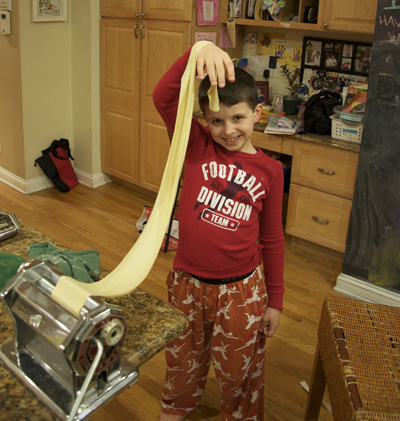
Well, that’s not entirely true. Getting it right was immensely satisfying.
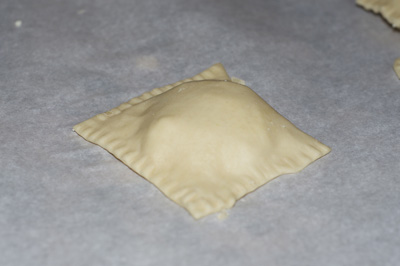
Once you have the sheets you use this fabulous little slicing/pinching wheel specifically for ravioli. This gives you the pillow “casing” into which you put the ricotta. You have to make sure the edge seals firmly as you will shortly be plopping the ravioli in boiling water and don’t want filling exploding everywhere.
The recipe calls for meatballs and tomato sauce as accompaniment and here is where the from-scratch obsession shows its ugly underside. These sides ended up being two separate meals entirely. For one, the fist-sized meatballs came from a Neapolitan recipe that includes grated Parmesan, garlic, basil, oregano, and nutmeg (vetoed by wife).

The sauce, however, wasn’t really a sauce but a ragù, basically an entire meal in a pot.
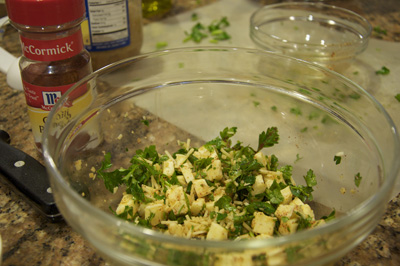
You pound pork shoulder flat, line it with pancetta, then fill it with a yummy payload of garlic, parsley, chili powder (hallmark of this region), nutmeg (vetoed), and pecorino or parmesan. Add white wine and canned whole tomatoes and simmer forever.

In a nutshell what you get after simmering this pork bomb is a sauce for pasta and a second meal, which we didn’t not even attempt to eat on the night in question.
All in all, a fantastic experience, though perhaps not one best-suited for a weeknight. Let me know if you’d like detail on the ingredients or process.
Full photo set here.
See also Spaghetti All’assassino and Lucanian risotto.
Ambient informatics through the rearview mirror
In 1998 I was nearing completion of the grad program at Georgia Tech in Information Design and Technology (now called Digital Media), cutting my teeth in the theory and practice that I use to this day. But some of it, like the project below for a course in Human-Computer Interaction taught by Greg Abowd (basically this class), only seems really meaningful nearly 12 years on.
Sonopticon was a team project to build a prototype of an automobile-based ambient sensing and heads-up display. We didn’t have to build a car that knew its surroundings — this was HCI, after all — but we did have to explore the issues of what it would be like from a driver’s perspective.
My wife and I took the car out one day (this is how you do anything in Atlanta) and filmed scenarios for later editing in After Effects. The RealVideo files (!) are gone, but some screenshots still exist, which I have strung together below. It’s laughable, really, the quality and overlays, but it conveys some interesting concepts that only now are becoming technically feasible. If the city of data really is coming into being, this is part of it.
And just because I’m channeling 1998 I’m gonna lay this out in one big honkin’ table. Take that CSS absolute positioning! (Best viewed in Netscape 3.0.)
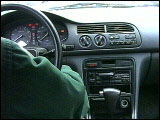 Ignition |
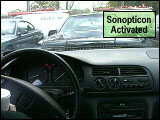 Sonopticon activated |
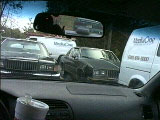 Mirror check |
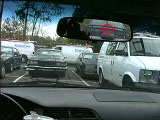 Caution avoidance alert |
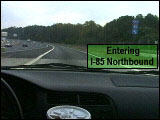 Entering I-85 |
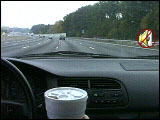 Active Noise Cancellation |
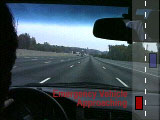 Emergency vehicle detected |
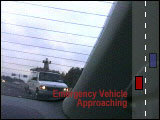 Visual confirmation |
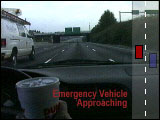 Vehicle passes |
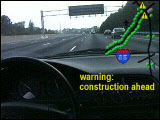 Upcoming construction |
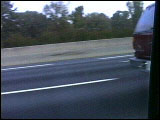 Blind spot check |
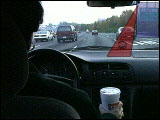 Vehicle moves into blind spot |
 Visual confirmation |
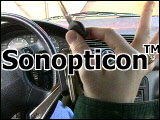 A satisfied user |
What’s funny to me all these years on is how my focus has shifted so decidedly away from augmenting the automobile to enabling an infomatics of the human-scale city, pretty much the opposite of what the car has done to our metro regions. Though I suppose making cars more aware of their surroundings is the one step towards this vision.
The full project write-up is here, if you are so inclined. I think we got an A.
(By the way, the car used in this demo is the one-and-only MySweetRide.)
Off the grid
BLDGBLOG has a wonderful post up comparing the way the building in the original Die Hard movie is used by the hero John McClane in every way except how it was designed to be used.
McClane explores the tower—called Nakatomi Plaza—via elevator shafts and air ducts, crashing through windows from the outside-in and shooting open the locks of rooftop doorways. If there is not a corridor, he makes one; if there is not an opening, there will be soon.
It’s a great essay, especially as it explores the real-world tactic [PDF] of Israeli troops who move through urban theaters by carving a path through the walls of adjacent buildings to remain unseen from the air or the street. (There’s also a fascinating digression on the way the new Bourne films use the city as a kind of weapon itself, contrasted with cities as mere setting for the gadget-dependent James Bond.)
But the main thrust of the piece comes from Die Hard: “[McClane’s] is an infrastructure of nearly uninhibited movement within the material structure of the building.”
This is the idea of the building as a network. And it scales up.
Our networked technologies already give us this sense of “uninhibited movement” within information space. If we consider the book an architectonic form (the Latin stanza means “room” after all) we see the emergence of the same dynamic of a decade ago when hypertext came into popular consciousness. Hyperlinks and unique IP addresses allowed us relatively uninhibited movement through a landscape of information, jumping to and fro, outside the linearity of the millennia-old codex.
I think what BLDGBLOG is pointing out are the cinematic imaginings — and military exigencies — that prefigure the way we increasingly think of the networked urban space as a mutable environment that can be bent to our will. It isn’t uninhibited in the truest sense (there are still walls to be destroyed or network outages to be dealt with), but barriers to movement are less dictated by the grid of streets and buildings than governed by another layer of experience, grounded in data and sensors.
Kazys Varnelis makes this point in another, powerful way:
In this condition of total urbanity, maps as navigational tools for the physical traversal of space are supplanted by intelligent maps for navigating a contemporary space in which the physical becomes a layer of data in a global informational space. If that space is created by society, it is also a space that, in its massive complexity, has become unknown to us, a second nature simultaneously also a second city and the space in which today’s identities are being formed. Much of this world is invisible and it is the task of the designer to help us understand it.
Intelligent maps — and a least a small number of films — help us think of the city as a platform for our own uses, related to but not wholly confined by the way it was physically built.
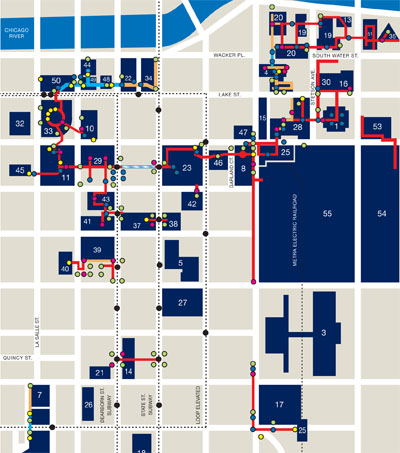
The physical city grid is vital, but even before networks and mobile technologies came to be the grid was made permeable by human need. Consider the Chicago Pedway. It’s an official but disjointed way of maneuvering through the central business district, initially constructed to give people a way of moving around safe from the elements. The Pedway is a series of tunnels and bridges that allow covered movement, wholly apart from the grid of streets and sidewalks. Desires lines, it seems, can sometimes be concretized. (As many of the diagonals is city street grids attest. Diagonals are often some of the earliest routes in the area showing human movement along paths of least resistance — or animal trails — that pre-date major settlement.)
There are thousands of other ways of moving through the dense city space that are, for now, merely habitual paths inside the heads of city pedestrians. Shortcuts through alleys, building lobbies, detours through subway connectors, or just routes that align with well-covered sidewalks. It is only a matter of time before these crowd-sourced paths of least resistance are made available via the network. (We’ve seen it in experiments like the “paths of least surveillance”, which of course is why the Israeli army does what it does.)
Of course, all dense, diverse urban areas would have walkscores of 100 if one could walk through walls. But we can’t and I’m not advocating the build-out of a completely porous physical environment or a LEGO-style recombinant cityscape. (Mark Z. Danielewski’s Tardis-like House of Leaves depicts one creepy end of this particular vector.) Constraint is as important as mutability. What’s physically available is as important as the ability to get to it.
But our concept of the city — what we can do with it — has changed because of the layer of networking and data that co-exists with it. Certainly ease of movement is increased, as is the act of information gathering (about nearby friends, businesses, and resources). But this is the low-hanging fruit. The real opportunity, it seems to me, comes from the analogy of the move from printed information to networked information: the ability we’ve been given to write to the space as well as read from it. Living in an architecture of information, we can more easily participate in its construction than we can with the physically built-environment. This is our right, if not a kind of civic duty for the information age. (More on this topic in a future post.)
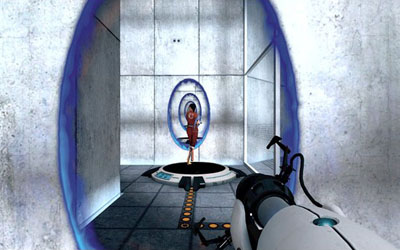
The video game Portal is interesting to consider as a kind of embodiment of a mutable environment environment that still partakes of rigorous constraint. In Portal you move about a highly orthogonal, multi-room architected space with a gun that can blast “entry” and “exit” portals — basically teleporters. You can’t create portals just anywhere, though, and often you’ve link yourself into a corner. It’s surprisingly fun (and good for kids who like blasting things, minus the carnage). The point, I think, is that there’s a certain deep human satisfaction in carving one’s own path, bending a physical space to one’s own needs. Portal, like our tools of networked urbanism, succeeds by meeting that basic human desire.
BLDGBLOG makes the point that the Die Hard sequels would not have gotten progressively worse if they had not abandoned the simple premise of a hero who uses a physical space to his own ends, suggesting that scaling Nakatomi plaza up to the level of a city in future installments would have been the logical (and entertaining) next step. I don’t disagree, but we don’t need Hollywood to do it for us. The city of information is being built, piecemeal, by the lived experience of its human actors everyday, an elaborate movie set overlaid on a functioning city street.
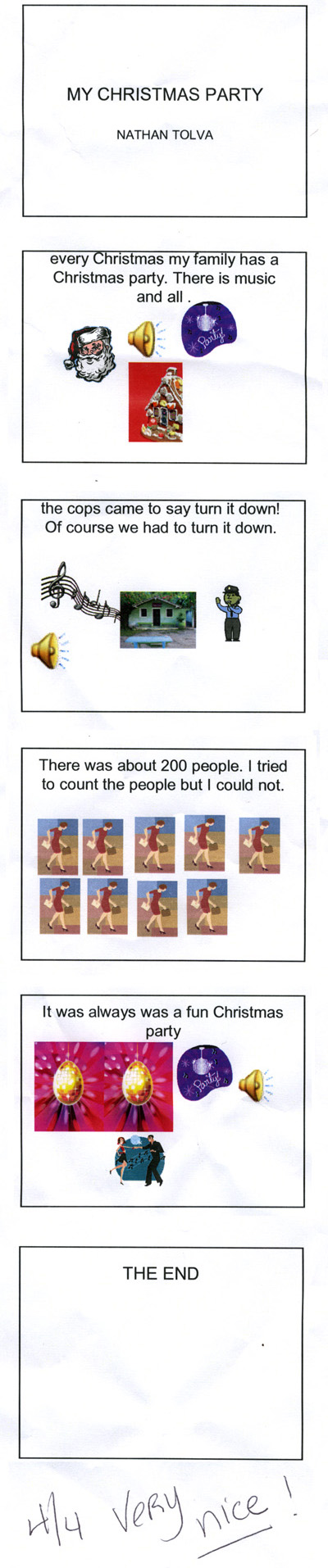
“Of course we had to turn it down.”
Not going to win any parenting awards here, but I think I know who will be carrying on the tradition in my twilight years. (Clip art brilliance, I say!)
Confabulism
New year, new conferences. And some old favorites too. Here’s a list of places I’ll be speaking in the next few months. If you’ll be at any of them, let me know. Would be great to meet up.
City Camp
January 23-24
Chicago, IL
ORD Camp
January 29-30
Chicago, IL
South by Southwest Interactive
March 13-16
Austin, TX
Panel: The City Is A Platform
IA Summit
April 9-11
Phoenix, AZ
Talk: Metropolitan Information Architecture: The future of UX, Databases and the (Information) Architecture of complex, urban environments — god, who writes that?
I’m sure more will pop up in the first half of the year. You can always follow my public Dopplr profile to see where I’ll be.
Hello, travel!
Mission Elapsed Time: 20:00:21:06:42:40

I went back through it this blog (and my Flickr account) on its 20th anniversary, retracing digital footprints made on what feels like a different planet. Here are some highlights.
The Terror Tourist
Explorations of place in horror fiction — real or imagined, geographical or psychological — culled from my time on The Heavy Leather Horror Show 2023-2026.
Subscribe to the podcast or the email newsletter or just read through the archives posted here.
The Ampcamper

How I hauled myself, two teens, an 80 lb dog, and a whole load of crap 4000+ miles across six states in twenty days using an electric vehicle. And survived to tell the tale.


