
Upcomings
Spring’s nowhere near Chicago right now, but the seasonal onslaught of conferences seems not to heed nature’s cycles. I’m going to be in a bunch of places coming up. Would love to meet up if you will be near.
Photo by billypalooza on Flickr
Transportation Camp East
New York, NY
March 5-6
South by Southwest Interactive (+ new day after Technology Summit)
“Smarter Cities: Driving Sustainable Growth”
Austin, TX
March 12 – 16
APA National Planning Conference
“Technology Infrastructure and Planning”
Boston, MA
April 11-12
RPA Regional Assembly
“Smart Cities, Smart Citizens”
New York, NY
April 15
National Mayor’s Summit on City Design
“Design and 21st Century Challenges”
Chicago, IL
April 27-29
Urban Systems Symposium
“Defining Urban Systems”
New York, NY
May 11-12
Full travel schedule here, for those interested. (There’s a good chance I will be in DC a bunch too.)
What it’s like to match wits with a supercomputer
I spent most of the May 1997 rematch between chess world champion Garry Kasparov and IBM’s Deep Blue supercomputer sitting in a grad school classroom. I think it was Intro to Human-Computer Interaction, ironically enough. The professor projected a clunky Java-powered chess board “webcast” (the term was new, as was the web) so we could follow the match. The pace of chess being deliberative and glacial, it really wasn’t a distraction. Not to mention that, at the time, I didn’t know how to play chess. But I do remember people caring deeply about the outcome. I went to work for IBM the following year.
Deep Blue’s descendant, if not in code or microchips then in the style of its coming-out party, is Watson, a massively parallel assemblage of Power 7 processors and natural language-parsing algorithms. Watson, if you’re not a geek or a game show enthusiast, was the computer that played Ken Jennings and Brad Rutter on Jeopardy Feb. 14-16 of this year. Watson won.
Wednesday of last week I got a chance to play Watson on the Jeopardy set built at our research facility for the show. I did not win.
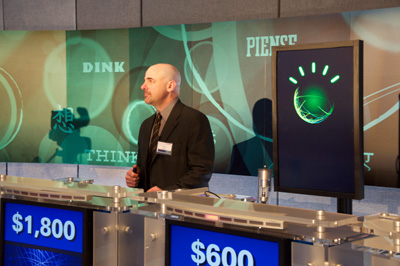
But I did hold the lead for a time and, in fact, I beat Watson during an unrecorded practice round. Honest!
Jeffrey Plaut of Global Strategy and I were the two human competitors selected to go up against Watson in a demonstration match. We did so at the culmination of a few hours of discussion with leaders from the humanitarian sector on how to expand Watson’s repertoire to put it to work in areas that matter. (More on that in a bit.)
IBM built a complete Jeopardy set for the actual televised match. Sony has lots of experience with this, as Jeopardy often goes on the road. But it’s clearly a hack: TV made the set look a lot bigger that it really is and the show’s producers had to jump through hoops to provide dressing room space and keep the contestants segregated from interacting with IBM’ers (to avoid claims of collusion, I suppose). Ken Jennings has some typically humorous insight on this.
Trebek was long gone, so we had the project manager for Watson host the session I competed in. He’s actually very good, as Watson went through a year of training with past winners and stand-in hosts. I was to play one round of Jeopardy. The rules were the same as the real game and Watson was at full computing capacity, with two exceptions. We were told that we could ring in and then appeal to the audience for help and, most importantly, Watson’s ring-in time was slowed down by a quarter second. The first I took as an insult — if I was going to compete against a computer I was going to do it myself — the second was a blessing.
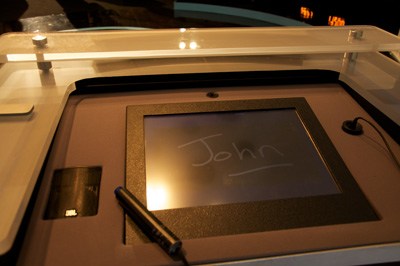
Standing at the podium is certainly nerve-wracking. There’s a small screen and light pen for scrawling your name and then the buzzer. I stood in Jennings’ spot and it was striking to see how worn the paint was on the buzzer. From sweat? Who knows, but that thing looked like it had been squeezed to death. Contestants can see the clue board and the host, of course, but there’s also a blue bar of light underneath the clues which is triggered manually by a producer once the host finishes reading the last syllable of the clue. This is the most important moment, as ringing in before the blue bar appears locks you out temporarily. Watson had to wait a quarter second at this point and I am convinced it is the only reason we humans were able to get an answer in edgewise.
In a way, this moment is as much human-versus-human as anything. You’re trying to predict exactly when the producer will trigger the go light. Factor in some electrical delay for the plunger and it can be a real crapshoot. This is why past champions perfect their buzzer technique and ring in no matter what. They just assume they will know the answer and be able to retrieve it in the three seconds they are given.
I got a bit of a roll in the category called “Saints Be Praised”. My Catholic upbringing, study in Rome, and fascination with weird forms of martyrhood finally paid dividends. (I also learned after the match that my human competitor was Jewish and largely clueless about the category.) The video above shows me answering a question correctly — something that seems to have shocked my colleagues and the audience. (And I would have disgraced every facet of personal heritage had I messed up a question about an Italian Catholic from Chicago.)
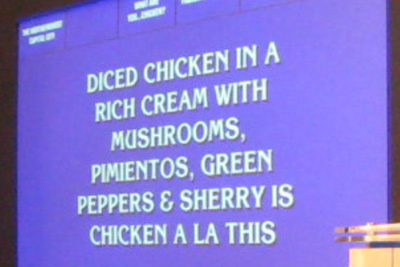
This clue was more interesting as Watson and I both got it wrong. The category was “What are you … chicken?” about chicken-based foods. Maybe my brain was still in Italian mode as I incorrectly responded “Marsala”, but Watson’s answer — “What is sauce?” — was way wrong, categorically so. This is insightful. For one, the answer, “What is Chicken A La King,” if Watson had come across it at all, was likely confusing since “king” can have so many other contexts in natural language. But Watson was confident enough to ring in anyway and its answer was basically a description of what makes Chicken A La King different from regular chicken. Note that the word “sauce” does not exist in the clue. Watson was finishing the sentence.
What’s most important and too-infrequently mentioned is that Watson is not connected to the Internet. And even if it were, because of the puns, word play, and often contorted syntax of Jeopardy clues, Google wouldn’t be very useful anyway. Try searching on the clue above and you’ll get one hit — and that only because we were apparently playing a category that had already been played and logged online by Jeopardy fans. The actual match questions during the Jennings-Rutter match were brand new. The Internet is no lifeline for questions posed in natural language.
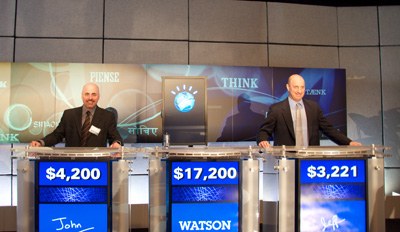
At one point I had less than zero (I blew a Daily Double) while Jeff got on a roll asking the audience for help. And the audience was nearly always right. Call it human parallel processing. But if I was going to go down in flames to a computer I was damn sure not going to lose to another bag of carbon and water. I did squeak out a victory with a small “v” — and Watson was even gracious about it.
Thinking back it is interesting to note that nearly all my correct answers were from things I had learned through experience, not book-ingested facts. I would not have known the components of Chicken Tetrazini did I not love to eat it. I would probably not know Mother Cabrini if I didn’t take the L past the Cabrini-Green housing project every day on the way to work. This is the biggest difference between human intelligence and Watson, it seems to me. Watson does learn and make connections between concepts — and this is clearly what makes it so unique — but it does not learn in an embodied way. That is, it does not experience anything. It has no capacity for a fact to be strongly imprinted on it because of physical sensation, or habit, or happenstance — all major factors in human act of learning.
In Watson’s most-discussed screw-up on the actual show, where it answered “Toronto” when given two clues about Chicago’s airports, there’s IBM’s very valid explanation (weak category indicator, cities in the US called Toronto, difficult phrasing), but it was also noted that Watson has never been stuck at O’Hare, as virtually every air traveler has. (The UK-born author of this piece has actually be stranded for so long that he wandered around the airport and learned that it was named for the WWII aviator Butch O’Hare.) Which isn’t to say that a computer could never achieve embodied knowledge, but that’s not where we are now.
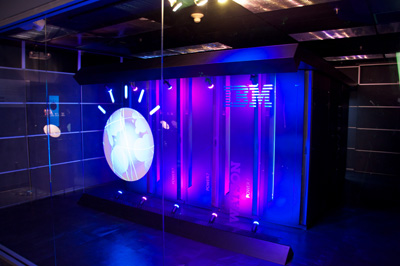
But all of it was just icing on the cake. The audience was not there to see me make a fool of myself (though perhaps a few co-workers were). We were there to discuss the practical, socially-relevant applications of Watson’s natural-language processing in fields directly benefiting humanity.
Healthcare is a primary focus. It isn’t a huge leap to see a patient’s own description of what ails him or her as the (vague, weakly-indicating) clue in Jeopardy. Run the matching algorithm against the huge corpus of medical literature and you have a diagnostic aid. This is especially useful in that Watson could provide the physician its confidence level and the logical chain of “evidence” that it used to arrive at the possible diagnoses. Work to create a “Doctor” Watson is well underway.
As interesting to my colleagues and I are applications of Watson to social services, education, and city management. Imagine setting Watson to work on the huge database of past 311 service call requests. We could potentially move beyond interesting visualizations and correlations to more efficient ways to deploy resources. This isn’t about replacing call centers but about enabling them to view 311 requests — a kind of massive, hyperlocal index of what a city cares about — as an interconnected system of causes and effects. And that’s merely the application most interesting to me. There are dozens of areas to apply Watson, immediately.
The cover story of The Atlantic this month, Mind vs. Machine, is all about humanity’s half-century attempt to create a computer that would pass the Turing Test — which would, in other words, be able to pass itself off as a human, convincingly. (We’re not there yet, though we’ve come tantalizingly close.) Watson does not pass the Turing test, for all sorts of reasons, but the truth is that what we’ve learned from it — what I learned personally in a single round of Jeopardy — is that the closer we get to creating human-like intelligence in a machine, the more finely-nuanced our understanding of our own cognitive faculties becomes. The last mile to true AI will be the most difficult, primarily because we’re simultaneously trying to crack a technical problem and figure out what, in the end, makes human intelligence human.
All good things.
It’s been two months now since we wrapped it all up. Could be that my lateness in writing about it was just to make sure that we really did mean that it was over. Or maybe I didn’t want to think about it being over. Most likely, it was sheer exhaustion and a house that needed putting back together.
In any event, certain parts of our final holiday party do need to be told. Sweet damnation, it was an amazing way to go out.
I’ve detailed the evolution of this particular fête previously, so I’ll just lay out the specifics. On December 11 my wife and I hosted the last event, completing an unintended triad of “world”-based themes that began two years ago with Around the World, continued last year with Out of This World, and culminated in this event, decisively, as The End of the World.
Newsflash: apocalypse isn’t the classiest theme for what is essentially a Christmas party. New Years Eve sorta has that tipsy tinge of impending end, but it’s never really the end, just a marker. (Except when the millennium flips, of course, and full-on pandemonium is acceptable.) We toyed with “at world’s end” as a physical location, ala Shel Silverstein’s sidewalk or cartographical terra incognita. But neither of these worked as well as the pure mayhem of doomsday.
Eschatology, it turns out, is a wonderfully flexible concept, so we went with it. Mad Max meets the Four Horsemen by way of Al Gore. With lasers and martinis.
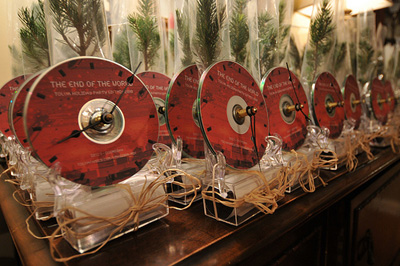
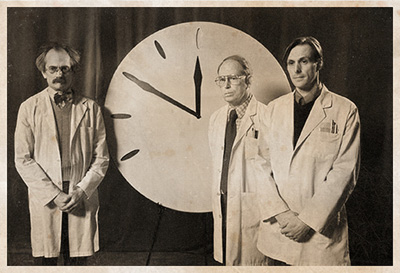
The favor was a special challenge. The party takeaway has traditionally been some form of music-delivery medium and, though I have long since stopped considering compact discs adequate to this task, the truth is that they did lend themselves astonishingly well to what we came up with. See, it’s a clock. Tick tock, tick tock, time’s up. Get it?
We figured most people wouldn’t make the connection to the doomsday clock, though there is something wonderfully creepy about a bunch of clocks ticking out of time with one another (cf., Orbital’s “The Box” remix, part of the audio excerpt below).
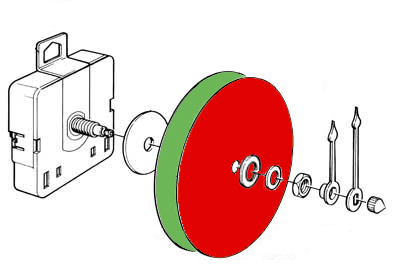
The clock face was composed of two CD’s — Doomsday and Rebirth — which were smooshed together and bolted onto the clock axle, as below. To listen to the discs you had to dismantle the clock, which consisted of unscrewing a single nut.
The clock sat in small frame which itself rested on a small “time capsule” that contained a scroll with holiday wishes and a reminder not to come back next year.
The last piece, really the only thing having to do with rebirth, was a small (live) spruce sapling hooked to the back of the clock rig. It all looked rather nice, festive even, though it was awfully time-consuming to assemble and frightfully delicate. I’d love to know how many clocks made it in working shape back to partygoers’ homes at the end of the night.
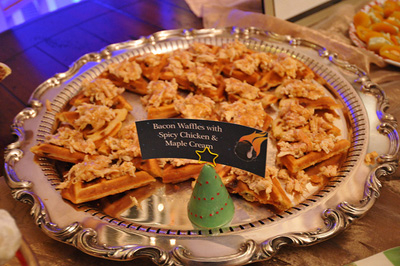
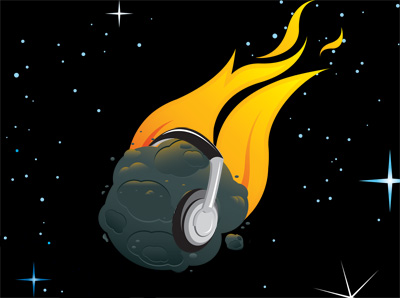
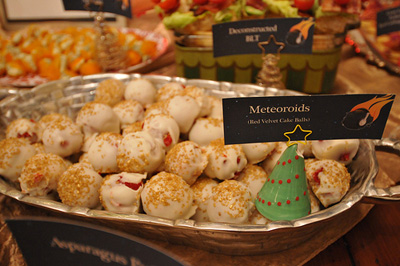
At the end of the world we will eat pork, a sign declared. We’re still not sure what that means, but the porktacular was a hit. With a nod to our stockyards, I’ll note that we used everything but the oink. Faves included the Bacon Waffles with Spicy Chicken and Maple Cream and the Red Velvet Cake Ball Meteoroids. (Here’s the full spread.)
Fingers the One-Handed Bartender returned this year and was responsible for much mirth, day-after illness, and possibly one pregnancy. We had intended to enlarge his veal pen of a bar area but never got around to it. We did however rig a display above his head that gave details on the custom drink menu. And the DJ booth had a special trigger for thirst, below.
Possibly my favorite new addition to the party was the DJ outfits. Last year we donned jackets festooned with electroluminescent wire, a tough thing to upstage — but in the intervening year the iPad had been released. And of course it wasn’t difficult to find shirts custom-reinforced to accommodate an iPad slid right into it. It was great fun. We had disaster video, spectrum analyzers, music-appropriate imagery, and all manner of screensavery stuff.
But the most fun was a LED ticker-tape app that allowed tweeting directly to it so that the crowd could scroll their own messages right across our chests. (Pretty sure that snippet below is “And the DJ is doing a great job” a brief interlude between what-a-bunch-of-nerds themed tweets.) The account’s still live, by the way. Maybe you’ll catch me wearing the iPad at work?
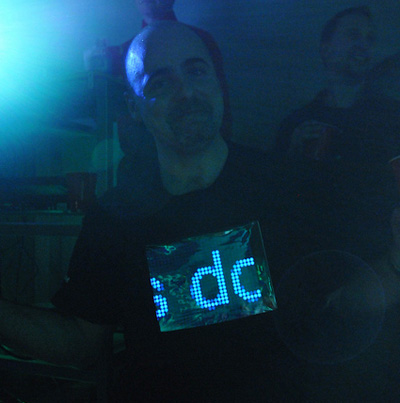

Other new additions this year included a drink shelf below the perishable electronics in the DJ booth. Call it a lesson learned from last year. The mirrored tree cones, staple of most past parties, also got custom spinners to throw disco ball shards of light around the room to remind everyone that they were, in fact, in a post-apocalyptic hell. And the popular photo booth had all manner of goodbye-cruel-world props.
Custom posters inspired by Britain’s wonderful WWII anti-panic propaganda decorated the house. (If you have not tried the Keep Calm and Carry On Calm-O-Matic, you really should.)
Lastly in the new things category, we went low-tech with a “memory board” for people to scrawl their thoughts about the last decade of bashes. It remained remarkably free of crude comments for much (but not all) of the night.
And yet it is the music and dancing that defines and prolongs this party. We didn’t have much luck recording the full set of Jesse Kriss, Michael Tolva and I this year, but this self-contained set does exist.
Conveniently, lots of people were singing about armageddon in the 1980’s. Thanks, Strategic Defense Initiative!
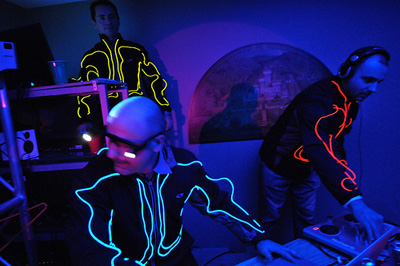
The EL jackets returned, of course, made seemingly all the fresher by the release one week later of Tron: Legacy. Way fun, way photogenic, and way too goddamn hot.
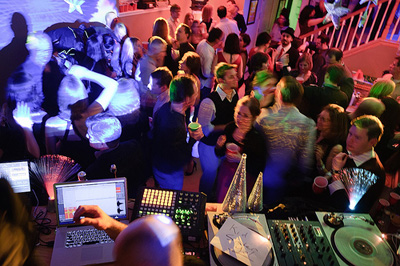
This year our visuals maestro Tom Herlihy did not have a calendar conflict with Kabul, Afghanistan and so was able to man the lights and projectors during about an hour of sobriety. Tom’s ever-able understudy Chris Gansen also lit it up, so to speak. For once in a club setting the air raid siren made sense.
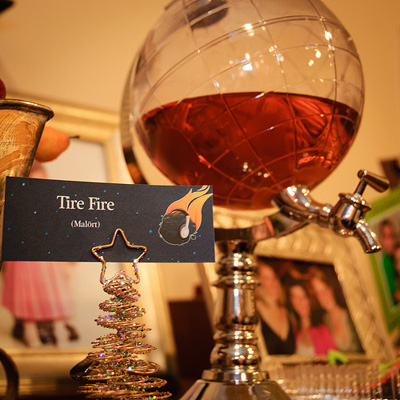
The liquor globes made a comeback as well. Luckily Malört, Chicago’s very own rotgut, neatly tied together our love of the Windy City and beverages that pretty much ensure that your world is coming to an end.
Which is a nice seque to illness. You could say that we were on-theme with pestilence, but the sad truth is that it seems our home — usually infested with the virus that is small children — was coated with a fine film of some mutant strain of stomach flu. Several got ill, including my mother-in-law who spent the entire party in the dual perditions of non-stop barfing and having to listen to four-on-the-floor bass until 4 AM.
The other casualty was Jesse Kriss, the DJ savant and ringmaster of the music-making that has jolted the past few years’ parties. Yet, Jesse played for at least 90 minutes, ashen-faced but not so lethargic that he couldn’t whip the crossfader. It was magic to watch, until he too collapsed into a bed upstairs and merely felt the party through the house frame vibrations. I think Joey and I did a pretty good job keeping the music interesting, but it simply was not the same without Jesse as mixmaster of ceremonies.
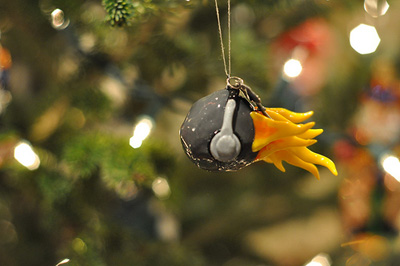
Some people didn’t believe that this was the end, but many knew. You could tell from the thoughtfulness of the hostess gifts, such as the handmade party logo ornament above and the retrospective photobook.
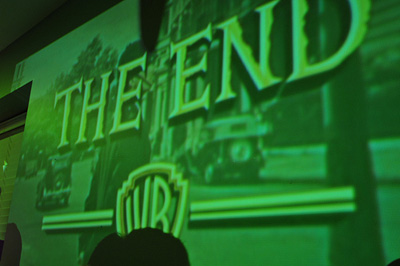
Right, so. No need to dwell on it. It was a great run. I’ll sum it all up with the text from the note we included in the time capsule. (Mind the sap. It’s sticky.)
Who the heck throws a holiday party with doomsday (and rebirth) as a theme, you might be wondering? Fair enough, but it’s a useful summary of the diverse emotions we feel as we end eleven years of parties with our favorite people. What started as a small gathering of disparate groups of friends as we were just getting our bearings as (kidless) Chicagoans has grown into an intense labor of love that is easily the highlight of our year.
But labor it is, and we feel our work is done. Energy that was poured into this spectacle now goes elsewhere, primarily to the three lovelies you see below, but also to you all — just in different ways. We know we’re lucky to have such happy and fun-loving friends and we’re immensely grateful you’ve chosen to spend a night of your year with us.
So let’s not focus on the end but rather the fun we’ve had and what comes next. A healthy 2011 to start, followed by more good times, and maybe a beautiful blue spruce in your yard many years from now.
——–
Here’s the full photo gallery.
Curious about past parties?
2009: recap | photos | giftmix | livemix
2008: recap | photos | giftmix | livemix
2007: recap | photos | giftmix
2006: recap | giftmix
2005: giftmix
Mission Elapsed Time: 20:00:21:06:42:40

I went back through it this blog (and my Flickr account) on its 20th anniversary, retracing digital footprints made on what feels like a different planet. Here are some highlights.
The Terror Tourist
Explorations of place in horror fiction — real or imagined, geographical or psychological — culled from my time on The Heavy Leather Horror Show 2023-2026.
Subscribe to the podcast or the email newsletter or just read through the archives posted here.
The Ampcamper

How I hauled myself, two teens, an 80 lb dog, and a whole load of crap 4000+ miles across six states in twenty days using an electric vehicle. And survived to tell the tale.


