
Forbidden City: Revealed on the History Channel
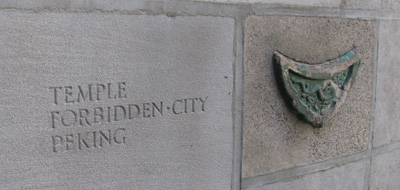
The street level outer wall of Tribune Tower in Chicago has all kinds of masonry and architectural adornment embedded in it from famous places around the world. A bit of the Taj Mahal, a sliver of the Parthenon, a brick or two from The Alamo, a chunk of the Berlin Wall, etc. It’s historical bricolage, literally. And a little odd, too — a sidewalk cabinet of curiosities composed of loot from Tribune reporters on foreign assignments.
I get it, though. Make the foreign and faraway more accessible, touchable. A proxy for tourism.
Now get ready, dear readers, for this is where I make the jump between two seemingly unrelated topics and in doing so stun you momentarily into forgetting how ham-handed the juxtaposition is.
There’s a better way. On October 10, IBM and the Palace Museum will launch The Forbidden City: Beyond Space and Time, a multi-user, immersive, three-dimensional virtual world recreation of China’s imperial palace. It won’t give you the feel of cold rock (or the microbial film of a thousand tourist fingers), but it is very much related to the desire to reach out and encounter the exotic in an embodied way.
If you prefer old-fashioned coach potato-variety virtual tourism, consider tuning in to the History Channel this Sunday, Sept. 21* for the premiere of its documentary on the Beyond Space and Time project. The show is the parallel story of the building of the palace and its virtual re-building, the latter explicating the former. It’s an interesting lens through which to look at a place: architecture as socio-history.
Plus, I’m in it. So there’s bound to be unintentional humor, if not outright farce.
Forbidden City: Revealed
History Channel
Sunday, Sept. 21
7:00 PM ET
* This airdate is US only. History International will broadcast the show at 9:00 PM ET on Wednesday, Sept. 24. Other international airdates to follow.
UPDATE: The virtual world is live and can be found at www.beyondspaceandtime.org.
But most of all, I missed YOU
I’ve been home from Africa just under a month. Thought I’d compile a list of things I miss and things I don’t.
Things I Miss:
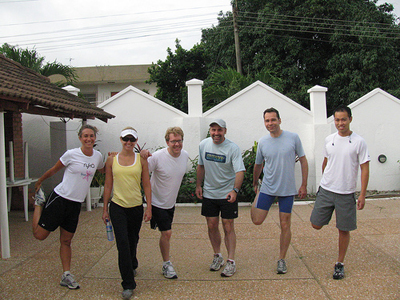
- The Ghanaian handshake – Slap your hands together loudly (not a high five, just an aggressive bringing together of the hands for a normal handshake), hold until its a little awkward, then pull apart with a snap. I never quite got it and always felt horribly unhip trying to pull it off. But it was cool to be greeted like that.
- Laundered shoelaces – There was no laundromat nearby so we had some sketchy service that would come into our rooms and look for anything dirty. Before I figured this racket out they actually unlaced my running shoes (reddened by clay from dirt roads) and washed them separately. Anything for the upcharge, I suppose, though it was nice to have such gleaming white laces.
- Having taxis hail me – You never have to wave a cab down in Ghana, especially if you’re white. No matter where you are or how little you look like you need a ride, dozens of taxis will beep-beep beep-beep until you demonstrably tell them to go away.
- Saying “Ougadougou choo choo” – Ougadougou (wah·gah·DOO·goo) is the capital of Burkina Faso, the country to Ghana’s north. It is also the world capital with the most vowels in it. (Take that, Bosnia!) The nickname of the train service in and out of the capital is perhaps the most fun thing to say since I learned “trabajaba” in high school Spanish.
- Rear window car signage and business names – For reasons I still don’t completely understand Ghanaians are obsessed with naming their cars and shops with unintentionally humorous phrases from the bible. Or from something that sounds scriptural. Or not. “Be Holy Electrical Works”, “Dr. Jesus”, “I came naked”, “It wasn’t me”.
- Our prison economy – There were 10 of us at the guest house and we had only what we shlepped from home. Inevitably people forgot things and/or had items to swap. Though the Ghanaian markets offered lots of goods, there were certain things (meds, amenities, candy) that we had to barter amongst ourselves. It became a prison economy where mosquito wipes and vodka, rather than smokes, served as coins-of-the-realm.
- Dial-a-proverb – Emerson said “language is fossil poetry” which is a pretty accurate description of how laden the Twi language is with poeticisms and figures of speech. In fact, formal conversation consists of little but such turns of phrase. My interest in this characteristic of Twi became a game with my friend Yaw who would take any situation I gave him, call his pal who’s a master of Ghanaian proverbs, and come back with an appropriate phrase for the occasion.
Things I Do Not Miss:

- Restaurant service – No matter where we went, city or village, Italian, Chinese, Lebanese or Ghanaian, all meals took at least two hours. Even when we thought we were being sly by calling in our orders, the service was atrocious. We think this was because of limited staff and the fact that everything was made basically from scratch as soon as it was ordered. There were never enough menus to cover the table and food was never brought to us even near the same time. Often people were served thirty minutes after others. The food, however, was almost always exceptional.
- The Ghanaian noise for getting one’s attention – I understand that this is a perfect example of clashing cultural habits, but the staccato hiss that Ghanaian’s use to hail someone is just poison to Western ears. It sounds like a curse or worse, though admittedly it does get your attention.
- Lack of currency – Last year Ghana re-denominated its currency such that 10,000 old cedis would be equal to one new cedi. There were many reasons for this, but most signage has not caught up. That’s a surmountable, calculable inconvenience, but the reality is that no one ever has change. Hacking off four zeros means no one has the sub-cedi currency known as the pesewa. Merchants can’t break even small bills. I can’t tell you how many times I simply walked away either without the good I wanted or having given the merchant a sizable “tip”.
- Instant coffee – ’nuff said.
- Compact fluorescent bulbs – Don’t get me wrong. I’m all in favor of CFL’s, but Ghana has adopted them in a huge way. I don’t think I saw an incandescent the whole time I was there — which itself is fine, but CFL’s have indiscriminately and nakedly replaced every bulb everywhere. There’s nothing less comforting that a bright, uncovered fluorescent bulb. To make the switch, in my opinion, requires not just environmental consciousness but also some stylistic consideration.
- Racist South Africans – I met three white South Africans while I was in Ghana. The first was a racist drunk at a local Internet cafe who obsessively gambled online while smoking a hookah pipe. One night he was too drunk to realize that a shisha coal had fallen onto his laptop power supply. BOOM! It was like someone detonated a small firework. But he kept gambling on battery power. The second was a chatty guy at a hotel I was staying at in Accra. He would not take any hint that we did not want to talk to him at breakfast and insisted on letting us know his impressions of Ghanaians, this being his first visit. Let’s just say he used the word “savage” frequently. The third was a very pleasant, younger guy on his own on a business trip who made it clear that not all white South Africans harbor such deep-seated racism. I’m glad I met him.
- Dirt roads – My ass and nerves will never be the same. See the first part of this post.
- Diet Coke false advertising – Called Coke Light in Ghana, Diet Coke is obviously the focus of a massive marketing campaign. Billboards and signage are everywhere. And yet, no one ever has it in stock. It is a mythical elixir, something promoted but never distributed. My colleagues made fun of me for continuing to ask for it after a dozen failures, but by then it was a matter of principle.
- Under-table space management – We often ate out in relatively large groups. This required restaurants to push tables together. Inevitably seats would be placed right at the junction of two tables where no two legs could ever go. We saw this everywhere. It was almost as if the ability to arrange a table with chairs around it were more important than actually seating people there.
And yet, those cons are not nearly enough to make me not want to get back as soon as possible.
1¢ stage … huh?
Seems like there are more first-time visitors to my humble blog than there used to be. This might be a function of my linking Twitter updates to Facebook status, which if you do the math means that a lot of non-geek acquaintances are now alighting on Ascent Stage without a clue in the world what the hell is going on. Welcome, dearest friends!
Thought I’d take a brief moment to explain the name of the blog, something I’ve never rightly done.
You get some hilarious pronunciations and questions, especially when trying to give out the URL over the phone in an interview, say. “A cent, as in one penny?” “Ascent’s ‘tage, like Hermitage?” “Nascent Stage, you mean like an infant?” “ASS-ent stage, what is this porn?”
Simply, an ascent stage is the part of the rocket that goes up as opposed to being the one that breaks for going down. Sadly, in the post-Apollo era this has mostly been the only stage a rocket has. We ain’t landing anywhere with a rocket as long as we have a Shuttle.
Ascent stage refers usually to the upper half of the lunar modules that we put on the moon. The descent stage landed the astronauts (counteracting the moon’s weak gravity); the ascent stage put them back up to link with the Service Module whose rocket would take them home. Simple enough.
But why the name? What I’ve always liked about the concept of an ascent stage (in addition to the space dorkiness) is that it implies progress, upward motion, forward movement. But also a discrete point in time, or phase. There’s also something very slightly sad about it too, because to ascend means you descended at some point and you’re leaving something behind. (In the Apollo case this was the descent stage itself.)
There’s a classic image from the last Apollo mission where they left a camera specifically poised to capture the ascent back up to the orbiting command module — something which had not been done on previous missions. Not sure what it is but there’s something eerie and solemn about the footage that was captured. Two guys in a rickety polygon blasting off from a much more stable looking bottom half, which is now left to decay on the moon forever.
So, that’s kinda the rationale or feeling behind the name itself: progress, ascendancy, upward motion … tinged with mystery, loss, even desolation. My blog.
By the way, I’m considering a redesign. Input welcome. Via CAPCOM, naturally.
iPhone apps and Flickr nit-picking
The iPhone 3G and firmware 2.0 were released hours after my plane departed for Africa. It was source of great consternation for me, but it did force a kind of critical distance that I rarely have from new technology releases. What did I learn? I learned that I don’t care for critical distance from new technology releases.
I did eventually get to update the firmware on my original iPhone while I was over there, though there was virtually nothing I could do with new apps without good network access. Read: all the battery-sucking issues, none of the benefits. Since I have been back I’ve gotten a 3G, ceding the original phone to my wife who really needed it.
Here’s a list of apps that I’m liking a great deal.
- AirMe – Takes photos and uploads them automatically to Flickr with geo info (and weather tags, if you want). Works with Facebook too. Here’s a sample photo.
- Last.fm – Last.fm has always been great, but conceptually is so well-suited to a mobile device. No background apps on the iPhone means it won’t play while you do other stuff (ala the iPod), but them’s the breaks with Apple.
- MLB.com At Bat – Recently updated to include field and batter infographic overviews. Very well-designed and pretty timely video clip access make this indispensable, even when you’re at the game (especially so at Jumbotron-less Wrigley).
- Remote – Possibly the most useful app out there, which is probably why Apple got to it first. Creates a slick remote interface for iTunes and Apple TV’s on your LAN.
- Rotary Dialer – Because you can, that’s why.
- Shazam – Too-good-to-be-true app that identifies the title and artist of a currently-playing music source (like the jukebox at a bar). Pretty damn accurate and it offers instant links to buy the track. Great party trick potential trying to stump it.
- Simplify Media – Sets up a server on your machine that allows streaming access to your iTunes library wherever you (or anyone you permit) happen to be. This was cool when it was computer-to-computer, but the ability to stream anything from home to your iPhone is game-changing. Points to a day when the iPod has no storage at all and is just a thin network interface to your cloud of media. Highly recommended.
- Tetris – Slower to start than the free knock-off (now removed) Tris, but still mesmerizingly addictive. Takes a while to get used to manipulating blocks by finger flick.
- Twitterific – Not sure I’d even use Twitter if not for the desktop app Twitterific. The iPhone version is just as scrumptious, adding in some location features to boot.
There are a few apps I want to like, but just don’t. NetNewsWire is everything I want in an offline feedreader (with desktop and web synching!), but it is just dog-slow. Takes forever to load my feeds. AIM works fine, but instant messaging just doesn’t work with the no background app paradigm. You can’t give all your focus to chat.
And here are the apps I wish existed.
Backpack – I know 37Signals is all about lightweight web apps, but what I would love is actual offline access with synch.
SMS over IP – We can make phone calls with VOIP, but why not SMS? This may exist and I don’t know it, but with AT&T’s ridiculous messaging fees, why put anything over the voice network you don’t have to?
MarsEdit – On-the-go blog composition. Synching with desktop drafts would be yummy.
A native NPR app.
Google Earth – Why not? The video capabilities are clearly adequate and with the iPhone location abilities seems like a natural.
A great e-reader app. Kindle-screen quality with iTunes store breadth of access? Sign me up.
A stickie note app that synchs at least to a desktop app, preferably to a web app too. Most text pad apps for iPhone do too little (see all the to do list apps in the App Store) or too much (like Evernote, which I tried desperately to like). All I need is stickie notes. ShifD is promising, but right now you can only get it on your phone as a web app. Not ideal at all. If you know of something along these lines, please let me know!
———-
In other news, I’ve been using Flickr a ton lately. The more I use Flickr the more I love it, but it has prompted some critical observations:
- Video on Flickr is fantastic, but none of the video metadata comes over. This may not be Flickr’s fault, but it breaks the videos-are-just-long-photos thing organizationally.
- There is a “Replace this photo” option for stills that is very handy when uploading high-res versions of low-res originals. But this function does not exist for video. You have to delete and re-upload, losing all metadata and comments. Boo.
- Speaking of replacing, it would be great if there were a bulk replace function. Having to do it photo by photo is so … unFlickr.
- Flickr slideshows do not include video. C’mon!
- FlickrExport for iPhoto is indispensable, but it does not allow permission-setting (CC, etc). This is a very correctible limitation, it seems to me. (There’s a Facebook export from iPhoto that works just as smoothly).
- Speaking of iPhoto, why will it not copy video seen from a shared library like it will photos? Annoying!
Phew. Feels good to release some geek.
Slave to the cliché
Recently I’ve had occasion to reflect on the awful state of presentations. You see them all the time — in meetings, at conferences, shunted around via e-mail — and they sap the soul.
There are many aspects of crappy presentations, but I’ll focus here on only one.
From Wikipedia:
“Shave and a Haircut” featured in many early cartoons, played on things varying from car horns to window shutters banging in the wind. Decades later, the couplet became a plot device in the film Who Framed Roger Rabbit, the idea being that Toons cannot resist obeying cartoon conventions. Judge Doom uses this to lure Roger Rabbit out of hiding at the Terminal Bar by circling the room and tapping out the five beats on the walls.
Here’s the scene from the film:
In film there’s a term called “mickey mousing” which refers mostly derogatorily to the underscoring technique of using music to exactly ape what’s seen on screen. Early cinema used it all the time, as the medium was new and unexplored. Examples include playing a sea shanty when a ship floats into view or mimicking the slicing of Janet Leigh in the shower in Psycho.
As with any technique used smartly it had its place, but mickey mousing quickly devolved into caricature as a stock device in cartoons (hence the name). Music in cartoons, usually orchestral, almost always reinforces in the most literal way the action on screen. Which is fine, because cartoons are meant to be laughed at.
But most presentations are not meant to be laughed at — at least not all the way through — and this is a problem. The idea behind mickey mousing pervades most presentations. That is, presenters often attempt to reinforce what is being conveyed in one medium (usually bland bulleted text) with another (usually hideous clip art of illustration).
This is almost always a bad idea. And the reasons are many.
First, it distracts from the real message. Presentations should be about the presenter, not about what’s on screen. If there is an image on screen it should complement, even slightly modify what the speaker is saying, not mindlessly illustrate what the bullets say. (Which goes the same for the bullets too: if what you’re saying is on the screen why even present at all?)
Second, mickey mousing in presentations demeans the intelligence of your audience. Do you really need to put a clip art image of an airplane next to your point about airborne supply chain routes? Does this make your point more compelling? Might it not say something more about the point itself? Or your confidence in the point? Or maybe just your confidence as a presenter? Most audiences, if not snoozing, are smart enough to ask these questions themselves.
And sometimes bad graphics have much direr consequences.
There are plenty of resources out there to help you make a better presentation. If you want an example of an extraordinary interplay between what’s being said and what’s being shown, have a look at Dick Hardt’s Identity 2.0 talk from OSCON 2005.
My colleague Ian Smith has put together a great overview of strategies for making yours more persuasive and entertaining. Highly recommended.
Maybe the simplest piece of advice is to ask yourself, is my presentation a deliverable or a performance? That is, is it meant to be read, studied, and digested (a solitary activity) or is it meant to sketch broad themes to many people and connect the authority of the presenter with the validity of the material?
These two things — a document and a presentation — should almost never be the same thing. They can cover the same material, but throwing a presentation made for reading up on the screen is like projecting the score of a symphony in the orchestra hall in lieu of music.
Tom bo li de say de moi ya, yeah Jambo Jumbo!
At the end of my assignment in Ghana I took a short safari on the Masai Mara in southern Kenya. It was extraordinary.
But it was hell to get to in every conceivable way. First we waited for seven hours in a cramped, hot hovel of a concourse while unspecified repairs were made on our plane. By the time we boarded at 4 AM we were too out-of-our-minds tired to care what possible repair could take that long and not require a full cancellation.
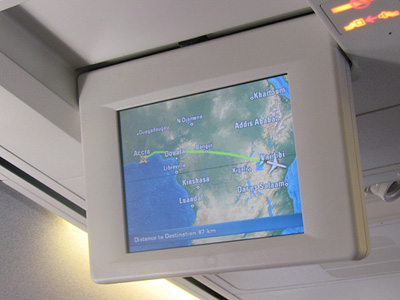
Arriving so late in Kenya we had to high-tail it out of Nairobi to make it to the Mara by nightfall. I didn’t realize why this was such an issue, until shortly after entering the Rift Valley and saying goodbye to any semblance of paved roads. Our driver/guide would have been maniacal in any vehicle, but the one we were in was particularly death-trappy. The speedometer did not work and yet every single warning light on the dash was a constant glowing red. I suspect the speedometer had been disconnected to get around a governor that the minivan supposedly had installed by the tourist commission.
Kenyans jocularly refer to the bumps of riding on pothole-ridden dirt at breakneck speed as “an African massage”. Which was funny for, perhaps, 100 yards. And then night came and the animals with it. It was exciting to see a herd of zebra in the middle of the road. Exciting for a second before realizing that my first experience with a wild animal might involve it coming through the windshield in a bloody heap. We actually rear-ended a wildebeest at one point.
Ah, but it was all worth it. The safari itself was a relatively last-minute, budget affair after our official assignment. Yet we were right in the middle of what’s known as the Great Migration when millions of animals (and their predators) move from the savanna of the Masai Mara in Kenya to the Serengeti in Tanzania.
You see so many animals in such a natural state in such a small amount of time that you start to think it normal, say, to have a group of monkeys invade your tent and steal your food. (Which they did, the little bastards.) But then you realize it is normal. Humans are just used to zoos, and National Geographic, and urban life (mostly) devoid of wild game.
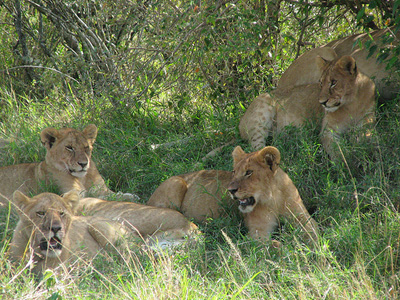
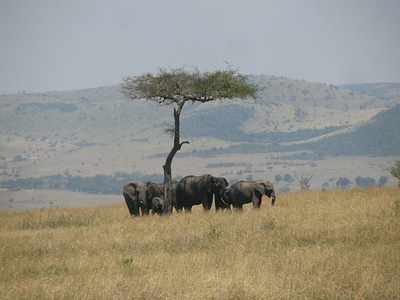
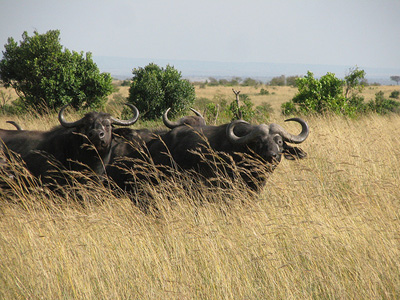
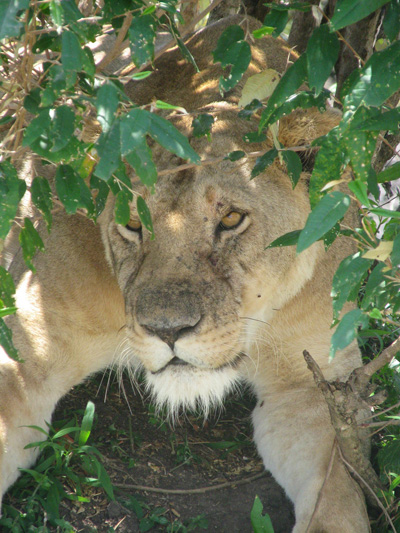
We saw zebra, impala, baboons, huge rabbits, bat-eared fox, grasscutters, wildebeest, Topi antelope, elephants, giraffe, vultures, hyland cattle, African buffalo, the rare black rhino, the secretary bird, vervet monkeys, Thompson’s gazelles, warthogs, ostriches, lions, hippos, mongooses, hyena, Marabou stork, eagles, guinea fowl, and one very elusive leopard.
Here are some glimpses from the full set of photos and video.


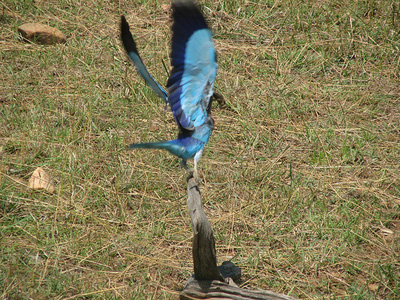
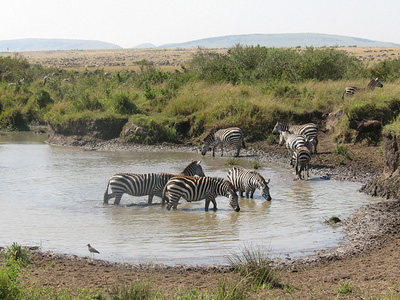
And now, the payoff. “Hello” in Swahili, the main language spoken in Kenya, is “Jambo!” which is a hell of a lot of fun to say. And it’s even more fun to say when you realize that it is what Lionel Richie was actually saying while rocking out during All Night Long. I can’t seem to find a translation of the full line (in this post’s title) so in the meanwhile, do yourself a favor and watch the video.