
Intolerable calamities
Walked through one of the four cemeteries in my neighborhood today. Among many heroes of the American Revolutionary War interred here is Reverend Moses Mather. He served as a Patriot in the war, but is most remembered for being snatched out of his church mid-sermon by the British and imprisoned on Long Island for many months before his release in a prisoner exchange. The headstone reads “Death is a debt to nature due which I have paid, and so must you.”
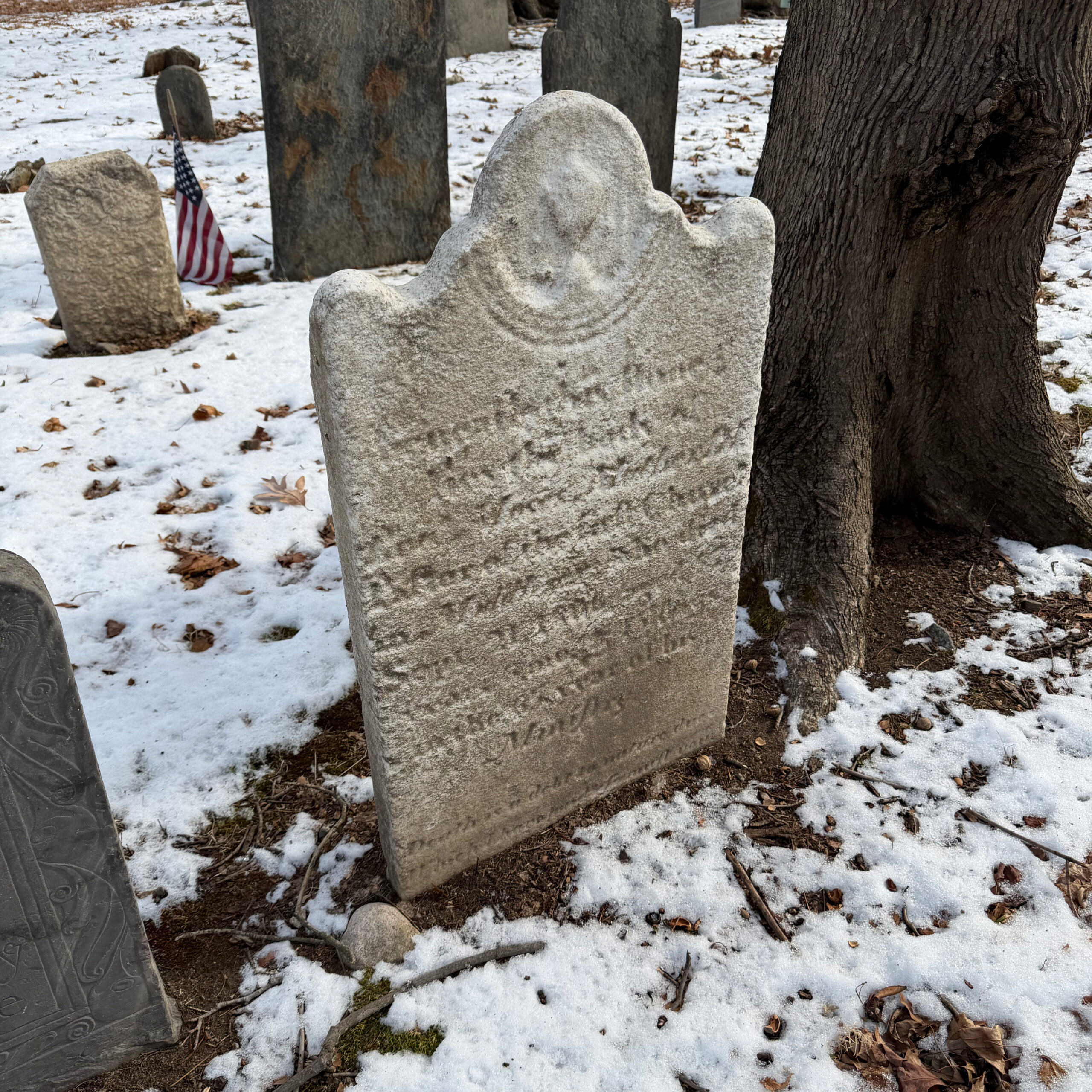
Here’s a section that caught my eye from his essay America’s appeal to the impartial world:
These unheard of intolerable calamities, spring not of the dust, come not causeless, nor will they end fruitless. They call on the Americans for repentance towards their maker, and vengeance on their adversaries. And can it be a crime to resist? Is it not a duty we owe to our maker, to our country, to ourselves and to posterity? Does not the principle of self-preservation, which is implanted by the author of nature in the human breast, (to operate instantaneous as the lightning, resistless as the shafts of war, to ward off impending danger) urge us to the conflict; add wings to our feet, firmness and unanimity to our hearts, impenetrability to our battalions, and under the influence of its mighty author, will it not render successful and glorious American arms?
It was not a crime to resist in 1775. It is not a crime to resist now.

Are you smarter than a student in 1924?
My wife and I owned a home at 60 Park Circle in Atlanta for a grand total of 14 months in the late 90’s. It was an eighty-year-old, single story affair that was actually on the National Register for Historic Places, though we never exactly figured out why.

The house had a partial basement and an extremely creepy, dank, dirt-floored crawlspace. I slithered into this space almost as soon as we took ownership. Towards the back was an old trunk. When I pried the trunk open it was sorta like when Belloq opened the Ark in Raiders with the hiss and the smoke seeping out. Except my face did not melt off.
The top of the trunk was composed of several strata of yellowed newspaper clippings, mostly about the 1924 presidential election. “Keep Cool with Coolidge!”
But the majority of the trunk was full of books, the text books of one W. A. (William) Strange, student at Emory University, resident of 306 Winship Hall.
I didn’t do anything with the books at the time. When we moved to Chicago I just loaded the trunk into the moving van. Well, two moves and nine years later I’ve delved back in.
There are 19 books in all, hardcover, musty, but in remarkably good shape. A snapshot of Mr. Strange’s courseload via the titles shows Spanish, Accounting, Psychology, Biology, Chemistry, Latin, and American History. The scribbled marginalia in the books is almost completely homework-related. Alas, there’s no musing on flappers, Prohibition, Rhapsody in Blue, the founding of IBM, the Beer Hall Putsch, the Geneva Protocol, or the first Macy’s Thanksgiving Day parade.
But the history book did contain a sheet of looseleaf paper, a quiz which earned Mr. Strange a C. (He only got three wrong answers, but such was the grading.) It is an interesting little document, not at all what you’d except to find in an American History class nowadays. Of course it’s only a sliver of a presumably much wider syllabus, but the questions seem decidedly regional. The phrasing of many of the questions makes it abundantly clear that there’s no such thing as a completely neutral view of history.
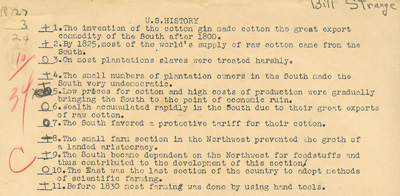
So, what happened to you Mr. Strange? And how did your books end up in that crawlspace?
Angioplastic diplomacy
Last week I hosted a small delegation from the Palace Museum in Chicago as we head into the final stretch before launching The Forbidden City: Beyond Space and Time project.
We planned a working lunch and had asked the Chinese team what they would be interested in eating. They emphatically requested traditional American fare, specifically Chicago grub. After a little hesitation, we went for it calling on the services of Portillo’s and Giordano’s.
And so, in a scene not so different from me inspecting foreign delicacies at the Night Market in Beijing the Palace Museum team cautiously approached the layout of Italian beef sandwiches, cheeseburgers, hot dogs, pizza and cheesecake.
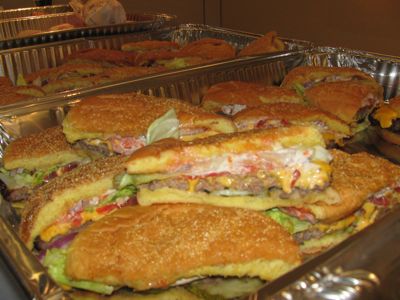
I’m not sure the team enjoyed it, frankly. That much fast food heaped together was a bit nauseating to behold, even for me. Though the room-wide indigestion of the post-lunch meetings did have the salutary effect of not letting anyone drift off to sleep.
Transcultural and trans-fatty.
Iraqi on the corner
Yesterday I hosted some Chinese partners from the Forbidden City in Beijing. They missed the Tibet protest march by one day which surely spared me some awkward questions, but we could not escape the Iraq war anniversary march. As the protesters filed past our restaurant window last night, the translator asked me “Why doesn’t your government stop it?” Which, you will admit, I could plausibly have taken to mean “the protest” given the inability to do such a thing in China — but she meant the war itself. I had to chuckle at the simultaneous complexity and simplicity of that question.
I tried to explain America post-9/11. I tried to explain the difference between urban centers and middle America. I tried to explain my personal beliefs. I did none of these well at all.
Later that night, after I had bid the Chinese 再见, I stopped at our corner store. The owner there is an Iraqi fellow named Amir. He knows my family and we know him. He’s the genial, Jacobsian neighborhood shopkeeper. The kind of guy who always rounds down the amount at the register.
But last night he was irate. He pointed to the television that’s always on, loudly, to an Iraqi satellite station. The coverage was all about an Iraqi cleric who had been murdered, the archbishop of the Chaldean Catholic church, the biggest Christian Iraqi community. Amir is Christian too. He said “They killed him. They are evil.” I asked who “they” was and he spewed “Muslims”. “There are no good Muslims,” he said.
I shook my head and said that there are plenty of good Muslims and quite a few who would agree with his outrage at the murder. But he would have none of it. He told me I only thought that because I knew American Muslims who have moderated their views in public. But he assured me that they too were evil, deep down. I started to explain that in fact most of the Muslims I know are devout and live in Cairo, but I could not get a word in. He was on the verge of tears. I told him I would prefer not to argue, shook his hand, and left.
I was troubled by it all, on this fifth anniversary of invading a country on a weapons-hunt. So I e-mailed an Iraqi colleague of mine, who also happens to be Christian, for her perspective.
Sad to say that even growing up under Saddam Hussein’s regime, I never felt any of this animosity. We were all in the same deep shit, Christians and Muslims alike, both being equal victims of a cruel regime. But at least we were free to practice our religion without any threats or dangers from Muslims. I wish I could say the same today.
There are moderate, loving, peaceful Muslims, but unfortunately their numbers are dwindling and their voices shrinking. What bugged me about the archbishop’s killing is the hypocrisy: can you imagine for a second how the Muslim community would’ve reacted if a senior religious figure was kidnapped by Christians and found dead? So while I don’t agree with Amir’s feelings, I kind of understand why he feels like that. A dangerous catch-22.
It’s all upsetting but maybe the more so because the cleaving of national identity along religious lines is not unique to Iraq. You see it here too.
The media and blogosphere of course is alight with commentary on five years of occupation. Lots of acrimony and analysis. But I return to the thought that there must be many people like Amir on both sides, full of hate, deeply sad, and not giving a damn about the cartographic assemblage known as Iraq.
Laboratory Conditions
The past spring I went on a field trip to scout vintage hardware for a film project with Steve Delahoyde of Coudal Partners. We ended up in Los Alamos, New Mexico. We ended up making a slightly different film.
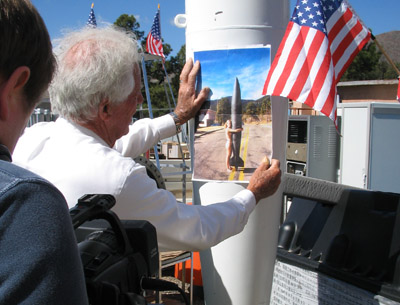
Presented in five parts, one per day this week. Start here.
(Wow, glad that came along. The image of the impaled turkey was making me ill.)
Kleptomerican
Recently someone stole the American flag we’ve had flying outside our home for years. My wife and I each thought the other had taken it down because of high winds. Only later did we realize it had been snatched. The house doesn’t look right without it.
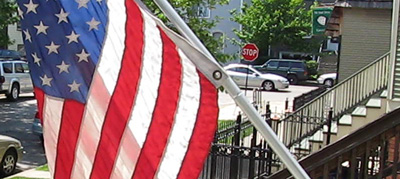
My wife is upset because it means some ill-intentioned stranger came up off the street and onto our porch. At night. With the kids sleeping just above. Meanwhile I’m pondering motivation. Does this mean the thief is aggressively pro-American or anti-American? You could make either argument. Of course, the real answer is likely that the burglar was aggressively drunk.
Guess I’ll have to booby trap the next flag. Maybe use the exploding ink packs that banks put in their money stashes. Yeah, I like that. I bet Colbert would too.
The National Museum of African American History and Culture
It doesn’t have a building and it doesn’t have a collection*, but today the newest museum in the Smithsonian family is open to the public on the web. The National Museum of African American History and Culture’s Museum on the Web is the first cultural institution that I know of to fully embrace the bottom-up contributions of web-users in an effort to populate itself with stories, photos, and media, oral-history style.

This functionality, called the Memory Book, permits site visitors to compose and upload their own “memories” about anything having to do with the African American experience. The posts can be tagged and are plopped into a visualized web of topics and other memories, forming what is hoped over time will become a rich, dense tapestry of interconnected stories. The Memory Book also contains the bulk of the museum’s material on the major figures and events in African American history. You can for instance, tag your memory “civil rights” and see it enmeshed in the same web of relations of the major figures relating to the movement.
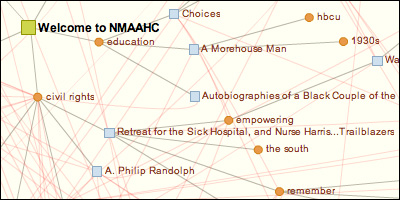
There is some great stuff in there. Here’s a taste of one of the entries called Negro Girl Changes the Color of Classrooms:
I was four years old. The youngest of seven children. I could not read. But I could watch TV. Seeing my big sister on TV made me know she was either a movie star or she was in BIG trouble. Years later, I learned it was a little of both.
Hooray intangible culture and compelling storytelling. And double hooray for the museum’s small staff for truly embracing the concept of a museum for the people, by the people.
This is the latest project by IBM in the cultural space, my first major launch for an institution in the United States. (And my first project built on Ruby on Rails.) I’m proud of the accomplishment and exceptionally so of my team.
The Washington Post has a short story on the Museum on the Web.
UPDATE: a bit of local flavor in the Chicago Tribune and the official write-up at IBM.
[*] But it does have a spot on the Washington Mall, the last slot on the north side just east of the Washington Monument.
Mission Elapsed Time: 20:00:21:06:42:40

I went back through it this blog (and my Flickr account) on its 20th anniversary, retracing digital footprints made on what feels like a different planet. Here are some highlights.
The Terror Tourist
Explorations of place in horror fiction — real or imagined, geographical or psychological — culled from my time on The Heavy Leather Horror Show 2023-2026.
Subscribe to the podcast or the email newsletter or just read through the archives posted here.
The Ampcamper

How I hauled myself, two teens, an 80 lb dog, and a whole load of crap 4000+ miles across six states in twenty days using an electric vehicle. And survived to tell the tale.


