
Culinary turntablism
Does anyone remember the scene in The Golden Child — maybe I should first ask, does anyone remember the movie The Golden Child? From 1986, with Eddie Murphy? Not one of his best. There’s this scene where he enters a Nepalese temple and encounters a ceremonial pillar that rotates around its vertical axis. Not knowing what to do, he scrubs it like a turntable DJ, making a scratching noise. Laughter ensues.
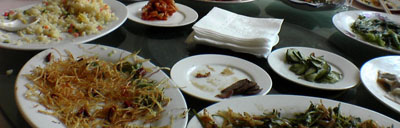
I think of that scene when I eat out in China because of the mechanism known as the zhuan pan at the center of the table. Known in the west as a lazy susan, this rotating platter is a fixture at traditional tables in China. It is both an efficient delivery mechanism and a wonderful social lubricant. Everything is communal and by definition participatory as the platter rotates forth and back. You just reach in with your chopsticks as a dish you like comes by. If you can get beyond the sanitary issues of this particular disease vector it becomes clear that the zhuan pan is a marvelous thing.
There’s something musical about the whole process. The zhuan pan is a DJ turntable set up.
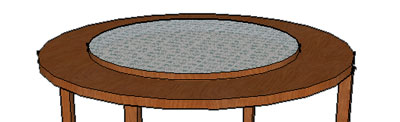
Consider it this way. The dishes are notes/chords/samples — discrete musical units of some kind. They appear at a point in time on the platter and rotate more or less consistently until they are removed or moved (more on this in a moment). So you have discrete units repeating in time from the perspective of a fixed point which in this case is me, the eater, but metaphorically is the armature of the phonograph. Units are added in time, layered in so to speak, and repeat at the same interval. Dishes leave the table periodically — their particular musical loops end. But the dishes return, smaller this time (the waitstaff transfers uneaten portions to smaller plates to make more room on the table) and they are placed closer in to the center of the rotating platter, allowing people easier access to the newer, fuller dishes at the periphery. In other words, the loops return in a changed state and with new, quicker intervals (rotating more quickly since their radial distances are now shorter). The zhuan pan rotates backwards too, but only quickly, a “scrub” if you will, to let someone grab a morsel that made its way by too quickly. The overall motion is forward.
Data visualization geek that I am I started considering the possibilities — which of course weren’t visual at all but more like data sonification (a field to be sure but not one much popularized). What would this meal sound like if the zhuan pan were a recording?

So I recorded each dish as a separate track in GarageBand. Each measure corresponded to one minute of the meal starting with the arrival of tea, which is the downbeat bass drum that remains constant throughout, the engine of the entire affair. Each new dish comes in more or less as I recorded it on a timeline in my notebook during the meal. (My hosts graciously obliged my notetaking as the curiosity of a unaccustomed Westerner.) Some dishes are single notes, some are short phrases, and at least one, the fish “flower,” is a constant note modulating in time with the rotation of the table. Each unit repeats with a period of five minutes. This is an average based on the number of revolutions of the table, but it is almost exact for at least the first two rotations of the 50 minute-long meal. With the exception of the tea-beat, volumes fade out for each track based on the consumption of the dishes. As noted above, the period of at least one dish, West Lake soup (represented by the piano), speeds up midway through the meal as it was transferred to a smaller plate and move closer to the center of the table, rotating faster. The two vinyl scratches correspond to an extended counter-rotation of the table. At 60 BPM one second correponds to roughly one minute of elapsed meal time. I think the time signature is 5/4, but I’m rusty on my Brubeck so who knows.
It is not what I’d call a chart-topper, but it isn’t cacophonous, though at quicker BPM’s it does get a bit muddy. I clearly could have done more. Instrumentation could be made to correspond more closely to the food type. (But what does “silver agaric” sound like?) Discord could be used to suggest tastes I did not care for. But the general idea is clear. Maybe on the next trip I can videotape the whole thing for the time-lapse music video this cries out to be.

In China you often encounter a circular jade plate known as a bi. It is ancient in origin and its purpose is not completely understood. The bi is flat and usually has a circular hole at the center. Movable type, gunpowder, paper. The recordable disc?
Invaders of Basilicata
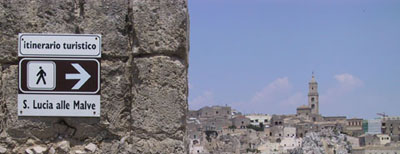
You kinda knew this was coming. Tourists are finally discovering Basilicata, the last untrammelled region of Italy. I’ve written a few times about why I think this part of Italy is so wonderful and it is true that a part of what makes it wonderful is that you just don’t encounter many tourists. Yet, the world needs to discover Basilicata and, apparently, it is.
A few signs that Basilicata is breaking out:
The May 2006 “Europe” issue of Travel and Leisure Magazine has a long piece on “Italy’s Secret City,” Matera, one of the provincial centers of gravity of Basilicata and one of the oldest continuously-inhabited cities in Europe. The online version of Travel and Leisure proclaims it more bluntly: Italy’s last, secret corner: Basilicata.
The April 2006 edition of Gourmet Magazine asks on the cover “Have You Been To Basilicata?” and delivers a full food-centric tour of the region. (The article is not online, but two of its recipes are.)
In the last few years at least two book-length travelogues have been written about Italy’s instep: Seasons in Basilicata and Under the Southern Sun.
My posts on Basilicata seem to have caught the attention of at least one of the members of Basilicata’s regional government. Recently he sent me a boxload of material relating to external promotion. Guides to wines and olive oils of the region, a CD of music to eat by (not kidding) by a classical composer from Basilicata, multimedia, maps, storybooks, cookbooks, catalogues of arts and crafts. These materials are all new. The regional government seems to be making a big tourism push. They have an advantage too in that a large percentage of foreigners with Italian heritage had ancestors from Basilicata. (The story of why — the destitution of the area in the 19th and 20th centuries — is a subject for another post.) Called the Lucani nel mondo, or Basilicatans of the world, these “expatriates” are a prime target for the new tourist marketing.
So, Basilicata is starting to shake the stereotype of bumpkin backwardness and desolation. This may mean that it will no longer serve as the backdrop of choice for religious moviemakers, but such is life. Basilicata and the south of Italy have for centuries been the Mediterranean waystation for marauding hordes and conquerors (a fact which gives it a greater diversity of cultural influences that regions to the north), so it is only fitting that they are now welcoming a different set of hordes — this time on their own terms.
8 days (crammed into less than) a week
That’s pretty much how I feel as I recuperate from an exhausting four days in Beijing.
This was the first trip to China where I truly experienced Wikipedia withdrawal. You really don’t know what you’ve got until it is blacklisted by a state government. I worry about the larger implications of this.
I always chuckle at the Chinese entry document when you are asked to check the box corresponding to your intention: Business, Conference, Official, Other (huh?), etc. There’s a box that says Settle Down. I’m tempted to check it. What does that mean? Give me your poor, your tired, your crazed Westerners looking to just settle down? I imagine the schoolmarm at passport control looking at me stoically and saying “You just need to relax, hmmm?”
I’ve realized now, after my seventh trip to the Far East, that the timeshift is truly diabolical. I suppose it is my own fault. When working in Europe and the Middle East you basically have an elongated work day. Do your thing there, return to the hotel, log on, work with your colleagues back home for a few hours at the start of their work day. In China, it is like this but with about a five hour gap between the end of the Chinese work day and waking Americans. After a few days of this the only reasonable thing to do is sleep during this period. Which completely destroys any hope of a sustainable schedule. The day becomes split: awake 6am-6pm, sleep 6pm-10pm, awake 10pm – 2am, sleep, etc. Awful. Maybe I should just treat it like a vacation from work back home.
That said, I can’t complain. Working at the Forbidden City is a special treat. IT geeks are almost always housed in basements, dungeons, or worse — and when I work there I am in a temporary trailer — but how bad can it be when you step out to this?
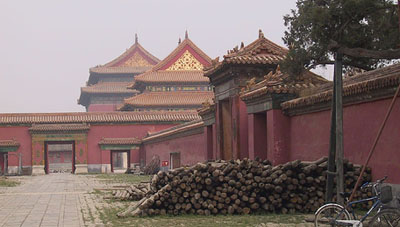
The Forbidden City is surrounded by a wide moat on all four sides. It is stagnant and forboding, as a defensive moat should be, I suppose. Yet, there are always a few dozen people fishing in it. I’ve never seen anyone pull anything living out of it, but from the size of the poles they use (without reels) I am pretty sure they are angling for some sort of slithering leviathan the size of a bus.
Our colleagues at the Forbidden City again hosted a ping pong tournament. I should have learned from the first drubbing last year. I think I lost 11-7, 11-8 which sounds way closer than it was. Yes, my opponent held his paddle upside-down, yes he stood way the hell back and played many of my shots after the ball had dropped below the plane of the table on his side, but what really threw me off was his serving ritual. He’d pet the table up by the net, move back, bounce the ball slowly on his paddle held parallel to the table, tuck it all back in close to his body (so I could not see it clearly), then whip out a serve that never went where I thought it would. If I managed to return it the shot was so lame that I was shortly searching for the ball ricocheting between server cabinets way behind me. Still, it was good fun and I really love that Chinese television always has professional ping pong coverage on. Taunting, yelling, sweating, injuries — the way ping pong should be.
Regeneration
In The Future of the Past, Alexander Stille expands on a comment by Italian conservator Michele Cordaro:
“The Chinese, like the Japanese and some other Asian nations, have a tradition of conserving by copying, or rebuilding.”
Conserving by rebuilding made considerable sense in China, where, until recently, virtually everything — palaces, temples, and houses — was built of wood. Paradoxically, in architecture, working in perishable materals could potentially offer a superior conversation strategy: rotting wooden parts could simply be replaced as needed so that, just as our bodies replace their old cells with new ones while we remain “ourselves,” the buildings would be constantly regenerated, remaining forever new and forever ancient.
Seems logical, but in practice Western conservation is based on a philosophy of repair rather than replacement. This stems from the West’s long privileging of permanence and originality in art (even when what we praise isn’t in fact permanent or exceptionally original). Copies are considered at best qualitatively lesser; at worst, acts of piracy.
These conflicting attitudes toward monuments are related to profound cultural differences. China and Japan have traditionally had a cyclical view of time. Dynasties would rise and fall, be replaced by new ones, but, like the Forbidden City, reemerging from its latest fire, remain fundamentally the same: each ruling group held the “mandate of heaven” …. In a world that was both eternal and ever-changing, rebuilding monuments made perfect sense.
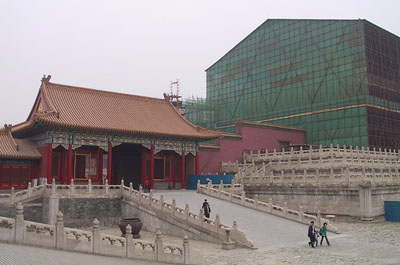
This past week I had the good fortune to be invited on a tour of the renovation of the roof of the Hall of Supreme Harmony at the Forbidden City in Beijing. This is the most important of the hundreds of buildings at the Forbidden City, now known also as the Palace Museum. The whole museum is being upgraded (as is all of Beijing, for that matter), but the work is most intense at the Hall of Supreme Harmony where a giant scaffolding and tent covers the swarm of workers who are in the process of removing the thousands of decaying terracotta tiles to get at the wooden infrastructure of the roof. The tiles are being meticulously removed and remade. The roof itself is imperceptibly sagging and this will be repaired too. The intricately painted outer beams will be repainted, resulting in stunning before and after comparisons. (Full photoset tour at Flickr.)
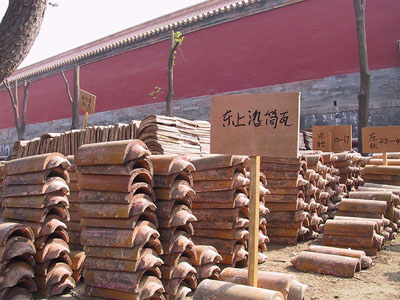
This is a less extreme version of wholesale rebuilding of cultural sites that Stille details in his study of Chinese conservation, but it is an example nonetheless. Only a specialist could point to what is original to the hall’s 1406 construction and what parts are copies installed since. This happens in the West too, of course, but the difference as I’ve experienced it in China is that it doesn’t matter. The originality of the building is the idea of it, what it represents.
The Palace Museum has a partnership with the Japanese printing company Toppan to create a detailed, high-resolution virtual replica of the Forbidden City. Right now only three of the main halls, including Supreme Harmony, are complete. The effect of moving about the virtual grounds in the wrapround-style theater is powerful, though in the people-free virtual model the awe created by the buildings’ scale is missing. There’s little aura to the simulacrum. The model will improve, of course, as the technologies of virtuality improve.
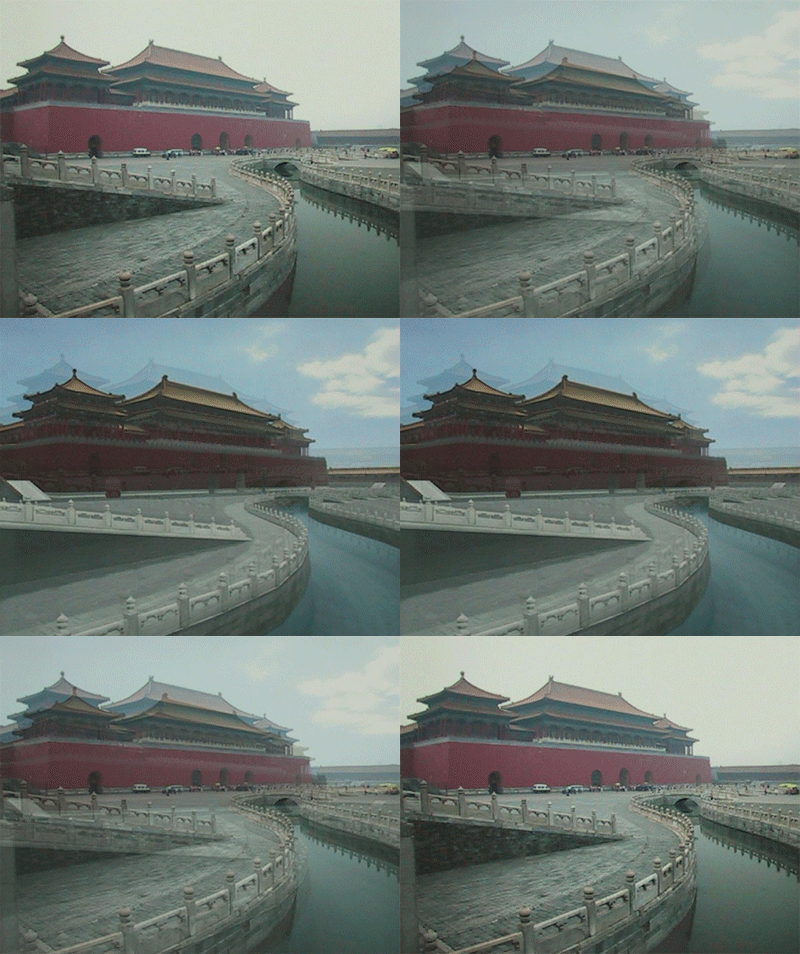
Comparison of a photograph and a still from the virtual model
No one claims that the model is the Forbidden City, but then you don’t get the usual quasi-apologies about its not being the “real” thing either. Most 3D modelling in cultural heritage is done for a specific purpose — reconstruction of what has been lost, for instance — and is treated as a teaching tool or a research resource. Not so at the Palace Museum. It will be interesting to see how this copy evolves.
What a smile ’round my face
Yikes, it has been a silent week ’round these parts. My travels in China have been crushing: a full work day on Beijing time plus 75% of a work day on US time. While this makes for a lot of time in front of the computer it does not produce much of a clear head for blogging. And this is why I am writing now from my flight 35,000 feet above the Pacific. This is my first flight with WiFi broadband and I just need to geek out a bit and say this changes everything. Time was, international flights were like day-long technology isolation chambers, but now that I have a connection (and a pretty fast one at that — 802.11g) it gets all screwy. I’m adapting my already nutty sleep schedule to Chicago time so that I can Skype with my wife. And the beauty of that, of course, is that we just leave it on the entire flight. She hears me; I hear all the goings-on at home. — for 10 hours. Just like ignoring each other at our own computers when we are under the same roof. Seriously though. This changes so much. I’ve watched streaming video, listened to iTunes radio, videoconferenced with a pal, Skyped my wife, and obviously e-mailed and surfed. Am I overdoing it this time? Absolutely. Will this go down as the best thing to happen to me before my baby arrives in a few weeks. Absolutely.
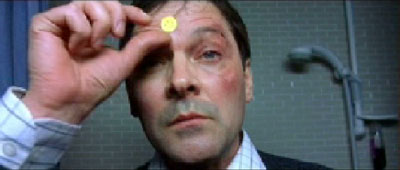
International travel alone is rough, but for some reason Four Tet’s “Smile Round the Face” cheers me up every time I watch it. It took me a few viewings to realize what seems so obvious: being a daddy is it’s own reward. Thanks, Kieran, for the cheer.
More China double happiness soon …
Story witch doctor
Recently I’ve been working with a really smart researcher in computational linguistics and, as is happening with increasing frequency with my colleagues, he happened upon my blog. The Icelandic connection with my last name (Tolva = “number witch doctor” = computer) was particularly interesting to him. He writes:
You’re right about the aversion to foreign words in Icelandic. I observed that there. The Icelandic “tala” for “number” appears to be related to the words “tal” in Danish and “Zahl” in German for “number”. “Tala” may also be related to “tell” and “tale” in English, because these English words go back to an Indoeuropean word “del” that means “count” or “recount”. There seems to be a semantic etymological connection between telling (a story) and counting. German “zählen” means “count”, and “erzählen” means “tell”. Danish “tælle” is “count”, and “tale” is “speak”. In English we can “recount” a story or give an “account” of some event(s). Maybe the semantic connection is that as you’re telling a story, you’re counting off the events?
So not only is my surname the made-up word for computer, but it has etymological connections to storytelling. Computers and narrative. Counting and recounting. It’s all so clear to me now. I suppose I am doing what I was destined to do.
(Of course, I’m not Icelandic at all.)
Chinese Labor Day
You know that scene in Father of the Bride II where Steve Martin has the route to the hospital intricately plotted out in the event that his daughter (or was it wife) goes into labor? I laughed when I first saw that, pre-kids. Now it makes me laugh for a different reason, since that kind of detailed plan is bound to go awry. You’re almost asking for it to, taunting the due date gods to throw you a curveball. Short of scheduling an induction — and even that can be unpredictable — there’s really no way of knowing what is going to happen or, more specifically, when it will happen.
Which is why there’s palpable concern in my house over my departure today for China. With flights leaving for the US only during a certain window of time and the jaunt taking somewhere in the neighborhood of 14 hours, there’s almost no conceivable way I could make it back if my wife suddenly went into labor. Sure, this is highly unlikely. She’s neither dilated nor effaced. But then, our second son was three weeks early — and week 37 begins precisely as I am arriving home. So does the Chinese May Day week-long holiday.
Let’s hope China’s celebration of labor and mine happen half a world apart.
Over spilt milk
My almost-five-year-old son passed a real milestone this week. It wasn’t what you’d consider a typical development milestone. He laughed at himself. That’s all. But not at a stupid joke he told or at an act of preschooler physical comedy. He accidentally tripped over my feet with a full glass of milk and spilled it all over the floor, me, and himself. One look at him sodden with milk made me break out laughing. Usually this sort of thing makes him deeply embarrassed and he usually cries. But this time, despite a touch-and-go moment of upper lip quavering, he actually burst out laughing too. Laughing at himself, at his act. This is huge, I think. Being able to laugh at yourself is critical to self-awareness and coping with life.
Hell, if I couldn’t laugh at my own idiocy half my life would be spent weeping.
Corporate lingo watch
Ever since I first heard someone ask to “take this conversation offline” I’ve had a biochemical aversion to corporate parlance, especially when technical terms are used unironically to describe non-technical things. Today’s morsel went something like this:
“Thanks, Bob, I really like those ideas. One that I’d particularly like to double-click on was …”
Shouldn’t it be “click”? I mean, isn’t the implication here that this is an idea that should be followed, like one follows a link? Or is he double-clicking it to run it like an application? Start it up?
You know, if you’re going to lace discussions with technical metaphors that are already a minefield of business-specific terms you could at least strive not to sound like you’ve just discovered the mouse and GUI. Oooh, the pretty icons make my copy of WordPerfect come alive!
Two bitter posts in a row. Feels good.
Let’s hear it for the [child of unknown gender]
As my wife begins week 35 of her pregnancy with child #3 I have almost perfected the ability to guess the age and/or social upbringing of any person (typically a woman) who says “Oh, you have two boys? You must be trying for a girl.”
Trying for a girl? How about hoping not to have a child with Down’s Syndrome? Or hoping not to deliver a baby with the cord wrapped around its neck? How about getting a clue, people? I know that parents sometimes decide to have another child simply because they want a certain gender, but this is perverse. Unless you’re centrifuging semen, that’s a recipe for disappointment half the time.
Yet, you see this attitude in older people all the time. Have a girl? Oh, you must be trying for a boy. And it is of course worse when you’re having a third child. As if no one in their right minds would attempt three without striving for a specific gender. I really don’t get it. Oh and I am so looking forward to calling people (including family) from the hospital to announce our new son and receiving a dramatic pause and limp “Oh, wonderful. Will you try for a girl next time?”