
How to create a LEGO mosaic
UPDATE: the kids have created a business based on this idea. If you’re interested in having a mosaic made from your photo, please visit www.thebrickbrothers.com.
When my oldest son was born in 2001 LEGO offered a cool online “Brick-o-lizer” that would take an uploaded photo and turn it into a five-tone grayscale grid of 1×1 bricks from which you could create a wall-hanging mosaic. LEGO would send you the exact right amount of bricks in bulk. Putting it together was as easy as paint-by-numbers. I did this for him and for his little brother in 2003.
My daughter was born a few weeks ago and so naturally I went back to the Brick-o-lizer to create her mosaic. Imagine my horror to find out that it isn’t available anymore. How could I deprive my baby girl of her LEGO mosaic? Well. Obviously. I couldn’t.
So, here follows instructions for doing it manually in Photoshop. (But before we begin, let’s be sure to acknowledge the unbelievably talented people who create LEGO mosaics in full color without a grid at all. I bow to your supremacy.)
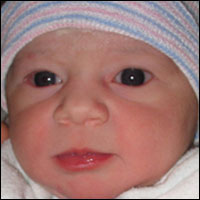
First, prep your shot as a square. For portraits, tight in is best. People will naturally view your mosaic from a distance or squinting to maximize contrast so details external to the person in the portrait will be lost (and a benefit-free pain in the ass to snap into the LEGO grid for you).


Change the photo to Indexed Color, select a Custom palette, and choose six shades of gray. The easiest way is to click on the grid and then when the color palette comes up choose Web colors only. Select white, black, and then a light, medium, and dark gray.

In Preferences > Guides, Grids, & Slices set the Grid to a prominent color, gridline every 10 pixels, and subdivisions 1. Turn on a grid with View > Show > Grid.
You’ll need to do some manual computation. The grid is 44 x 44 which is 1,936 bricks. Eyeball or, if you prefer, count as many of each of the five colors you will need.
You’ll then need to go to the LEGO shop and order the bricks.
You’ll need one X-Large Gray Baseplate , one set of 2×4 Roof Tiles Steep Sloped Black, one set of Black Roof Tiles 25° (2×2, 2×4, Corner), and then as many 1×1 Studs in White, Light Grey, Medium Grey, Dark Grey, and Black as you need.
Once it all arrives, use your gridded Photoshop image or print it out and enjoy a few hours of mind-numbing bricklaying.
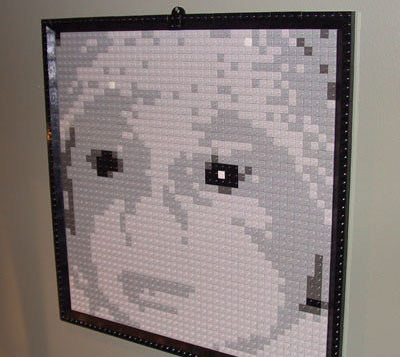
Back in the saddle
And I’m already sore. Thanks to everyone who wrote with congrats on the newest little bundle. Charlotte and Mama are doing wonderfully. Her brothers regard her with love, curiosity, but mostly indifference. I mean, she’s not exactly stealing their toys yet — or even awake much — so she’s been deemed low-threat.
The other new delivery is one that plugs in. I’ve been playing around with a 17″ MacBook Pro for a few weeks now. It is a superb machine. Running a G5 at home and having moved most of my critical applications (mail, calendar, to do lists, etc) to online/synch services allowed for a pretty smooth transition. Still, working for IBM on a Mac can be a challenge. Though there are some great resources internally for doing so (and a healthy IBM Linux community that will help you run Anything But MS) some things still require Windows. Which is why running XP in Parallels virtual machine is such a blessing.
Some thoughts.
- There is no solution for in-flight (or in-car) powering of the MacBook Pro. This isn’t a problem unique to Apple but rather to newer laptops that run at 85W. Airplane power connectors shut off when anything tries to draw more than 75W. Inverters seem not to work. Since airlines are likely not to retrofit their fleets, what’s needed is a way to reduce the wattage pull via software on the machine. This is a serious problem for international travel.
- As yet there are virtually no cards available for the Express/34 slot. Obviously PC cards don’t work (which limits the usefulness of running XP a bit), but the real problem is the lack of cellular wireless cards, 2.5G or 3G. Also a big issue for a frequent traveller.
- Right-click. I use it, I need it, I quite love it. Yes, you can plop two fingers on the trackpad and click for a right-click, but that’s cumbersome. All Apple would have to do is elegantly split the long mouse button. But I doubt that’ll happen.
- The trackpad is nice, sure. But I miss the keyboard trackpoint. It is easier to use on cramped airplanes and it allows you never to remove your fingers from typing orientation. Sigh.
- No dedicated reverse (which is to say forward) delete button. You can do this with Fn-Delete, but I never realized how much I delete going forward until now.
- There’s no IBM VPN client for Intel-based Macs, yet. The company that makes the IBM VPN for PPC Macs is working on it, but right now this means I have to proxy all IBM-bound networking through Parallels and the XP VPN client. A cool solution, but let’s face it: a pain in the ass.
Most of these are travel-related gripes, which begs the question. With three kids at home now, maybe I shouldn’t be travelling so damn much?
Such great heights
OK, so, we didn’t expect that to happen.
Today Planet Earth and two flabbergasted parents welcomed Charlotte Mae Tolva, a beautiful, healthy 7lb. baby girl. Robyn and I are still in a bit of shock. We felt nearly certain that this baby was a boy and that he’d join his brothers in a lifetime of mayhem and dastardliness. But no. Baby Charlotte skipped our anniversary last week in favor of a different holiday. She arrived just in time for most retail shops to be closed for the Memorial Day observance and so prevented us (or rather our families) from buying anything remotely girl-like that we can bring the little darling home in. You see, we own only boy-gear (most of it threadbare) and didn’t even bring a “safety” outfit to the hospital. But maybe closed baby shops is a good thing. I fear a crazed orgy of girl-stuff purchasing from relatives and friends.
Oh, and I suspect The Darnedest Things blog category is going to start filling up rapidly once we introduce the big bad brothers to Charlotte this evening. Check back for their trenchant insights into boy-girl relations and anatomical differences.
Welcome, sweet little baby. You’re the best kind of surprise.
Decade
You may be wondering if the baby has come yet or not. The answer is no and the reason is obvious. Vito the Fetus (the in uteronym) is waiting to come later today. In fact, it is waiting just long enough for us to shove the kids off to their grandparents for the long weekend and to settle down to celebrate our 10th wedding anniversary in some semblance of peace. Yes, today marks one decade since my girlfriend Robyn had the striking lapse in reason of saying “I do” when posed the fateful question. So now, as we wait for the birth of our child and the next “happiest day of our lives” I’m reminded of that first happiest day ten years ago. I thought I knew then how lucky I was, but of course that’s silly. Only looking back on what a special woman, amazing wife, and devoted mother Robyn has become can I even begin to compute the staggering odds against me finding someone so perfect.
For the rehearsal dinner ten years and one day ago I created a video of photos, music, and hilariously terrible on-screen graphics using two VHS decks and a 75MHz Gateway PC. We watched it again today. For one, it was way too long. I don’t know what the hell the audience was thinking while I stood up there and narrated, but each of the photos was on-screen for like 10 seconds. Interminable. Get this clown off the stage. But the really funny thing is that in the course of dubbing the tapes I screwed up somehow and spliced in a Home Shopping Network channel audio feed. This wasn’t heard at the dinner because my audio tape was separate from the video (high tech synching involved me signalling to my brother to press play on the deck across the room — I’m so ashamed), but watching it again with the HSN audio was truly surreal. Basically HSN 1996 sounds different in no way from HSN 2006. Still hawking the same crap with the same plastic enthusiasm. The dubbed video was a crazy blend (dare I say mashup) of nostalgia and hucksterism.
That last line may have seemed like an ironic comment on marriage, but no. Now if you will excuse me, we have to prepare for Vito who would like nothing more than to share a birthday with our anniversary.
Ground Zero bickering stops for a moment to Think Different
The International Freedom Center, a cultural hub designed to commemorate 9/11 by promoting America’s most important value at the site of its worst foreign attack, was shelved last year when the governor got cold feet because victims’ families wanted the entirety of Ground Zero turned into a somber memorial to the dead.
911Memorials.org, a grass-roots watchdog site that helped expel the Freedom Center, has been tracking developments at Ground Zero. Today they asked “Can a glass box save Ground Zero?” (a reference to the new Apple Store design on 5th Ave).
Well, in any event Apple opened a nifty store at GM [General Motors]. LMDC in creating the below level plaza design cited the GM building plaza. That plaza was a dreay failure. Amazing what a glass box did for improving it. A glass box would sure address a lot of problems they have now.
Um, hello? Was no one awake last year? Snøhetta’s design for the Freedom Center — now the design for the ambiguous Cultural Center and possibly for the Memorial museum itself — is exactly that. The majority of 9/11 artifacts was to be housed underground with at least one above-ground entry via the glass box that was the cultural center. How is it that the Apple design is now a unique inspiration? And isn’t Snøhetta still contracted for some construction at Ground Zero? I’d like to know what problems the glass box/mostly underground design will solve this year that it would not have solved last year?

Crosstown classless
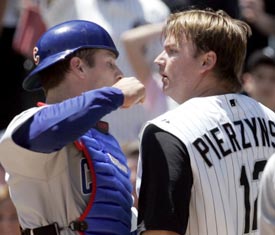
“Say there, A.J., how are ya? Congrats on the World Series and all that. I was wondering, do you wear the championship right on this finger or this finger?” Whack!
Urban scar tissue
[Update: Before you send me a nastygram about being a suburban-bound latte-swilling cretin, maybe read a little more closely. I’m a huge fan of the train and urban transportation in general. Scar tissue is a metaphor, not a value judgment.]
A little over a decade ago I helped build six single-family homes in Chicago on Melrose St. just east of Lakewood Ave. We were driving posts into the dirt for a fence on an irregular diagonal property border when we hit something solid that turned out to be a railroad tie. We later learned that the screwy lot line was the result of surface train tracks that once cut through the area, the remains of which we had dug up.
I was reminded of this today by this great satellite image of the urban tissue of San Francsico reassimilating land once used by railroad tracks. Sure enough when you scale back a bit you see the same evidence of “healing” from the area around where I worked on the homes in Chicago. Roads, parking lots, buildings, row houses and, ultimately, the front door of Wrigley Field all conform to the serpentine crawl of the former track.
[Full map.]

Most interesting is that this urban scar tissue is actually part of what you might call a festering wound: a four-block portion of the line (south of this image) is still in operation serving a single customer. The path follows the route of the old Chicago & Evanston Railroad line and the functioning spur is called the Lakewood Branch. The only thing that runs on it is the Sugarland Express, a train that delivers sugar and corn syrup to the Peerless Confection Company twice weekly. Even so, the city is trying to heal over it. When the sugar train comes through residents must move their cars off portions of the tracks that serve as parking lots most of the rest of the week.
Five-year-old philosophy
My oldest one is a deep thinker. Recently as we passed some strangers on the street he asked “What happens to people when you don’t see them anymore?” He was hovering around asking whether they ceased to exist, though he never actually said so. We explained that they kept on living their own lives and that we’d probably never see them again. This saddened him a bit, though only slightly less that it puzzled him. I think he’s only just realizing that the sum of human experience is a superset of his own. Peg him for an empirical rationalist philosopher when he grows up and for god’s sake no one mention Schrödinger’s cat.
But he’s even more obsessed with names. He simply cannot understand how there can be things that do not have names. He constantly asks about how something can exist if it doesn’t have a name. I explain that there are thousands (millions?) of species of animals, mostly small critters, that we suspect exist but have not been discovered and so have not named. Not to mention undiscovered stars, comets, planets and new concepts, future fashion trends, and dance moves. This might all be prompted by the fact that we have spent the last nine months referring to his unborn sibling without precisely naming it. It would also follow from the fact that he likes to name damn near everything, even the most mundane inanimate speck. Like Adam naming stuff in Eden, the power to name is the power to make real for my boy.
Whatever it is, I think the two obsessions here are related. For my son, reality is directly experienced and labelled. If it is not directly experienced — a story, for example — or explicitly named — a baby in utero, for example — it just isn’t real.
I’ll hold off on introducing him to Second Life for now.
Chickens
I married a Southerner. Happily. This has meant many things, all positive, including an expansion of my perspective on the American experience that I’m grateful for. But it also means that my wife has a genetic predisposition to enjoying country music. True, this has mostly faded in the years since college and since we’ve moved to Chicago. But ocassionally she needs a fix and because our music is all part of one server and played through an app that sends all songs played to a server that I excerpt on this blog you’ll sometimes see my queue tainted with twang. And normally this twang comes from The Dixie Chicks.
Now, I have no specific aversion to country music. I just don’t care for it. I went to college in Nashville where I experienced a broad range of the genre, from near-folk to “new” country and everything in between. Never cared for any of it.* But whatever. The thing is, I really respect The Dixie Chicks. You might recall that they proclaimed embarrassment being from the same state as Bush a few years ago. At the time, America was preparing for war. This didn’t sit well with the bedrock mainstream radio audience of country music. Death threats were hurled, stations were boycotted, everything you’d expect from a demographic trying their best to affirm stereotypes of gun-toting, chest-beating, and a profound confusion of the difference between loving America and loving America’s leadership. The Dixie Chicks took it in stride, apologized, kept touring to sold-out crowds and that was that.
The Dixie Chicks have a new album. Country stations by and large still cave to the vocal few who find it unpatriotic to play their music. And yet, the Dixie Chicks are one of the most frequently downloaded acts on the Internet. Mainstream radio, running scared as it is from downloadable music, streaming music, and satellite radio, needs to do everything they can not to lose more listeners, but this is really quite pathetic. They are digging their own grave by not playing what people want to hear. Truth is, most people don’t really care what the Dixie Chicks or any other band stand for. They just like the music. If stations keep listening to an extreme minority they’ll end up playing only for them and fulfilling the feared outcome of not having a market that can support their ad-based model.
Not all heavy metal is about eating babies and Satan worshipping, so why should all country music be about ramming an American flag up a terrorist’s ass? Please people. The market will bear this out. If enough people are truly upset about the Dixie Chick’s stance then they will make no money, their label will drop them, and they will cease to be viable as a commercial music act. But for now, this isn’t happening. Accept it and relish the fact that most of the places that country music listeners most fear don’t embrace that kind of freedom of speech or free-market mechanism. It is as thoroughly American as a pickup truck.
[*] OK, I will admit that I do find bluegrass somewhat interesting. When I was a DJ on our college station the slot before mine was a long-running and award-winning bluegrass show. As I queued up my records and CD’s in the second studio I came to appreciate the genre in the brief slice I got over the monitors. But just you try to make a smooth segue from banjo to Front 242. Not possible.
Names and bein’ a kid
With thanks to Baby Roadies for the idea, here are the 10 worst names for our soon-to-arrive child based on Chicago streets:
- Wacker Tolva
- Hubbard Tolva
- Elston Tolva
- Irving Park Tolva
- Lawrence Tolva
- Damen Tolva
- 31st Street Tolva
- Randolph Tolva
- Fairbanks Tolva
- Sangamon Tolva
And the 10 best:
- Superior Tolva
- Sedgewick Tolva
- Ogden Tolva
- Locust Tolva
- Balbo Tolva
- Racine Tolva
- Archer Tolva
- Bryn Mawr Tolva
- Grand Tolva
- Weed Tolva
And with thanks to Solider Ant here are 10 things that “make me feel like a bright-eyed little kid again”:
- Dunkin’ Donuts vanilla long johns
- Organizing space-theme LEGO minifigs into battalions
- Playing organ notes with the foot pedals
- The Superfriends
- Cassette tape dubbing
- Playing short-ball “tennis” on the driveway
- Choose Your Own Adventure
- The Magikist Lips
- Raiders of the Lost Ark
- Playing with my own kids