
Winter dreaming
Holy mackeral it was cold today! Not a day for Christmas shopping up and down State Street. (‘Course, when is?) I’m going to my happy place. Right. Now. Damnit.
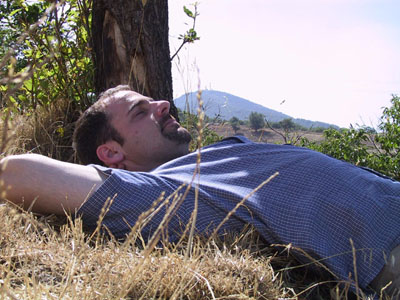
Here’s me in 2003 outside Barile, Italy, where Horace composed part of his Odes, excerpted below. In the background is the extinct (yeah, right) volcano Vulture. In the foreground is my belly filled with lovely Aglianico del Vulture wine.
In childhood’s days, on trackless Vultur,
beyond the borders of old nurse Apulia,
when I was tired with play and overcome
with sleep,
the doves of story covered me o’er with
freshly fallen leaves, to be a marvel to all who
dwell in lofty Acherontia‘s nest and Bantia‘s
glades, and the rich fields of Forentum in the dale —
how I slept safe from bears and black
serpents, how I was overspread with sacred
bay and gathered myrtle, with the gods’ help a
fearless child.
Return to New Orleans
“FEMA, the new four-letter f-word.”
This was one of the signs I encountered minutes after leaving the New Orleans airport on a brief trip to see family this past weekend.
There’s gallows humor about too though. The Times-Picayune was running a FEMA Trailer Holiday Makeover on how to spruce up your temporary domicile despite the circumstances. This of course only applies to the areas with power since you can’t get a FEMA trailer if there’s no power in your area. I was flabbergasted to see how much of New Orleans still lacks this basic utility.
In fact, I was stunned the entire time I was there. From the shockingly understaffed emergency room at East Jefferson General Hospital (another story entirely) to the three-story high mounds of wreckage piled into the medians between boulevards to the patchwork quilt of blue FEMA tarps covering rooftops from Slidell to the bayou, there was so much more still hurting in the area than I — or most of America, I’d bet — realizes. News outlets occasionally check back and there’s the sometime blip on the political radar of Katrina fallout, but for the most part I was unprepared for the degree to which New Orleans is down for the count, seemingly for quite a while.
I had composed a draft of this post before I even arrived in NOLA. I was going to put into words my feeling that Mardi Gras should go ahead full steam this year as a show of the vitality of the city. I’ve scrapped that draft, filed away for some time in the future. New Orleans is not ready. The city is non-functional. Sure the airport is open, but it is ghostly. Only a few gates and a fraction of the concessions are operational. There’s a palpable pall the moment you set foot in the terminal. Driving into the city proper is horrific. Destroyed cars have been towed to the center of I-10, a vast graveyard of corroded metal. The West End, like much of Orleans Parish, is in total ruin. Cryptic FEMA spray-painted symbols adorn every home — and all are abandoned. Doors open, high water mark stains clearly visible, entire neighborhoods are empty. Houses lean and lurch from the foundation damage. Every street intersection — where the traffic lights, if upright, are still not working — is cluttered with makeshift signage for all manner of assistance: tree-shredding, gutting, roofwork, and generic disaster relief services. Yet, basic services are unemployed. (When was the last time you saw a Jiffy Lube offering a signing bonus?) Church steeples point horizontal, straight at the ground still somehow attached, or have impaled parking lots in front of the places of worship. And the trash. By one count there is 34 years worth of rubbish to be hauled away. Junk is literally everywhere, even in the higher-ground neighborhoods relatively untouched by the water.
I arrived and took a cab to my wife’s grandmother’s house where I was to meet my family momentarily who were coming from elsewhere in the city. Entering the neighboorhod I encountered a sign that said “Looters will be shot.” I exited the cab and, without a key, poked around the house for a way into the backyard to wait. I should have known that I would look suspicious. I immediately noticed people mulling about the subdivision looking at me in an unfriendly way. Luckily my wife pulled up shortly, but I am not sure circumstances would have been different if I had loitered longer. I was not prepared for this. I imagined a city on the mend — hobbled for sure, but bound together in a kind of sturdy let’s-get-on-with-it mode. I didn’t see this at all. I’m sure it exists in places, but most of my relatives are depressed and not a few bitter. There’s racial tension in people who have never been disposed to think in those terms. And looting jokes are not funny. This is one case where the news seems not to have covered the worst of it.
Two of my wife’s uncles stayed through the storm. One stayed with his two teenage children, a decision he forcefully admits regretting now. The day after the hurricane when the levees broke he and his kids spent their time moving from house to house shutting off neighbors’ gas lines. At one point my uncle was in the back of the house working with the gas while his children were inside trashing things that would rot from the refrigerator. Suddenly they saw a man through the front windows with a shotgun yell “Hey!” Scared, they ran to get their father’s pistol and headed for the attic. A showdown was averted when the man turned out to be a state trooper from the neighborhood who did not recognize my uncle’s car in the driveway. He was also African-American. Such is the near-tragic misunderstandings that ensue when an every-man-for-himself mentality results from the complete breakdown of law and order.
McDonald’s are shuttered. The Wal-Mart is closed. Yet, drive-through daiquiri bars and po-boy shacks are up and running. The good times will roll again, there’s no doubt. But New Orleans needs time and help and an army of able-bodied workers to get back on its feet. I think Mardi Gras should be celebrated this year. But only for the local residents as a celebration of the living. The city cannot afford the extra police presence, the tonnage of trash, or the degree of lawlessness that normally attends Fat Tuesday and its run-up. New Orleans is no stranger to hangovers, but this time we need to let it recuperate fully before inviting her to party again.
Portrait of the Author as a Young Dork
Gizmodo is running a great contest asking for a scanned photo of readers “looking like the biggest dork in the world at age 10-18.”
Yes, I owned a thin tie with piano keys on it. Yes, I had parachute pants. But maybe I’m too close to this to judge.
What do you think? Should I enter? Be honest.
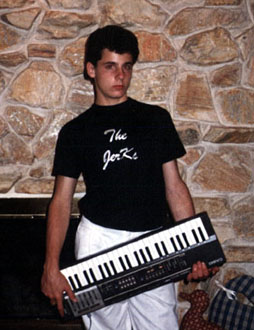
No, really. Be honest.
Eternal Egypt on the High-Tech Texan
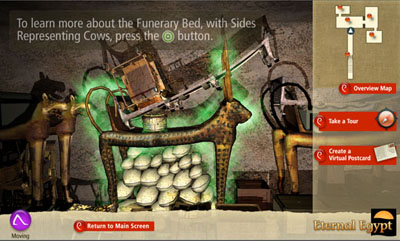
This Saturday at 12:30PM Central I will be interviewed as part of Michael Garfield’s High-Tech Texan show on Talk Radio 950 AM KPRC in Houston. The subject is the placement of the first Eternal Egypt kiosk at the Houston Museum of Natural Science as part of their Mummy: The Inside Story exhibit.
I’m tempted to scream “Am I the fourteenth caller!? Did I win!?” when I get on the line, but I’ll probably refrain. I will, however, be in New Orleans with no good (quiet) place to take the call so who knows what will happen.
The High-Tech Texan is streamed live for you Eternal Egypt junkies outside broadcast range.
To create an aquifer
My father wants to add a word to the Oxford English Dictionary. Now, I love my parents very much so I mean no disrespect when I say that language is not their strong suit. They’ve been making up words for as long as I’ve known them — but they don’t know they are making up words. For example, my mom calls me an “aggravant” which is like an irritant who aggravates. Great word, but not in the dictionary of course.
Only recently has my dad gotten the bee in his bonnet to actually get one of his neologisms into the OED. Poor guy. He doesn’t realize you can’t just write the editor a letter to petition for inclusion. Here’s an excerpt of his submission:
The word is “acquifier”. It means “the process of acquifying”. It is used in governmental and scientific writings to refer to the material comprising the “acquifer” and / or performing “the process of acquifying”. Unfortunately, it is believed by some that the only acceptable word is “acquifer”. But, “acquifer” refers to a specific area or place (frequently a proper noun) rather than the afore stated material and / or process.
Essentially what he is asking for is a word for the process of the creation of an aquifer. The problem is that “aquifier” implies that there is a process called aquifying and it suggests that there is an agent of this aquifying (the “aquifier”). I am not sure this is the case. What is the agent? Water itself? But the real problem is that, unlike the word police French, American lexicographers don’t just add words. New additions have to be proven to be in common usage.
So let me take a moment to state officially that Ascent Stage does not use nor does it support the usage by others of the word “aquifier.”
Digital music 2.0
Digital music is mainstream, that’s for sure. But we’re only now seeing the true power of what having one’s collection digitized can do — beyond the obvious portability of it all.
In the vinyl and CD eras, one navigated a music collection by album. There was no other way to do it. You selected the record/disc and then maybe the track and that was that. Digital music libraries with filterable metadata, smart playlists, and all manner of apps for organization make navigating music a lot more flexible, if not significantly easier than the old days.
CoverBuddy gives you an iTunes-like interface that represents albums as cover art thumbnails. CoverFlow takes this concept one step further and presents 3D cover art that you can flip through as though through a booklet of CDs.
Fun for sure, but it is online music services that truly open up possibilities.
Most talked-about these days is Pandora from the Music Genome Project. Basically a streaming radio station set atop a massive database of style data for thousands of songs and artists, Pandora delivers tunes based on the internal characteristics of a single song (or more) that you like. Once you start listening you can further hone your tastes — er, genetic composition.
Pre-dating Pandora is Last.fm and their Audioscrobbler service. This too delivers customized recommendations and a personal radio station, but it is based on what like-listening users have played rather than a close (human) analysis of styles. (It also powers the playlog of Ascent Stage.)
MusicBrainz offers a different slant. Think of it as a wikipedia for musical meta-tags. CDDB on steroids. MusicBrainz offers downloadable applications to help you properly tag your music in a way that reflects the user-contributed info in their vast database.
But this presents a problem — at least to me. Certainly artist and album information can be somewhat standardized, but much of tagging is subjective. For example, I find that I almost always start listening by heading into a genre first and then to an artist and then (maybe) to an album. The genre category is my front door. But it is also the most subjective and least standardized. One person’s Ambient is another’s New Age, Heavy Metal another’s Hard Rock; Dance another’s Techno. But that’s a good thing. There’s opportunity for personalization, to make the categories your own. Here are mine.
| 1980’s | If it was released in this decade and has that new wavy feel (i.e., not classic rock) then it goes here. Obviously a problem category since it is the only chronological one. |
| Alternative | If it was ever played on mainstream radio and is not 1980’s or classic rock, it goes here. |
| Ambient | Mostly electronic. Not New Age. |
| Audiobook | Including spoken word. |
| Children’s | Obvious, though certain bands like They Might Be Giants have kid albums that might as well be in other genres. |
| Christmas | Obvious. |
| Classic Rock | There’s certainly a cutoff date for this in my mind, but I have no idea what it is. |
| Classical | Obvious. |
| Country | For my wife. Please disregard. |
| Electronica | Most everything, but increasingly difficult even to know what part of an album constitutes electronic. |
| Halloween | Obvious. (I love Halloween.) |
| Jazz | Obvious, though there’s much overlap with certain sub-genres of Electronica. |
| Mashup | My newest genre. For categorizing music whose reason for being is to mess with generic labels. |
| New Age | Gotta put Ottmar Liebert somewhere. |
| Oldies | I suppose this is chronologically-bounded too. Classic rock and roll, pre-1970. |
| Original | My own music. |
| Pop | Not 1980’s, not rock, not alternative. Prince, for instance. |
| Soundtrack | Both scores and soundtracks, actually. |
| Surround Sound | There’s no confusion on this one. Pure sonic muscle-flexing. |
| World | Global styles. |
There are more here than I would like, but this is the smallest number that adequately divides. My feeling is that keeping the number of these doors few is key. Too-fine generic subdivision makes a top-level category useless. I have a friend who sub-divides using the Grouping tag religiously. (There’s even a guy out there who hacked iTunes to let him more easily categorize classical music.) Yet, to me, that way insanity lies. You can always further describe something, but how much is enough? Is genre a function of chronology, musical style, popularity?
I’m disgressing. The point is that there is no answer to these questions and that is a good thing. Genre is personal. I’m the first to admit that my categories make no good sense and overlap horribly. I’m all for data standards, but not in this case.
Which isn’t to say that digital music depersonalizes the experience. If anything it has multiplied the possibilities of expressing oneself. Collaborative, themed mixes are all the rage these days. And just recently Jason Freeman released the iTunes Signature Maker, a stunningly cool app that scours your music collection and creates a unique sonic “signature” of your musical taste — a kind of schizophrenic flashback through what matters most to you. The output is uncanny. Here’s mine (2:12 minutes, 3.1 MB, MP3).
Howdy, neighbor
Nearly every day for the last three years I’ve said hello or briefly chatted with our next door neighbor, Steve, “Home Improvement”-style through the wooden fence. He’s always around so I presumed he either didn’t work or that he worked from home.
Today, thanks to a holiday gift of a bag full of cookies I now know what “Uncle” Steve does. Who would have ever guessed?

Golly, they’re flavorful!
Cleaning up the gutter
Quick note of thanks to Jeff for manning the marginalia links this past week. Good stuff. Just one question: how do you really feel about religion?
I’ve got a backlog of links to post so expect a dumping.
That is all.
Ultimate snowball
Last night, as the snow came down in buckets, a friend commented on how perfect it would be to start a snowball fight against the masses huddled on the opposite L train platform. As we all waited for the delayed trains and came more and more to resemble snowmen, it seemed like a great idea. Perfect distance, a perfect no-man’s land — the electrified rails — in between the opposing armies, and in fact a perfect reason: people on the east platform were, in part, headed to the south side on the orange line. People on the west were headed to the north side on the brown. How better for Cubs fans to blow off some post-World Series steam? (Poor purple line commuters. They were going north too but were unfortunately clumped in with the orange liners. Collateral damage, I guess.) Only one problem. The snow was way too dry. You couldn’t form a snowball at all.
Pity. That would have been fun. At least until someone fell into the tracks.
Composting waveforms
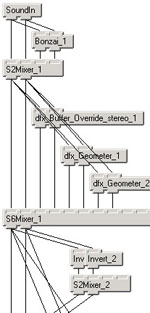
My interest in Four Tet led me to a novel application he uses called AudioMulch. In a nutshell this program allows you to build a visual diagram of how your sound sources will flow, enabling what the developers call “an analog approach to electronic music.” The main window allows the composer to stitch together “contraptions” — basically nodes that either input, output, or modify sound — to create a kind of sound machine that can be tweaked entirely visually. The interface is fascinating (not unlike the video processor GraphEdit, which I mused on so long ago) and gets you creating interesting sounds immediately. The tool is powerful, too, permitting layering and full sequencing. And the potential for creating visually interesting networks of contraptions (beautiful in their own right) that also create cool music is really appealing. I’ll work on that.
Mission Elapsed Time: 20:00:21:06:42:40

I went back through it this blog (and my Flickr account) on its 20th anniversary, retracing digital footprints made on what feels like a different planet. Here are some highlights.
The Terror Tourist

A roughly monthly exploration of places in horror fiction — real or imagined, geographical or psychological — culled from The Heavy Leather Horror Show.
Subscribe to the podcast or the email newsletter or just read through the archives posted here.
The Ampcamper

How I hauled myself, two teens, an 80 lb dog, and a whole load of crap 4000+ miles across six states in twenty days using an electric vehicle. And survived to tell the tale.


