etc., recall the word
resoldered here
in a pane of sand.
— R. Kenney

Ascent Stage
a life-in-progress

« November 2004 | Main | January 2005 »

December 30, 2004

“Is it over?”

Today we put in Mary Poppins for the first time for our three-year-old son. He immediately asked if it was over. You see, Mary Poppins, like most movies of its period, opens with screen after screen of detailed credits. Today's movies having barely any at all my son naturally figured the movie had ended. I mean, come on, that much text belongs at the end, right?

Posted at 10:44 PM | Permalink | Comments (0) | Topic: The Darnedest Things

December 29, 2004

Two degrees of separation

Each year I give away a CD’s worth of music to my friends at the end of the year. Not so much a compilation of the year’s best, it is merely a collection of the music I enjoyed this year regardless of when it was released. Since I give it away at a party the tracks are largely uptempo. This year I tried my hand at mixing the whole shebang into one continuous track using Traktor, a simple program of shocking complexity. I wasn’t completely successful, but the experience did add one more bullet item to my growing list of resolutions for 2005: learn to match beats so as not to create music that sounds like an EKG pinging cardiac arrhythmia. (Full list of resolutions coming soon.)

My pal Len Perez also released a mix for his friends this year — four CD’s to my one — so I thought it interesting to note the overlaps. Granted our tastes are similar, but this very small scale collaborative filtering is still notable given that we receive our musical inputs from different sources.

So, the overlap: Orbital, Sasha, Mr. Projectile. Orbital released their last album this year; Sasha his first (studio album, that is). Mr. Projectile is the one to watch — perhaps the most promising artist of his genre this year.

Posted at 8:43 PM | Permalink | Comments (0) | Topic: Music

December 27, 2004

Wine and fine fabrics

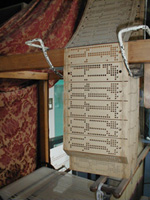
Gutenberg, the story goes, was inspired to build his printing press from the mechanics of a wine press. Who knows if that’s true or not, but I’ve always loved the idea that the most important invention in the history of the world sprang from a way of making alcohol. No less interesting a story — though certainly better documented — is the degree to which the automated weaving loom created by Joseph-Marie Jacquard in 1802 inspired punch-card controlled computing and, arguably, the entire notion of separating data from the control program in an automated system.

I’ve got some history of fascination with the loom as a metaphor for computing and so I was naturally drawn to James Essinger’s new book on Jacquard and his loom. The book is about 100 pages too long and too strident in its claims about the importance of the loom to the history of computing overall, but it is not a bad book at all: controlling weaving patterns with punch-cards did in fact inspire Charles Babbage and Herman Hollerith to do the same with their computing and tabulating engines. What’s most interesting to me is the historical prevalance of the computing-as-weaving or computing-begat-from-weaving motif. Though Ada Lovelace was probably the most articulate in portraying the linkage, the idea has never been so much a part of the popular imagination as it is today in the World Wide Web. Arachne’d be proud.

Posted at 9:10 PM | Permalink | Comments (0) | Topic: Words

December 24, 2004

Carbone Dolce

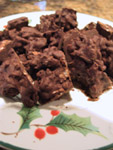
Here’s an easy way to remind the kids that they’ve been bad this year without scarring them for life. There’s a super-simple, traditional Italian dessert called Carbone Dolce, literally “sweet coal”, presumably a confectionary joke, but possibly pre-dating the whole stockings for bad kids thing. In any event, it could not be easier. You melt 400 grams of chocolate then mix in about half that in crushed Rice Crispies, form into coal-like clumps, and let cool. Voila! All the recipes I’ve come across are in Italian and I know they call for white chocolate, but I cannot figure out how or why you’d make something look like coal with white chocolate. Any ideas? Anyway, add a few pretzel sticks to the mix and you’ve got yer sticks and coal for the holidays. Better than pre-packaged, I’ll say.

Merry Christmas, dear readers!

Here’s the crew of Apollo 8 sending a Christmas Eve wish (Quicktime) to Earth as they orbited the moon, the first humans to do so, 36 years ago.

Posted at 8:43 AM | Permalink | Comments (0) | Topic: Italy

December 22, 2004

Going, going, gone

The blogosphere likes to talk about toppling old media. Today, I saw it topple for real, with nary a blogger in sight. Beats my normal daydream-fodder cubicle vista.

I should have one hell of a view carved out for me when I return to work after the holidays. A temporary thanks to The Donald.

(Photo gallery here.)

Posted at 4:29 PM | Permalink | Comments (0) | Topic: Chicago

December 21, 2004

Mommy, is that a type of swimsuit?

No doubt conservatives hear the gallop of the Four Horsemen in this story, but I find this totally hilarious. Someone at the YMCA near me needs a better Dayplanner. Citing “a very regrettable scheduling error,” the Y overlapped an all-night transgender fashion show with a 7am kids swim meet.

Tired omnisexuals. Protective yuppie parents without their lattes. Bewildered children. Hilarity ensues.

Posted at 8:05 AM | Permalink | Comments (0) | Topic: Chicago

December 20, 2004

E-mailing Richard Powers

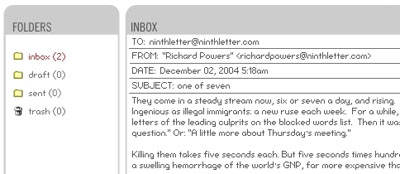
The e-lit blogs are abuzz about “They Come in a Steady Stream Now,” a new online piece by Richard Powers, the much-lauded author who consistently joins themes of technology and art in his novels. The general tenor of the comments on the new piece (with exceptions) seems to be mild disappointment that such an esteemed author didn’t create a masterpiece with his first foray in digital lit. I disagree, but not because “They Come in a Steady Stream Now” is exceptional — it isn’t, though it is very good indeed.

Thing is, Richard Powers is already an e-lit author. I saw Powers speak at the Chicago Humanities Festival a few years ago. It was the first time I’d heard him after years of knowing him through the written word alone. Perhaps that explains what happened to me. Powers delivered a reading of what came to be called “Literary Devices” at the CHF. This gets a bit convoluted so follow me here. In the listening “Literary Devices” seemed like a straightforward recounting of an e-mail exchange that Powers was involved in after delivering a real paper called “Being and Seeming” (“real” because I Googled it right after the talk — still online here). I was completely captivated by the conversation which, in a nutshell, revolves around a system called DIALOGOS, a next-generation ELIZA that convincingly writes fiction and sucks Powers into an ongoing exchange. It was only after the session ended on my way home did I realize that I had been completely duped. The CHF had not invited him to deliver a paper — it was total fiction, just sittin’-around-the-campfire storytellin’. And I had given myself to it utterly. I was the test subject who couldn’t distinguish the human from Turing’s machine.

Now, granted, this wasn’t electronic literature. Hell, it wasn’t printed literature. (Only much later did Salon publish the story, since removed, but available for purchase now.) This was oral literature in its most primitive form. Yet, in its colloquial, fast-paced, almost stream-of-consciousness delivery it really did evoke an e-mail exchange: call it performance e-lit. I was so amazed at how taken I was with this story I e-mailed Powers as soon as I got home. Like the now-fictional correspondent from the talk, I was the audience member who was striking up a real dialogue with the author, effectively continuining the narrative by e-mail — my own personal electronic appendix to the story.

All of this is an elliptical way of making the point that I consider the reading of “Literary Devices” to be Powers’ first jump into electronic literature, though it had none of the trappings of typical e-lit. No links, no point-and-click interactivity. But in its is-this-real-or-am-I-witnessing-artifice way it was the perfect Turing test and one that spawned at least one (though probably more) personalized narratives via other channels. The experience of the story, rather than the words on the page, was akin to some of the best e-lit experiences I’ve had and that’s why I consider “Literary Devices” an exemplar of the form.

“They Come in a Steady Stream Now” is certainly worth reading — Powers as always plumbs the human depths of technology — but it is more run-of-the-mill electronic literature and that, in the end, is why it is, well, run-of-the-mill.

UPDATE: Powers joins the conversation at Grandtextauto. An 8th e-mail, so to speak.

Posted at 8:25 PM | Permalink | Comments (1) | Topic: Words

Accessing a book like a hard drive

If there’s a book that I remember more vividly than most from my childhood it has to be Inherit the Stars by James P. Hogan. The story is kicked off by the discovery of a 50,000 year-old human skeleton in a spacesuit on the moon. The ancient astronaut also had some effects with him, including a book. The scientists use a scanner that can read the book without opening its very brittle, damaged pages, basically peering into and reconstructing the sheets at variable depths. I always thought that was so cool.

Turns out this is no longer a fictional technology. Researchers at the University of Kentucky have figured out how to do it. Imagine being able to scan like this on a bookshelf- or library-wide scale, gulping down petabytes of data without cracking into the books themselves. (Via MGK. Thanks Matt!)

Posted at 11:12 AM | Permalink | Comments (0) | Topic: Science/Tech

December 18, 2004

Glove on the abort handle

For those of you who noticed that the NASA Administrator, Sean O’Keefe, resigned this week, do you care? Didn’t think so. I sure hope his successor realizes how much has changed since the shuttle last went up.

Posted at 10:03 AM | Permalink | Comments (0) | Topic: Space

December 16, 2004

a + 30 + a'

I hadn’t read John McDaid since his seminal hypertext fiction Uncle Buddy’s Phantom Funhouse helped push me out of traditional literary studies onto the track I’m on now. Eight years ago maybe? Then this week Boing Boing enthusiasically blogged “Keyboard Practice, Consisting of an Aria with Diverse Variations for the Harpsichord with Two Manuals,” one of McDaid’s short stories. Since it caught me in that rare moment when I have just finished a book on the train to work and have nothing to read on the ride home and it was available for download I thought I’d give it a try. Well well well. I gotta agree with Cory. This is one hell of a story. You have to think McDaid is familiar with Richard Power’s Goldbug Variations (especially given his epigrammatic mention of gene sequences), the only other story I know so self-consciously influenced by Bach’s Goldberg Variations. I dare not try to wring a synoposis from either. Suffice to say that McDaid ably turns the reader into a rapt listener at a futuristic piano recital. It is a beautiful, lyrical story. Frankly I don’t remember his prose being so textured, but maybe that’s because I was too enamored of the medium back in the Uncle Buddy Hypercard days. In any event, this is worth your time. Pop Glenn Gould on too, if you have it. Download here.

Posted at 8:16 PM | Permalink | Comments (2) | Topic: Words

December 15, 2004

Speaking of lake views ...

Up until last week, I didn’t have one from my cubicle. Now, thanks to the strange progress of the dismantling of the Sun-Times building I have been granted a little portal to the east. (Note: if you look closely through the building you can see the bridge from which the enterprising gentleman from yesterday’s post was evicted.) Granted, I’d prefer a cataclysmic immolation of the building like you see on TV (mostly because the building is an architectural abomination), but that’s really not possible with the river right there. Still, that’s got to be safer than what they are doing now. I’m no OSHA supervisor, but should you really be using a frontloader to destroy the roof that is the only thing keeping you (and the frontloader) from plummetting to the next floor down? Oh, and Mr. Worker-Guy who randomly destroys things on the roof with a giant axe: I want your job.

Posted at 8:27 PM | Permalink | Comments (0) | Topic: Chicago

December 14, 2004

Wheels and towers

Daniel Libeskind became a celebrity when he was selected, amidst much controversy and eventual, bitter infighting, to provide the master architectural plan for Ground Zero. But before that, he was a minor hero of mine for orchestrating the construction of a funky 16th century contraption called the “reading wheel,” basically a precursor of modern hypertext. Libeskind’s studio took great pains to reproduce this machine:

“To try to become the pure medieval craftsman — that’s really the object of this exercise … So we did it that way. We got up at the crack of dawn, four o’clock in the morning. We built this machine in a small place without any power tools, just with hand tools; with no electricity, just with candlelight. We went to bed early because with candlelight you can’t work late. And we did it in silence because there is nothing to talk about when you work like that.”

ramelli_new.jpg

One wonders if real students of Libeskind’s style and oeuvre could chart a linkage between his interest in the reading wheel and the twisting, aerie-like Freedom Tower. Perhaps it is the turbines in the lattice at the top of the structure? (Not sure about that one; didn’t Skidmore add that?) Who knows, but I like the tower better for it.

The wheel itself, though not Libeskind’s version, pops up from time to time in literature and art. Richard Lester used some version of the wheel as a pratfall prop in his Three Musketeers. And, most recently, in The Confusion Neal Stephenson uses the wheel, called a Bücherrad, as a literary device (literally) in the lab of Gottfried Leibniz. Wheel on over to Amazon and read a bit.

Elegantly primitive, technologically advanced, but most of all beautiful in how it addresses a simple need, the wheel is truly captivating. If Libeskind achieves half that with his tower at Ground Zero he’ll have accomplished quite a lot.

Posted at 9:00 PM | Permalink | Comments (0) | Topic: Art/Design

Available: loft apartment w/ lake and river view

Some people outrun drawbridges, others live in them. For three years Richard Dorsay has been living in a makeshift home amidst the girders under the upper roadway of the Lake Shore Drive bridge that spans the Chicago River. The media is calling him homeless but he apparently had rigged electricity from the bridge allowing him to have a TV, microwave, and Playstation in there! He even washed in the normally-empty control-house that operates the bridge’s ups and downs. Best of all, Mr. Dorsay would ride the bridge as it went vertical to let the sailboats through. The cops evicted him Sunday after a former roommate — bridgemate, girderpal? — ratted him out. This guy deserves some sort of ingenuity award from the city — and a warm place to live.

Posted at 8:50 PM | Permalink | Comments (0) | Topic: Chicago

December 12, 2004

Little Glimmers

It may not be a Miracle on 34th St., but the annual CTA Holiday Train is fairly amazing. I happen to love this little tradition. The L adds a flatbed car and lets Santa and his reindeer and elves ride it. Each of the passenger cars is extensively decorated and staffed by CTA volunteers dressed as elves. Holiday tunes are piped in. The best part of it all is watching kids on the street look up and spot Santa and his crew flying past on the elevated tracks — as close as they will ever come to actually seeing the sleigh airborne, I’d wager. Note that this is wintertime Chicago. The wind on that flatbed car has to slice through the volunteers like so many daggers. Yet, they are all cheer.

This year the effort was unusually heroic because of the financial straits the CTA finds itself in. First they cancelled the special train over guilt at the operational costs and in light of upcoming layoffs. Then they reinstated it after the public made it clear that this was unacceptable. I believe the CTA came to realize that their efforts at winning the hearts and minds of its riding public in the PR war for better funding was ultimately more important than the costs involved.

For me, the once-yearly sight of a car full of passengers actually smiling and speaking to one another — rather than diligently avoiding eye contact as is normal behavior on the L — in itself is a great thing, a gift of sorts.

Posted at 7:14 PM | Permalink | Comments (0) | Topic: Chicago

Jewelboxed

There’s little I love more than when someone takes a simple idea and makes it extraordinary through attention to detail and good usability. That’s precisely what Coudal Partners, a design firm in Chicago that made a bit of a name for themselves with Photoshop Tennis, has done with their side business called Jewelboxing. They were unhappy with the packaging available for CD’s and DVD’s so they did something about it. I used their system to package the annual year-end mix I give out to my friends. Kudos to Coudal. Highly recommended.

Posted at 10:59 AM | Permalink | Comments (0) | Topic: I Like

December 9, 2004

New media everywhere

Matt Kirschenbaum asks “What if new media simply became a part of what writers and artists did, not something special or new?”

Well, first thing you’d need to do is stop calling what we do new media, but that’s peripheral. I’d tweak Matt’s question just slightly to ask: What if new media — or whatever name we give it — is just something that people do? Not artists or writers, per se, but people in general. New media is, after all, just expression, creation, manipulation using a computer. Some of it is mundane (e-mail), some of it is beautiful though perhaps not art (elegent code)*, and some of it would qualify as art because of the way it partipcates in an emotional and intellectual dialogue with the viewer/user. Digital communication today is a completely normal mode of human expression for most people. Very little is ‘new’ about it, even if it is very young medium. So I’m with Matt. Let’s ride that bandwagon of normalcy. If we ply our trade well it will be highly considered, irrespective of medium designations.

* This is a topic for another day. I’m not so sure code isn’t art.

Posted at 10:48 PM | Permalink | Comments (0) | Topic: Work

Flipbook

Moving files from one computer to another I came across this gem. In the summer of 2002 my brother and I took a trip to NYC and we visited the American Museum of the Moving Image in Queens. (Which I highly recommend, by the way. There’s a persistence of vision demonstration using strobe lights and a giant whirling contraption that is worth the price of admission alone.) One of the interactive exhibits allowed you to act in front of a digital camera that snapped images to create a printed flipbook. We digitized it, of course. Click the image to see the animation.

Posted at 9:28 PM | Permalink | Comments (0) | Topic: Fun

December 7, 2004

Once a hardware company, always ...

Well, it’s official. IBM is selling its personal computing division to Chinese computer-maker Lenovo. The ubiquity and sometimes-elegiac tone of the coverage of the transaction points to a fact that I live with every day: people still think IBM is a hardware company. I have come to see the futility of trying to overpower that meme. No matter that over 60% of IBM’s revenue comes from services and consulting. When IBM does something again as revolutionary as invent a personal computer then maybe the public perception will shift. Until then — even after IBM is long out of the personal computing market — people will think it outrageous that I work on a Mac at the office and find it odd that many IBM client solutions have no IBM hardware at all in them.

‘Course, I use a ThinkPad too and I think it is a superb machine, the best PC laptop made. And I thought that well before I took a job with the big ‘BM. That’s the only part of the sale that gives me pause. I certainly hope Lenovo can keep up the quality. By the way, did you know the ThinkPad design was inspired by a traditional Japanese lunchbox?

And, no, I don’t believe the Apple rumors. It just doesn’t make sense to me. But hey, strange bedfellows abound.

Posted at 8:35 PM | Permalink | Comments (0) | Topic: Work

December 5, 2004

Donnie Darko

I’m late to the game on this, but no matter. Donnie Darko is the best film I’ve seen all year. I can’t remember the last time a DVD finished and I immediately jumped to the menu to play it again. (My normal post-movie routine is to visit IMDB to read the trivia on the flick.) Re-viewing is almost built into the movie itself. The dramatic fulcrum of Donnie Darko is the title character’s reaction to knowing how things will turn out before he should know. Donnie Darko is richly rewarding, bitingly funny at times (Patrick Swayze is absolutely superb), and even frightening. Apparently the director, Richard Kelly, was 26 when the movie, his first, was released in 2001. Goodness gracious.

Time travel, a creepy man-bunny, Michael Dukakis. It’s all there. Rent this movie.

Posted at 6:29 PM | Permalink | Comments (0) | Topic: Movies

December 4, 2004

OneVoice

Daniel Lubetzky is going to win the Nobel Peace Prize one day. You read it here first. Daniel is the founder of PeaceWorks, a not-only-for-profit business based on the principle that economic interdependence eventually can overcome socio-political turmoil. Basically they get people on opposite sides of a conflict to work together to produce high-end foodstuffs. But that’s only half the story.

The PeaceWorks Foundation — a group I have been working with for a few weeks now — is the non-profit wing of the company. Their main project is OneVoice, a unique grass-roots effort to promote the views of the vast swath of moderate Israelis and Palestinians. The process is fairly simple. Once Israelis and Palestinians are registered to vote with OneVoice (both online and by volunteers on the ground) they are asked to state their opinions on a variety of issues. The referenda are rolled out in phases and contribute to a progressively more honed and unified position statement that will eventually be forwarded as a mandate to global leaders. One interesting point is that, in an effort to promote negotiation, absolute rejection of a proposal is not allowed. You are alloted a limited number of points with which to register your relative level of discord. Use too many on any one issue and you may not have the ability to reject a point later in the vote. The mechanism is a gravitational pull to the center.

There’s a real urgency now with the upcoming Palestinian elections. Daniel and his team are preparing for television coverage, new voting, and a high probability that a supporter of the OneVoice initiative will succeed Arafat. To capture some of this momentum, they’ve created a blog. It’s nascent, but look for it to mature rapidly in the coming week or so.

I’m proud to be a part of this.

Posted at 2:03 PM | Permalink | Comments (0) | Topic: Work

December 2, 2004

Favorite things, first in a series

Seems like I have come across quite a few useful, fun, or otherwise notable things lately. Thought I’d share.

Dynamap - Currently only for Manhattan, the Dynamap is a map made of polarized lenses stacked on each other so that when you alter the angle of viewing you see different layers of information: street grid, subway system, neighborhoods. Innovative and totally useful.

Konfabulator - Clearly someone at Apple thinks this is the future of modularized, task-specific applets since they are building Konfabulator-like functionality into the next version of their OS. But Konfabulator one-upped Cupertino by becoming cross-platform. To get a quick sense of what Konfabulator does visit the widget gallery.

del.icio.us - Social bookmarks. Like Friendster, except with your links. See how many or how few people link like you do.

flickr - Superb online photo gallery. Impressive editing and organization tools. Great attitude.

Web Developer - Extension for Firefox that adds a slew of geeky web dev tools, but the best by far is a block level element outlining function. Indispensible for ferretting out nested <div> tags and such. (Example.)

Delicious Monster Library - An iLife-like app (Mac-only) that organizes your books, software, videos, and games. Cool part: it can use a webcam to simulate a UPC code scanner, directly grabbing the volume info from Amazon.

Moleskine notebook - Paper PDA. Proto-blog tool. (Even hackable.) Snapping the elastic band over the cover is strangely satisfying.

Smarty Pants - Movable Type blog plug-in that enables curly quotes, em-dashes, and real ellipses. “I’m … not — kidding.” Rejoice!

ISS-Soyuz bags - Satchels and backpacks made from used Soyuz re-entry parachutes. “Why, yes, this bag has been to space and back.”

Posted at 8:31 PM | Permalink | Comments (1) | Topic: I Like