
Codemusic
Lately I have been loving a few truly innovative audio apps for the iPhone, none having to do with it being an iPod.
I had always thought that mobile audio creation software were frivolous party tricks. Hey, look at me, I can play Baby Got Back on my 3″-wide keyboard! But that’s changed.
A while back I wrote about an idea for including audio processing code in the header of MP3 files. The premise was that, in addition to creating a music track, the artist would provide parameters for real-time playback modification based on user input, randomness, or anything else. The song would never (or at least wouldn’t ever have to) be the same.
The team at RJDJ have taken this idea to the extreme. The free and pay RJDJ apps in the iTunes store both provide “scenes”, akin to music tracks, complete with artwork. These scenes are nothing but audio processing algorithms.
All input happens via the lavalier microphone on the iTunes earbuds. Basically the scenes take the ambient noise surrounding you and remix it. Some of the scenes do this subtly, some are more musical, but all of them make you the focal point of the remix — not so much a musician as a conductor. I’ve listened to the noise of the L train, walking down the street, and the cacophony of three kids at dinner time. It is completely entrancing. Location-based remixing.
So, to our list of traditional musical interfaces — stick hitting animal skin, horse hair pulled across wire — we add one’s physical movement through life’s soundscape.
Here’s a more musical scene based on my eastward walk through the city a few days ago*. Note especially the interpolation of me almost being hit by a cab crossing Michigan Ave. at 1:16 (red marker on map). The horn makes the piece, in my opinion, but the beauty of this particular scene is how the bleeps and bloops are modulated by the ambient street noise.
Of course this map isn’t connected in any way to playback control, but with the iPhone’s GPS it seems like an obvious evolution of the RJDJ app. The possibilities are many. How about a View in Google Maps button in iTunes? Or a site that aggregates user-created tracks and plots them over one another on a map, a personal-social musical-spatial mashup. Dan Hill’s city of sound, indeed.
——–
There are some other apps of note too.
Bloom is a generative music app from none other than Brian Eno, working with Brian Chilvers. You initiate notes of music by touching the screen. Each note plays and interacts with other notes in expanding concentric circles, like dropping pebbles in a pond. As with scenes in RJDJ, the parameters of note interaction are constrained by “moods”. These are the algorithms that govern the evolution of the sounds you start off. Spore for music. (Not a coincidence that Eno did the music for Spore, of course.)
Ocarina is one of those apps that makes you love the creators for thinking of it. Basically Ocarina turns your iPhone into a high-tech flute. OK, you say, I can see touching the screen like you cover the holes of a woodwind, but where do you blow? Why, the microphone of course! They’ve turned the lack of a wind guard on the iPhone mic into a feature! Light exhalation makes less noise on the mic and produces a lower intensity of the current note combination, and conversely. It’s brilliant really.
——–
* There’s no easy way to export audio from RJDJ, but this handy tool allows you to parse the backup file that the iPhone generates on your machine. You can pluck out the .wav files right from the RJDJ folder.
Crowds in Grant Park
People demanding change, a museum fixed in time.

Protesters at the 1968 Democratic National Convention
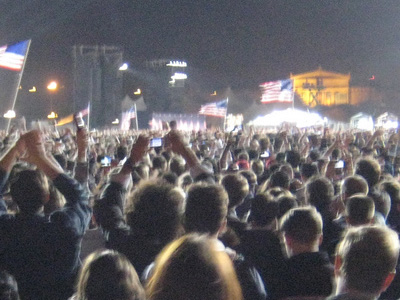
Supporters on election night, 2008
The Mashability Index
A while back my brother gave me several thousand songs from GoodBlimey.com. Almost all the tracks were mashups. Each song was composed of two songs by two different artists fairly equally smooshed together.
All the track titles were in the A vs. B format (e.g., Black Eyed Peas vs Kraftwerk) — and this gave me an idea.
I exported all the track data as a text file. Then my pal Chris Gansen wrote a script that nuked everything except the two artist names for each track and transformed the data into a spreadsheet like this:
A B 1
A C 1
B D 1
C D 3
C B 2
…
Then it was just a matter of plugging the data into ManyEyes and playing with the visualization types. The best by far is the bubble chart view. (Here’s the interactive chart.)Where the first two columns were artists names and the third column was the number of times they were mashed together in unique songs.
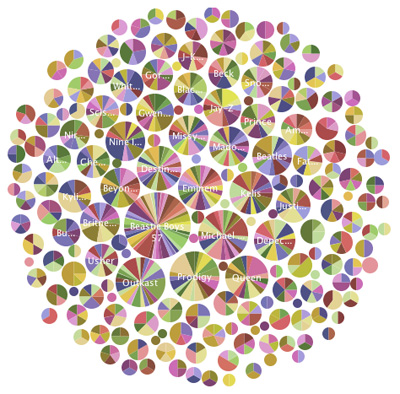
Each circle above represents a single artist. The larger the circle the more other artists the selected artist is mashed with.
The color slices actually tell you at a glance which other artists have been mashed … if you are an autistic savant who can pick out a single color in a sea of several hundred chromatic gradations, that is.
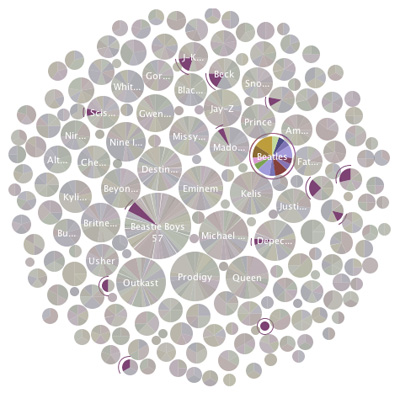
Much easier is clicking a circle which highlights the other artists with which it is mashed.
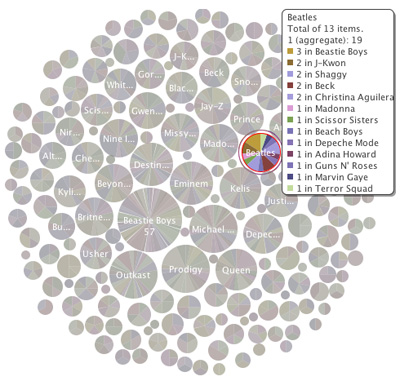
An alternate view gives the most complete information complete with number of mashed tracks per artist combination.
One other useful view was the network diagram. It shows actual connections between artist combos. The best feature of the diagram is that selected nodes highlight all the other artists with which it is matched. Easy to figure out who’s connected to whom. (Here’s the interactive diagram.)
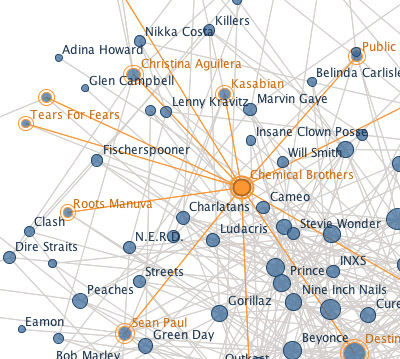
So what have we learned? Certainly my data set does not contain every mashup ever made. But there were thousands and I think the charts give a good sense which artists mash best (look for the big circles) and mash best with whom.
But there’s far more that could be done. For one, there’s no data in these charts on which songs are being mashed. I have the info — just haven’t figured out how to integrate it. What I really would love to get at is why two artists make sense together. This would require stylistic data, notoriously subjective and consequently unreliable. Still, consider this but a start of the analysis.
Two particular projects influenced my work on this index. The History of Sampling by Jesse Kriss is a bar that I didn’t even come close to hitting, but it provided a great place to aim. And Andy Baio’s analysis of the samples in Girl Talk’s Feed The Animals showed what could be done with an idea, Amazon Turk, and some cool visualizations.
In truth, getting this data into shape was a massive pain in the ass. It was horribly formatted to begin with and took a great deal of kicking and shoving to play nicely with Many Eyes. Above all thanks to Chris — but Jesse Kriss, Frank Van Ham, and Martin Wattenberg of the Many Eyes team deserve applause too.
This is a lot cooler than My Music Genome, isn’t it?
Skip St. John
Well, look who has a blog.
My brother has claimed his own parcel of the web (MySpace don’t count, sorry Joey). I look forward to redirecting all our conversation with one another to comments and trackbacks between our sites.
Enjoy: www.skipstjohn.com.
(Clearly the blog title is an affectionate homage to me. Brotherly hagiography, if you will.)
Sightings
Some upcoming talks for those of you who like your rambling in person.
Tomorrow I’m attending the Chicago Colloquium on Digital Humanities and Computer Science at the University of Chicago. It is a small, single-track, free (!) conference that I have wanted to attend for years. I’ll be in the poster sessions, fishing for interest in using our non-profit grid for scholarship in arts and culture.
On Nov. 7 I’ll be speaking at the University of South Carolina in Columbia. The talk is called “Architecting Cultural Spaces: The Past, Present, and Many Futures of Digital Humanities” as they kick off their own Center for study of the same. I’ll post to Slideshare when it is complete.
I’ve had a panel accepted for next year’s SXSW festival. It’s called Entrepreneurship in the Belly of the Beast — basically an anti-SXSW screed about the opportunities for getting away with stuff in a big company. I’ll most likely be booed off stage by startup junkies. Or fired for calling my company the Beast. Win-win.
If you’ll be at any of these events in the coming days and months, please drop a line!
Mission Elapsed Time: 20:00:21:06:42:40

I went back through it this blog (and my Flickr account) on its 20th anniversary, retracing digital footprints made on what feels like a different planet. Here are some highlights.
The Terror Tourist
Explorations of place in horror fiction — real or imagined, geographical or psychological — culled from my time on The Heavy Leather Horror Show 2023-2026.
Subscribe to the podcast or the email newsletter or just read through the archives posted here.
The Ampcamper

How I hauled myself, two teens, an 80 lb dog, and a whole load of crap 4000+ miles across six states in twenty days using an electric vehicle. And survived to tell the tale.


