
Be like Ada
Today is international Ada Lovelace Day. Don’t know who Ada Lovelace was? Well, that’s part of the problem.
See, a while back I pledged to post on this day about a woman in technology who I admire. The pledge is part of a campaign to raise the profile of women’s contributions to the field. More importantly to me is the collective effort to define role models for young women considering a career in high tech — and who are likely daunted by the overwhelming gender discrepancy therein. It’s astonishing, really, considering how limitless the field is and how generally egalitarian the overall vibe is of the tech scene. But you don’t need charts and surveys to know that things are out of whack. Just get yourself to a tech conference. It’s a sausage fest.
I’ve had the luck of working with dozens of talented women in my decade-plus of employment at IBM and my generally geeky wanderings have given me the privilege of meeting many more.
But today I want to tell you about Jennifer Martin. Jen’s a Creative Director in the Chicago Center for Solution Innovation in IBM. I’ve worked with her for most of the last eight years. Her title belies her unique skills in information architecture and user interaction design. Jen is an expert in bridging the gap between end-user requirements, usability, and design that can be easily translated into a coded thing.
If you’ve ever wondered where the magic happens between an idea and a piece of code, it is with the information architecture — and Jen is a magician of the highest order. Except that it isn’t sorcery. Far from it: IA, as it is called, is wickedly difficult to do well because the devil is most certainly in the details. That page with boxes and arrows on it might look like it represents how you think your app will work, but hand it to a developer who needs to code for every eventuality or hand it to a graphic designer who needs to know what functions really do and nine times out of ten it will be back to the drawing board.
Not with Jen. She’s fluent in the language of both user needs and developer requirements — a false distinction I’m perpetuating even by writing it that way. Design is design and when you get it right it is mostly incontrovertible. Jen gets it right. (And she’s got her priorities in line too.)
Don’t believe me? Have a look at a few of the projects I’ve worked on with her. Eternal Egypt, a challenge to design a seamless experience across a website, PDA’s, mobile phones, and a standalone kiosk. Or, The Forbidden City: Beyond Space and Time, truly the bleeding edge of information design as Jen took to designing an experience in a custom, multi-user virtual world for the Palace Museum in Beijing. I’ll stop there not for lack of other examples or to mitigate Jen’s embarrassment at this post, but because in a way this isn’t the point at all.
Jen Martin is just an example herself. She doesn’t design circuits (though there are plenty of women who do). She’s not a stereotypical geek or the female caricature portrayed in so man male-designed games. She’s just someone who had talent, chose a very high-technology field underserved by that talent, and made a name for herself. We need more like her. Many, many more.
So girls — or ladies, if you’re considering a career change (and who isn’t during this economic apocalypse?) — know that you’ll be in good company if technology interests you. And remember that the popular image of the pocket-protecter wearing man in ill-fitting clothes is just an image. Like any stereotype, it can be erased. You have the undo.
Did a panelist just say bestiality?
So, the panel I moderated at SXSW went exceedingly well. That’s what happens when you stack the deck with smart, witty, quotable peeps. I was honored to be up there with them.
We projected the #sxswbeast feed for the audience in real time to get a sense of the mood and questions. In lieu of the podcast of the talk (which has not yet been posted) you can thumb through the feed and get a pretty damn good idea of the meat of the talk. The Hive Mind as Cliffs Notes.
Here’s a Wordle cloud of all the tweets that came in. Click for larger. (Find the suppository!)
In another vein is this visualization from Social Collider. It shows lateral connections between Twitter conversations. The vortex at the middle represents all the different audience conversations happening during the talk. But the interesting bits are the lines that shoot out to the left and right, like the rings of Saturn. These represent similarities to other tweets taking place at the same time. Most are from SXSW itself so the graph is, in a way, a snapshot of thematic resonance at the conference between sessions. The more horizontal the line, the more simultaneous the discussion.
Here’s the visualization. Click for larger.
Slightly humorous is that one of the tweets was about the book Orbiting the Giant Hairball — a classic on the topic of corporate entrepreneurship. Hairball indeed!
Straight from T. Herman Zweibel
While on the hunt for my family’s local history I was helpfully pointed to the online archive of the Chicago Tribune. It is an amazing resource and one hell of a timesuck. Half the time it feels like you’re reading the Onion; the other half makes you realize just how far newspapers have fallen as the organ of record for society.
I stumbled upon this bizarre blurb from Oct. 14, 1920, back when the Trib was known as the Chicago Daily Tribune (“The World’s Greatest Newspaper,” apparently). It reads like some kind of personal alternate universe.
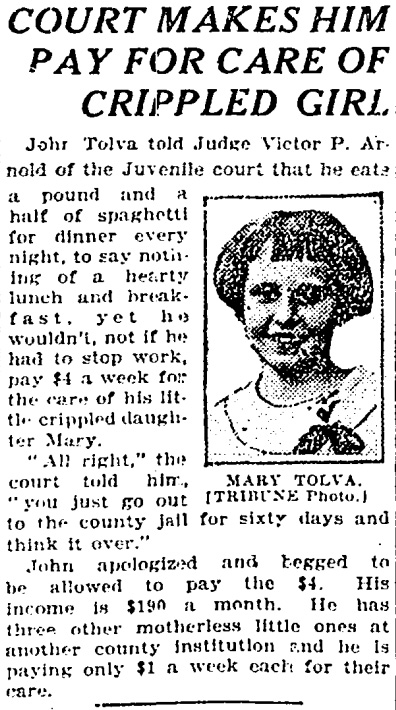
That John Tolva sure was an ass.
Note that I too have three children, though they are thankfully not motherless. Also, I do not eat a pound and a half of spaghetti each night.
1903
Departure
On the train to Naples the old ladies in black thought she was menstruating when she asked them for help disposing the bloody cloth. She let them think so. The train was cramped when they left Barile, but when it picked up passengers in Potenza it filled so full you merely leaned into others to maintain balance. It was not the place to make a public fuss over a choleric baby.
Living in a big, old city like Chicago is a four-dimensional experience. You move around the street grid, up high into skyscrapers, down into the underbelly of subway tubes, but time too is layered into the built things, seen only if you are looking, meshed into the streetscape like a discolored piece of gum that’s just another part of the sidewalk. Until you look more closely at it.
The baby hadn’t made a noise since they arrived at the port. He was swaddled up against Grazia tight enough that she’d feel it if his shallow breaths stopped. She sat down on the steamer trunk. Giuseppe, unsure which ship was theirs, barreled chest-first into the noisy confusion of Neapolitan seamen, stevedores, travelers, and common thieves. Grazia attempted to nurse, but she couldn’t let down. The baby had not taken milk in eight days.
I knew that my great-grandparents had come to live in Chicago in the same way I know Mrs. O’Leary and Al Capone and Saul Bellow lived here — and with about as much tangible connection to same. Certainly I had occasion to think of their lives. Three times in 14 years I had trekked to their village in poor, arid southern Italy, learning a bit more each time, eventually being welcomed by their hometown as one of their own. And that was part of the problem. I could connect with them in Italy, but not here, in the town where they started a new life and became American.
Gibraltar was still in sight when baby Michele died. There were no facilities to keep his body on board. An Arbëreshë steward who heard his own strange accent echoed in the parents’ sobbing drew Giuseppe close, felt the bitter waft of Amaro Lucano on the big man’s breath, and told him that he could not emigrate with a corpse. Michele, tightly bound and ballasted, was lowered gently into the waves. Grazia heaved somewhere in a mass of ladies in black and rosaries. Giuseppe changed some of his dollars for lire and drank it away.
I had gone searching before, just before the last trip to Italy. I started at the end, hunting with my kids for a nondescript tomb marker. We found Giuseppe, buried Joseph Tolva, on a sweltering summer day that gave way to a torrential storm just as we found the house he lived in when he registered for World War I in 1915. But these were milestones only. Markers of events, not the experience of a life. I had the records from Italy, the scraps of US government documents from the period, even a few photographs, but what most eluded me was Giuseppe’s connection to my city.
They had argued about taking the baby to America as sick as he was, but the passage was paid, the job was arranged, and the padrone was waiting in Chicago. There would not be a second chance. On July 28, 1903, nine days after they lost the only thing of importance they brought from Italy, Giuseppe and Grazie Tolve arrived in New York City. Three lines, one of them crossed out, on the ship manifest marked their entry. Giuseppe admitted to carrying $25 and told the agent they were bound for one Rocco Calandriello Jr. at 50 Blue Island Ave., Chicago.
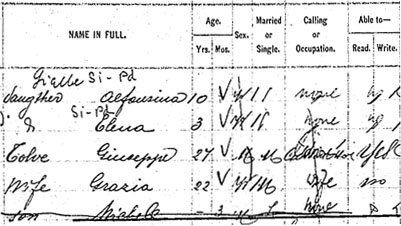
Arrival
That name and that address have perplexed me for years. None of my living relatives had heard of Rocco Calandriello, Ancestry.com had too many records to be useful, and 50 Blue Island Ave wasn’t an address that existed anymore. I considered it a dead end.
A few weeks ago at a conference I met Dennis McClendon, a professional mapmaker from Chicago. I casually mentioned that I knew that streets had been renumbered earlier last century but that I had gotten no further. Dennis cleared up my confusion in the span of about 15 minutes. On his laptop he brought up a scan of the 1909 document detailing all the renumbered buildings. Six years after Giuseppe and Grazia arrived 50 became 707 Blue Island Ave.
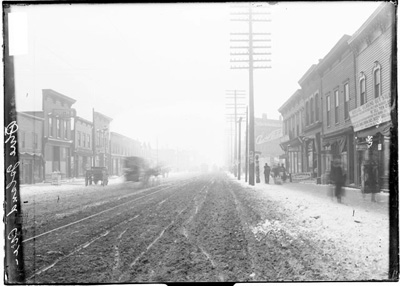
Blue Island Avenue covered in snow, with stores on either side, pedestrians on the sidewalk and horse drawn vehicles in the street, 1907. Source: Chicago Historical Society
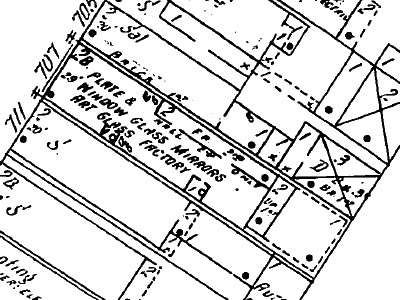
Source: Sanborn Fire Insurance Maps of Chicago

Source: Polk's "Criss-Cross" Directory
Of course, the building could have been something vastly different in 1903, though it is marked as a business rather than a residence from as early as 1886. My guess is that Rocco Calandriello really was Giuseppe’s uncle, though an uncle through marriage, but what he did and why he did it at 50 Blue Island Ave. is not something the documents tell us.
Before I could inform Dennis that Google Maps still couldn’t locate 707 Blue Island Ave. he noted that part of that street had been demolished in the 60’s to make space for the University of Illinois at Chicago campus — the very campus the conference we were attending was being held on!
We overlaid the pre-destruction map on current satellite photography of the area and had a lock. I was out the door with my camera before I could even say thanks.
Blue Island Avenue is one of a handful of diagonal streets in Chicago, cutting southwest to northeast into the city center. Before the university was built it ended at Harrison Street; now it stops at Roosevelt Rd. Interestingly — and helpfully — the campus layout largely preserves the outline of the original thoroughfare. The gum you notice on the sidewalk only when you step in it.
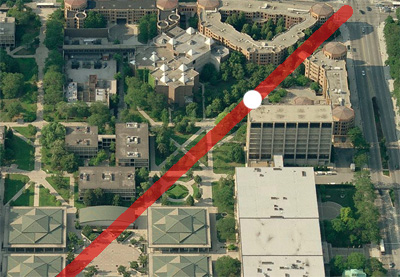
I’m pretty sure this is where 50 Blue Island Avenue once stood. Coincidentally, this spot is a few hundred feet from where Jane Addams’ Hull House now resides, having been moved from its original location during the UIC construction. Given that recently-arrived Italians constituted a major slice of the neighborhood that Hull House served it is almost impossible to think that Giuseppe and Grazia did not receive assistance from Addams.
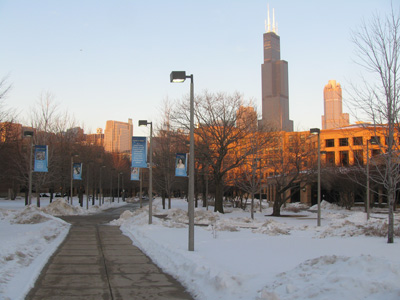
I didn’t find Rocco and of course the building is gone, but I tramped around the Near West Side on a few Saturdays and came to know the area of town my great-grandparents called home. It grounded something for me, fleshed out another dimension of my personal relationship to the urban space. And set the stage for 1909.
Mission Elapsed Time: 20:00:21:06:42:40

I went back through it this blog (and my Flickr account) on its 20th anniversary, retracing digital footprints made on what feels like a different planet. Here are some highlights.
The Terror Tourist

Explorations of place in horror fiction — real or imagined, geographical or psychological — culled from my time on The Heavy Leather Horror Show 2023-2026.
Subscribe to the podcast or the email newsletter or just read through the archives posted here.
The Ampcamper

How I hauled myself, two teens, an 80 lb dog, and a whole load of crap 4000+ miles across six states in twenty days using an electric vehicle. And survived to tell the tale.


