
Off-world, a party turns 10
Ten years ago my wife and I had just moved to Chicago. Kidless, dual income, cool new top floor condo. We threw a Christmas party for the few people we knew. It was fairly low-key: appetizers, beer and wine only, and holiday tunes softly played. The invitation even had an end time on it.
It isn’t like that anymore.
The get-together has become something of a spectacle, an entire year’s worth of creative energy throttled into a single night that reminds us of a youth I don’t think my wife or I ever actually had. And it’s kidless once more, having evolved into a house-sized version of stays-in-Vegas that the children would surely be embarrassed by later in life if they had the memories. (And will, thanks to this post, hundreds of photos, a full video feed and the Google bots. Sorry, kids.)
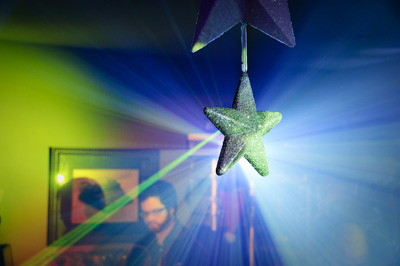
The parties early on never had themes, but eventually we started giving away favors and that led to light theming, usually holiday-related (e.g., “I Think They Spiked the Nog” and “Lords a-Leaping”.) But themes are a gateway drug and soon enough we were in full-blown obsessive-compulsion about every last detail conforming to the chosen motif.
Last year, the theme was “Around the World,” celebrating travel of all kinds and lending itself handily to silly tie-ins. This year’s theme — Out Of This World — seems almost predetermined given the re-use it made possible of certain globe decor from last year, but also because of what a space nerd I am. (And yes, it lends itself to a world “trilogy”, more on which later.)
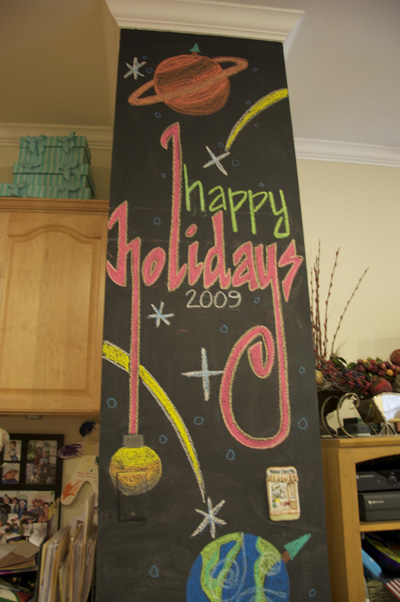
The favor proved challenging as we had designed ourselves into a bit of a corner last year by dumping CDs in favor of USB keys. The consensus opinion (meaning my wife’s) was that people really didn’t use the key drives — leading me to question our choice of friends, frankly — and the decision was to go back to CDs.
This led to what I thought was a fantastic idea. I’d build an armillary sphere with the compact disc as the celestial equator! Wait, come back. If I admit that it would have taken months and every shred of sanity I have to actually make them, you have to admit it would have looked amazing.
Next idea: ringed planet. It was a contentious design process, honestly, but in the end it yielded something great. The CD (two actually) formed the rings, a styrofoam ball sliced in half and glittered formed the planet. This set like a garnish on a mini-martini glass which itself was set atop a coaster that was our holiday card (photo of kids with greeting). Initially Robyn suggested the card be a flag planted atop the planet. Which of course is silly, given that Saturn is a gas giant and you can’t plant flags on it. Sheesh! (This kind of thinking led to a chandelier planet arrangement that was far from accurate.) Our fantastic nanny, Ellen Gallerini, and her business partner — the Glitter Girlz — bore the brunt of the assembly work. Amazing, huh?
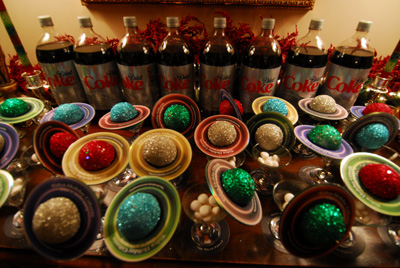
But the real stroke of genius came from Robyn: the glasses were filled with Mentos and the entire favor display was backed with 2-liter bottles of Diet Coke. Blastoff! (If you’re unaware of the particular physics involved here, have a look.) Not sure if anyone tried this, but in keeping with our tradition of home-wrecking favors we have reports that the glitter got into and all over virtually everything it touched. I can’t imagine the discs were actually playable. (Which is OK: you can download it here.)
Food and drink stayed on-theme, my particular favorite being the red velvet frosted cake balls peddled as moon rocks. The custom drink list, bane of our hired bartenders and the ultimate scapegoat for much that happens, was equally tasty. Choice selections included the Tang-tini (Tang and blood orange martini), Fly Me To the Moon (Passion Fruit Vodka and Prosecco), and the Black Hole (Espresso Martini). Bottleable quanities of each of these drinks were sucked from our carpet by Stanley Steemer a few days after the party.

A note on the bartender. Serving drinks for this party is pure misery. In an effort to encourage a flow through the house, we put the mixed drinks and bartender in the basement. This meant he was subjected to at least 7 hours of aural and visual assault in a very limited space. Add drunk revelers and dancing bodies. Stir.
Well, we’ve solved this problem and his name is Matt Vogel, aka “Fingers”. We didn’t know the reason for this nickname until he showed up. Fingers, you see, has only one hand. Fingers insisted we call him such and I protested until he produced a business card with “Fingers” on it. You can imagine our thoughts when a one-handed guy showed up for what is a tough assignment for a barkeep with four arms. But here’s the thing: Fingers was amazing. He kept pace, didn’t complain, and stayed late — all with a great disposition.
The theme is fun. The food, drink and decor are festive. But the genetic mutation that’s most responsible for the party’s evolution is what happens in the basement. To quote a friend, “I don’t even mess with the first floor anymore.” Let’s go there.
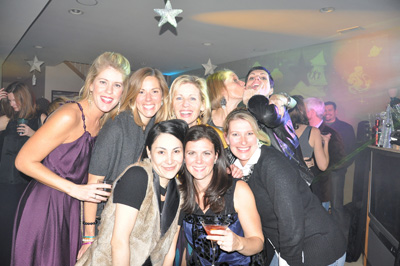
Basically the lower level is just one big media generation machine. “Photobooth”, live video feed, lots of roving photo/video cameras, a closed-circuit feed to two projectors, two iSights snapping at regular intervals, and a recording of the audio from the DJ booth ensure that it is well-covered. Good thing too; there are a lot of cute boots down there.
It’s a massive effort. We move every last shred of furniture and decor out of what is a very functional and much-used basement (our family life routine is also effectively moved out), then load in a forklift’s worth of plywood to construct what becomes the Nightclub on Henderson Street.
We amped up the lighting this year, figuratively and literally, adding three high-powered spots, stage washes, and a physical control panel to the full roster of DJ spots, LED cans, strobes, projectors, and laser. This is all due to a guy who wasn’t actually at the party. Tom Herlihy, visuals expert and total lighting nerd, loaned all the equipment, trained a totally capable assistant, Chris Gansen, and then decamped for Kabul, Afghanistan for work. And this was the reason for the live video feed. Tom caught parts of the party in the Dubai and London airports. Totally worth it.
The DJ booth is simply a beast. Originally constructed to accommodate two people, enlarged to fit four, and then, this year, completely rebuilt. The 2009 version situated the three DJ’s more comfortably while giving the AV control a kind of crow’s nest above it all and, importantly, providing a dance platform behind the DJ surface, since that’s where we found people pooled anyway.
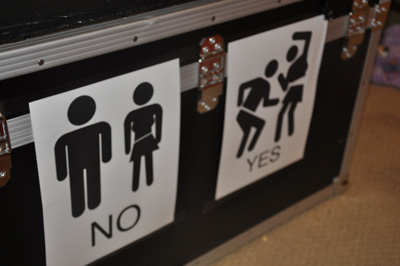
Clearly raised areas attracted people in past years, so we build two dance platforms out in the crowd. These were sturdy and festooned with instructions that we figured even the drunkest partygoers would understand.
The DJ setup this year exceeded all past. The unbelievable Jesse Kriss returned (this time from Seattle rather than Boston) and provided the real turntable chops. He was the master of ceremonies for all audio, messing with whatever Joey and I were pumping out via Ableton and Traktor. We also had a Korg KAOSS pad (a tactile/visual effects and loop controller) which were totally smitten with mere seconds after hooking it up.
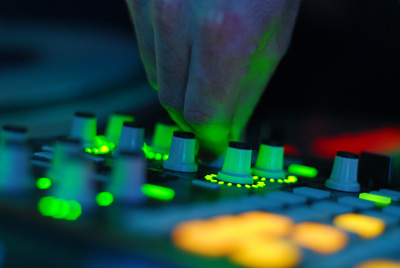
We played for over eight hours, covering a serious range of tunes. Jesse, Joey, and I really seemed to click this year, handing off more smoothly than catastrophically most of the time. (I stress most of the time. See custom drink menu, above.) The floor was packed with dancers for hours. The apotheosis of the party, truly.
Jesse’s fantastic beginning set is excerpted here with full tracklisting.
The built-in downfall of the party, it seems to my wife and I, is the ever-more-difficult challenge of making the spectacle that much bigger year-on-year. But that’s a problem for the future; we hit the mark this year. Inspired by Daft Punk inspired by Tron we constructed three glowing jackets of electroluminescent wire for the DJ crew. The nerdfest began about four hours in and was met with a solid wall of cheering.
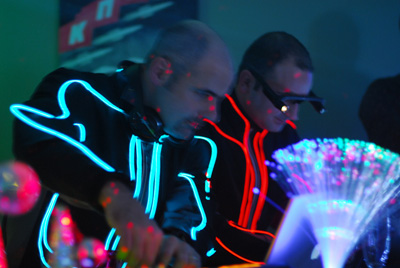
The jackets were a bit of a pain in the ass, as we had to affix the somewhat delicate EL wire with tiny safety pins from inside the jacket. But my god was it worth it. Everyone wanted to wear them, which was fine by us as they were hot as hell. Biggest upside: wearing a jacket of copper wire with electricity coursing through it was an effective deterrent to me taking my shirt off, something that has regrettably become a de facto tradition at the party. Not this year!
Though there’s no end time on the invitation anymore, there’s something about this party that demands a discrete finale rather than fading out with hangers-on. Last year this finale came courtesy of the Chicago Police Department. We escaped that this year, somehow. (How we weren’t charged with “operating a public place of amusement without a license” is beyond me.)
This year the ending came via a small explosion.
Piecing together exactly what happened was a massive chore taking weeks and all kinds of CSI-style cross-referencing of testimonial and media timestamps. The folks still there at 3:45 AM said later on that the power cut out. Apparently I rushed to the circuit breaker in the back bedroom to check this and in the process intruded on two sleeping guests who had called it quits.
But that wasn’t it. Couldn’t have been. The recording of the night proved that power remained as it continued for hours uninterrupted after the music ended. We were pulling from four separate circuits in the basement, having learned our lesson from the strobes in previous years.
The next morning the only thing people recalled was me saying “Party’s over. Get the hell out!” But my laptop was completely dead. Dead, but seemingly unmolested. No drink spills apparent anywhere. This is not, however, what Apple repair ultimately said. “Extensive internal liquid damage” was the diagnosis. As best we can tell, liquid seeped in through the Superdrive bay slot on the right side of the laptop and then destroyed everything but the hard drive and wireless radios. No idea how that could have happened.
And that’s how the party ended.
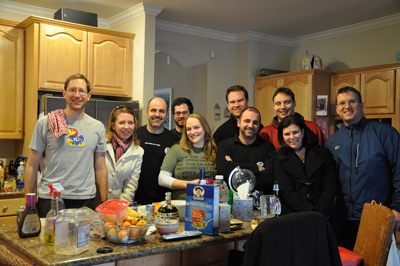
But how it came to be is more important. Dozens of people gave dozens of hours to realize such a thing. We’ve mentioned Tom Herlihy, Jesse Kriss, Chris Gansen and my brother Michael, but that leaves out Justin Bowersock, Alyson Higgins, Cathy Brennan, Heidi and Pat Potter, David Balcom, Mike Bloebaum, Ricky Thorpe, Michelle Simpson, Tom Alter, Ellen Gallerini, Jodie Deschler and others who absolutely made it happen. I’ve said it before and I don’t give a damn if I say it again. This your party too. THANK YOU.
The experience is extraordinary, for sure, but so is the toll it takes on the family to bring about. The half-jokes Robyn and I made about this being our last party during the run-up became less than half as the party approached. But we recognize that we can’t just end something like this without warning. Too many people have too good a time to do that.
So I’ll ask you, dear reader, if you’ve been around the world and off the world, what’s the only thing left to do to the world?
——–
Here’s the full photo gallery. See also Chris Gansen’s great shots.
Curious about past parties?
Read about 2008 (photos!), 2007 (photos!) and 2006.
Or listen in: mixes from 2008, 2007, 2006 and 2005.
Our second city
Recently I was asked by WBEZ, the Chicago NPR affiliate, to write an essay on a topic or trend from 2009 that I would like to see carried forward “from here on out”.
What I wrote was a condensation of a year of conferences and talks informed by IBM’s Smarter Cities perspective — all with a Chicago bent. It was an interesting and ultimately enjoyable exercise, whittling down a tough subject into something to be read aloud. I’m grateful to NPR for the opportunity and their collaborative editing.
Here’s the link to the transcript and audio on NPR. The actual broadcast, I’m told, will be during All Things Considered on 1/1/2010. Pretty sure the broadcast is Chicago-only.
Here is the original essay, which gives a little more context to my screed.
This past year offered Chicagoans some unique opportunities to consider our collective identity as a city. We looked forward, dreaming of how we might remake the urban space to host the world and its Olympians in 2016. We looked backward, celebrating Burnham’s 100-year-old vision for what the city might become and, perhaps more interestingly, what it never did become. These two events both asked Chicagoans to imagine a city that did not exist, to grapple with a series of what-ifs about the built environment.
And yet, there’s another city — equally intangible — being built even as we move on from the Olympic decision and unrealized bold plans. It is a literal second city, built right atop our architecture of buildings, streets, and sewers. This is the city of data — every bit as complex and vital as our physical infrastructure, but as seemingly unreal (and unrealized) as the what-might-have-beens of Burnham’s Plan and Chicago 2016.
But what is a city of data and why should Chicago care about being one?
IT research firm Gartner notes that by the end 2012, 20% of the (non-video) data on the Internet will originate not from humans but from sensors in the environment. If your eyes just glazed over, let’s look at this from a different angle: if Gartner is right, for every four text messages that a pedestrian sends, the sidewalk she is walking on while doing so is also sending an equivalent amount of data. The city itself is becoming part of the Internet.
This is happening already. The city is increasingly instrumented; nearly everything today can be monitored, measured, and sensed. There are billions of processors embedded in everything from structural girders to running shoes. Millions of radio frequency identification tags turn inanimate objects into addressable resources. The city is immersed in a environment of data continuously built and rebuilt from the lived experiences of its occupants. And yet, this information architecture is hardly planned, much less dreamt about, or celebrated.
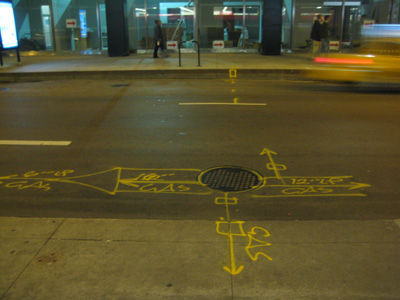
Consider the intersection of Michigan Avenue and Congress Parkway, what Burnham envisioned as a grand pedestrian-friendly concourse leading westward towards a towering civic center and eastward to the lakefront. This was never built, of course. (The circle interchange is our civic center, alas.) And yet there’s another built world, equally intangible, an infrastructure of data, overlaid on this intersection.
- Three students surf the web thanks to an open WIFI cloud that leaks out of a local hotel lobby.
- Several GPS units in cars all update with detail about the intersection as they approach.
- Sensors embedded in the water main below the street register a blockage.
- Closed-circuit cameras in three different shops capture the same window shopper as he moves down Michigan towards Randolph.
- An exhausted cyclist’s bike computer uploads his location and energy expenditure as he stops to use his iPhone to log into a Zipcar waiting to take him home.
- The city 311 database is populated with 7 different service requests from the surrounding area, coming from phone and e-mail.
- Taxis criss-cross the intersection as their fare data trails are logged locally and broadcast to dispatch.
- Four different people tweet from different perspectives on the same news crawl that moves across a building’s frontage.
- A bus stops to pick up passengers and bathes them in the glow of the full-color video screen running along its side.
- RFID chips on pallets loaded into building docks beneath the street respond to transducers in the receivers’ doorways.
And on and on. The examples are commonplace, but together they form an infrastructure — or superstructure — a second set of interactions, invisible or barely visible, atop the interactions that we plan for and currently build for. Proprietary, public, local, remote — all manner of data continuously permeates the streetscape. And yet we scarcely think of how it plays a part in the city that we’re building, the city that we want to become.
We don’t dwell on physical city infrastructure much either — unless we’re momentarily captivated by an architectural facade or, more commonly, inconvenienced by some lapse in the expected service. And yet. We’re the city that defines architectural styles for the world, that elevates an urban planner to local celebrity, that engages in a heated debate about the merits of remaking ourselves for the Olympics. From here on out why should we not apply such passion to the next wave of digital infrastructure? It is a decision not to be made lightly or as a thought exercise: how we design our city of information is as vital to quality of life as streets, schools, and job opportunity.
Dan Hill, a leading urban designer in matters digital, notes that we often think of the information landscape like street furniture and road signs, as adornment or a supplement to the physical environment. But fissures in a city’s data infrastructure are as consequential as potholes. They are structural failings of a city at the most basic level, in a way that a busted piece of street art would never be.
Think of cell phone outages — “dark zones” — as potholes in the urban information landscape. Or consider GPS brownouts, such as cause error in bus-tracking when the CTA enters the satellite-blocking skyscraper canyon of the Loop. But these examples are minor compared to the real issue before us: how do we proactively build a city of information that is inclusionary, robust but flexible, and reflective of a city’s unique character?
Our built structures — physical and digital — are manifestations of the patterns of human life in a city. They encode our desires, our needs, and our hopes. In some cases the permanence of the built environment inhibits or works at cross-purposes to these goals. (Think of expressways as barriers to the way people move about neighborhoods.)
We have a unique opportunity to ensure that our digital infrastructure avoids the mistakes of our physical infrastructure, to make Chicago the envy not just of building architects but of information architects.
I suggest two ways to start. To engage in a dialogue about this new built environment — such as we did collectively this summer — our city planners and citizenry need to be at least as conversant with the language of information architecture as we are, at a basic level, about physical architecture. Call it an aesthetics of data. This is as much a matter of becoming aware of what’s happening around us, of figuring out the most elegant ways of making the unseen felt, of thinking of our urban spaces as I described the interactions at Michigan and Congress.
Second, we need to recognize that, while the power of information is the power to connect, every linkage made represents a connection not made or, at worst, a disconnection. (Think again of the unintended effects of expressways on neighborhood mobility.) Our plan for a networked urbanism should seek above all to be maximally enfranchising, lowering barriers to commerce and community.
We must take up this mantle and be active participants in the design of this networked urbanism. We must make our voice heard. From educating our elected representatives about the opportunities before us, to encouraging our youth — who increasingly live in a world of data — to think critically about their role in the urban fabric, we must embrace this challenge with the same passion embodied in our historical tradition of remarkable plans for Chicago.
[This essay is cross-posted at the Building a Smarter Planet blog.]
Sing-a-long
It’s a feel-good family post. So deal with it.
Seasons Greetings, all! Got some homegrown Christmas tunes for you.
The first is Nathan in the annual Alphonsus Academy Holiday Concert. He was selected as a soloist for the second grade’s rendition “Silent Night” and he did it masterfully.
The only problem is that the audio levels were way off in the church. The piano is much too loud. (I have tried to EQ it down a bit.) Nathan kicks it solo style around 1:10. “All is calm” and “SleeeEEEEeeeep in heavenly peace” rather pegs it as him.
Nathan Tolva and Mrs. Durkin’s Second Grade Class, AACA
Next up is an impromptu family sing-a-long. Robyn and I heard Charlotte “singing” Feliz Navidad from her bed (behind a closed door) so we crept up and started recording. When her verse ended I piped up from the hallway, which caused her brothers to join in from behind their closed door. Recording continued, hilarity ensued.
You’ll have to turn up the volume pretty high, at least at the beginning. Note how at one point Charlotte asks herself “How do you say [unintelligible] in Spanish?” Pardon the muffled giggling from Robyn and I. And enjoy the remix with Señor Feliciano.
“Feliz Navidad”, The Tolva Family
And yes, I did just put an audio recording of me impersonating a horn section stab on the open Internet.
Merry Christmas!
My 15th minute
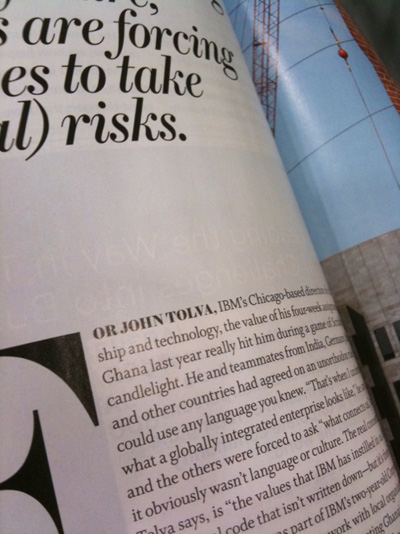
Photo by Josh Nard
So. Remember when I went to Africa last year? Life-changing, job-changing, everything-changing. Yes, well, the program I was a part of — called the IBM Corporate Service Corps — recently was profiled by Fortune Magazine in their issue on the best companies for leaders. The CSC is both a leadership development program and a way to assist small businesses in “pre-emerging” markets. And Fortune loves IBM for that (and other things).
The other news — which took me quite by surprise — is that my experience is actually the opening lede to the story (which in print is on the cover). Wow.
Have a read: How to build great leaders, Fortune Magazine, Nov. 20, 2009.
Mission Elapsed Time: 20:00:21:06:42:40

I went back through it this blog (and my Flickr account) on its 20th anniversary, retracing digital footprints made on what feels like a different planet. Here are some highlights.
The Terror Tourist
Explorations of place in horror fiction — real or imagined, geographical or psychological — culled from my time on The Heavy Leather Horror Show 2023-2026.
Subscribe to the podcast or the email newsletter or just read through the archives posted here.
The Ampcamper

How I hauled myself, two teens, an 80 lb dog, and a whole load of crap 4000+ miles across six states in twenty days using an electric vehicle. And survived to tell the tale.


