Deprivation and focus
Last year I spent an hour in a sensory deprivation tank and thoroughly enjoyed the experience — so much so that I mentioned it to a friend and before I knew it ABC News had dubbed me a “floating enthusiast“. Well, the celebrity has worn off and I’m still a float tank devotee. Last Thursday I returned to the tanks, but this time I was armed with a waterproof iPod case and underwater headphones.
It all goes back to Autour de la Lune, the haunting, minimalist album by Geir Jenssen aka Biosphere. Many months ago I had commented to a friend that the harmonically rich drones from this album coupled with a removal of non-auditory sensory input (such as when partially submerged in a bathtub) was like an out-of-body experience. My friend mentioned that, in fact, there were real sensory deprivation chambers in Chicago. And thus the story picks up. The first two times in the tank I was in silence, listening only to my breathing getting slower and the pulsation of blood through my inner ear.
But this time I was ready for audio. Call it extreme sensory focus, if you will, enabled by a deprivation of all other sensations. The unit worked flawelessly. I floated as normal, iPod on my chest. The ear inserts which sound awful out of water came alive when submerged. The water in the tank acted a bit like a speaker diaphragm. It was like my head was in the middle of a surround sound field. Truly audiophile-quality listening.
I chose Autour de la Lune because it was the music that originally got me thinking of sensory deprivation, but more importantly it was the only kind of music that I felt would work with the timeless, motionless nature of the tank. My reasoning was that any kind of music that conveyed the passage of time — that is, music with a beat, or with lyrics, or with any kind of discernible structure or movement at all, indeed anything with discrete tracks — would jar you out of the hypnagogic stasis of the tank. Jenssen’s opus fit the bill perfectly. While there are tracks on the album the tones blend seamlessly throughout. There is absolutely no way of knowing where you are in any individual track as the timbres and harmonics cycle, overlap, and interact. (Sample here, here, and here.) I must say, it worked beautifully in the tank.
The album is the result of Jenssen’s access to Radio France’s archival recordings of a dramatization of Jules Verne’s De La Terre A La Lune (From Earth To Moon). You’d think this was a factor in my selection too, since a float in the nothingness of the tank must in some way approximate a spacewalk or the noiseless, lightless experience of deep space. Alas, this only occured to me after the fact. Truth is, the experience is more about inner space than outer space.
As in previous silent floats I found myself coming in and out of lucid mental moments. The music was enveloping; it felt like I literally floated in it. At times I forgot I was hearing anything and just drifted off into thought or a kind of dream. I do know that these brief flares of dream-like visions were much more intense than in silent floats. (No hallucinogens or controlled substances involved.*) Twice I recall having vivid flashes of people becoming increasingly more physically deformed. But these were brief, not part of any larger dream narrative — for one, I wasn’t asleep — just glimpses of something from my mind.
A few times I was unable to distinguish the music from the sound of nothingness. I don’t mean silence. Even a silent tank is quite loud after a while. Your ears can ring from the noise of your vascular system doing its work. (The tanks provide earplugs, if you like.) Because so much of Autour de la Lune is composed of harmonics at the extreme ends of the sonic frequency there were times when I did not know what I was hearing — music, myself, or the echo of both in the reverberant saltwater solution.
To me the best ambient music effects the same kind of experience as a sensory deprivation tank, focusing the mind, providing a sense of envelopment, and effacing the passage of time. If NASA won’t let me tool around in the Manned Maneuvering Unit, I guess this is the next best thing.
[*] I did eat the better part of a poppyseed coffee cake that morning, so it is possible that I had a higher than normal level of opiates in my body. I’m pretty sure I was unaffected by this.
Coasting
Maciej Ceglowski has written an oustanding piece on what’s wrong with the US manned space program. No argument here.
But NASA dismisses such helpful suggetions [about discontinuing manned space altogether] as unworthy of its mission of ‘exploration’, likening critics of manned space flight to those Europeans in the 1500’s who would have cancelled the great voyages of discovery rather than face the loss of one more ship.
Of course, the great explorers of the 1500’s did not sail endlessly back and forth a hundred miles off the coast of Portugal, nor did they construct a massive artificial island they could repair to if their boat sprang a leak. And we must remember that space is called space for a reason – there is nothing in it, at least not where the Shuttle goes, save for a few fast-moving pieces of junk from the last few times we went up there, forty years ago. The interesting bits in space are all much further away, and we have not paid them a visit since 1972.
Window to my world
Some choice morsels from the last twenty-four hours in my household.
My newly four-year-old son is hell-bent on being able to wipe his own butt these days. So I’m showering, he’s pooping, same bathroom. He wipes with enough paper to cover a house in a John Hughes movie. Proceeds to bend over to the ground, ass aloft, and smashes his rump against the shower door glass. He asks me to check to see that he is clean. Let me tell you, this kind of scatological evaluation is not easy from the other side of a steamy shower door. I tell him I think he should wipe again. So he loads up with toilet paper again and proceeds to run out of the bathroom. He comes back about five minutes later and explains that he had to go to his room so that he could wipe in the mirror. I still don’t know exactly how he accomplished this. Best guess is that he was bent over looking through his legs backwards at the mirror. OK can we stop talking about this?
Today same son looked outside as dusk approached and said, “Mommy, its nighttime. When does the babysitter come?” Nice Pavlovian reaction to the end of the day, son. We don’t go out that much.
The youngest son was napless and ornery at the restaurant tonight. We had to scoot his high chair away from the table so he had nothing within banging distance. Mama offered him some crunchy chip thing. He took it, stared her right in the face with a completely emotionless expression, and crushed it into dust with his hand still outstretched, like a Hollywood villian pulverizing the hero’s antivenom as he sits in a snake pit. This is when you ask for the bill before your food arrives.
Careful with those clippers
A couple of thoughts on the emergency repair of the shuttle tile fillers that will take place soon.
This kind of unrehearsed response to a potential calamity is precisely the kind of thing we need to be comfortable with if we are ever going to leave Earth orbit again or go to Mars. So, on the one hand, I feel that there is a bit of overreaction from NASA at play here — that filler fabric has come undone thousands of times before and it was not the result of any impact at launch. But this could also be a sign of a new risk-tolerant NASA, the “old” NASA so to say. Not a NASA that accepts risk cavalierly but one that has confidence that a task that has not been dissected from every angle and rehearsed for months might still be worth the effort. Jim Lovell (of Apollo 8 and 13 fame) has suggested that one of the problems with NASA post-Challenger has been a reluctance to embrace the unknown, to push boundaries where the risk seemed worthwhile. Certainly NASA has attempted first-of-a-kinds since Challenger, but this statement rings true. Conducting this ad hoc repair is a good thing for NASA’s confidence, even if not 100% necessary.
Good luck, Stephen Robinson!
If I were in to garden gnomes
This is what I’d have.
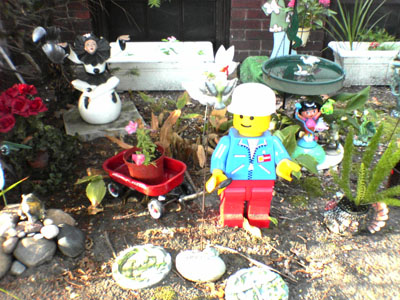
I need to start a new category called Found On The Walk To The L.
STS-300
NASA
Space.com notes:
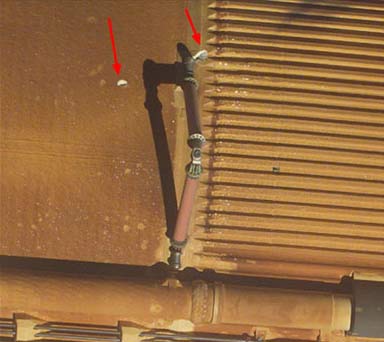
Atlantis is already mated to its own external tank-solid rocket booster launch stack, and was slated for a Sept. 9 liftoff before today’s foam find. NASA also tapped Atlantis to serve as a rescue ship for the STS-114 crew in the remote chance Discovery was too damaged to return home and its astronauts forced to take shelter aboard the space station. That contingency rescue mission is known as STS-300.
No one is faulting NASA for reacting with such care to the news that foam insulation did in fact shake loose during launch. The images of the divots and missing patches are eerie reminders of Columbia, scars of an ignorance we thought we’d overcome. But one has to wonder if the dozens of new cameras trained on the shuttle during ascent is making the problem seem worse than it is. Stuff shakes loose in the tug-o-war with gravity. Always has. In whatever we build to fly us to space next we need to attempt to prevent debris and harden whatever critical surfaces might be compromised by that debris.[*] This kind of protection was not added in the post-Columbia changes, to my knowledge.
The clock is ticking on the shuttle transportation system. My bet, we won’t make 2010.
Re-entry is going to be tense.
[*] The heat shield on the Apollo capsule was safely sheathed until very close to the beginning of re-entry, for example.
Nation’s tallest building proposed
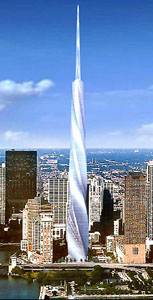
550
feet
taller
than
the
Sears
Tower.
Wow.
I like this design for three reasons.
(1) Trump hates that it would overshadow his latest homage to himself.
(2) The City of Big (Square) Shoulders needs more curve, less quadrilateral in its skyline.
(3) It shares elements of what the the now-fortified Freedom Tower once was (and still could be).
Maybe this will knock some sense back into that design.
Aloft
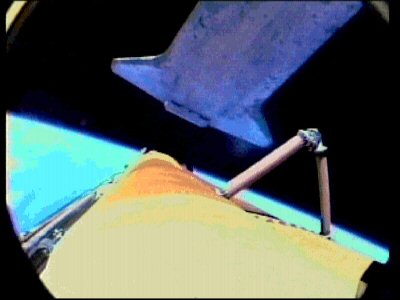
Associated Press / NASA TV
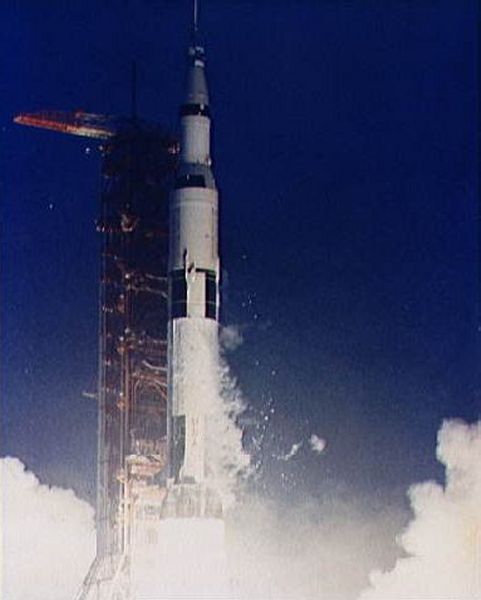
I’ve been known to bad-mouth the shuttle in these parts — mostly a tough love thing — but I gotta admit that I got a little choked up to see it leap off the pad this morning. Bravo, NASA.
Eileen Collins and the crew had what looked like a flawless ascent. CNN noted that her voice before the solid boosters peeled off was shaky, but c’mon she’s on top of 6.6 million pounds of thrust. Like trying to have a phone conversation sitting on the roof of a locomotive.
NASA’s launch announcer always has a brief prepared tag line right when the countdown goes from minus to plus. This time he said “… beginning America’s new journey to the Moon, Mars, and beyond.” This is interesting because none of that journey involves the shuttle. NASA is looking forward, so much so that they used the return to space of the shuttle to reaffirm its retirement. I like this.
And the camera on the external tank! I’ve seen other launches from this angle, but never from the shuttle. That was damn cool. I’m scrounging for footage of the separation of the tank from the orbiter — something no one had ever seen previously. Amazing how smooth that was and to see the orbiter engines direct it to orbit.
No word on the fuel sensor gauge, but, as a friend who had a flaky gauge on his Wagoneer noted, the key is just to jot down your mileage as you tank up. Isn’t that what mission specialists are for?
Friendly confinement
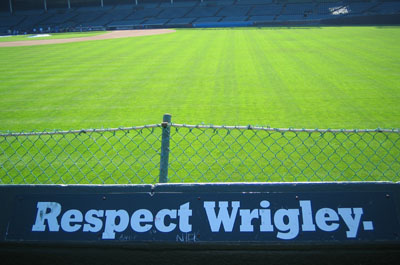
For Father’s Day I received a behind-the-scenes tour of Wrigley Field with my wife and oldest son. What a gift. If an unsanctified place can be holy, Wrigley is it.
One thing that struck me is how completely devoid of advertising the park is. You sense this when watching a game, but that’s the thing about a lack of in-your-face advertisement: when it isn’t there you focus on what matters and don’t consciously register its absence. In fact, you have to look really hard to find any advertisement. Up until a few years ago there was none, zero, zip. But now it exists on seat-back cupholders (which, if you are looking at that during a Cubs game, you got bigger problems), occasional scrolls on the three small LED boards, and — during big games — on the green screen in back of home plate. The green screen is particularly Wrigleyesque in that visitors to the park don’t ever see the superimposed ads. Only the shleps at home.
The other thing that really strikes you is what a shit-hole Wrigley is off the field. Built in 1914, the park is just a tad younger than Fenway — and it shows. The press rooms are like veal pens, the visiting team locker room is laughably awful — it actually smells like mildew, and I bet the Cubs clubhouse is less spacious than many minor league locker rooms. But hey. It is a ballpark. For ballplaying. No reason to dally in the locker rooms. Just get out there and play on the best field in baseball.
Fans on the rooftops. The L clanking by. Sailboats on the lake visible from the cheap seats. Manual scoreboard. Old Style beer. Amen.
Terror incognita
News from London. News from Egypt.
The latest from the UK shows just how cowardly terrorism is as an act. The image of a smoldering, confused would-be suicide bomber running out of a tube car looking for his partner — but you said it would blow me up — is simply pathetic. Too incompetent even to remove himself from the gene pool correctly. Terrorism is like any kind of media-borne meme. The more it spreads initially the more powerful it is. But there is a point at which it saturates and after fails to have the impact it once did. When horror turns to anger terrorism has failed. The problem is that terrorism is also a last-ditch effort, an act of desperation, and when people are desperate logic rarely works. It will take a long time for these cowards to realize that the initial power of their acts has long since dissipated.
I was thinking about why the London transit system, particularly the Underground, is such a target and I think the answer is fundamental to terrorism itself. Mass media of course is the accomplice of terrorism, the mechanism for global broadcast and amplification that allows a relatively small act to frighten millions. Terrorism succeeds or fails on this basic premise of small-to-large. The tube system is nothing but a physical network, the very embodiment of a vast, interconnected system where a small event ramifies outward until a much larger effect is achieved: total system shutdown. But there is a difference. Mass media is unidirectional; the tube is a true network. Media can only echo, amplify, send out. The tube — and all networks — adapts, re-routes, compensates. Human society is a network too and it adapts just like the tube does. Another lesson likely lost on the desperate.

And then Egypt. Beautiful, idyllic Sharm. When I was there in 2003 a shopkeeper ran after me on the boardwalk and begged me to come to his store. I thought he was just a pushy bazaar denizen, but when I got inside with my brother and co-worker he pulled out a book and showed us entries from people all over the world. He asked visitors to write something representative of their country, a kind of guestbook passport. He had dozens of European entries, but no American. It took me a moment, but I ended up writing the words to “Take My Out To The Ballgame.” The shopkeeper loved it and asked me to sing it. I’m no singer, but I didn’t care. I did my best. National pride, I guess. The shopkeeper shook my hand, hugged me, and sent us out with a massive smile. I have nothing but wonderful memories of Sharm. It cuts deeply to see the destruction there, like watching a gorgeous person senselessly disfigured. But there’s no fear, no terror. Only anger.
Mission Elapsed Time: 20:00:21:06:42:40

I went back through it this blog (and my Flickr account) on its 20th anniversary, retracing digital footprints made on what feels like a different planet. Here are some highlights.
The Terror Tourist
A roughly monthly exploration of places in horror fiction — real or imagined, geographical or psychological — culled from The Heavy Leather Horror Show.
Subscribe to the podcast or the email newsletter or just read through the archives posted here.
The Ampcamper

How I hauled myself, two teens, an 80 lb dog, and a whole load of crap 4000+ miles across six states in twenty days using an electric vehicle. And survived to tell the tale.