
Crayon box morning
Last night I was thinking how much the front page needed some color. I had to look no further than a few spring gardens on the walk to the L this morning.

Stabbed in the trackback
A while ago I installed a small script that disallows comments on this blog that are not actually typed in. That is, it looks for multiple keystrokes as opposed to one single dump of text — the behavior of a spambot (or someone who copies-and-pastes comments wholesale). It has stopped 100% of the spam I used to deal with daily.
Alas, the scourge of trackback spam persists. Does anyone know of anything that will effectively block trackback spam? Ideally it too would be a keystroke-based defense, but anything that really works would do. I’d hate to have to shut off trackbacks as they are one of the most innovative things about blogs!
Help?
Olde media vs. the blogosphere
I must heartily second this rant at Whole Lotta Nothing.
For the new year I promised myself (#4) that I would not make fun of sites that position blogs and the “mainstream” media diametrically, but after reading this I think I’ll go back to heckling.
Here’s an axiom to live by. If you have to cast an issue as good vs. evil, you’re probably masking your own insecurity or the indefensibility of your position.
Favorite things, part the third
Aerolatte – This little gizmo is neither a sexual aid nor a hair removal device, though it looks like both. Warm some milk in the microwave then whip it with the Aerolatte and pour into coffee. Instant latte, no Starbucks or foaming machine. I don’t drink latte, but I find myself grabbing it just to stir in sugar. Automate everything!
Stair Basket – With house lots only 25 feet wide a lot of Chicago living happens on multiple levels. Add to that the amount of crap that accumulates and is dispersed around the place with two kids and you quickly find yourself piling stuff up on the stairs to remind you to take it up or down. Add in general clutziness and perhaps drunkenness and you have a real hazard. That’s where the stair basket comes in. Now you only have one large thing to break your ankle on as opposed to lots of little things.
Greasemonkey – I join many people in thinking this is the greatest Firefox extension ever. Basically it allows people to write small Javascripts that do some amazing things. My favorites include always providing a download link for embedded movies, stripping the margin crud from Boing Boing, and adding Netflix links to IMDB. But far and away my favorite Greasemonkey script is the Chicago Transit Authority hack of Google Maps. Now in addition to the street and satellite view you can switch to a CTA view that shows you where your address is on the subway grid. Wonderful.
Smarterchild – At work our internal chat client has about a half-dozen bots that can do your bidding for you (fetching addresses, monitoring feeds, etc.) so I was pleased to see this ability on the open interweb. I find myself using Smarterchild most often simply to pop up a reminder at a given time. Smarterchild is my friend.
Plaxo – I was initially very skeptical of this service. Storing all your contacts externally is just asking for trouble, in my opinion. But I am a convert now. Plaxo has a great interface, an online version (so you’re not stuck using Outlook), a phone synch option, and — this is important — it does not require your contacts to register with Plaxo to use it. I have reconnected with three or four people that I had lost touch with simply because of the one-to-many update requests you can manage with Plaxo. That alone is worth the cost. Which is $0.
Getting my fix
Crain’s Chicago Business profiles my reading habits this week in their Info Junkie column at the back of the paper. It is an odd way to describe someone — the sum of what info one consumes — but in a way it is no stranger than the impression you might get of me from reading this blog. I considered just exporting my RSS feeds as a list and handing that to Crain’s, but they wanted a bit more detail.
The story is online but only available as an abstract to non-subscribers. Access is free for eight weeks and no credit card is required, but honestly, what I read is probably not interesting enough to warrant the time it will take you to register. You be the judge.
In a kingdom by the sea
I rediscovered this poem this weekend. Forgot how much I loved it.
Annabel Lee, by Edgar Allen Poe
It was many and many a year ago,
In a kingdom by the sea
That a maiden there lived whom you may know.
By the name of Annabel Lee;
And this maiden she lived with no other thought
Than to love and be loved by me.I was a child and she was a child,
In this kingdom by the sea;
But we loved with a love that was more than love —
I and my Annabel Lee —
With a love that the winged seraphs of heaven
Coveted her and me.And this is the reason that, long ago,
In this kingdom by the sea,
A wind blew out of a cloud, chilling
My beautiful Annabel Lee;
So that her highborn kinsmen came
And bore her away from me,
To shut her up in a sepulchre
In this kingdom by the sea.The angels, not half so happy in heaven,
Went envying her and me —
Yes! — that was the reason (as all men know,
In this kingdom by the sea)
That the wind came out of the cloud by night,
chilling and killing my Annabel Lee.But our love it was stronger by far than the love
Of those who were older than we —
Of many far wiser than we —
And neither the angels in heaven above,
Nor the demons down under the sea,
Can ever dissever my soul from the soul
Of the beautiful Annabel Lee.For the moon never beams, without bringing me dreams
Of the Beautiful Annabel Lee:
And the stars never rise, but I feel the bright eyes
Of the Beautiful Annabel Lee:
And so, all the night tide, I lay down by the side
Of my darling — my darling — my life and my bride,
In her sepulchre there by the sea —
In her tomb by the sounding sea.
Thanks, Anabeli!
Wet cement botany
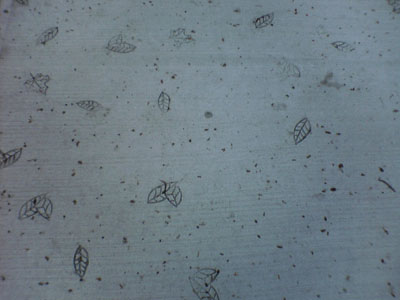
It took me few blocks to realize that Vancouver’s sidewalks come preloaded with leaf impressions. The relief is a bit high (extra heavy foliage?), but the effect is kinda nice. Fossils of tree-lined avenues that don’t actually exist.
Innovative, so I’m told

Well, here’s a great surprise. Eternal Egypt is on the other side of “and the winner is …” for a Best of the Web award at Museums and the Web 2005 in Vancouver. The project received the accolade in the Best Innovative or Experimental Application category. Eternal Egypt joins a pretty distinguished group of sites, including the Theban Mapping Project (which still makes my jaw drop) and of course the venerable Hermitage project which garnered the overall Best of the Web award in 2000.
Congratulations to CultNat and the IBM team!
The Genographic Project

OK, I’m pretty excited about this project. Today National Geographic and IBM announce a five-year partnership to map the patterns of dispersal and change of human DNA across the Earth. The goal is to develop an accurate picture of ancestral human migration patterns by analyzing genetic markers — mutations transmitted from generation to generation — in blood samples and cheek swabs from people all around the world. This is forensics on a global scale, macrogenealogy.
What makes this project unique, I think, is the opportunity for public participation. In addition to the indigenous populations that comprise a major part of the study, interested people anywhere can purchase a cheek swab kit and submit their cells for analysis. The process is completely anonymous. All your cells get is a barcode. The results can be interesting, sometimes dismantling preconceptions about one’s family lineage going way back. (One Italian-American IBM executive who participated in an early test was shocked to learn that his family line extended into the mountains of Iran. How his family got there from Africa is one question that this project hopes to answer.) Once you submit your cells and the DNA is analyzed you can log in to the site and see the migration patterns, such as they are known at that point, of which your family is a part.
This will be controversial, no doubt. Society itself (not to mention the racist mind) depends on a firm belief in where people come from, who they are, and who they are not — however dubiously tied to fact these beliefs may be. But better to know the real shape of the family tree than only to imagine it, no?
Info on the specifics of IBM’s involvement is available. Some coverage here and elsewhere.
A picture isn’t worth a thousand lines of code
I like to prattle on about poetry and code-writing. I’ve been known to do the same about images and poetry. But I’ve never invoked the transitive property to claim that painting and code-writing are kindred activities. Honestly, it never ocurred to me. Maciej Ceglowski ruminates on why this is such an awful analogy.