
ScrobbleViz

Audioscrobbler continues to amaze me. Profiling your listening tastes and creating a personal stream from that profile is cool, sure, but you soon crave a visualization of the network of relationships that your taste is at the center of. Enter the TouchGraph app for Audioscrobbler. It is pretty basic, plotting relationship maps of artists based on the same algorithm that computes your musical “neighbors.” But you could easily see a more generic app that could take your Audioscrobbler XML feed and continually morph the map (like the Eternal Egypt screensaver, blogged yesterday, does). Clicking on any node might take you directly to a stream of that artist (or the iTunes store). Or maybe there’s an integration point with the attractive (and more info-dense) LivePlasma.
My current thought-exercise, though, is what to do with the links between the music nodes. How could you sonify them? What does the musical connection between, say, Johnny Cash and Cake sound like?
See also: In the gutter
Museums and the Web 2005
I’ll be presenting at this year’s Museums and the Web conference in Vancouver, April 13-16. If you’re going to be there (or live in Vancouver) and want to meet up, drop me a line. Five years ago one of my projects won the Best of the Web award here. Here’s hoping Eternal Egypt can regain the honor amongst such worthy competition.
Eternally yours

The Eternal Egypt project — long my primary focus at work — has just released a screensaver for PC. It is actually a functional app, cycling between three separate modes. It will run a loop similar to the splash screen on the website and will download images randomly from the site (with a running history and ability to send an e-card). My favorite, though, is the mode where it continuously traverses the spatialized relationship web known as Connections. You can do so manually straight from the screensaver too. Have fun!
Fantasy and reality
Baseball season’s almost here and that means fantasy leagues are gearing up. Steroid usage is all the talk too with fans on the slippery slope of a debate over what constitutes “real” athleticism. (Steven Johnson predicts that elective surgery is the next category of performance enhancement.) Meanwhile, more entertainment dollars are spent on computer games than attending actual sporting events. (And who knows how much more is spent gambling on sports — a meta-sporting activity, so to speak — than on the sport directly.) Hard to know the boundaries of the real sport.
What I’d like to see is an application that merges an online fantasy basball league, a sports-action baseball game, and a Sim Baseball-type universe (such as this). This way you could field your actual fantasy team (using current or past players) and, using the rich data of past performance, play out actual games at any level from just watching stats crunch against each other spreadsheet-macro-like to actually trying to make Aramis Ramirez hit a pitch from, say, Pedro Martinez. Then, layer in the Sim component (based on as much data as can be mined) to allow you to operate the virtual club and individual players as fully as possible. Salary caps, personality/compatibility issues, performance-enhancing drugs — you’d decide all of this. Or, at least let the data-rich simulation run its course based on a few parameters you set. For example, what would happen if everyone in the league was on androstenedione?
Maybe this kind of app already exists. Seems like it would be hellishly complex, though.
The real question is: how soon until the virtual derivatives of sport feed back into the sport itself? (Not counting gambling scandals, that is.) It happens in other forms of entertainment all the time. How long before there is a game that pits the actual human players of the two best fantasy teams — or some computer-modelled aggregate of the best fantasy teams at any given moment — in the world against each other?
Networks and lines
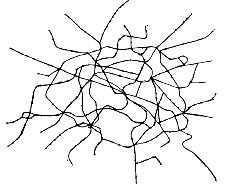
Abstracted map of the Paris metro
I have been thinking about networks since Craig’s thought-provoking comment about the radial nature Chicago L system a few days ago. Thing is, I can’t shake the feeling that narrative and transportation networks are somehow related.
One easy relationship has to do with consumption. I enjoy being on the subway because it affords me time to read that I otherwise would not have. (I turn down rides home because I crave the time to read on the subway.) But what I really love is the way the L — especially when it is underground and impervious to cell transmission — eliminates options. You may be late for work, but there’s really nothing you can do about it. You can’t call anyone; you can’t get off the train and get to work any faster; you’re stuck. And that is wonderful. I feel like I suffer from a surfeit of options sometimes. It is so nice to just resign yourself to the moment. I’m going to keep reading until my stop, damnit. So nice to succumb to linearity.
But that’s not really what interests me. I’m still trying to tease this out, but clearly subway system design has conceptual similarities with new media. Stories can be point-to-point, multi-linear, radial, and true networks. They can even break out of the established route, creating new stations further afield. If you mapped these narrative arcs I bet they would bear a striking resemblance to the abstracted maps of subways around the world.
The final timelapse
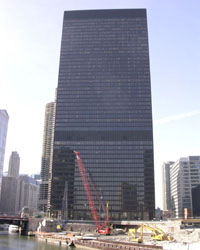
Video stitcher extraordinaire Jack Blanchard delivers this last timelapse (WMV, 10MB) of our officecam Sun-Times deathwatch. Now with music!
Meanwhile, A Daily Dose of Architecture presents a photographic homage to my building, newly — and temporarily — presenting a stunning view from the Michigan Ave. bridge thanks to the demolition.
Is that straight out of 2001: A Space Odyssey or what?
Word problem, the riveting conclusion
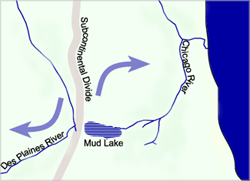
A follow-up to my previous post about water drainage on Harlem Ave. It was, of course, a trick question. At least one of you suggested as much, though no one actually got the answer right. You see, Harlem Ave. is the rough location of a miniature continental divide. Water to the west of Harlem flows west; drainage east goes east. What took me a while to realize is that there still is only one Continental Divide. Drainage west of Harlem doesn’t keep flowing west. Eventually it dumps into the Mississippi and thence to the Gulf. Going the other way ends up in the Lake or the Atlantic. So the answer, assuming no sewer craziness, is that the hydrant run-off will end up in the Gulf.
The Chicago Public Library explains this a bit better. Among other things, this divide is what made the area so attractive to early explorers. A short portage and you could be headed to the Mississippi or the Great Lakes. (Before the Chicago River was reversed, that is.)
Oh, by the way, that little traffic incident didn’t really happen. Just a story in the service of the contest. But thanks for the concern!
In the gutter
I’ve been messing around on the right side of the blog alot lately. Here’s what’s new.
I’ve felt the need for some way to post blurbs that either have no relevant link or don’t warrant the focus of the main flow. Thus, the micropost. Right now it is updated manually, but I am looking to automate. Gotta be an MT sideblog plugin or something, right?
The marginalia section is a del.icio.us-powered link farm. I’m not quite done tagging the links themselves, but when I am that’ll start all kinds of fun. Like this.
Recently played tunes comes courtesy of the excellent Audioscrobbler service. If you have not checked this out yet, do. Basically, you install plugins for your audio programs (iTunes, etc.) and everything you listen to is logged at Audioscrobbler. Over time the site develops a very nuanced profile of your musical tastes. But the real value is in the social functions. You develop musical “neighbors” and can track musical “friends”. Best of all your profile powers a customized radio stream called last.fm. Personalization and social computing done so right.
Two sidenotes on this section. First, like the marginalia, the recently played list is just an RSS feed formatted and served by RSS Digest, which I recommend. But the shortest refresh period is 30 minutes for RSS Digest and this really is not quick enough for the playlog feed. So I am exploring the MTRSSfeed plugin to take one step out of the process. Anyone had any luck with this?
Second, while Audioscrobbler has plugins for iTunes and syncs up with the recently played tracks on your iPod there was no “plugin” for the Audiotron networked audio device, the component that supplies music to the rest of my house. Not tracking the Audiotron would have meant radically skewing my listening profile since the genres I listen to throughout the house differ substantially from what I listen to in front of my computer. But, as happens so often on the web, as soon as you need something, it appears. Kelly Felkins posted a Perl script called Atronscrobbler for doing precisely what I needed. Not only that, but he was kind enough to make code revisions on-the-fly to get it to work for me. The script runs on a computer and just polls the Audiotron and pushes updates to Audioscrobbler. Now, with the exception of the kids’ music that is skewing my profile, I am completely covered. Anyone else have the Audiotron-Audioscrobbler combo going? If so, there’s a group devoted to it now.
The recommended music section is mostly the same, except that links to the iTunes Music Store now contain my affiliate code. If you don’t want Apple to make a micropayment to me for the referral then you can skip this. But why would you deprive me of these penny fractions? Note that, where possible, album info links to discogs.com. Also, I will link to un-DRM’ed files, if they exist, rather than to iTMS.
The outbound links section is redone and powered by Blogrolling. I’m not sure it is working entirely properly yet.
Lastly, the GeoURL badge links to this blog’s neighbors in meatspace.
There are other minor updates, but that’s the bulk of ’em. Thanks for reading.
See also: Marginalia
Slump driving
Stopping your car under a viaduct at night could remind you of being in your own garage at home, right?
Friday night as my wife and I were heading to a restaurant with some friends we had to navigate around a car strangely stopped in the middle of the road (going under the tracks just west of the Cortland street bridge, for you Chicagoans). As we drove past we glanced over to see the driver of the stopped car slumped over the wheel and looking very unwell. We stopped. Our friends stopped. Traffic stopped. My friend, an M.D., did a quick check. The driver was alive, but doc thought he O.D.’ed. We gently roused him, stopped the car (which was — oddly — in park), and removed him and the keys.
The paramedics and cops eventually came and we went on our way. I’m not sure the guy was drunk, but he was clearly on something. I’m convinced he thought he had pulled into his garage, calmly put the car in park, and then blacked out. Not that he’s not an idiot, mind you. Just my theory.
Arcade symphony
Call it recombinant audio archaeology. Andy Hofle has recorded the noises of classic arcade games of the 1980’s from the available ROM emulations and then mixed and layered them into a stunning simulacrum of the experience of being in an arcade. He’s got background noise, coin changers, and even people talking. A current-day casino might come close, but you’d hear so much more in a casino: slots cha-chinging, recorded voices entreating you to play, and more realistic noises. An arcade in 1983, on the other hand, was all about synthetic bleeps, bloops, and blow-ups. And this is why I love it. The background radiation of my youth.
Mission Elapsed Time: 20:00:21:06:42:40

I went back through it this blog (and my Flickr account) on its 20th anniversary, retracing digital footprints made on what feels like a different planet. Here are some highlights.
The Terror Tourist

A roughly monthly exploration of places in horror fiction — real or imagined, geographical or psychological — culled from The Heavy Leather Horror Show.
Subscribe to the podcast or the email newsletter or just read through the archives posted here.
The Ampcamper

How I hauled myself, two teens, an 80 lb dog, and a whole load of crap 4000+ miles across six states in twenty days using an electric vehicle. And survived to tell the tale.


