
Going, going, gone

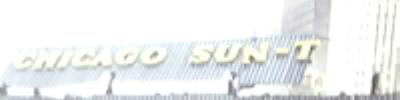
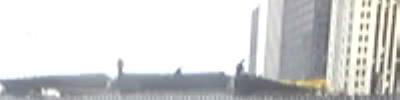
The blogosphere likes to talk about toppling old media. Today, I saw it topple for real, with nary a blogger in sight. Beats my normal daydream-fodder cubicle vista.
I should have one hell of a view carved out for me when I return to work after the holidays. A temporary thanks to The Donald.
(Photo gallery here.)
Mommy, is that a type of swimsuit?
No doubt conservatives hear the gallop of the Four Horsemen in this story, but I find this totally hilarious. Someone at the YMCA near me needs a better Dayplanner. Citing “a very regrettable scheduling error,” the Y overlapped an all-night transgender fashion show with a 7am kids swim meet.
Tired omnisexuals. Protective yuppie parents without their lattes. Bewildered children. Hilarity ensues.
E-mailing Richard Powers
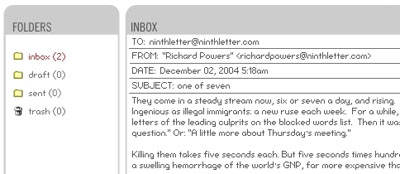
The e-lit blogs are abuzz about “They Come in a Steady Stream Now,” a new online piece by Richard Powers, the much-lauded author who consistently joins themes of technology and art in his novels. The general tenor of the comments on the new piece (with exceptions) seems to be mild disappointment that such an esteemed author didn’t create a masterpiece with his first foray in digital lit. I disagree, but not because “They Come in a Steady Stream Now” is exceptional — it isn’t, though it is very good indeed.
Thing is, Richard Powers is already an e-lit author. I saw Powers speak at the Chicago Humanities Festival a few years ago. It was the first time I’d heard him after years of knowing him through the written word alone. Perhaps that explains what happened to me. Powers delivered a reading of what came to be called “Literary Devices” at the CHF. This gets a bit convoluted so follow me here. In the listening “Literary Devices” seemed like a straightforward recounting of an e-mail exchange that Powers was involved in after delivering a real paper called “Being and Seeming” (“real” because I Googled it right after the talk — still online here). I was completely captivated by the conversation which, in a nutshell, revolves around a system called DIALOGOS, a next-generation ELIZA that convincingly writes fiction and sucks Powers into an ongoing exchange. It was only after the session ended on my way home did I realize that I had been completely duped. The CHF had not invited him to deliver a paper — it was total fiction, just sittin’-around-the-campfire storytellin’. And I had given myself to it utterly. I was the test subject who couldn’t distinguish the human from Turing’s machine.
Now, granted, this wasn’t electronic literature. Hell, it wasn’t printed literature. (Only much later did Salon publish the story, since removed, but available for purchase now.) This was oral literature in its most primitive form. Yet, in its colloquial, fast-paced, almost stream-of-consciousness delivery it really did evoke an e-mail exchange: call it performance e-lit. I was so amazed at how taken I was with this story I e-mailed Powers as soon as I got home. Like the now-fictional correspondent from the talk, I was the audience member who was striking up a real dialogue with the author, effectively continuining the narrative by e-mail — my own personal electronic appendix to the story.
All of this is an elliptical way of making the point that I consider the reading of “Literary Devices” to be Powers’ first jump into electronic literature, though it had none of the trappings of typical e-lit. No links, no point-and-click interactivity. But in its is-this-real-or-am-I-witnessing-artifice way it was the perfect Turing test and one that spawned at least one (though probably more) personalized narratives via other channels. The experience of the story, rather than the words on the page, was akin to some of the best e-lit experiences I’ve had and that’s why I consider “Literary Devices” an exemplar of the form.
“They Come in a Steady Stream Now” is certainly worth reading — Powers as always plumbs the human depths of technology — but it is more run-of-the-mill electronic literature and that, in the end, is why it is, well, run-of-the-mill.
UPDATE: Powers joins the conversation at Grandtextauto. An 8th e-mail, so to speak.
Accessing a book like a hard drive
If there’s a book that I remember more vividly than most from my childhood it has to be Inherit the Stars by James P. Hogan. The story is kicked off by the discovery of a 50,000 year-old human skeleton in a spacesuit on the moon. The ancient astronaut also had some effects with him, including a book. The scientists use a scanner that can read the book without opening its very brittle, damaged pages, basically peering into and reconstructing the sheets at variable depths. I always thought that was so cool.
Turns out this is no longer a fictional technology. Researchers at the University of Kentucky have figured out how to do it. Imagine being able to scan like this on a bookshelf- or library-wide scale, gulping down petabytes of data without cracking into the books themselves. (Via MGK. Thanks Matt!)

a + 30 + a’
I hadn’t read John McDaid since his seminal hypertext fiction Uncle Buddy’s Phantom Funhouse helped push me out of traditional literary studies onto the track I’m on now. Eight years ago maybe? Then this week Boing Boing enthusiasically blogged “Keyboard Practice, Consisting of an Aria with Diverse Variations for the Harpsichord with Two Manuals,” one of McDaid’s short stories. Since it caught me in that rare moment when I have just finished a book on the train to work and have nothing to read on the ride home and it was available for download I thought I’d give it a try. Well well well. I gotta agree with Cory. This is one hell of a story. You have to think McDaid is familiar with Richard Power’s Goldbug Variations (especially given his epigrammatic mention of gene sequences), the only other story I know so self-consciously influenced by Bach’s Goldberg Variations. I dare not try to wring a synoposis from either. Suffice to say that McDaid ably turns the reader into a rapt listener at a futuristic piano recital. It is a beautiful, lyrical story. Frankly I don’t remember his prose being so textured, but maybe that’s because I was too enamored of the medium back in the Uncle Buddy Hypercard days. In any event, this is worth your time. Pop Glenn Gould on too, if you have it. Download here.
Speaking of lake views …
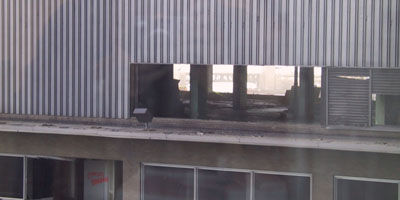
Up until last week, I didn’t have one from my cubicle. Now, thanks to the strange progress of the dismantling of the Sun-Times building I have been granted a little portal to the east. (Note: if you look closely through the building you can see the bridge from which the enterprising gentleman from yesterday’s post was evicted.) Granted, I’d prefer a cataclysmic immolation of the building like you see on TV (mostly because the building is an architectural abomination), but that’s really not possible with the river right there. Still, that’s got to be safer than what they are doing now. I’m no OSHA supervisor, but should you really be using a frontloader to destroy the roof that is the only thing keeping you (and the frontloader) from plummetting to the next floor down? Oh, and Mr. Worker-Guy who randomly destroys things on the roof with a giant axe: I want your job.
Wheels and towers
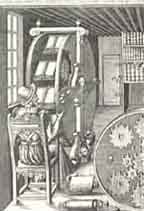
Daniel Libeskind became a celebrity when he was selected, amidst much controversy and eventual, bitter infighting, to provide the master architectural plan for Ground Zero. But before that, he was a minor hero of mine for orchestrating the construction of a funky 16th century contraption called the “reading wheel,” basically a precursor of modern hypertext. Libeskind’s studio took great pains to reproduce this machine:
“To try to become the pure medieval craftsman — that’s really the object of this exercise … So we did it that way. We got up at the crack of dawn, four o’clock in the morning. We built this machine in a small place without any power tools, just with hand tools; with no electricity, just with candlelight. We went to bed early because with candlelight you can’t work late. And we did it in silence because there is nothing to talk about when you work like that.”
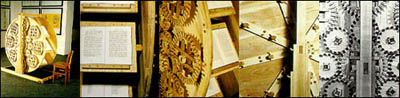
One wonders if real students of Libeskind’s style and oeuvre could chart a linkage between his interest in the reading wheel and the twisting, aerie-like Freedom Tower. Perhaps it is the turbines in the lattice at the top of the structure? (Not sure about that one; didn’t Skidmore add that?) Who knows, but I like the tower better for it.
The wheel itself, though not Libeskind’s version, pops up from time to time in literature and art. Richard Lester used some version of the wheel as a pratfall prop in his Three Musketeers. And, most recently, in The Confusion Neal Stephenson uses the wheel, called a Bücherrad, as a literary device (literally) in the lab of Gottfried Leibniz. Wheel on over to Amazon and read a bit.
Elegantly primitive, technologically advanced, but most of all beautiful in how it addresses a simple need, the wheel is truly captivating. If Libeskind achieves half that with his tower at Ground Zero he’ll have accomplished quite a lot.
Available: loft apartment w/ lake and river view
Some people outrun drawbridges, others live in them. For three years Richard Dorsay has been living in a makeshift home amidst the girders under the upper roadway of the Lake Shore Drive bridge that spans the Chicago River. The media is calling him homeless but he apparently had rigged electricity from the bridge allowing him to have a TV, microwave, and Playstation in there! He even washed in the normally-empty control-house that operates the bridge’s ups and downs. Best of all, Mr. Dorsay would ride the bridge as it went vertical to let the sailboats through. The cops evicted him Sunday after a former roommate — bridgemate, girderpal? — ratted him out. This guy deserves some sort of ingenuity award from the city — and a warm place to live.
Little Glimmers
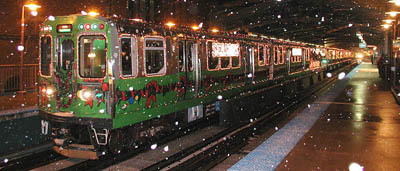
It may not be a Miracle on 34th St., but the annual CTA Holiday Train is fairly amazing. I happen to love this little tradition. The L adds a flatbed car and lets Santa and his reindeer and elves ride it. Each of the passenger cars is extensively decorated and staffed by CTA volunteers dressed as elves. Holiday tunes are piped in. The best part of it all is watching kids on the street look up and spot Santa and his crew flying past on the elevated tracks — as close as they will ever come to actually seeing the sleigh airborne, I’d wager. Note that this is wintertime Chicago. The wind on that flatbed car has to slice through the volunteers like so many daggers. Yet, they are all cheer.
This year the effort was unusually heroic because of the financial straits the CTA finds itself in. First they cancelled the special train over guilt at the operational costs and in light of upcoming layoffs. Then they reinstated it after the public made it clear that this was unacceptable. I believe the CTA came to realize that their efforts at winning the hearts and minds of its riding public in the PR war for better funding was ultimately more important than the costs involved.
For me, the once-yearly sight of a car full of passengers actually smiling and speaking to one another — rather than diligently avoiding eye contact as is normal behavior on the L — in itself is a great thing, a gift of sorts.