
Jewelboxed
There’s little I love more than when someone takes a simple idea and makes it extraordinary through attention to detail and good usability. That’s precisely what Coudal Partners, a design firm in Chicago that made a bit of a name for themselves with Photoshop Tennis, has done with their side business called Jewelboxing. They were unhappy with the packaging available for CD’s and DVD’s so they did something about it. I used their system to package the annual year-end mix I give out to my friends. Kudos to Coudal. Highly recommended.
New media everywhere
Matt Kirschenbaum asks “What if new media simply became a part of what writers and artists did, not something special or new?”
Well, first thing you’d need to do is stop calling what we do new media, but that’s peripheral. I’d tweak Matt’s question just slightly to ask: What if new media — or whatever name we give it — is just something that people do? Not artists or writers, per se, but people in general. New media is, after all, just expression, creation, manipulation using a computer. Some of it is mundane (e-mail), some of it is beautiful though perhaps not art (elegent code)*, and some of it would qualify as art because of the way it partipcates in an emotional and intellectual dialogue with the viewer/user. Digital communication today is a completely normal mode of human expression for most people. Very little is ‘new’ about it, even if it is very young medium. So I’m with Matt. Let’s ride that bandwagon of normalcy. If we ply our trade well it will be highly considered, irrespective of medium designations.
* This is a topic for another day. I’m not so sure code isn’t art.
Flipbook

Moving files from one computer to another I came across this gem. In the summer of 2002 my brother and I took a trip to NYC and we visited the American Museum of the Moving Image in Queens. (Which I highly recommend, by the way. There’s a persistence of vision demonstration using strobe lights and a giant whirling contraption that is worth the price of admission alone.) One of the interactive exhibits allowed you to act in front of a digital camera that snapped images to create a printed flipbook. We digitized it, of course. Click the image to see the animation.
Once a hardware company, always …
Well, it’s official. IBM is selling its personal computing division to Chinese computer-maker Lenovo. The ubiquity and sometimes-elegiac tone of the coverage of the transaction points to a fact that I live with every day: people still think IBM is a hardware company. I have come to see the futility of trying to overpower that meme. No matter that over 60% of IBM’s revenue comes from services and consulting. When IBM does something again as revolutionary as invent a personal computer then maybe the public perception will shift. Until then — even after IBM is long out of the personal computing market — people will think it outrageous that I work on a Mac at the office and find it odd that many IBM client solutions have no IBM hardware at all in them.
‘Course, I use a ThinkPad too and I think it is a superb machine, the best PC laptop made. And I thought that well before I took a job with the big ‘BM. That’s the only part of the sale that gives me pause. I certainly hope Lenovo can keep up the quality. By the way, did you know the ThinkPad design was inspired by a traditional Japanese lunchbox?
And, no, I don’t believe the Apple rumors. It just doesn’t make sense to me. But hey, strange bedfellows abound.
Donnie Darko
I’m late to the game on this, but no matter. Donnie Darko is the best film I’ve seen all year. I can’t remember the last time a DVD finished and I immediately jumped to the menu to play it again. (My normal post-movie routine is to visit IMDB to read the trivia on the flick.) Re-viewing is almost built into the movie itself. The dramatic fulcrum of Donnie Darko is the title character’s reaction to knowing how things will turn out before he should know. Donnie Darko is richly rewarding, bitingly funny at times (Patrick Swayze is absolutely superb), and even frightening. Apparently the director, Richard Kelly, was 26 when the movie, his first, was released in 2001. Goodness gracious.
Time travel, a creepy man-bunny, Michael Dukakis. It’s all there. Rent this movie.
OneVoice

Daniel Lubetzky is going to win the Nobel Peace Prize one day. You read it here first. Daniel is the founder of PeaceWorks, a not-only-for-profit business based on the principle that economic interdependence eventually can overcome socio-political turmoil. Basically they get people on opposite sides of a conflict to work together to produce high-end foodstuffs. But that’s only half the story.
The PeaceWorks Foundation — a group I have been working with for a few weeks now — is the non-profit wing of the company. Their main project is OneVoice, a unique grass-roots effort to promote the views of the vast swath of moderate Israelis and Palestinians. The process is fairly simple. Once Israelis and Palestinians are registered to vote with OneVoice (both online and by volunteers on the ground) they are asked to state their opinions on a variety of issues. The referenda are rolled out in phases and contribute to a progressively more honed and unified position statement that will eventually be forwarded as a mandate to global leaders. One interesting point is that, in an effort to promote negotiation, absolute rejection of a proposal is not allowed. You are alloted a limited number of points with which to register your relative level of discord. Use too many on any one issue and you may not have the ability to reject a point later in the vote. The mechanism is a gravitational pull to the center.
There’s a real urgency now with the upcoming Palestinian elections. Daniel and his team are preparing for television coverage, new voting, and a high probability that a supporter of the OneVoice initiative will succeed Arafat. To capture some of this momentum, they’ve created a blog. It’s nascent, but look for it to mature rapidly in the coming week or so.
I’m proud to be a part of this.
Favorite things, first in a series
Seems like I have come across quite a few useful, fun, or otherwise notable things lately. Thought I’d share.
Dynamap – Currently only for Manhattan, the Dynamap is a map made of polarized lenses stacked on each other so that when you alter the angle of viewing you see different layers of information: street grid, subway system, neighborhoods. Innovative and totally useful.
Konfabulator – Clearly someone at Apple thinks this is the future of modularized, task-specific applets since they are building Konfabulator-like functionality into the next version of their OS. But Konfabulator one-upped Cupertino by becoming cross-platform. To get a quick sense of what Konfabulator does visit the widget gallery.
del.icio.us – Social bookmarks. Like Friendster, except with your links. See how many or how few people link like you do.
flickr – Superb online photo gallery. Impressive editing and organization tools. Great attitude.
Web Developer – Extension for Firefox that adds a slew of geeky web dev tools, but the best by far is a block level element outlining function. Indispensible for ferretting out nested <div> tags and such. (Example.)
Delicious Monster Library – An iLife-like app (Mac-only) that organizes your books, software, videos, and games. Cool part: it can use a webcam to simulate a UPC code scanner, directly grabbing the volume info from Amazon.
Moleskine notebook – Paper PDA. Proto-blog tool. (Even hackable.) Snapping the elastic band over the cover is strangely satisfying.
Smarty Pants – Movable Type blog plug-in that enables curly quotes, em-dashes, and real ellipses. “I’m … not — kidding.” Rejoice!
ISS-Soyuz bags – Satchels and backpacks made from used Soyuz re-entry parachutes. “Why, yes, this bag has been to space and back.”
Take a memo

The shoot continues and the levels of overlapping documentary going on are humorous. To start, the project is a documentary about the history of documentation and interpretation in Egypt (that is, Egyptology). Fittingly, today we videotaped the famous Seated Scribe statue being scanned in three dimensions by a laser shape-grabber. Of course people were snapping pictures of the videotaping. So let’s recap: photography of the videotaping of a scanner capturing a sculpture of a person writing. That’s about as far back as this meta-documentary hall of mirrors went. If I only I were blogging it in real-time.
“Quite a pile”
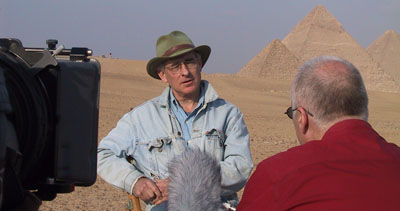
I’m back in Egypt with the crew shooting the Eternal Egypt documentary. Everything’s going as expected: the hurry-up-and-wait of the film business multiplied by the hurry-up-and-wait of Egyptian life.
We interviewed Mark Lehner today. Along with Zahi Hawass and in addition to referring to the Great Pyramid as “quite a pile,” he’s most (recently) known for his discovery of the “workers’ village” (photos), the urban complex of the pyramid-builders at Giza. He’s a fascinating guy and, like Kent Weeks, wonderfully articulate about the importance of what he’s doing. You’ll have to wait for the documentary for the full scoop, but something he said today really made me think. He was explaining how astonishing the pyramids of the Fourth Dynasty are, given their precision and size. Importantly, he noted that no undertaking on their scale in the time it took to build them was ever duplicated in ancient Egypt. He then made a quick aside — I’ll bet it’ll end up on the cutting-room floor — that this burst of activity and innovation can be likened to the US space program’s accomplishments in the 1960’s. The implication is that we’ve not achieved anything comparable in the 35 years since we landed on the moon. Which, of course, is true as far as manned spaceflight goes.
But it got me thinking. There are many, many people who believe the only way to explain the Giza pyramids is to turn to supernatural forces, lost civilizations, or alien intervention. “Pyramidology” is an entire pseudo-science dedicated to these claims and there is no shortage of TV programming that laps it up. So I ask, if we are unable to get out of low-Earth orbit in the coming decades will the popular imagination begin to search for extra-human explanations as to how we accomplished the moon landings in the first place? That is, if enough time passes after a watershed technical achievement is it inevitable that humans will seek to explain its occurence in non-human terms? Certainly, there is a fringe that always does, but I wonder if technical singularlites like the Apollo program are doomed to mystification if not repeated. Can’t we just go to Mars and not find out?
Linguistic sidenote. The location producers here in Egypt are known as “fixers” and they are a three-person family team. They are extraordinarily good at what they do. They are also near-anagrams of one another: Romany, Ramy, and Mary. Wish I had thought of that with my kids.
Safety dance
Did anyone catch this weird one-point safety in the Texas-Texas A&M game on Friday? I was at the game and it was hilarious to see the crowd erupt in cheers at the awarded point (after the botched extra point) while virtually no one knew or understood what the hell they were cheering for. I’m no football scholar, but huh?
I promise no more 80’s song title references. Got carried away. Sorry.