« May 2005 | Main | July 2005 »
June 29, 2005
Like a caterpillar
"Daddy, I'm not going to take a bath until you let me smell the maggots one more time."
What's most wrong with this statement?
(1) child giving parent an ultimatum
(2) presence of maggots somewhere in our home
(3) implication that he doesn't need to bathe unless exposed to maggots
(4) suggestion that I let him smell the maggot-pile in the first place
(5) that he needs another hit of rot-waft
Posted at 8:18 PM | Permalink | Comments (1) | Topic: The Darnedest Things
Architectural spine
BusinessWeek just published their annual design awards. The Kansas City Public Library won one for their facade-as-library-shelf.
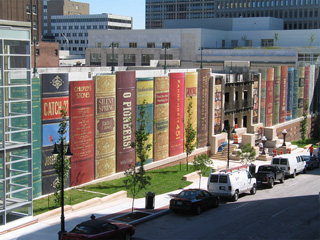
I knew I was on to something in this post, but maybe not quite so literally.
See also: Virtual flâneur
Posted at 9:22 AM | Permalink | Comments (0) | Topic: Art/Design
June 28, 2005
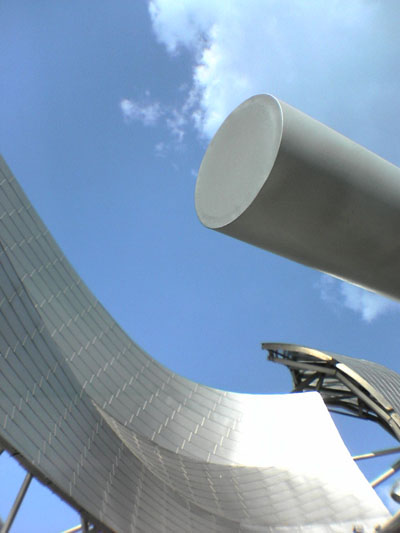
Algebraic soundboard
Terminus of one of the tubes that form the lattice "dome" above the great lawn at Millennium Park with the ribbon-like Gehry bandshell behind it.
Posted at 11:20 PM | Permalink | Comments (0) | Topic: Chicago
"Heresy" after a decade
Ten years ago I wrote a paper for a small graduate school conference that in retrospect marked a real turning point in my life. The Heresy of Hypertext: Fear and Anxiety in the Late Age of Print was a bit of a personal manifesto, an attempt to bring my literary critical skills (my day job) to bear on the new media of hypertext (what I obsessed about most of the rest of the time). But, in truth, it was actually an extended rant to my English grad school professors about the importance of hypertext and digital text. Great scholarship "Heresy" wasn't -- and oh my how saturated it is in gradschool-speak neologisms! -- but it is still the most linked-to part of any site I have ever had. It has even been anthologized and translated.
But ten years is a long time when you're writing about new media. Let's see how it holds up.
Just as bibliographers regard 1501 as the year that printed books emerged from the "cradle" of their post-Gutenberg nativity, the first year of the coming millennium will likely serve as a convenient demarcation point for the end of the beginning of electronic textuality.
True enough. By 2001 blogging was in full swing, putting to rest any notion that the written word and electronic media were somehow incompatible. Though literary hyperext was not a mainstream phenomenon in 2001 (and is not now) I think it is fair to say that by 2001 most would agree that electronic textuality had matured to the point where the distinction between it and the printed word was largely academic -- a sure sign of cultural assimilation.
Though this new textuality promises to level hierarchical distribution of and access to even the most esoteric data, we should not make the mistake of equating the leveling with a reduction in the standards of professional scholarship. In fact, in such an intraloquial and interactive scenario, shoddy work quickly draws attention to itself, succumbing to the necessarily higher standard of excellence in a web of virtual collaborators and competitors.
Mostly true. Wikipedia is a great example of this kind of collaborative weeding-out of shoddiness. A web of casual editors does expose deficiencies in rigor and quality faster than in other media. But the very anonymity, publishing reach, and fungibility of electronic text also makes fraud a hell of a lot easier.
To the mind weaned on the indelibility of the printed word, electronic text seems unstable, less epistemologically graspable. I submit that this mostly unconscious perception of instability generates anxiety in the reader, anxiety of the type usually written off to the "it just feels different" category.
I think I missed on this one. Perhaps it was true in 1995, but I'm now of the opinion (largely because of Matt's work) that the immateriality/instability was an illusion. The "just feels different" aspect, I suspect, was mostly a function of screen resolution.
Not a bad little paper, after all. Overwrought to be sure, but a personal milestone and one that I will always look to as the springboard that launched me into the arc that I am still on.
Posted at 10:43 PM | Permalink | Comments (1) | Topic: Science/Tech
June 27, 2005
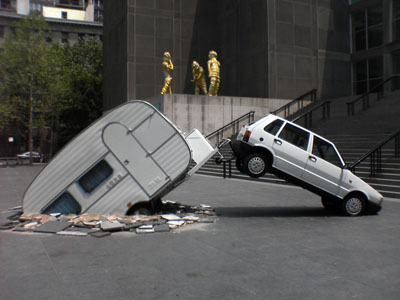
Always check the hitch
At the MCA.
Posted at 8:08 PM | Permalink | Comments (0) | Topic: Art/Design | Topic: I Like
June 26, 2005
Tips for bulk-shucking crawfish
Do it outside. Juice will splatter when you crack the carapace.
Keep separate containers for shucked and to-be-shucked mudbugs. They look remarkably similar and after removing the meat from a few dozen you'll start to confuse the two piles if you use one container.
To remove tail meat, do the following. Press down with the thumb of one hand where the tail meets the body. Push towards the head with thumb. Rip head off with other hand, discard head. You should have two legs (or more) still attached to the tail and a small white Y-shaped piece of meet sticking out from the tail (pulled from the body itself). Crack off the carapace where the legs are connected. Push index finger, nail first, between the meat and the shell from front to the end of the tail, severing the connection between the two. Pull out meat. Remove small, usually dark vein that runs the length of the tail. The key is to pull it out rather than rip it out since there is a small piece of meat that covers the vein and might as well be retained if you can do it.
Darker-red crawfish have harder shells. On these dark crawfish, you might want to crack the tail like you would do with a lobster before attempting the above.
Your thumbs and forefingers will develop lots of micro-cuts. This is nothing to worry about.
Assuming you seasoned your crawfish with liberal amounts of cayenne (and related hot stuff) your hands will begin to burn after about twenty or so shuckings. It seems the spice-infused crawjuice just seeps in. This is something to worry about. It hurts.
About 17 lbs. of crawfish generates as much meat as pictured above. Lots of work. Best to make certain you're really into crawfish before undertaking. Good luck.
Posted at 11:23 PM | Permalink | Comments (0) | Topic: Fun
Tonsiloliths
My brother and a co-worker of mine both have tonsiloliths. Literally, "tonsil stones" and sometimes referred to, so pleasantly, as "throat scabs" these nasties are actually just whitish balls of accumulated goo that form around food particles and bacteria rather like a pearl does around a grain of sand. They live tucked away in the tonsil cavity, occasionally peeking out to say hello and cause a little halitosis. Oh, they also are without question the stinkiest things I have ever smelled produced from a living human body.
If they are ready you can pop them out and dispose of them. I've had the unfortunate privilege of witnessing both my co-worker and my brother do this. The funny thing is that they both thought they were uniquely afflicted with these mouth-born stinkbombs and were either too embarrassed or too unconcerned ever to wonder if it were a documented condition. Of course, it is. Googling around a bit with descriptive keywords it is easy to find forums devoted solely to people happy to be in the company of other tonsilolith-producers.
Having witnessed all this, I consider myself a second-hand tonsilolith sufferer. At present, there are no online communities devoted to this topic.
Posted at 11:03 PM | Permalink | Comments (150) | Topic: Science/Tech
June 23, 2005
Semiotics of freedom
A question for you. What is the difference between these two things?
Exhibit A
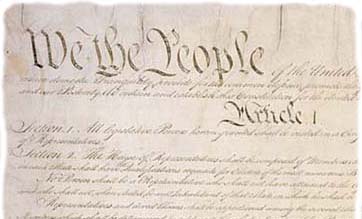
Exhibit B

Give up? The first establishes the freedoms that Americans enjoy and must protect at all costs. The second is a symbol of that freedom. OK, so another question. Which is more important to you? Which would you be more likely to put your life on the line for? Seems to me an easy choice.
Whenever the issue of flag desecration comes up I can't help but think of early religions that came to value physical depictions of a god more than belief in the deity itself. Aren't we past this, people?
Posted at 11:56 AM | Permalink | Comments (0) | Topic: America
June 21, 2005
Nailed
My son crawled out of bed tonight and announced to us that he needed his toenails clipped. I thought this was the funniest thing I had ever heard -- at least a very creative excuse not to go to sleep (what if a long nail caught on the comforter?!) -- but I immediately knew that laughing would not be received well by thelovelywife. I stifled my laughter in my elbow pit.
Without looking up from her magazine my wife dryly replied, "Son, we do not trim toenails every night. Go back to bed." Which he promptly did.
See, I would have blown that exchange in any myriad of ways.
Posted at 7:58 PM | Permalink | Comments (0) | Topic: The Darnedest Things
June 20, 2005
Lincoln for our time
As New Yorkers and political activists around the country bicker viciously about the story of freedom to be told at Ground Zero, I was able to make a trip down to Springfield, Illinois last week to visit a freedom museum of a different sort, the newly-opened Abraham Lincoln Presidential Library and Museum.
I went in with low expectations, figuring that the experience would be either like the creepy robots in the Disneyworld Hall of Presidents or the imposing apotheosis of Lincoln at his memorial in D.C. It was neither. It was, in short, one of the best museum experiences that I have ever had. I'd highly recommend taking a trip down there to see it, if you can. The website is lackluster, but the buildings themselves are quite high-tech. Here are some highlights:
Ghosts of the Library - Think holodeck meets your local librarian. This might be the most interesting application of technology. The museum calls it "holavision" (blech), but it is really just projection that the audience views through a stage-wide pane of polarized glass. A real actor (the "librarian", though with a twist that I will not ruin for you) interacts with a real set and with seemingly three-dimensional projections on the stage. The effect is very convincing. The most interesting part of this section is that the purpose of it is to explicitly address the connection between period documents/artifacts and the stories that are told in the museum. That is, they make a strong case for the importance of the seemingly inert collection of documents and artifacts and how they relate to the vivid stories that the museum tells. It is convincing and well-presented. Basically the credo of the Eternal Egypt project: using historical source materials (elements) to bring stories to life. (Also a great political trick, tying the importance of the library to the success of the museum.)
Hall of Whispers - A simple but moving hallway depicting the political invective that brought the country to the brink of the Civil War. This is done through period political cartoons and "whispered" broadsides that rain down on visitors as they move through zones of directional audio. The interesting thing is how the use of skewed lighting and off-center mounting of the cartoons create a disconcerting, almost unstable feeling as you walk through the hallway. (Some people get dizzy, apparently.) In other words, even if you don't read or hear anything in the hallway you get the sense of a nation coming apart. A little spooky actually.
Lincoln-Douglas Debates - Controversial but fascinating, this exhibit uses a real television control room with multiple feeds going simultaneously to recreate these historic debates as if they occurred today. They have real news anchors (I remember Tim Russert, specifically) with fake infographics and news crawls ("Physicians discover substance called 'germs'!"), and actors representing Lincoln, Douglas, and supporters yelling back-and-forth ala today's news shows. You watch this from the perspective of the television room producer. Not sure if it completely works, but it certainly had children rapt in a way that the debates might not normally.
The Union Theater - An extremely high-tech theater with multiple proscenium-style stages, overlapping/moveable screens, rumble seats in the audience, and other special effects. The current programming there is a show called The Eyes of Lincoln that uses the actual depiction of the man's eyes in photographs over the years as points of departure for explaining his life. It might seem a stretch, but it actually works. (Look again at his left eye. It wanders.) What I liked was the thought given to the actual subject-matter in such a high-tech theater. They could easily have gone all George Lucas on the thing and relied only on the smoke machines, but they didn't.
Looking for Lincoln - Not a technology, per se, but interesting in that this program seeks to explicitly situate the museum exhibits in the context of other Lincoln sites around Illinois. Throughout the museum you are entreated to "look for" Lincoln at his home, law office, or other related structures around Springfield and elsewhere in Illinois. Likewise out in Springfield one encounters well-presented plaques that give background and direct people into the museum for more information. Sort of a dispersed regional tour embedded in the museum proper.
There are of course more traditional museum exhibits -- artifact-based -- but even these are nicely enhanced with technology, such as projected signage that is nearly identical to the actual printed signage on the walls. (You have to pass your hand in front of them to tell.) Overall the museum is about experiences and storytelling and the technology is used in the service of that. Critics call this Disneyfication. I think they've avoided the worst excesses of that label.
Lastly, lest my rah-rah for the museum make you forget that I am talking about downstate Illinois, I have included this photo of a hog truck pulled up right in front of the Futurama-Prairie Style museum building (seen from the rotunda of the library across the street). The old and the new.
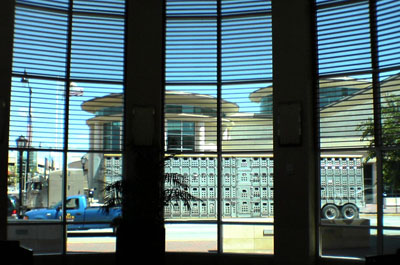
Posted at 10:25 PM | Permalink | Comments (0) | Topic: Art/Design
Copy/Paste/Swap
Here's something I need invented, if it does not already exist. I want to highlight a selection of text in an editable field and paste into it what I have on my clipboard (normal function so far) replacing the contents of the clipboard with what I am pasting over. A swap function, if you will. I could use this in a variety of situations. Someone tell me this hack/app exists. Please?
Posted at 10:20 PM | Permalink | Comments (1) | Topic: Science/Tech
Zap
Laptop's back from the shop. It has been a cascade of technology failure for me lately. Last week, my iPod just back from refurbishment (HD was flaky), I excitedly plugged it into the USB port on my laptop. Zzztt. Immediate shut down. Wisp of electrical smoke snaking out of the side vent. Lovely.
The laptop booted, but without working Bluetooth or USB ports. Funny thing was, I missed the Bluetooth way more than the USB. That's got to be some kind of milestone for me personally. I realized, outside of my system-frying iPod, that I never plug anything into the USB. Mouse is Bluetooth; printer at work is; phone connection is; headset (for Skype) is. Long live the golden age of wireless.
And yes, if you're counting, this is motherboard death #2 in calendar year 2005. Somethin' ain't right.
Posted at 10:09 PM | Permalink | Comments (1) | Topic: Science/Tech
June 17, 2005
Maximizing reading time
Recently, anticipating a dull drive into downstate Illinois, I purchased Freakonomics as a digital audiobook from iTunes. Well-blogged and approaching supermeme status, Freakonomics was an excellent book. My only criticism was in the format. Some of the data-heavy parts of the narration (lists, recitation of percentages, etc.) didn't work so well in the format of an ever-onward audio stream.
But the audio format did give me an idea. Smartly, the iPod and iTunes synch virtual "bookmarks" so that you can always know where you left off. But what I'd really like is the ability to tell an audiobook on the iPod which page I left off in the print version of the book (and vice versa, to have the iPod tell me where I would be in print). Why? I would like the ability to seamlessly switch reading modes -- visual and audiotory -- as the environment around me dictates. The most common scenario I envision is on my commute, the precious time when most of my day's reading happens. I carry my book with me on the walk to the L train so that I have it out when I reach the platform, but that walking time is time I could be reading if I didn't have to be heads-up negotiating traffic on my stroll to the L. But since I always have my iPod headphones on (for music) it would be great if I could tell the iPod where I left off in print. I'd gain an extra few minutes of reading time. Likewise, if the train was too crowded to comfortably open a book I could revert to the audio format. I still highly value the physical phenomenon of reading a book and would not want to give that up, but it seems to me some fluidity of output would increase my reading efficiency greatly.
Practically this would be problematic. For one, audiobooks are expensive. Owning hard copies in addition to audio versions seems excessive. Also, with so many versions and paginations of a single book title -- no to mention abridged and extended audio versions -- the synching would be very difficult. Lastly, and I suspect this is the real deal-breaker, I bet it would be somewhat jarring cognitively to switch back-and-forth between reading modes. Reading a book normally simply takes more work, a greater level of engagement, than sitting back and having it read to you. Maybe I underestimate our ability to do this. People switch between reading, watching TV, and carrying on a conversation all the time. But I think it is the fact that these tasks are all different as opposed to being an identical narrative in different modes that allows us to make the cognitive switch.
Guess I'll have to test it out and report back.
Posted at 7:36 AM | Permalink | Comments (0) | Topic: Words
June 13, 2005
Import > Life
A corrupt iPhoto preferences file caused me to have to re-import nearly 10,000 digital images recently. Watching them all get sucked in and displayed for a fraction of a second might be like what having one's life flash before his eyes is like, if that in fact happens. (Reminds me of that scene from Flash Gordon when Dr. Hans Zarkov is having his brain probed and displayed on a screen.) Weird which images burn in to the brain as the rest flicker by. I'd call those the Important Moments if they were not so completely random, mundane, or titillating. Wait, maybe those are the Important Moments.
Posted at 11:37 AM | Permalink | Comments (0) | Topic: Science/Tech
June 12, 2005
Premiere tonight

Posted at 6:31 AM | Permalink | Comments (2) | Topic: Egypt | Topic: Work
June 11, 2005
A unique phone call
"911 emergency services."
"Yes, hello. I just passed under Montrose Ave. in a canoe and the bridge is on fire."
"In a canoe?"
"Yes, on the Chicago River. In a canoe. The bridge is on fire from underneath. Smoke's billowing out across the river."
"Ah ... ok. We'll have the fire department out right away."
"Will you send fire boats that shoot water from giant nozzles?"
"Probably not, sir."
[frustrated grunt] "I'll keep paddling then. Good night."
Posted at 10:27 PM | Permalink | Comments (0) | Topic: Chicago
June 10, 2005
No one calls them microcomputers anymore either
Well the micropost experiment failed miserably. Culprit: time. Rather, lack thereof. I never got around to integrating microposting into the posting mechanism or the RSS feed/archives. So it was a manual process from start to finish. From now on all tiny posts will happen as regular blog entries. Better that way.
For the record, here are all the microposts to date.
++++++
My health club is promoting a kung fu class for three-year-olds. Short of an intro to electrical re-wiring I'm unable to think of a worse form of recreation for my child. Hee-yaa!
"Install a dashboard funtion which controls the speed of the wipers so that they keep time with the stereo." from Idea-A-Day
My son is having trouble eating a hot dog. Wife thinks fast. Carves top of frank into a cone. Slits ends, inserts potato chips as foils/stabilizers. Presents to son as as rocket ship. Fascinated, he eats the whole thing in between blast-off noises. Brilliant!
How hard is it to get NASA back on track? Perhaps it requires a rocket scientist.
Yearn for a simpler time, Lego block spacegeeks? Can’t stand specialized bricks that can only be used to build one damn thing? The Classic Space forum is for you (and me, obviously).
Today’s philosophically-profound spam: “Anyone who considers arithmetical methods of producing random digits is, of course, in a state of sin.”
Last week I installed a great snippet of code for the input forms on this site and have not had a single piece of comment spam since. I’m in a bit of awe at this hack and wish there were one for trackbacks too. And no, I am not telling you what it is, you crazed Nigerian Viagra-addled Texas Hold ‘Em Freak.
What do you get when you mix a Kraftwerkian vocoder, disco grooves, and an earnest profusion of power chords? Why, Robot Rock, of course!
The WSJ has a great article on “Rock's Oldest Joke: Yelling 'Freebird!' In a Crowded Theater: For his part, Mr. Doughty suggests that musicians make a pact: Whenever anyone calls for "Freebird," play it in its entirety -- and if someone calls for it again, play it again. "That would put a stop to 'Freebird,' I think," he says. "It would be a bad couple of years, but it might be worth it."
iTunes as social icebreaker is an interesting idea. “Hi there, I noticed your taste in music is awful. May I buy you a drink?”
Note to person dumping the room service trays outside my door. If you are doing so out of compassion because you think I am hungry, thank you, but a knock would be helpful since I don't really care for half-day-soggy cereal. If you are doing so because you don't want it to clutter your slice of hallway, please stop. I have almost stepped into your breakfast wreckage twice now. Oh, and eat your strawberries or you'll get scurvy.
Fugitive Haiku
Poet-of-the-month
No background check required
Please keep the award.
The plural of the word 'mail' is simply 'mail' so why do people consider 'e-mails' the plural of 'e-mail'? This bugs me way more than it should.
There's a guy who works out at my health club who uses the pay phone every time he is there. But he also has a cell phone. I see him on it all the time. This can only mean one thing, right? He's having an affair. Has to be.
Note to interior designers. If we ask you to come over for a consultation on how to redesign/expand our home don't ask me if I really need all the computers I have on my desk. This will not win you business.
Naples, Italy is on the peninsula's southwest coast. Naples, Florida is on that peninsula's southwest coast. Is this a coincidence?
If one were not careful overhearing others' conversations in restaurants one could surmise that there is an entire stratum of society whose perception of Christianity is solely informed by The Da Vinci Code. This would be unfortunate.
I heard today that 6% of Americans have passports. Surely this will increase now that Canada requires a passport to cross the border, but good golly that seems suprisingly low. And I'm from the flyover states.
On a flight recently the pilot left the cockpit for coffee and a lav break, but not until a burly flight attendant -- the burliest they had around, that is -- positioned a metal drink cart perpendicular to the aisle as a rampart blocking access to the entire forward galley area. He just stood there with arms crossed glaring down the aisle. I'd never seen that before. You'd think a lockable door separating the main cabin from the cockpit/gallery/lavatory would do the trick, but clearly there are problems blocking passengers from emergency egress.
"Don't sweat the small stuff. And don't pet the sweaty stuff." Written on a Vancouver pub window.
"Yeehaw!" is not a foreign policy. Not new, but this bumper sticker made me laugh.
"You know it is spring in Chicago if you are cold at Wrigley Field. When you are no longer cold, it is summer." - LG
You don't have it this bad, but you can probably relate. Prepare to waste a good a good half-day.
Why have the voicemail menu options always recently changed? And why won't you tell me what has changed about them? Press 1 for recent changes. Would that be so bad?
Forgot this one on the friends-who-sell-stuff post. Actually, didn't know about it. High school pal Diana Jacklich (now Hamann) is the Wine Goddess. Quite an appellation.
One of my favorite authors, Steven Johnson, is on The Daily Show tonight talking about his new book Everything Bad Is Good For You, a piece of tinder that has the blogosphere alight.
Posted at 9:29 PM | Permalink | Comments (0) | Topic: Housekeeping
June 9, 2005
On your game

If any of you doubted my previous observation that fishing line and condoms are marketed identically please note the product I encountered in Canada.
Sensation, Extra Smooth, Extra Tough, Big Game. Someone has a great sense of humor at Trilene.
Oh and when they break! Not sure which is worse.
Posted at 3:24 PM | Permalink | Comments (0) | Topic: Fun
June 8, 2005
Done fishing
In high school my best pal and I would go fishing in Canada with our dads. We decided to do the trip again this year. Destination: Sandy Beach Lodge on Trout Lake in northern Ontario, 26 miles northeast by seaplane from the town of Red Lake, a five hour drive from Winnipeg. With no roads in and only four small fishing camps on it Trout Lake is pristine wilderness. After being depleted of its stock to feed Canadian troops during WWII the lake is once again teeming with Walleye, Northern Pike, and Lake Trout.The lake is home to Ojibwa Native Americans, many of whom provide guiding services to fly-in fishermen like us. Tough fellas, the Ojibwa. The best guide, Bruce, was a quiet badass with a tattooed list of crossed-out former lovers on his right arm. He explained to us very matter-of-factly how he hunts moose around the lake. Not with a gun, not with a bow, not even with a trap. No, Bruce hunts and kills moose with ... an axe. Just sneaks up on them -- moose sleep standing up like cows -- and thwack-thwacks them in the neck until they die. Trust me, if you saw this guy you would not doubt this story one bit. To facilitate getting the moose back to camp Bruce would normally hatchet it to death as it slept standing in shallow water. Thing is, Bruce can't swim so if there were any, you know, issues while hacking the half-ton beast to death Bruce could have a problem on his hands rather quickly. Bruce scared me a little bit.
A fishing trip with the guys on a remote lake is rather like life on a sailing ship in earlier centuries, I'd wager. Specifically I think the incidence of scurvy might be comparable. When every provision at the camp has to be flown in you just have to have priorities. Case of Labatts or apple bushel? Canadian Club or fresh berries? Luckily even in such conditions human ingenuity thrives. Turns out that the Inuit people who live well north of Trout Lake near the veggieless Arctic Circle have a fascinating method to avoid succumbing to Vitamin C deficiency. OK, follow this. Algae + moss = lichen. Lichen grows on rocks near the Arctic Circle. Lichen contains Vitamin C. Humans cannot digest lichen. But caribou can ... and do. That's right. The image you have is correct. Inuit get their veggies by disemboweling caribou and squeezing out half-digested lichen sausages from the entrails. Yum yummy!
But that's not all! Caribou are smart enough to swim across lakes to islands to give birth to their calves because they know that wolves -- their natural predators -- can't swim. And because caribou hair is hollow even a newborn calf can float in the water and quickly learn to swim back to the mainland. And this is why Bruce the Axe-Hunter does not stalk caribou.
Here's a typical day. Correction, here is what every day was like exactly. Wake. Eat breakfast of carbohydrates and pork. Fish until noon. (Start drinking at first catch.) Find shred of shore to build a fire and cook fish for lunch in cube of pure, snow white lard. Keep fishing until 5pm. Happy hour until dinner. Dinner of carbohydrates and [other meat]. Sit around fire, drinking. Actually the best part of the evening was by far the appearance of the Northern Lights. It was hard to take your eyes off them as they pulsed their way into the whole night sky. Like zoning out in front of a screensaver.
The forests around Trout Lake are straight out of Middle Earth. Sphagnum moss covers the ground giving it a strangely suburban lawn feel, until you step foot into it and realize the spongy sensation is what you thought the astronauts must have felt like bounding along the moon in that much-replayed Apollo footage. It is hard to believe such density of living things could exist on what is essentially exposed rock -- what is known to geologists as the Canadian or Pre-Cambrian Shield. Glaciers basically shaved off all the topsoil and deposited it into the heartland of the US (thanks for that!) leaving a gigantic expanse of rock. But travelling around Trout Lake you are reminded again and again how life will take hold in the least hospitable places. From a distance you see an island grown over with trees, a fractal crayon box of greens. But as you get closer you realize that the spongecake biomass that it all grows out of is just the accumulated recycling of eons of plant life that took hold, died out, and decayed -- creating a little more for the next round of life to grab hold of.
I really feared connectivity withdrawal up there. With no cell service, no phone line, no TV, and of course no Internet I wondered how I would cope. You know what? I didn't even think about it. I'm not nearly as dependant on being wired in as I thought I was. This realization may have been the best part about the trip. Hmmm, no. Catching the biggest Northern of the trip at shore lunch in front of everyone else. That was the best part.
I wanna go back.
Posted at 10:24 PM | Permalink | Comments (1) | Topic: Fun
June 6, 2005
Searching, searching

Remember those trips to Egypt from late last year and early this year where I was traipsing around with a film crew? Well, the documentary is finally going to be broadcast and I'm very pleased with it. Kunhardt Productions and especially the writer-director Graham Judd did a fantastic job. I get to play armchair geek Egypt tech guy in the last part of the show.
The subject of the show is the history of Egyptology, a survey of major trends in the discovery and documentation of Egypt's historic past. The work of my team at IBM and our partner CultNat on the Eternal Egypt project is featured in the final "act" of the show -- the high-tech continuation of a tradition of documentation and preservation that stretches back in the modern era to Napoleon. My team also developed the prominently-featured 3-D environments used to illustrate certain segments of the show. The fidelity and dramatic quality of these environments surpass anything on the website.
We don't chisel into the pyramids with a robot. We don't claim to have found the mummy of Nefertiti. We don't even mention the death of Tutankhamun. But this is why you are going to tune in, right? Something fresh!
More information at The History Channel.
Posted at 9:23 PM | Permalink | Comments (0) | Topic: Egypt | Topic: Work
June 4, 2005
An Evening With Kraftwerk
The venerable German quartet Kraftwerk returned to Chicago tonight, the first time in seven years. No single group has influenced my listening tastes more than Kraftwerk and so seeing them live is always a treat.
I was struck by a few things tonight. Though Kraftwerk is praised for its groundbreaking style and influence on hip hop, industrial, and electronica, their style is often denounced (and parodied) as stiff, unfeeling, and immutable. It is true that the energy from the stage doesn't come from band members doing Townsend windmills. But in fact if you consider Kraftwerk's output not so much songs as themes (leitmotif seems the most apt word here, ja?) which are reworked and tweaked over the course of decades you see that they are in fact quite dynamic as artists. Consider that there are only a handful of themes in their ouevre -- transportation, fame, energy, human-machine integration, computing -- and that each has evolved either by incorporation into new songs (Tour de France into Aero Dynamik), by digitization and reworking (The Mix),or by considerable updating (Tour de France into Tour de France 2003). A good example is the way Radioactivity has evolved from a paean to Marie Curie to a polemic against nuclear energy.
The live show is extremely nostalgic. As pathbreaking as Kraftwerk is their live visuals contain long sections of period-specific artwork, vintage video, and command-line-aesthetic computer graphics. In fact, the band has never actually been about the future, though their subjects are often futuristic. Though they are all digital now, the aesthetic of Kraftwerk is still firmly rooted in sensibilities of the past. This is atypical in their musical genre. But then, they pretty much invented the genre, so they're entitled.
I am embarrassed to admit that after 25 years of listening to Kraftwerk and attending three live shows I only tonight noted the irony that the Most Sampled Band in History actually invented the sample well before digital recording made it possible. Rather than pre-record sounds of everyday life Kratwerk usually imitates them. The clank of a train hitch, the crank of a bike wheel, the Dopplery overlap of horns on a highway -- all these things are imitated using sounds and parameters from the synthesizers, rather than samplers. Call it mimetic synthesis, low-fi sampling. Call it royalty-free.
Posted at 11:52 PM | Permalink | Comments (0) | Topic: Music
June 3, 2005
I, Cartographer
One of the most popular posts on this blog was my copyright-unfriendly screenshotting of images of future Chicago from the movie I, Robot. I really loved the way the film layered future urban development into the current cityscape. I annotated some of the images and developed a map of where I thought the film's main building, the U.S. Robotics headquarters, was located.

Well, turns out the special edition of the DVD just released contains a shot of a pre-production map (above) that the CGI team used when rendering Chicago 2035. I'll leave the comparisons to those who care but suffice to say that I think they got the placement of USR HQ and Spoonerville wrong.
God help me if I am turning into the type of person who submits continuity errors to IMDB all day.
Posted at 9:44 PM | Permalink | Comments (0) | Topic: Movies
A long walk out of Africa
I'm just back from Canada (great trip, more soon) and my genographic data analysis is complete. The first finding is that I am, in fact, of the human species -- a data point which generates almost limitless disbelief among acquaintances. Second, it is interesting that, well, it connects my genography to my actual genealogical line (the family I actually know about as opposed to my descendants 60,000 years back) and plops it right where I thought it'd be: southern Italy. I didn't expect that kind of linkage.

My Y chromosome exhibits a genetic mutation known as M172 which makes me a member of haplogroup J2. M172 itself is related to a mutation called M168 which astonishingly can be traced to a single individual called "Eurasian Adam," the common ancestor of every non-African person living today. His descendants are the only line to survive after leaving Africa. But back to M172. This line heads out of east Africa to the Arabian peninsula, takes an incunabular pitstop in Mesopotamia, then treks west through Turkey, Albania, and into Italy. But what's that fork across north Africa? And all the other forklets? Well that's what this project hopes to figure out as it analyzes DNA from indigenous people around the world.
Oh boy. I got some reading to do.
See also: The Genographic Project
Posted at 8:28 PM | Permalink | Comments (0) | Topic: Genealogy