Africa
September 9, 2008
But most of all, I missed YOU
I've been home from Africa just under a month. Thought I'd compile a list of things I miss and things I don't.
Things I Miss:
- The Ghanaian handshake - Slap your hands together loudly (not a high five, just an aggressive bringing together of the hands for a normal handshake), hold until its a little awkward, then pull apart with a snap. I never quite got it and always felt horribly unhip trying to pull it off. But it was cool to be greeted like that.
- Laundered shoelaces - There was no laundromat nearby so we had some sketchy service that would come into our rooms and look for anything dirty. Before I figured this racket out they actually unlaced my running shoes (reddened by clay from dirt roads) and washed them separately. Anything for the upcharge, I suppose, though it was nice to have such gleaming white laces.
- Having taxis hail me - You never have to wave a cab down in Ghana, especially if you're white. No matter where you are or how little you look like you need a ride, dozens of taxis will beep-beep beep-beep until you demonstrably tell them to go away.
- Saying "Ougadougou choo choo" - Ougadougou (wah·gah·DOO·goo) is the capital of Burkina Faso, the country to Ghana's north. It is also the world capital with the most vowels in it. (Take that, Bosnia!) The nickname of the train service in and out of the capital is perhaps the most fun thing to say since I learned "trabajaba" in high school Spanish.
- Rear window car signage and business names - For reasons I still don't completely understand Ghanaians are obsessed with naming their cars and shops with unintentionally humorous phrases from the bible. Or from something that sounds scriptural. Or not. "Be Holy Electrical Works", "Dr. Jesus", "I came naked", "It wasn't me".
- Our prison economy - There were 10 of us at the guest house and we had only what we shlepped from home. Inevitably people forgot things and/or had items to swap. Though the Ghanaian markets offered lots of goods, there were certain things (meds, amenities, candy) that we had to barter amongst ourselves. It became a prison economy where mosquito wipes and vodka, rather than smokes, served as coins-of-the-realm.
- Dial-a-proverb - Emerson said "language is fossil poetry" which is a pretty accurate description of how laden the Twi language is with poeticisms and figures of speech. In fact, formal conversation consists of little but such turns of phrase. My interest in this characteristic of Twi became a game with my friend Yaw who would take any situation I gave him, call his pal who's a master of Ghanaian proverbs, and come back with an appropriate phrase for the occasion.
Things I Do Not Miss:
- Restaurant service - No matter where we went, city or village, Italian, Chinese, Lebanese or Ghanaian, all meals took at least two hours. Even when we thought we were being sly by calling in our orders, the service was atrocious. We think this was because of limited staff and the fact that everything was made basically from scratch as soon as it was ordered. There were never enough menus to cover the table and food was never brought to us even near the same time. Often people were served thirty minutes after others. The food, however, was almost always exceptional.
- The Ghanaian noise for getting one's attention - I understand that this is a perfect example of clashing cultural habits, but the staccato hiss that Ghanaian's use to hail someone is just poison to Western ears. It sounds like a curse or worse, though admittedly it does get your attention.
- Lack of currency - Last year Ghana re-denominated its currency such that 10,000 old cedis would be equal to one new cedi. There were many reasons for this, but most signage has not caught up. That's a surmountable, calculable inconvenience, but the reality is that no one ever has change. Hacking off four zeros means no one has the sub-cedi currency known as the pesewa. Merchants can't break even small bills. I can't tell you how many times I simply walked away either without the good I wanted or having given the merchant a sizable "tip".
- Instant coffee - 'nuff said.
- Compact fluorescent bulbs - Don't get me wrong. I'm all in favor of CFL's, but Ghana has adopted them in a huge way. I don't think I saw an incandescent the whole time I was there -- which itself is fine, but CFL's have indiscriminately and nakedly replaced every bulb everywhere. There's nothing less comforting that a bright, uncovered fluorescent bulb. To make the switch, in my opinion, requires not just environmental consciousness but also some stylistic consideration.
- Racist South Africans - I met three white South Africans while I was in Ghana. The first was a racist drunk at a local Internet cafe who obsessively gambled online while smoking a hookah pipe. One night he was too drunk to realize that a shisha coal had fallen onto his laptop power supply. BOOM! It was like someone detonated a small firework. But he kept gambling on battery power. The second was a chatty guy at a hotel I was staying at in Accra. He would not take any hint that we did not want to talk to him at breakfast and insisted on letting us know his impressions of Ghanaians, this being his first visit. Let's just say he used the word "savage" frequently. The third was a very pleasant, younger guy on his own on a business trip who made it clear that not all white South Africans harbor such deep-seated racism. I'm glad I met him.
- Dirt roads - My ass and nerves will never be the same. See the first part of this post.
- Diet Coke false advertising - Called Coke Light in Ghana, Diet Coke is obviously the focus of a massive marketing campaign. Billboards and signage are everywhere. And yet, no one ever has it in stock. It is a mythical elixir, something promoted but never distributed. My colleagues made fun of me for continuing to ask for it after a dozen failures, but by then it was a matter of principle.
- Under-table space management - We often ate out in relatively large groups. This required restaurants to push tables together. Inevitably seats would be placed right at the junction of two tables where no two legs could ever go. We saw this everywhere. It was almost as if the ability to arrange a table with chairs around it were more important than actually seating people there.
And yet, those cons are not nearly enough to make me not want to get back as soon as possible.
Posted at 10:15 PM | Permalink | Comments (0)
September 2, 2008
Tom bo li de say de moi ya, yeah Jambo Jumbo!
At the end of my assignment in Ghana I took a short safari on the Masai Mara in southern Kenya. It was extraordinary.
But it was hell to get to in every conceivable way. First we waited for seven hours in a cramped, hot hovel of a concourse while unspecified repairs were made on our plane. By the time we boarded at 4 AM we were too out-of-our-minds tired to care what possible repair could take that long and not require a full cancellation.
Arriving so late in Kenya we had to high-tail it out of Nairobi to make it to the Mara by nightfall. I didn't realize why this was such an issue, until shortly after entering the Rift Valley and saying goodbye to any semblance of paved roads. Our driver/guide would have been maniacal in any vehicle, but the one we were in was particularly death-trappy. The speedometer did not work and yet every single warning light on the dash was a constant glowing red. I suspect the speedometer had been disconnected to get around a governor that the minivan supposedly had installed by the tourist commission.
Kenyans jocularly refer to the bumps of riding on pothole-ridden dirt at breakneck speed as "an African massage". Which was funny for, perhaps, 100 yards. And then night came and the animals with it. It was exciting to see a herd of zebra in the middle of the road. Exciting for a second before realizing that my first experience with a wild animal might involve it coming through the windshield in a bloody heap. We actually rear-ended a wildebeest at one point.
Ah, but it was all worth it. The safari itself was a relatively last-minute, budget affair after our official assignment. Yet we were right in the middle of what's known as the Great Migration when millions of animals (and their predators) move from the savanna of the Masai Mara in Kenya to the Serengeti in Tanzania.
You see so many animals in such a natural state in such a small amount of time that you start to think it normal, say, to have a group of monkeys invade your tent and steal your food. (Which they did, the little bastards.) But then you realize it is normal. Humans are just used to zoos, and National Geographic, and urban life (mostly) devoid of wild game.
We saw zebra, impala, baboons, huge rabbits, bat-eared fox, grasscutters, wildebeest, Topi antelope, elephants, giraffe, vultures, hyland cattle, African buffalo, the rare black rhino, the secretary bird, vervet monkeys, Thompson's gazelles, warthogs, ostriches, lions, hippos, mongooses, hyena, Marabou stork, eagles, guinea fowl, and one very elusive leopard.
Here are some glimpses from the full set of photos and video.
And now, the payoff. "Hello" in Swahili, the main language spoken in Kenya, is "Jambo!" which is a hell of a lot of fun to say. And it's even more fun to say when you realize that it is what Lionel Richie was actually saying while rocking out during All Night Long. I can't seem to find a translation of the full line (in this post's title) so in the meanwhile, do yourself a favor and watch the video.
Posted at 12:49 AM | Permalink | Comments (0)
August 24, 2008
Africa is a way of thinking
I came to some startlingly common sense realizations while in Africa. For instance, its now clear to me that sustainable environment practices and Africa are inextricably linked. They aren't separate matters or concerns or causes. To act on one is to act on the other.
Here's the obvious part. Africa -- and the entire "Global South," as it is often called -- stands to lose the most from planet-wide environmental deterioration. The fate of Africa has always firstly been tied to the environment. Even when you subtract out all the man-made horrors that Africa has seen life on the continent is shaped in deep ways by the ecological, geological, and meteorological hand it has been dealt. Subsistence agriculture, wars over limited (or precious) resources, lack of access to coasts, the range of the tsetse fly -- all these things define life more immediately than the environment does (for now) in other places.
But there was insight too. A lesson, you could say, that the first world can learn from the third. Sustainability is a way of life for Africans. They don't think about it as such. It isn't a campaign or a movement like it has become in the West, but it is evident everywhere, woven into everything Africans do.
Simply put, Africans live with resource scarcity. They have not experienced consumption out of whack with production because it has never been a possibility.
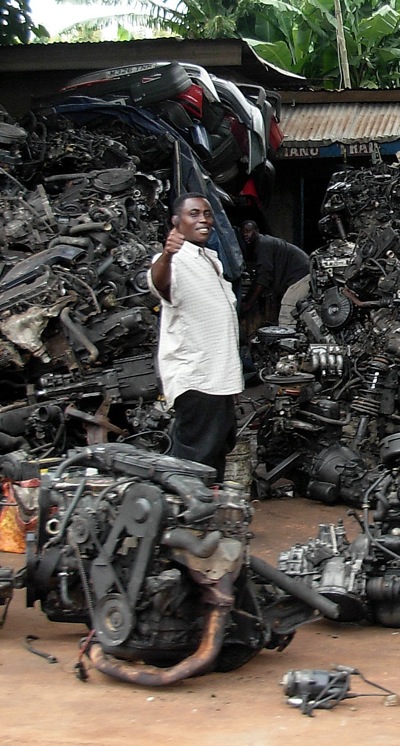
For every place you see selling cars you see five places recycling every possible component of the cars. Usually its for repair, sometimes it is to create something utterly different.
Or take tro-tros, the ubiquitous, horn-happy minivans that criss-cross every part of Ghana moving people more efficiently than a bus system every could. It's a totally decentralized, mostly private group taxi service. Mass transit on an unbelievable scale with no set routes at all. Need a ride? Flag a tro-tro. You'll get where you're going. (Not unlike hailing a "taxi" in Russia, though there rides are less frequent, less capacious.) While tro-tros are almost universally decrepit, smoke-belching buckets of bolts, the system as a whole is by far more environmentally friendly than private cars or even a fleet of taxis.
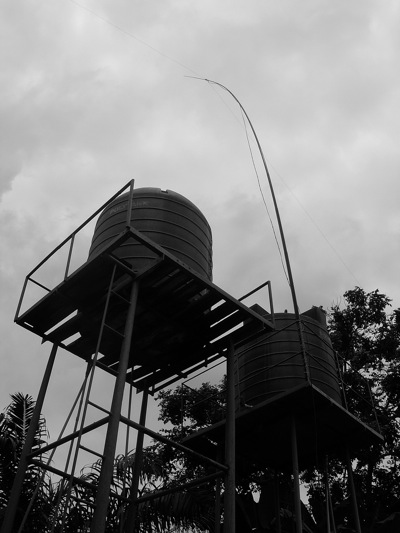
One fact of life in Ghana is the unreliability of centralized services. The electricity grid, for example, cuts out a few times every week. Just ... off. Usually mid-day when it is hottest out. Yet this is not nearly as disruptive as it would be in the West. Partially this is just an attitude of resignation; that's just the way it is. But because it's the norm most places simply do it themselves with generators on standby (or have ways of manually doing what would otherwise be electrically-powered).
There's no central water supply either so in urban areas private gravity tanks (or nearby streams) provide running water. The explosive growth of mobile phones is in part fueled by a lack of reliance on a centralized grid of services. It's obviously not industrial age mega-infrastructure but more like modular, emergent services -- build as you go, bottom-up. Like the Internet itself, basic services are built to work around outages.
To a Westerner this seems like privation but, looked at another way, it is a built-in constraint on excess usage. Self-sufficiency isn't radical; it's practical. And self-sufficiency naturally requires an intimate knowledge of one's own patterns of consumption. You use what you have and nothing more. It ain't rocket science.

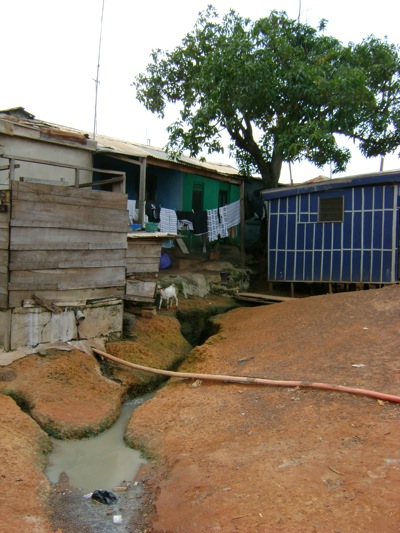
So why is this a lesson? Certainly I'm not claiming that open sewers or power outages are the way forward. Nor should it be taken to mean that Africans are somehow immune to over-exploitation of resources.
Yet, Africa provides an example of what a society might look like that has so totally internalized sustainable living that it informs everything it does. Africa as a behavioral template, not a developmental one.
There are many paths that lead to this way of living within one's means. You can choose to do it or you can be forced to because all your other options have been exhausted. Most of Africa has no other choice.
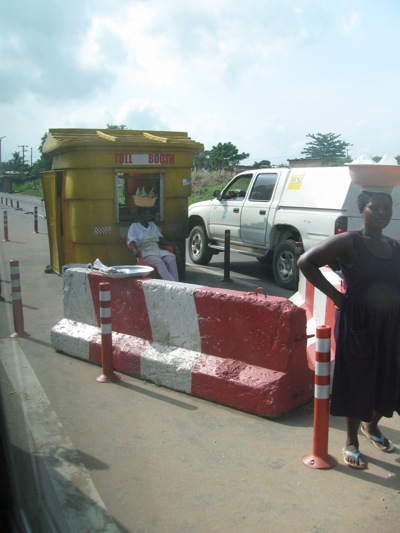
It took me a while to realize how pragmatic the idiosyncrasies of daily life are in Ghana. After first I thought the army of vendors on the road was a nuisance. They're not "roadside" but in the middle of the road, often long lines of people selling the exact same thing -- tissues, water, power strips, mangos, anything. (Even the mayor wants them off the road.)
But actually it makes a ton of sense because traffic is often such a mess. It's like one huge drive-through mall. In the lingo of a typical consultant: they've monetized gridlock. It's efficient and practical, such as at the toll stop pictured above. I'm not arguing for in-road vending so much as noting that what seems crude is often entirely sensible, bordering on ingenious.
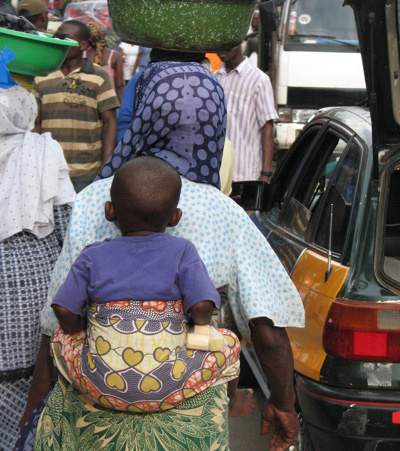
It's hard for non-Ghanaians not to do a double-take when they see women carrying staggering loads on their heads, but once the shock wears off you realize, wow, that really is efficient. The arms are free to do other things while the entire frame of the body distributes the load atop the spinal column. Also, it makes for good posture.
But the most practical form of carriage is the way babies are swaddled. Just a single sheet wrapped around the child who's straddling the mother's back and literally sitting atop her butt. I never once saw a child squirming or screaming and the moms looked similarly non-plussed. Again, the arms are free to do whatever.
What do baby swaddling and sustainable living have to do with one another? They're both examples of deep-rooted pragmatism. It seems simple, even backwards sometimes, but the way of life I saw both in Ghana and Kenya was firstly about solving everyday problems. It's largely coincidental that many of these problems are matters of production and consumption -- the very basis on our misaligned relationship with the planet.
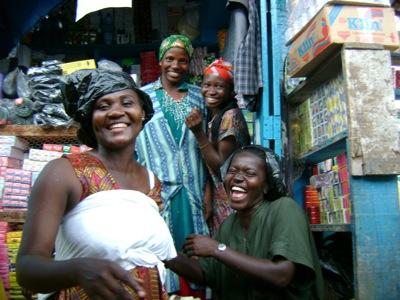
Let's take some inspiration from Africa. It's a plentiful, renewable resource, after all.
Posted at 3:08 PM | Permalink | Comments (0)
August 20, 2008
Rocks and hard places
In Ghana I took a trip with Margaret to her mother's home village of Tanoboase (tah·no·bo·AH·say). It's dirt poor, centered around the local voodoo shrine, and governed by a chief -- in other words, a microcosm of what makes Ghana unique, world's away from the urban centers of Kumasi and Accra.
Tanoboase is a good example of a town that would seem to be able to pull itself up a level. It is on the main artery from Kumasi to Tamale and it stewards a stunning historical-natural eco-tourism project. It's close to the Boabeng-Fiema nature sanctuary (teeming with monkeys treated as children of the local gods) and it is near an amazing set of waterfalls.
And yet, Tano (as it is called) hasn't been able to capitalize on the tourist dollars that overflow to similar areas near the slave sites of Cape Coast.
Boase means 'under the rocks' and the landscape up in this region is forest punctuated by crazily-shaped summits popping out from the trees. The form of the rock -- caves, natural bridges, smoothed planes, boulders balancing on points -- suggests some powerfully-erosive water flow through here eons ago.
This all makes for arresting views so it wasn't a surprise to learn that there's a Catholic (Benedictine, to be precise) monastery nestled into a nook. Kristo Boase is a quiet little operation of only about a dozen men (a convent is slated to open next year). Mostly it is prayer and agriculture in a secluded, inspirational setting. The monks don't observe silence but the place is supernaturally silent. You're as likely to hear a monkey screech as anything else.
One especially interesting point for me was a visit to the monastery's cashew orchard. I've written previously about the fascinating biology of the blister nut, so imagine my delight at being able to see acres of them on the tree. They don't just eat the cashews -- no, this is a Catholic monastery: they distill the nuts into a potent liquor.
It's cashew schnapps. And it is odious. But I bought a bottle, as well as cashew jam. I'm a supporter of the blister nut.
From Kristo Boase we headed a short distance into the town of Tano -- and by town I mean about a half mile of variously-dilapidated structures hugging the Tamale road. This was Margaret's true homecoming. She had not been back to visit in 25 years, but before we were all out of the car family came running up to greet.
Margaret's aunt herded us around from villager to villager. I couldn't keep track of who was related and who wasn't -- but then, maybe that wasn't even a distinction anyone made. It was as if the Chicagoan Margaret had just been up the road at the next village for a while.
Lots of furious chatting in Twi, lots of stares, but no one at all visibly perplexed at my radiant alabaster skin. I was with Margaret.
Tano's two claims to fame -- and sources of tourism, such as it exists -- are the local voodoo shrine and the sacred grove, closely connected to one another. The shrine is an odd thing. It houses a dark room and a tabernacle-type bowl said to contain Taakora, head of the Akan nature gods. It's run by a fetish priest and you're allowed in for a small fee. Margaret would have none of it and insisted on staying outside the "evil" place. I had to go in, of course. Honestly I couldn't see much -- it was deliberately creepy and shadowy.
It's remarkable how seemingly unfazed Ghanaians are by their overt, omnipresent displays of Christianity and their reverence for hyperlocal animist gods. Something like 70% of Ghanaians are Christian, with the remainder Muslim. Yet nearly all villages have some sort of local spirit who receives supplication and is the threat behind frequent curses being placed on people.
Margaret's brother was cursed by a villager years ago for a perceived slight. Her family -- singularly Christian -- took no heed. Her brother later had surgery on his throat for some ailment that the villagers all took as proof of the fulfillment of the curse. Rather circular logic, but there it is. The simple fact is that most Ghanaians pray to a Christian God while respecting what they call "small gods."
As is customary when visitors come to town we met with the local chief, the Tanoboasehene. He remembered Margaret too and even gave her a hug, which was odd since protocol requires you to speak to the chief through his assistant. Hugs apparently do not contradict the prohibition against addressing the chief directly.
Also a matter of custom is presenting the chief with a bottle of liquor, usually schnapps. (Hey hey, the blister nut saves the day!) A small quantity is then poured on the ground in remembrance of villagers past. Yes, this is precisely where the African-American "tradition" of "pouring one out for my homies" originated. You won't be surprised to learn that in Tano it was done a bit more reverentially than in America.
From the shrine you depart for the Tano Sacred Grove, the real home of Taakora as well as the site of the origin myth of the local Bono people. It is also the location of a last stand of local Akan during the tribal wars and slave raiding of 17th century.
The grove is certainly treated as sacred. Everything in it is protected (hence its eco-tourism designation) and there is a vaguely temple-like atmosphere walking in the semi-darkness of the vegetation and overhanging rocks. There's myth and ritual at every turn. (Apparently virgins who enter the grove to fetch water will go blind.) It can be plain eerie.
Once you make it up the rocks and peer out across the tops of trees you realize that, religious or not, it is a rightful source of pride for the locals.
Margaret of course wanted to know what I made of all of it. She wanted to know how we could help jumpstart tourism, anything to help. I'm not an expert on tourism of course, much less rural African economic development, but it seems to me the problem is basically infrastructural. Getting to Tano is a chore, if not downright risky.
The "main artery" is barely paved and has lots of lethally-overloaded trucks traveling at incomprehensible speeds. Most tourists hug the coast, visiting Elmina, Cape Coast, and possible Kakum National Park. But there is a subset that ventures into the Ashanti inland empire and this would be Tano's target group -- if only they could get there.
The problem is the road. Open up the bandwidth and good things can happen. It's the network economy of the industrial age: connectivity doesn't just move stuff about, it multiplies the value of stuff. Without dependable physical access Tano can't participate in the economic revitalization of the rest of the country.
But Tano isn't going anywhere. Like most villages cut off from the grid of urban services, they're largely self-sufficient. And the Sacred Grove is obviously enduring and legally protected to stay that way. The road will come.
Posted at 5:09 PM | Permalink | Comments (0)
August 18, 2008
Call of the wild
In Kenya I stayed in a tent camp -- not at all a luxury and a great way to extend the daytime safari thrill of being surrounded by animals. It was a thrill mostly unseen as the night came alive with noises that were always just outside the radius of the feeble gas lanterns around the camp.
Maasai tribesmen, hired by camp, patrolled the grounds at night, but it was still unnerving. Perhaps even more so when I'd start to wonder why we needed guards in the first place.
Cracking branches, rustling in the brush, and occasional screeches in the distance -- it all made getting up to take a leak outside the tent at night positively terrifying. In fact the night before I arrived a lion came into camp at night and roared for about twenty minutes. The Maasai said it was just "talking" to its pride.

Coincidentally I had been reading a fascinating survey of 20th century music that mentioned in passing a study by two psychologists exploring the reason that certain musical passages give people the chills.
Their theory? It's related to the call of the wild, which also explains the feeling of hearing an animal cry in the distance in a dark tent.
In our estimation, a high-pitched sustained crescendo, a sustained note of grief sung by a soprano or played on a violin (capable of piercing the 'soul' so to speak) seems to be an ideal stimulus for evoking chills. A solo instrument, like a trumpet or cello, emerging suddenly from a softer orchestral background is especially evocative.
Accordingly, we have entertained the possibility that chills arise substantially from feelings triggered by sad music that contains acoustic properties similar to the separation call of young animals, the primal cry of despair to signal caretakers to exhibit social care and attention. Perhaps musically evoked chills represent a natural resonance of our brain separation-distress systems which helps mediate the emotional impact of social loss.
Put another way, a solo instrument breaking free from the larger family of sound evokes in humans a kind of separation anxiety, an empathetic response that, like separation, is largely fear-based. And this response, the authors posit, is evolutionary. It's related to animals (or human babies) calling out for attention. The call of the wild is a call of isolation. And isolation is scary.
They continue, attempting to explain the chills further.
In part, musically induced chills may derive their affective impact from primitive homeostatic thermal responses, aroused by the perception of separation, that provided motivational urgency for social-reunion responses. In other words, when we are lost, we feel cold, not simply physically but also perhaps neuro-symbolically as a consequence of the social loss.
"Homeostatic thermal responses" ... yes, a hug. Chills as symbolic response to a lack of skin contact with others of your group. (Consider this image of a monkey baby clung to the bottom of its mother.)
The best example I know of this phenomenon in music ("A solo instrument ... emerging suddenly from a softer orchestral background") comes a little more than halfway through the first movement of Beethoven's Fifth Symphony, about 27 seconds into this excerpt. There's nothing else like it in the entire piece. It has given me chills ever since I first really heard it in college.
See also a podcast from today's Guardian on related evolutionary insights from music.
Posted at 8:44 AM | Permalink | Comments (1)
August 7, 2008
The Gold Coast
Our work in Ghana is finished, though the projects themselves are just begun.
I think we've made some difference with Aid to Artisans. They now have a very comprehensive analysis of their producers' chain of supply from raw material to end consumer, video documentation of same, a set of recommendations on revamping their website including a redesign, and a roadmap for e-commerce. I'm pleased.
I'm also exhausted, and dirty, and homesick. But there's one last adventure. I'm headed to Kenya tomorrow for a four-day safari on the Masai Mara, edge of the Serengeti. It's a tent trek: no electricity, running water, or (can you believe it?) net access. Leaving all my gadgets in Accra. Offline, gridless, naked.
I have so much more to write about Ghana. Amazing fishing villages, a visit to a voodoo shrine, and playing in a tennis tournament as the only obruni. But it'll all have to wait.
Thanks for reading this past month. Back in the fold after the safari!
(Full photo and video set is here, if you're interested.)
Posted at 1:19 PM | Permalink | Comments (1)
August 6, 2008
Brass
Part six (of six) of the Ghanaian Handicraft series.
I've left the most complex handicraft until the end. I'm ashamed to admit how long it actually took me to figure out just what the heck was going on. A metallurgist, I'm not. But it is also arguably the coolest craft I learned. Here's why.
Brass artisans take take the trash of technology -- gears, circuit boards, wires, pipes -- and transform it into art. It seems so right -- such a fitting way to repurpose what otherwise would be non-biodegradable and in some instances toxic. (Glass bead artisans do something similar with discarded bottles.)
Specifically brass workers strip zinc and copper where it can be found and, though the level of impurity is high, they're able to forage quite a bit.
But let's back up. Making brass is relatively easy compared to getting it into the shape you want. Basically the art in this craft is all about the mold. It starts with long strings of honeybee wax. How the wax is shaped is exactly how the envisioned product will look. That is, where wax is in your model is where the liquid brass will harden. So get it right.
Charcoal is the material around which or through which you place the wax. It holds things in place. So, as in the video above let's say you are making hollow, decorative spheres (for a necklace, for instance). A charcoal ball at the middle supports the wax decoration which will eventually becomes the brass.
OK, follow me on this. It hurts the brain a bit. Charcoal is packed around the finished wax model too. So basically you have the shape of the final product, in wax, completely surrounded by charcoal. Then this is all encased in a mud and straw crucible.
The key to it all is that there is no wax isolated completely inside the crucible. It all touches some other wax and is finally connected to strands of wax that poke out of the charcoal. See where this is going?
The crucibles are heated around a fire and the wax melts. It is drained out -- thanks to nothing being isolated and the "channels" of wax that stick out of the mold. What you have is a perfect inverse mold of what you're trying to make. Just pour in the brass (melted obviously) and let it set. Chip away the charcoal and voila! Brass from trash.
More brass-making video here.
Posted at 2:31 PM | Permalink | Comments (0)
Sally Struthers go home
Been struggling with how to put into words something I've felt visiting the poorer areas of Ghana.
Like most Westerners my concept of poverty in Africa is heavily informed by aid campaign advertisements. (I blame Sally Struthers completely.) Pre-programmed, one just sort of expects to find misery and unhappiness: sobbing, curled children with distended bellies; emaciated frowns from doorways; a total lack of joy.
I have seen none of this. In fact, if there's any emotion I see more frequently than others it is happiness.
Now, before you say that I have confined myself to upscale, urban areas, I'll note that most of the first two weeks' work was in the field in tiny villages without electricity, running water, or any infrastructure whatsoever.
Certainly there is much misery and want in Africa. Failed states, pestilence, warfare -- take your pick. But the longer I am in Africa the more I realize that we've been conditioned to believe that Africans are not happy. Purely from a aid organization sales perspective this makes sense: if people are happy with their plight in Africa why send your support check in?
It comes down to this: standard of living is not the same thing as quality of life. Would Ghanaians love to have other amenities that first-world citizens enjoy? Perhaps. Are they in abject misery because they do not? No way.
In thinking that Ghanaians' quality of life suffers because their standard of living is below ours we're making a cliched blunder, guessing at the perspective of someone else through the filter of your own cultural sensibilities. It's arrogant.
Africa could use help, there's no doubt. But aid will never be effective if we provide it based on caricatures of behavior meant to tug at us emotionally. So, Sally, go home. I know children lack food and die of horrible illnesses in Africa. But images like that mask the real complexity of the needs and promise of African society. Let's be more honest.
Posted at 3:44 AM | Permalink | Comments (3)
August 5, 2008
Clay
Part five of the Ghanaian Handicraft series.
As in many cultures, pottery is made from clay in Ghana. Yet as a craft it is hard to find here, largely because it is considered utilitarian, with a market that's almost completely domestic. People use the pots, bowls, and vessels in everyday life.
Unlike other handicraft that is created at some distance from the source of the raw materials, potting happens close to the river banks that provide the clay, presumably because it's a pain to move large quantities of the dense, wet material.
We visited the tiny village of Nfensi and were taken to their river. It was one of those glad-I-took-my-malaria-meds moments. (Luckily we were there during the daytime, before the virus-toting Anopheles skeeters come out.)
Once hauled up from the water the clay is pounded repeatedly to loosen it up. (The pounder uses the same tool that smashes open yam and cassava for fufu, incidentally.) There's a further step of kneeding, then the potter slices off as much clay as he'll need and slaps it on the wheel.
The potter's wheel is completely manual. One guy cranks it while the master shapes the clay.
It happens so quickly and effortlessly -- probably not surprising given that they turn out approximately 1,000 items every three days.
Once dried, the clay objects are prepared for the igloo-shaped kiln. It's infernally hot around the oven which the artisans actually walk into to stack the clay pots. Then the "door" to the oven is bricked up and the fire is allowed to go for a few days. The door gets broken back down and out come the finished, though unadorned pieces.
There is an export market that consumes larger, more finely decorated pieces, but it is overshadowed by the more "traditional" wooden export market. To many Westerners, Africa means wood carvings (masks, statues, etc). But those consumers who are interested in owning the most "real" African goods -- what one study calls "authenticity buyers" -- might look to pottery as an alternative.
More clay pottery video here.
Posted at 5:34 AM | Permalink | Comments (0)
August 3, 2008
Ghana One: Who's Who?
With the final week upon us I thought I'd introduce you to my teammates from the inaugural IBM Corporate Service Corps mission in Ghana. (Update: I added myself.)
![]() | Ritu Bedi
Alias: Sweet Mango Home: Delhi, India Primary Skill: Breakfast negotiation. Little-known fact: Acid reflux almost caused Ritu to bail out of the Kakum Canopy Walk. |
![]() | Arindam Bhattacharyya
Alias: Hookah Home: Kolkata, India Primary Skill: Has a sixth sense for locating good Indian food anywhere on the planet. Little-known fact: Arindam can eat more than you. Try him. |
![]() | Roslyn Docktor
Alias: Happy Camper Home: Washington, DC, USA Primary Skill: Clipper-based hairdressing. Little-known fact: She's been to Zambia. No really, just ask her! |
![]() | Pietro Leo
Alias: Tee Wee Home: Bari, Italy Primary Skill: Injecting humor when it is least expected or appropriate. Little-known fact: Looks equally crazy when clean-shaven. |
![]() | Julie Lockwood
Alias: Gertie Home: Boulder, CO, USA Primary Skill: Can frighten small Ghanaian children to tears simply by looking at them. Little-known fact: Has visited 90% of the toilets and "near-toilet experiences" in Ghana. |
![]() | Fred Logan
Alias: Chief Home: Ottawa, Canada Primary Skill: Capital infusion to the local souvenir and handicraft industries. Little-known fact: Taught disco dancing in the 1970's -- even appeared on TV. |
| Stefan Radtke
Alias: Shortwave Home: Bonn, Germany Primary Skill: Can speak in morse code. Little-known fact: Set up a full shortwave radio station at our hotel. | |
![]() | John Tolva
Alias: Mule Home: Chicago, IL, USA Primary Skill: Perspires more than his body weight every four hours. Little-known fact: With enough tin foil, Stefan's shortwave antenna, and an intricate yoga pose John can steal wireless from the hotel down the street. |
![]() | Charlie Ung
Alias: Flip-Flop Home: Vancouver, Canada Primary Skill: Imperturbable. Little-known fact: To mosquitos Charlie is mostly a bony frame transporting a big bag of delicious blood. |
![]() | Peter Ward
Alias: Biscuit Home: Warwick, England Primary Skill: Extraordinarily detailed blogging.. Little-known fact: Peter has wireless access in his room and, as such, is the object of a team conspiracy to abduct and relocate him. |
Posted at 3:42 AM | Permalink | Comments (0)
August 1, 2008
Textile
Part four of the Ghanaian Handicraft series.
Few crafts are as closely linked with their place of production than kente cloth weaving is with Ghana. Tradition holds that five villages in the Ashanti region were declared official kente-weaving centers by the first king of Kumasi. Only two of these villages still produce the textile and of these Bonwire (pronounced bon-RAY) is the most famous.
The colored yarn is imported -- a rare example of an international supply dependency in Ghanaian handicraft. This may be more a sign of market demand for the widest range of color and, as such, would be a positive thing, evidence of adaptability in an ancient form.
Before being placed on the loom, individually-colored yarn strands are reeded and warped in open outdoor spaces. This basically consists of mixing the colors together manually (by drawing out precise lengths then painstakingly intertwining separate colors) so that the weavers have the color elements pre-assembled when they insert it into the loom. It's warp and weft sous-cheffing.
Though mass-produced kente can be churned out from automated looms, the traditional setup is a wooden box that fully engages the limbs of the operator. Feet press on make-shift pedals to raise and lower the separate planes of fabric (which form the kente background) while one hand flits the bobbin of thread in and out (which creates the actual design). The other hand variously adjusts the comb that pounds the new threads into place and a separator that gives the bobbin more room to work. It happens fast.
It's mesmerizing really, high-technique, high-speed, and in full color. (There's high tech too. New designs and particularly complex patterns are designed first using a custom computer application. There's no automation involved, just a pre-design that when printed helps the weavers understand the sequence of overlapping shapes needed to make the end design.)
Men -- and it is always men, traditionally -- work at the looms side-by-side. There's no talking, no singing, maybe a radio on, but basically just the hypnotic squeak and wooden clatter of the looms.
Typically a single 8" by 5' section of kente takes a month or more to finish. Sections are sewn together and sold in larger pieces as traditional Ashanti tunics or for Western uses such as duvets and throws.
To come across a workshop in Bonwire is to enter a world of bold geometries and colors -- a vibrant contrast to the matte earth tones of what is otherwise a fairly poor village.
There's a cultural center outside of Bonwire that's totally deserted. (It has a relatively clean toilet; we've stopped there twice.) Clearly this was the town's attempt at capitalizing on its famed craftsmanship -- but that plan seems to have run off the rails. If any craft village can become a tourist destination it is Bonwire. Our goal, in part, is to help Aid to Artisans figure out how to do this.
More textile-weaving video here.
Posted at 6:52 PM | Permalink | Comments (0)
July 31, 2008
A homecoming
Our great family friend Margaret Kumi has arrived in Kumasi from Chicago. I could not be happier (unless it were my own family who arrived). She's brought a care package from home and familiarity -- maybe the best package of all.
Sunday she and I head to the village of Tanoboase to meet the chief and see what can be done. (Backstory here.)
Abena Dekyi, Margaret's sister-in-law, prepares homemade dishes for us in her home. Hands down the best meal I have had in three weeks. Yum!
Posted at 5:24 PM | Permalink | Comments (0)
Glass
Part three of the Ghanaian Handicraft series.
Glass beads are not an indigenous art form in West Africa. Today's Ghanaian bead-makers continue a craft introduced by Europeans in the 15th century. Glass beads, made then primarily in Venice, were used as barter for the raw materials that Europeans desired. As glassmaking was not widespread in Africa the articles of fashion made from the beads were highly sought after and, in time, came to be called 'trade beads,' a de facto coin of the realm.
Trade beads were often swapped for slaves. You'll also hear them referred to as 'slave beads.' Unlike some Westerners, contemporary artisans obviously find no dark irony in carrying on a craft meant initially to quantify the worth of a human being. And why should they? Like refusing to salt your fries because it too was once used to barter for slaves.
The "raw" materials for the bead-makers are discarded bottles. It's a wonderful thing, really. At zero cost, the artisans collect up as much glass as they can (though, admittedly it is a bit tougher here than in the West because you can't buy new bottles of soda, for instance, without returning an empty one). From trash to jewelry -- can't beat that product life-cycle.
The bottles are smashed. And smashed again. And again. Repeatedly until the glass is just a fine, pulverized powder. (Don't inhale.)

Once in powder form the glass is mixed with various dyes and filled into molds depending on the desired bead shape. Then, into hell's oven for melting.
Typically the molds yield semi-circular halves which are then melted together to form spheres. They are then joined on a string, often with differently-colored beads, thanks to the central axle in the mold that preserves a hole through the bead.
More bead-making video here.
Posted at 11:03 AM | Permalink | Comments (0)
July 30, 2008
Straw
Part two of the Ghanaian Handicraft series.
Straw weaving is not a craft normally associated with the environs of Kumasi. Mostly that honor belongs to the far northern town of Bolgatanga. (Say that word. Say it now. And enjoy how delightful it is to hear.) But we wanted to get a sense of the craft and it turns out that the actual raw material (the straw) is cheaper nearer to Kumasi. So some small artisans have sprung up.
It's the simplest craft we've observed. The most serene too. A single artisan with a bunch of straw strands, some dyed, sets out and weaves the object in mind. No tools; the very definition of handicraft and skill.
It's a family affair in the small villages that produce straw-woven goods. Everyone seemed so damn happy, just weaving away. They know what they are doing, how to do it, and why they're doing it. It was inspirational, in a way.
More straw-weaving video here.
Posted at 1:40 PM | Permalink | Comments (1)
July 29, 2008
Wood
Part one of the Ghanaian Handicraft series.
Wood-carving is one of the oldest craft traditions in Ghana. Wooden sculpture is produced throughout the country and has a high export value. Two weeks ago we visited the village of Ahwiaa to observe and talk to artisans trained in the traditional discipline.
Wood is delivered to them from the forests hewn roughly into the intended shape of the end product. From there small outdoor workshops of carvers set about shaping the objects into final form. The workshops are a welter of flying wood chips, sweat, and clanking. Masters silently instruct their apprentices.
It all seems so random and haphazard, but obviously these gentlemen know what they are doing. And they are all gentlemen. Female woodworking is taboo mostly because of the posture assumed by artisans: the wood chunk is held between the legs and shaped there. Ghanaians disapprove of tools being used in the vicinity of female genitals.
The artisans are preternaturally fit. They look carved from solid material too. The main implement is a metal gouge placed carefully on the wood and then struck by a mallet. The carvers wear two pairs of pants over one another for protection. The outer pants are ripped and frayed from numerous skewed strikes.
We visited the main woodworking area in Ghana, an area of the Ashanti region near Kumasi. Traditionally the king of the Ashanti (called the Asantahene, currently Otumfuo Nana Osei Tutu II) is the custodian of all arts in the region because of the historic relationship between craftsmanship and the royal house. What this means today is that he serves a quasi-governmental position of promotion and support for the arts, including being the nominal patron of our organization Aid to Artisans.
Aid to Artisans does more than just serve as a middleman for the producers. They hold courses on reforestation and forest management for their producers and recently purchased a small section of woodland as a kind of nursery/laboratory for the study of sustainability techniques.
And yet, it seems to be a losing battle. Every day I've seen huge trucks hauling massive felled trees. In fact they aren't really trucks, just two sets of wheels lashed to the mammoth trunks. Even in Kakum, which is protected by law, there is logging taking place. One wonders how much longer this art form can survive without importing lumber.
More wood-carving video here.
Posted at 2:42 PM | Permalink | Comments (0)
July 28, 2008
Social bookmarking in Africa
Geeks in the West are infatuated with social media. And for good reason, sharing makes good, selfish sense. It allows processing the infoglut through the filter of people you know and trust. And yet, as in so many things that computers make easy, social sharing of data requires nothing more than a communication medium and a community.
Two weeks ago we visited Mfensi, a village outside of Kumasi graced with a clay-banked river. It is, thus, a pottery-making center. I'll post about the fascinating process from river-bottom to pottery in a bit, but for now have a look at this. It isn't graffiti, but rather the village phone book.
The mobile phone is king in Africa, of course, but there are no add-on services as in the West. No voicemail, no server-side contact list. You can call and text and that's about it. So why not have a community address book? Scrawl it on the wall. No downtime -- and if you need context you just ask someone. Simple and wonderfully efficient.
Posted at 2:20 PM | Permalink | Comments (2)
July 27, 2008
What I'm doing in Africa
I think some of you are wondering what I'm doing here in Africa besides site-seeing and longing for faster connectivity. It's an odd thing, for sure.
There's only one flight from the US to Accra, Ghana and I was on it. Looking around the cabin you see mostly Ghanaians and the white people you just wonder about. At the risk of grossly generalizing, I'd say business class is full of well-heeled business people and perhaps aid workers with enough frequent flyer miles to qualify. It's a distinction I've been pondering since I arrived. Which am I?
The IBM Corporate Service Corps, of which I am a part, is a bit of both. Our goals are equal measures corporate social responsibility for a global enterprise and advance market research in a promising country. There are 10 of us here -- and teams elsewhere around the world -- who are helping small businesses pro bono both because it is the right thing to do and because it provides us with knowledge about how best IBM could become part of the marketplace here.
Each team has multiple projects. Mine is with a group called Aid to Artisans, the primary NGO tasked with promoting, educating, and marketing traditional Ghanaian handicraft locally and worldwide.

Here are our specific objectives.
- Assist ATAG to construct an interactive website to serve as an informational tool, showcasing the activities and operations of the organization to the outside world. The site should help the organisation to create more avenues for market development through e-commerce and to enable ATAG to communicate and link-up with members of its affiliate association (ACNAG) in a more free and convenient manner.
- Conduct a supply chain analysis serving to bridge the gap between the concept stage of product development to the production stage through to the end user of the product in question. The analysis will include sourcing raw materials, designing, prototyping, production of products to packaging, warehousing, exporting and retailing through to the consumer.
- Capture the relationship between the processes and document them, if possible, audio-visually.
It's a strange middle ground we occupy. Not exactly business, not exactly aid. (Indeed, some NGO folks we've met expressed outright skepticism at our mission here. While, back home, most businesspeople take a while to understand why we'd ever go to Ghana.)
My sub-team colleagues are the talented Julie Lockwood and Charlie Ung.
When we're not traveling to meet the producers in the villages or the exporters at the coast we work at the Aid to Artisans field office in Kumasi. It's a great space at the Cultural Center. Can't beat the ambient music.
In the queue is a series of posts on each of the different types of artisans we've visited. That's the good stuff. Soon.
Posted at 5:52 PM | Permalink | Comments (1)
The integral trees
I've heard Ghana called "Africa for Beginners" mainly because it is relatively stable, economically promising, and English-speaking. Yet it is also not the Africa of Western, romantic stereotype. There's no Heart of Darkness-esque jungle, no Lion King savanna. Ghana once was mostly rainforest, but logging and farmland creation mostly denuded the landscape in the last century.
Still there are patches, now protected. One of the best is Kakum National Park, just outside of Cape Coast a few dozen clicks from the beach. We visited Kakum on Saturday. It was breathtaking. Sublime in the true sense of the word: beautiful and terrifying.
Apart from the wildlife -- which includes such rarities as pygmy forest elephants (I had no idea such a thing existed) and a crazy diversity of birds -- the park's main attraction is an elevated rope bridge walkway right through the tree canopy. It's an amazing thing. You set out on it just a few meters above the ground and are several hundred feet above the forest floor before you realize you can't turn back.
It's all rope and wood plank and with the exception of the rusting steel wire brings immediately to mind the scene from Indiana Jones and the Temple of Doom where our hero hacks the bridge in two.
There are seven bridges in all, stretching more than 1000 feet between gigantic trees on which small viewing/rest platforms have been constructed.
It was all built in 1995 by shooting rope via crossbow from tree to tree, then scaling the monsters old school, ground-up style and rigging the rest. You don't question the engineering as much as the 13 years of maintenance. Things deteriorate quickly in a rainforest. Also, big as the trees are, once you land on the platforms there's a noticeable sway -- emphatically not the thing you want to feel having just crossed the chasm. It's scarier than it seems.
There isn't a whole lot of wildlife-viewing up on the bridges. Mostly you're battling the sweat that threatens to compromise your grip on the rope "rails" and hoping no one on your stretch panics.
Posted at 4:00 PM | Permalink | Comments (0)
An economy of enslavement
Last year I had the privilege of building the initial website for the National Museum of African American History and Culture, the newest Smithsonian institution on the Mall in DC. It was a period of deep immersion for me in facets of my national history that I had only a survey-level understanding of. I was very much looking forward to visiting the slave castles of Ghana's coast.
This past weekend we visited Elmina and Cape Coast, the largest transfer points for the Middle Passage of slaves to the Americas by European traders. Both towns feature beautiful white-washed castles that sit atop dungeons of horrific ambience and memory. They held about 2,000 male and female slaves at a time before transfer through "doors of no return" to awaiting ships.
I've been in Africa for over two weeks and not once felt self-conscious about my skin color. But inside these castles I couldn't help but feel like an interloper. No one made me feel this way, to be sure. And I felt no personal guilt: my family came to the US well after the slave trade was abolished. And yet, touring the castle with two African-American couples felt slightly strange, like I was intruding on something sacred. The slave dungeons were full of flowers left by descendants.
At dinner that night I told Asha that slavery is a source of shame for America (though, I suppose, in truth I was speaking for myself). She added that it is a source of shame for Ghana too. The peoples of Ghana are as implicated in the trade as Europeans of course. White traders didn't raid the interior of Africa for slaves; captives were traded from rival tribes for weapons, gunpowder, and alcohol. Of all the parties involved in this foul enterprise, only the slaves escape blame.
You pass through the Door of No Return in Cape Coast Castle and you're back in the present. Fishermen mend nets in the shadow of the fort, carrying on the work that existed before the Europeans came. Children look out to sea and frolic in the waves. The past is just a big white building.
Posted at 3:55 PM | Permalink | Comments (0)
July 23, 2008
Off the map
Get in a cab in Chicago and chances are better than not that your driver is from West Africa -- often Ghanaian, usually Nigerian. In my experience they know the city as well as other drivers, if not slightly better -- certainly better than I do.
And this is why I am utterly perplexed at what I now understand as bald fact: Ghanaians in Ghana are terrible at estimating distance. Ask three Ghanaians how far from points A to B and you will get wildly different estimates. Five minutes from one person versus thirty minutes from another is not unheard of. But even when you ask for distances in units of length you will get absurd variance, or no earthly idea at all. Far versus not far. And not far usually ends up being at least 30 km.
This person says Kumasi to Accra is 2 hours; that person says 6 hours. One of these people is wrong.
I heard a Ghanaian refer to GMT as "Ghana Man Time". Cracked me up. (By the way, I was bisected by the real GMT yesterday.)
It isn't just distance and time. Today I headed out on my own to arrange a dinner with some students from Michigan Tech working in Accra. I grabbed a map of Accra that had on it the restaurant I wanted to go to. I approached a cabbie who looked at the map. He flagged another driver, then another, then another, until I had a small crowd gathered looking at my guide book. Much excited chattering in Ga (different language here in Accra; my Twi was useless -- or, rather, more useless than normal).
Finally it dawned on me. As politely as I could I asked "You don't know how to read a map, do you?" They immediately all confirmed that the map itself meant nothing to them, though they easily read the labels and words. They were obviously not illiterate. Just cartographically illiterate.
Now, I understand that it is sometimes hard to abstract one's street-level knowledge of a city to an aerial version of the same. It is a puzzle to be solved, a kind of cognitive transform that involves whittling 3D to 2D. But someone whose job it is to actually know the city you'd think would have this ability.
Perhaps one aspect of the Ghanaian inability to judge distance/read maps/know the location of anything is that streets are very rarely signposted and, if marked, not really known by name. See, even though the drivers could read the street names on my map they had never heard of any of them. It's all so very bizarre.
Here is a typical cab experience:
"Can you take me to Tante Maria restaurant?"
"Sure!"
"Do you know where that is?"
"Yes."
[drive along aimlessly for 20 minutes]
"Do you know where we are going?"
"Yes."
[drive along for 20 more minutes, generally back the way ye came]
"Are you sure you know where we are going?"
"Yes."
[Taxi stops. Driver gets out and randomly polls people on the street for directions. Gets back in. Drives for 20 more minutes.]
This last sequence -- the stop-and-inquire -- typically happens at least three times per journey. Usually the outcome is that the cabbie ends up not only not knowing where he is going but usually not even where he is. It is at this point that you cut your losses and bail out.
Clearly this lack of spatial awareness is not something biological. Ghanaians in the US do just fine. So it must be cultural, something about Ghana itself that causes spacetime to warp. Like the island in Lost.
Posted at 12:36 PM | Permalink | Comments (1)
July 21, 2008
10 days in Ghana
I'm in Accra, Ghana now, back where this adventure started last week. It's been wonderful and exciting, exhausting and not a little frightening. Let me provide an example that covers a single twenty-four hour period last week.
We have a "handler" named Asha. She works for Citizens Development Corps, which is based out of Accra, so she's our only daily contact in Kumasi. Asha's great: 23, urbane, well-educated, and a serious party girl. (I've nicknamed her "Brimful", a reference she both likes and gets.) We talk music.
Asha has a friend who owns a club in Kumasi. I believe I found that fact out approximately 100 seconds before she had him on the phone and had procured an invitation for me to DJ there. So, last Thursday, not even a week in Ghana, I hauled my laptop over to Time Out for a truly impromptu set. (OK, it wasn't the least prepared I have ever been, but it was close.)
Apart from having no Nigerian music on hand -- whoops -- and some uppity patrons miffed that karaoke night was being upstaged by an obruni (Twi: "whitey"), it was pure joy.
I started with standard (even clichéd) Western tunes, quickly sprinted to more contemporary beats, veered over to Adam Beyer and Talvin Singh, did my best not to maul a bunch of Ghanaian High Life music I have, then ended with a long set of trance to placate the Tiësto-craving Lebanese who were crawling all over the plexiglass in front of the booth.
In short it was an amazing high. The club owner woke me up with a phone call at 7 the next morning to ask me if I would do it again. Quite a compliment, despite the hangover from the free (hooch) gin he paid me in.
And now a photo interlude. I just love the gazes of these kids.
The next day was a bit different. We were criss-crossing Kumasi on our way out of town to visit villages where traditional handicrafts are created. Talking to artisans and observing their trade in action was the first part of our task here (much more on which in a future post). It was thrilling.
As we were heading back into town for lunch our two Ghanaian colleagues in the front seat gasped and slowed the card down. Now, readers who have been to Ghana will know that no Ghanaian motorist ever gasps, blinks, slows down or really even cares. It is a massive deathrace free-for-all on the streets -- a fact made laughable by the cheery Christian slogans painted on the back of nearly every car.
But gasp they did. Lying in the median of the street on the left side of our car, right outside my rolled-down window, was the dismembered corpse of a human being. It was a man. At first I thought it was a car crash victim, but as I looked closer I realized that he had been hacked with a long blade. It was perfectly obvious and completely nauseating, reminding me instantly of the way a roadside vendor had opened up a coconut for us the day before. The dead man's head was flayed open from numerous machete blows.
But there was no blood on the street. This person had been murdered elsewhere, mutilated, and put out on show. A lynching. We pulled away and for several minutes the whole car was silent. I was shaking. Finally we tried to ask our hosts what in the hell we had just seen. They were upset too, though it was hard to tell exactly why.
They explained that crime was on the rise in the Ashanti region and that people were becoming increasingly unhappy with the sentences delivered by the court system. As such, vigilante murders were becoming more and more common as angry mobs sought to punish and deter crime. Obviously our hosts had no idea what crime this guy had committed -- if he had done so at all -- but that was their answer: vigilantism.
Fair to say that little episode annihilated any high I was riding from DJing the night before. I couldn't shake the image, wished I hadn't stared. We did little work the rest of the day that required lots of talking. No one really wanted to interact. That night none of us could sleep.
I suppose there's an upside to being shaken so deeply. I'm much more sober about Ghana now. It's still a wonderful and special place, but I think I can evaluate it more objectively now. The senseless horror of that corpse in the street (with children playing around!) pretty firmly knocked off the rose-colored glasses I had on.
In between these two poles of emotion are ten days of fantastic new experiences. I've uploaded all the photos to date and as much video as this poor bandwidth can handle. Here's the full set, updated nearly daily.
Bear with me as I've not properly tagged or annotated most images yet (and some of them really require explanation). Also, most photos have no high-res version. Just too bandwidth-scarce over here. Will replace them when I am back home.
Stay tuned for a multi-part series on the visiting the artisan villages and documenting their work. Amazing stuff comin'.
Thanks for reading!
Posted at 3:30 PM | Permalink | Comments (3)
July 15, 2008
Ghana intermittent
I'm in Kumasi on an Internet connection frailer than a house of cards. But hey, better than nothing. Here's the quick and dirty. We're settled into Kumasi, our guest house, and our places of work. I'm stationed with two teammates at the Ghana Cultural Center, which houses my partner Aid to Artisans. Looks like an achievable list of tasks for four weeks and the workspace is as good as it gets. No air conditioning, but I did get to shake it with traditional Ashanti dancers during a break today. Can't beat that.
Yes, there's video of that, as well as some truly great photos -- but the hard truth is that the connection in Kumasi is crap. (I've tested three places now.) Download is tolerable; upload horrendous. Can't even get a single photo up. So, media may have to wait until I can get back to Accra. Shame. But on the other hand I guess I'll just have to be more descriptive in my posts.
Tomorrow it is off to a few villages outside of Kumasi to meet the makers of three types of traditional arts: brass-, wood-, and textile-based. They are the beginning of the road in the supply chain and the beginning of our analysis, plus seeing them at work will be a great treat. Can't wait.
So, expect a longish dispatch in the next few days. And sorry for the quick spurt of media then nothing. WAWA: West Africa wins again. (It has a bit of a streak going.)
Update: obviously I have added media where possible.
Posted at 5:52 PM | Permalink | Comments (0)
July 9, 2008
A little bit about Ghana
The more you know ...
Ghana, formerly known as the Gold Coast, was the first nation in Africa to receive independence from colonial rule in 1957.
Accra, Ghana, capital of the country, is a sister city of Chicago, USA.
There is no place on Earth you can travel to and require more vaccinations than coastal West Africa.
Ghana is the size of the US state of Oregon (roughly 92,000 miles2).
The name Ghana refers to the ancient empire of Ghana located in Senegal, Mauritania, and Mali with no overlap whatsoever to the current geographical boundaries of the country.
Ghana is the country closest to the center of the globe, as defined by international measurement. The prime meridian runs through it and the equator is only a few degrees south of the coast.
An amazing amount of the world's scrap electronics end up in Ghana for precious metal recycling.
This is the Cicero Guest House, where I will be staying. It ain't the Four Seasons, but I'm not complaining.

So that's it for posts pre-departure -- maybe until Aug. 15 given connectivity, but I doubt it. I'll be chronicling the adventure here (much as I did in Italy exactly one year ago) and on the newly-launched official IBM Corporate Service Corps blog.
Thanks to everyone for the well wishes, offers to assist with the family while I am gone, and claims on my personal items should I not return.
Posted at 7:34 PM | Permalink | Comments (0)
July 7, 2008
Offline dance
We've been told there's no Internet at the hotel in Kumasi (though an unsubstantiated report says the proprietor is "working on it"). The program manager has earnestly stood by his directive that we should experience the Internet the way Ghanaians do, which is to say (if they do at all) at public cafes.
I see the point. You can't consult much less design for a culture whose particular constraints you do not understand. OK. But this my biggest concern since, as a team with a job to do involving (at least in my particular task) using the Internet as a route to market, this seems like an unfortunate and avoidable self-limitation.
But so it is. To make matters more challenging, we're told that power cuts out in Kumasi two to three times a day. Many places have backup generators; many do not. So, you can imagine the near-panic I'm in being a creature of connectivity. I'm not proud of it, just laying it out truthfully.
It's a reversal of the productivity direction I've been working towards for years: a near-total online workflow. Sure, I use desktop apps and love a few dearly. But they're almost all hooked to networked data and have a web-based interface too. Most simply won't work without a connection. My laptop is about to become an island.
Thinking through how it will actually work has been interesting, though. There are three scenarios, not counting the pipe dream of guest house Internet:
- Connection at place of work, relatively nearby Internet cafe
- No connection or very limited connection
- Machine failure
The first is the most likely, though it still involves long offline periods. It's pretty easy really: e-mail gets pulled into Mail.app and calendar items into iCal whenever I can connect. NetNewsWire can suck down feeds for offline review.
But that leaves Backpack and Basecamp, two online services I use for personal and project task management. There's a great offline synch app for Backpack called Packrat, but for Basecamp I'm basically hosed. In a stroke of great timing, my files at Google Docs now live offline thanks to the Google Gears integration it now offers. I compose blog posts in the superb MarsEdit so that's not a worry. I suppose there are some offline Flickr apps, but that seems like such a hassle. IM, Twitter, virtual worlds: forget about it.
The second scenario is basically the same, only more dire. I suspect I will just abandon e-mail altogether and just compose offline blog posts hoping to cast their bottles into the sea at some point.
The last scenario -- total computer death -- had me considering bringing two laptops ... until the sheer idiocy of hauling all that hardware to Africa brought me to my senses. (Some of my teammates are considering not even bringing one. What!?) When you consider that the closest Apple Store is half a continent and a sea away, you basically realize that letting go is easier than fighting it. If the MBP dies, my hipster PDA takes over.
If this particular calamity should come to pass I've loaded up a USB key with a bunch of portable apps so that I can at least fake the semblance of a personalized workspace at a public terminal. Loading critical data onto the key just isn't practical, though, so I'll basically be all dressed up with no place to go.
And yet. There's an upside to these scenarios. There are still a few apps that require no connection at all. In fact, the distractions of the 'tubes are actually a hindrance to using them in some ways. I'm thinking specifically of Ableton Live, but also tools like Tinderbox and Scrivener. All these are for personal composition. I can imagine being hunched monk-like in my room hammering out new tunes and chapters, perversely thankful for the isolation.
That is, if the electricity stays on. There are as yet no affordable (or compact) solar-powered solutions for laptop power. So, I have my three MBP batteries.
Add to all this worry that the iPhone 2.0 update and 3G hardware is released the day after I leave and you may understand better why I am obsessing more about Internet withdrawal than microbe invasion.
If this sounds like spoiled geek whining, you're probably right. But I think this post will be a useful record to return to when the real conditions of daily work present themselves. I'm pretty sure I'm being shortsighted. Which is probably a good summary of my overall preparedness for this adventure.
Not too long now. Departure Thursday.
Posted at 12:13 AM | Permalink | Comments (1)
July 4, 2008
Love of country
In late 2001 we were giddy with our first child. The fallen towers and clingy new parent syndrome had pretty much bivouacked us into our condo. The last thing we wanted to do was bring a stranger into the home to be a nanny.
We interviewed a couple of ladies, all eastern European as I recall. Nice enough, all capable of tending a baby, none capable of making us feel good about it. Then we were referred to Margaret Kumi, a classy, soft-spoken mother of many. She was from Ghana.
During the interview Margaret good-naturedly answered my silly list of questions. I remember asking what the first thing she would do if our baby got hurt. She didn't really understand what I was asking, probably because it was a trick question, and the right answer was so damn obvious. I wanted her to say "I'd call you," but of course the answer was (and is): make sure the kid's alright. Later, after we easily hired her, I reflected on how much more that question said about me than her.
Margaret was our full-time nanny for almost five years. We welcomed her into our family and, surprisingly, she did the same for us. We came to know her children, her adopted children, her husband, and visiting relatives from Ghana. We were introduced to baby naming parties, the glutinous food known as fufu, and the sonorous language called Twi.
Her connections with Ghana were strong; most of her family still lived there and she returned twice while she was in our employ. When I was working in Egypt I thought often of making a side-trip to Ghana -- a longer flight than cross-country US, but a side-trip in my mind. It never quite worked, mostly because it required a layover in some sketchy Nigerian refueling depot on the FAA might-not-wanna-go-there list.
When I was accepted into the IBM Corporate Service Corps the program manager asked me where I wanted to go and I immediately said Ghana. Margaret and her family were ecstatic. It was a unique moment. You might think this closed some sort of circle, a postmodern Roots with a twist. But it sure didn't feel like that. It felt like a start -- and the wheels I could surely see turning in Margaret's head confirmed as much.
A few weeks later off the high of the acceptance, during one of our Sunday evening Twi lessons, Margaret and her husband told me that they wanted my help. They had been thinking for a while of returning to Ghana. The country was doing well relative to West Africa and even absolutely for sub-Saharan Africa. Margaret wanted to open a daycare center in Kumasi. She said they had been trying to figure out a way to get back to Ghana while I was there so I could, in her words, help her figure out how to do start a business there. My emotions at this time were a somewhat perfect balance of eagerness and bewilderment.
I am an African know-nothing. I've read a few thousands pages on the continent and its history, peoples, and business outlook since I was accepted into the program, but let's be clear here: I don't know the first thing about starting a business in the relatively comfortable nest of the USA let alone Ghana. But how could I say no? Margaret is a product of Ghana and her care for my kids derived from that.
There's another thing though. This isn't payback. My desire to help Margaret isn't what many characterize as Western guilt about Africa. I have no colonialist baggage; I feel no latent pangs over the slave trade (though you might ask me again after I visit the Middle Passage embarkation points). It's more personal than that. Margaret came to America for a better life, remitted part of her earnings to her family in Kumasi as best she could, and then, because of mature governance and a world eager to help, she's now afforded an opportunity to return home. It's rare and, though our lives will be the lesser if it happens, so very right.
Margaret told me last week that she's secured a plane ticket and will be there when I am. I couldn't be happier.
It's an interesting thing to reflect on this July 4 weekend. I'm proud of my country -- and my company -- for putting me in a position to help.
Posted at 5:05 PM | Permalink | Comments (0)
June 5, 2008
Artisan
So, you may know that I am headed to Africa for five weeks on a special assignment for IBM. It is called the Corporate Service Corps and it is a unique undertaking for a large corporation. For any company, for that matter. It is the Peace Corps meets multinational company meets corporate citizenship. I leave on July 10.
You're thinking, good luck trying to sell a blade server or consulting in Ghana. Or, you shameless pigs, Africa needs basic infrastructure, not computing firepower. You're right. But it isn't either of those. We're not selling; we're completely cut off from the network of peers in the company that makes us corporate workers. We're guns-for-hire working for tiny businesses.
This program is the most globally-minded program I've seen IBM undertake in ten years. The idea is simple: send IBM'ers to places on the cusp of entering the global market and where we have no real presence. Might never have, in fact. But doing right by the global community isn't just about doing so in markets in which we do business. You're not believing that as you read it, but it is true. We are completely OK with the fact that we may never do business in Ghana, but that's not really the point. The point is that it is frankly stupid to pigeonhole knowledge anywhere in the world. Helping one place will flow elsewhere. Better businesses in one place ultimately is good for other places. It's not unlike environmental responsibility, actually.
There are multiple assignments per location. Mine is with the NGO Aid to Artisans. It's goal: "to enhance income levels and employment generation in the craft industry in Ghana through product design and development, business training, market development, advocacy and advisory services."
My goal? To help them develop an e-commerce site and understand their supply/value chain.
We'll see. But I couldn't be more excited.
Posted at 11:23 PM | Permalink | Comments (1)
March 26, 2008
In to Africa

So, looks like my resolution not to travel as much in 2008 has officially been deferred to 2009.
Today I was notified that I have been accepted into a new program in IBM called the Corporate Service Corps that will place about 100 employees in "pre-emerging markets" around the world for month-long assignments.
It is a volunteer-oriented effort -- not tied specifically to business goals per se -- in places we have no real market footprint: Tanzania, Ghana, the Philippines, Turkey, Romania, and Vietnam.
The program pairs IBM teams with small businesses in these areas for one month to help modernize their business processes. Teams will be composed of a cross-section of technologists, industry experts, and business strategists. Peace Corps meets small business development.
The competition for the slots in the first waves of the program was pretty intense. Over 5,500 IBM'ers from more than 50 countries applied for about 100 slots. That probably says more about the unique opportunity than it does about general unhappiness with people's dayjobs. Certainly does for me.
I don't know exactly where I will be going, but I strongly suspect it will be Ghana, specifically the city of Kumasi, probably be this Fall. I'm thrilled.
This June I launch my project in China, the largest, most complex undertaking in my career. In August I mark ten years in IBM. To then do something as clearly different as working with a third-world business in a place like Africa is an opportunity for a change of perspective that I simply can't pass up.
This quote from Paul Ingram at Columbia pretty much nails exactly why I applied:
The fact that you are an excellent programmer or salesman, or can lead a project in your own area and culture, doesn't mean you can be a great leader outside of your technical or cultural expertise.
But it wasn't an easy decision. The thought of leaving thelovelywife and midgets continually prompts a what-the-hell-have-I-done response. But they've been amazingly supportive. It is true that something feels very right about this. Maybe it is that I know it will have a significant impact on my career but in ways I can't really foresee. I'm OK with that.
The other thing about Ghana, if that's in fact where I'm headed, is that I have a built-in network of acquaintances there via our long-time (though former) nanny, Margaret Kumi. We haven't told Margaret or any of the dozen other Ghanaian men and women we've befriended over the years, but my guess is that I'll be shlepping a gross ton of gifts over to Africa. I am OK with that, too.
UPDATE: Confirmed, I'm going to Ghana in late September. Hooray!
Something tells me that this is going to rival last year's Italian odyssey.
Some coverage from today:
Volunteering Abroad to Climb at IBM
IBM's Corporate Service Corps Heading to Six Emerging Countries to Spark Socio-Economic Growth While Developing Global Leaders
More on this as I find out more. Yay new things!
Posted at 5:24 PM | Permalink | Comments (3)