
Thanky
Happy Thanksgiving to the US readership of this blog! Here’s hoping you get your fill of family, friends, and fowl.
And to those readers not in the USA thanks for reading. Here’s a list of places people have visited Ascent Stage from recently. I don’t know who you are, but I’m glad you stopped by!
Buenos Aires, Argentina
Vancouver, Canada
Beijing, China
Stockholm, Sweden
Silkeborg, Denmark
Valladolid, Spain
Pune, India
New Delhi, India
London, England
Santo Domingo, Dominican Republic
Kitchener, Canada
Mechelen, Belgium
Hong Kong, China
Fleet, England
Arequipa, Peru
Dusseldorf, Germany (Kraftwerk, is that you?)
Nottingham, England
Coventry, England
Montreal, Canada
Meet the Friendlies
China recently unveiled the sporting event pictograms for the 2008 Olympics. I’ve been a fan of these little icons since Australia somewhat amazingly created one for each sport using little more than boomerang imagery. Athens continued the trend of using culturally-specific imagery in the pictograms by styling each event icon as if it were found etched on the side of an ancient amphora. (What, Plato never played ping pong?)

But China has gone further, entering the realm of the awesome and bizarre. Meet the Friendlies. The five main mascots — Beibei, Jingjing, Huanhuan, Yingying and Nini — are endearing and meaningful (spelling out “Welcome to Beijing” among other things). It can’t erase the horror that is the Whatzit mascot from the Atlanta games, but it helps.
Their cuddliness is deceiving, though. The actual sport pictograms truly kick ass.

From left to right that’s the Modern Pentathlon, Taekwondo, and Shooting, also known as Plunder, Uppercut, and Make My Day.
More on Olympic pictograms and logoing:
The Graphic Design Olympics
A Mini History of Olympic Pictograms
Logos and Mascots
Dear Santa
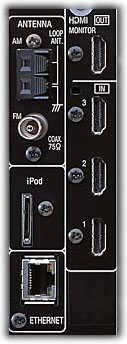
I know this is a lot to ask, but we’re a bit strapped for cash what with two kids and a nice mortgage rate that is about to become unfixed. Are you aware of the new A/V receiver from Denon, the AVR-4306? Obviously it is high on many people’s lists, but if you’ve forgotten, this is the one that finally is doing something with the Ethernet port on the back. Sure you can listen to Internet radio — big deal — but you can also finally treat your receiver as a network-controllable device, just like everything else on your home network. Need to re-route the DVD output, adjust speaker volumes, change the input to the trusty cassette deck? Just bring up the device’s web page and do it from any computer in the house or — if you’re really a control freak — from work or on the road.
So you probably remember it now and you’ll also recall that this puppy has two built in iPod ports, one in back for a permanent hookup and one in front for spur-of-the-moment guest DJ’ing like, say, at a party. (I know, I know, I wouldn’t think this would be useful either, but some friends of mine have an iPod dock built into the wall of their kitchen and let me tell you it makes for an outstanding get-together to be able to have guests pop their ‘Pod’s into it. Trust me.) Once docked the iPod is controllable just like everything else from the unit’s web page. Oh, and another thing, there’s a USB port on the front for hooking up removable media. The AVR-4306 mounts the drive and reads the media for immediate playback. Oh, oh, and do you see those four HDMI ports there? Do you? Three in, one out. That’s the coup de grâce, the pièce de résistance, That Which I Must Have. (Is that greedy? Sorry. I’ve been good. Really.) This spectacle of modern audiovisual magic actually upconverts any video signal — composite, s-video, component, hell if you sketch it a picture it’ll probably try to convert that too — straight to digital HDMI for a single output to your TV.
Bliss, no? At forty-some pounds it’ll be a bit heavy to lug here, I admit. So maybe, if you agree that I deserve it (and, frankly, I’m unable to conceive of a scenario where you would not) then may I suggest using Fedex Overnight shipment? Preferably to arrive before our annual Christmas Party? Sure, you’re invited. Thanks!
Oh, my kids have a list for you too. But I’ve misplaced it at the moment.
FightAIDS@Home

Lots of great new things happening at the World Community Grid. It seems like it has been running for a lot longer than a year, but our first birthday just passed and we’re happy to announce a new project running on the grid to contribute to AIDS research. FightAIDS@Home uses computational methods to identify new candidate drugs to block HIV protease, a key molecular structure that, when blocked, stops the virus from maturing.
For the last year the World Grid ran the Human Proteome Folding Project, which has been providing scientists with data on how individual proteins within the human body affect health, enabling them to develop new cures for diseases like lyme disease, malaria and tuberculosis. Scientists now have descriptions of 120,000 protein domains that are critical to human well-being.
Also new is section for children at sister-site TryScience.org that explains the concept behind grid.
If you’re unfamiliar with the Grid project, it basically allows you to use idle processor cycle time (or share it with other apps) to conrtibute to large, distributed computationally-intensive problems. A great way to participate in meaningful research.
Yes, I’m still hoping for a humanities-related grid project, but it is hard to argue for limited resources when there are so many humanitarian and life sciences challenges to solve.
Spam of the day
“Smith & Wesson: The original point and click interface.”
Made me laugh. If only computers were as easy as guns, you know? You can pry my computer from my cold dead hand.
Hanging out in Bel-Air?
Just a reminder that if you’re in the area I will be speaking this evening at UCLA. Logistics here.
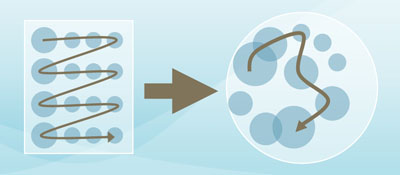
Artifacts from the Future: Experience Design for Cultural Spaces
November 17th, 2005 • 7:00 p.m.
Melnitz Hall Sound Stage 1 (Room 1451)
There’s got to be a better way
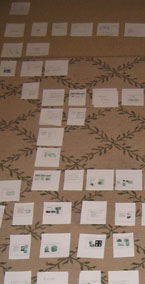
For me these days it seems that the task of creating a presentation is really an act of merging and culling prior presentations, then creating new material to stitch it all together. Powerpoint is awful at this. What’s really needed is a way to view multiple presentations (trying … hard … not … to … say … “decks”) in a single window with all available slides so that you can mix and match and group. Sort of like the thumbnail view but with the flexibility to arrange stuff non-linearly. I don’t think Keynote does this either. I end up printing it all out and arranging on the floor. The GTD people surely love this low-tech information design, but I’m not convinced software couldn’t solve the problem (and free up my kid’s play area floor space)
Tinderbox for Windows where are you?
More junk for your inbox
Those of you don’t use newsreaders and who hate coming to the site only to find it looking exactly like it did last time you checked may be interested in the e-mail subscription option I’ve added at the very bottom of the page. For the exceptionally lazy, you can avoid scrolling and subscribe here.
Check your junk e-mail folder for my upcoming posts on Viagra, mortgage deals, brazen teen nymphomaniacs, and East African investment opportunities.
Deliberately wearing the wrong clothes
I’m a Civil War novice. Dad paraded my siblings and I yawningly through battlefield after battlefied in our youth and I’ve come to know patriotic Galena, Illinois — Ulysses Grant’s place of residence at the outbreak of the war — as a second home over the last decade and a half. Still, I know next to nothing about the war or the period. I’m just an unreconstructed European Studies major dropout, I guess.
That’s changed recently, though. Or, is starting to anyway. During the course of the International Freedom Center project and the Eternal Egypt History Channel documentary I had the fortune of working with Peter Kunhardt, principle of the documentary team at Kunhardt Productions and descendant of Frederick Hill Meserve, one of the earliest and certainly the most prolific collector of Civil War photographs in the country. The collection, begun in the 1890’s, contains nearly 200,000 images including all of the known extant photographs of Abraham Lincoln. (Yeah, you read that right.) Peter and his brother Philip are conscientious stewards of this trove and their enthusiasm for the subject matter is infectious.
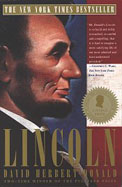
I met the brothers in Springfield a while back to tour the new Abraham Lincoln Presidential Library and Museum. It was a surprisingly moving experience. Hard to impress when it comes to museums, I left thoroughly so. So my interest was piqued and I purchased David Herbert Donald’s Lincoln. The biography was engrossing and powerful, an ample primer to the universe of scholarship and opinion surrounding Lincoln as we approach the bicentennial of his birth. Donald sticks very close to Lincoln and the primary sources, letting the eloquence and complexity of the railsplitter’s life emerge on its own. The picture that develops of Lincoln is of a politically-engaged but heretofore mostly politically-failed misfit whose genius, once in office, could be attributed to his ability to hold together magnetically repulsive personalities in his cabinet, to capitalize on his caricature-as-character backwoodsiness, and to steadfastly adhere to conviction inside a tempest of diverse national opinion.

Donald’s biography ends a few sentences after Lincoln is pronounced dead, basically hanging this Civil War-era neophyte off the narrative cliff. But, rather than pick up the thread at Reconstruction I’ve backed up a bit and started on William McFeely’s Grant. A different type of book than Donald’s, McFeely’s Grant often tells the story from inside Grant’s head, reading into his spartan correspondence and statements with something approaching pscyhoanalysis. Where Mary Todd Lincoln is a big part of Donald’s book, Julia Grant is the key to the life of her husband for McFeely. Her letters to Grant do not survive, but his replies to her serve as a touchstone for much of the insight into the man’s character. Grant’s relationship with his father — who seemed never happy with his son’s increasing accomplishment — is also closely read.
One similarity between these two very different giants of American history is striking. McFeely calls Lincoln and Grant both “masters at deliberately wearing the wrong clothes,” that is, at being able to use difference as an advantage, deriving vitality from the friction of idiosyncracy rather than the comforts of likemindedness.
I’m not finished with Grant nor, I suspect, with this period. You won’t see me re-enacting Bull Run any time soon, but I fear I’m hooked. Suggestions for future reading are very welcome.
Incidentally, for you parents out there, the Kunhardt brothers have another claim to fame. They are the grandsons of Dorothy Kunhardt, author of the classic children’s book Pat the Bunny.
Shallowed ground
I took a long weekend fishing trip to coastal Texas last week, which explains the brief posting hiatus. It was in almost all respects the very opposite of the fishing trip to Canada I took earlier this year — except that we were still catching large fish, thankfully.
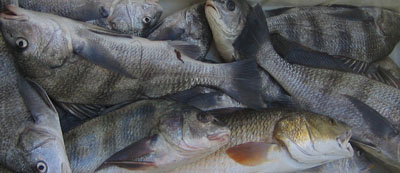
This time, instead of a maniacal Indian guide who used his free time hunting moose with an axe, we had Larry, a weathered good ol’ boy with enough life experience stories to have our rapt attention during the lulls between finding fish. Larry was a native of Aransas Pass, Texas, a small nearby town whose economy, like most of coastal Texas, ebbs and flows with the fortunes of the energy sector and the abundance of catchable wildlife that swim in or fly over the intercoastal waterway. Tip: when talking to a guy about his experience working on a deep sea oil rig don’t make the mistake of jokingly asking him if he still has all his digits. To my mortification, he raised a hand and showed me that, in fact, he didn’t. Ha ha, bad joke. But he took it in stride and proceeded to tell us a horrifying story of being trapped in a cage elevator that had stuck under the drilling platform. Perfectly describing the universal fear of climbing partially out of an elevator only to have it begin moving again Larry told us matter-of-factly how the unstuck cage sliced off his finger as he grasped the ledge. Comes with the territory, I guess. He actually seemed more irritated at having been hooked in the nose by a huge spoon lure from a novice client’s cast on his guide boat. (This client, unbelievably, tipped Larry $5 and said he should get himself a beer after he removed the barbed tip from his face and continued to guide them the entire day!)
Of course, even with Larry, Mother Nature rules. Some houses on the coast were still boarded up from Rita, which thankfully missed to the north. The intercoastal waterway itself is an ever-changing expanse of extremely shallow water whose sub-surface topography is a constant challenge to boaters. The waterway with its dredged shipping channel for barges is more like a series of rivers that flow together and apart — except that the “land” between the rivers is water too. I’m glad I was drinking beer in the passenger seat. Navigation is the real reason to have a guide. Lifelong natives of the area can flit around the waterway at high speed deftly reading slight changes in the surface to know when three feet of water suddenly changes to six inches. The ability is uncanny and more than once our tag-along boat without Larry grounded itself suddenly, embedding its prop into the mud and spewing a halo of muck far into the air. (Incidentally Larry hates tag-along boats. He says it is “like dating a fat girl.”)
You too can experience the stories and marine life expertise by visiting Larry’s website. Be sure to check out the Blast and Cast special (hunting ducks in the morning, fishing in the afternoon). I don’t hunt, but I like the sound of it.