
Laughs in Rome
Today in Rome I was chatting with the bellhop at the hotel, waiting for a cab. Actually that sounds a lot like we were having a conversation. Edit: I was fracturing his native language as we talked at each other in Italian. Anyway, he asked where I was from. I said Chicago. Oh Chicago, he exclaimed! Then he grabbed himself and said in an absolutely perfect impersonation of half my family “Eh, how you doin’?” Phonetically: ha yo doan? Three syllables, stress on the middle one. I laughed a lot louder than I probably should have, but it was such an odd thing. Here was an Italian impersonating what I have always regarded as an Italian-inflected mangling of English like you hear in many urban areas. I didn’t have the vocabulary to note the irony to him.
My second laugh was today at a coffee shop watching an American try to order a cafe mocha like she clearly does at Starbucks back home. The barista was utterly befuddled. And here she thought she was so cultured. They both left that transaction disappointed I think.
Osiris, meet Jesus. Jesus, Osiris.
Yesterday I was a guest speaker at my son’s school. Each week a new student becomes The Chosen One, he/she whose ego shall be inflated by week’s end. This was my son’s special week, so I volunteered to come talk to the class about my job, specifically about my work in Egypt. I figured that’d be more interesting to four-year-olds than, say, XML or Gantt charts.
Now, I’ve given presentations to CEO’s and government officials, to audiences skeptical and outright hostile, but I gotta say prepping for the preschoolers ranks right up there in terms of pre-show jitters. I mean, blowing a pitch to a client is one thing. Embarrassing your child the very first time you get a chance in front of his peers, that scars for life.
I now realize that talking about Ancient Egypt to a group of kids who don’t understand the concept of death is extremely difficult. How to explain the mummy? (“The wrappings keep the Egyptians cool when they take forever-naps.”) I did get a bit of a kick out of introducing the class to some of the Egyptian pantheon of gods, especially as this is a Catholic school. I had visions of the tots explaining to their parents that they learned about Osiris, Lord of the Dead, at school. Multiculturalism, kids. Teach the controversy.
At one point I introduced a finger puppet of a pharaoh. I explained that he was the leader of Egypt, that he wore a headdress that made him feel powerful like a lion, and that he ruled everything he could see with absolute power. At this point one of my son’s friends exclaimed “Just like President Bush!” No, I’m not kidding. I only wondered if he meant the puppet part or the absolute power part.
“More than you know, kid, more than you.”
I don’t really mind blizzards
There is a running joke in my family that my brother-in-law is the only person ever to have to evacuate the same hurricane twice. He fled Hurricane Georges in 1998 from Tampa to the safety of relatives in New Orleans. And then had to flee again back to Florida when the storm took aim for the Crescent City.
I’m not sure we’ll joke about this anymore.
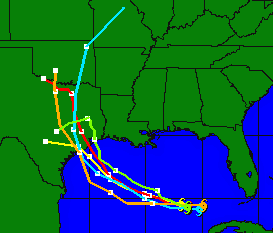
Rearranging my wife’s family from Louisiana and Texas to account for Katrina and now Rita is becoming a logistical game of chess with Mother Nature. Five grandparents and six sets of aunts, uncles, and cousins fled Katrina. The cruel irony is that they are all mostly lined up in towns stretching from coastal Texas, to Houston, to Austin — the precise path of Rita. Flooding likely won’t hobble Houston and Austin (though at this rate even inland Austin will be dealing with a category two hurricane), but when power goes out those scorching cities will be very dangerous places to stay. So, the family exodus begins again. Destination Dallas.
Last report is that my sister-in-law and nephew had moved 32 miles out of Houston in 4 hours.
Jobs4Recovery
It is good to drop everything you are working on once in a while, you know? After Katrina hit I was asked to develop a quick employment portal for job-seekers in the states most affected by the disaster. The result, a partnership between IBM and the US Chamber of Commerce, is a search front-end that links into data from Indeed.com and JobCentral.com, plots results via Google Maps, and delivers state-specific secondary resources. This is what happens when you have a smart, talented team to work with.
Need a job? http://www.jobs4recovery.com
Or post one.
Let’s get to work people! There’s much to do.
Proud of my little pantheist
“Mommy, what is god’s job?”
“Um.” A silence pregnant with panic.
“What does he do?”
“Well, he created the world and now he watches over it.”
“Oh, that’s good. So we could all be god then couldn’t we?”
“Eat your lunch, son.”
The destruction of Clermont Harbor
We knew from the aerial shots that Clermont Harbor, home to my grandparents-in-law, was destroyed by the storm surge of Katrina. But certain areas of the image allowed us to hold hope that something survived.
We know this to be untrue now. There is nothing left in Clermont Harbor. Rick at The Chronicles of Jake did my family the great service of taking a detour in his trip to Waveland to photograph my in-laws’ street. The magnitude of the wreckage defies belief, even after the endless parade of gulf coast images in the media has somewhat inoculated me.
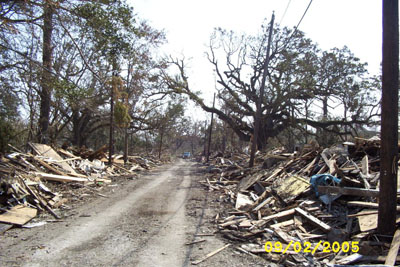
We’re fairly certain that this is Forrest Ave. in Clermont Harbor.
Reader Jennifer writes:
My husband and I went on Saturday, 9/3 to salvage what we could and we came away with a garden sign and football. I’m sorry to say that there is not a structure left standing in the community of Clermont Harbor south of the railroad tracks. It is nearly impossible to find anything amidst the rubble.
Special thanks to Rick and Jennifer. (Viva blogosphere!) And thanks to everyone who wrote to offer support. All our relatives are safe. Some of the family from Kenner have already returned, with those from Gretna and Algiers possibly behind them soon. Those who suffered more damage have been relocated to Baton Rouge and Texas.
Social voicemailing
Recently my office switched over to VoIP telephony. Cool enough, but the best thing about it is that I can finally check voicemail online without picking up the phone. Voicemail queues up on a website as WAV files. I periodically download them to a local folder that feeds into iTunes and is tagged as Voicemail. A local colleague* recently noted he could access my voicemail via iTunes since I was sharing my music library. This gave me an idea. Why not share voicemail with trusted colleagues on your local LAN? Or, better yet, podcast it? Here’s how my message would change:
“Hi, you’ve reached John Tolva with IBM. I probably will not return your call, but you should know that many of my office colleagues will have access to any questions you might have. They may even provide answers. Thank you.”
This could be big. Social voicemailing.
[*] The same colleague from this post. I found him!
The evolution of the LEGO computer block
Recently we’ve been sifting through about six tubs of LEGO bricks that I grew up with and still own. It has been an archaeological dig through my past. Not only is it fun to find certain blocks I used to love, but I’ll often come across some aborted or half-destroyed creation and I’ll almost instantly (and quite eerily) remember why I built it or what corner of my LEGO universe it occupied. This is from two decades ago, mind you. But the real treasure in this dig are the non-LEGO items buried in the brick-silt. Small, fractured toys, leaked batteries (and their dried acid), dessicated food stuffs, and all manner of childhood jetsam probably make up 5% of the brick tubs. Your hands become visibly dirty after running them through the tub for just five minutes. But even the scum tweaks nostalgia a bit.
I’ve recently discussed The coolest LEGO brick ever. During the latest excavations I made it a point of picking out all the computer-type bricks I could find. Here’s what I found.
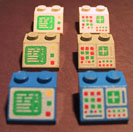
First, the classics, in two versions. There’s the command line terminal on the left and the flashy-button sci-fi bleep-bloop box on the right. No one ever knew what that one did, but it flashed and bleeped and it seemed right at home on the launchpad. The evolution of the colors is the interesting thing in how it roughly sketches the evolution of real case colors. The earliest blue computers derived from spaceships and command bunkers, evolved into the beige-box ubiquity of the IBM PC era and thence to the whites of the post-iMac world.

The special find was this version of the command line model. It is inverted so that it hangs above the minifig user. Because, as is obvious, computers that you dangle over your head mean that you have a lot of screens to keep track of and that you are, thus, supercool.
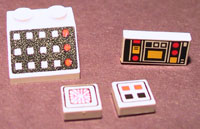
In the LEGOverse computers seem to have taken a step backwards after the golden age of space-inspired computer blocks. At least the early machines had screens. This lot of button panels seem like a throwback to analog days. Not sure what to do? Press the red button.
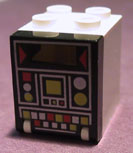
‘Course, sometimes you needed the big iron. Here’s the only LEGO mainframe with removable front plate that I know of.
And lastly, assorted bricks that belong to what you might call targetting computers. The one on the right actually lit up when attached to a battery. Still not as cool as the classics, but in their vectory goodness they echoed Battlezone, flight sims, and other important arcade games of the era.

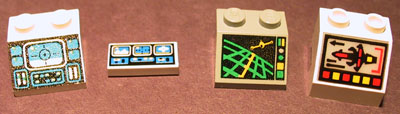
At this point I thought I pretty much had the complete evolution of LEGO computer bricks documented — at least up to the point that LEGO sets and themes diversified to the point of incoherence. (What in the hell is Bionicle?) But I should have known better. LEGO geeks have done a far more thorough job of documenting computer bricks than I ever could. But hey, even the best archaeologists only confirm what’s already known, right?
Nature’s vs. nurture’s call
Currently my four-year-old son’s most requested song is “Mongoloid” by Devo, specifically this a capella version. His constant requesting of it can’t be good in the long term, especially since his uncle has Down’s Syndrome. The upside is that I guarantee he is the only preschooler who knows that the condition is chromosomal.
Recently he announced “You know, Dad, everybody poops … except Mommy.” This is curious because neither I nor my wife has ever told him that she is a non-pooper. (Oh, and also it is untrue.) I’ve never seen a reference to immaculately crapless mothers on any kids’ TV show and I can’t imagine this is a point of discussion at school. Are little boys born incapable of believing their mothers could be dirty in the way that their fathers clearly are?
Speaking of ingrained behaviors, the older boy actually leaps for joy — there is no other way to describe the ecstatic dance he does — when he hears the 20th Century Fox fanfare that precedes their movies. You know, the martial drums and horns? This is because this is how Star Wars movies begin and forever the two shall be linked in his mind. This of course is a terrible setup for disappointment before the several hundred Fox flicks that aren’t followed by a yellow text crawl into the distance.
Mac nano
First things first. I didn’t receive a cease-and-desist from Apple. I took down the original post about getting OSX Tiger to run on an Intel-based laptop because I, you know, panicked. Not sure why I did that, but then Katrina came and life got nutty for a while and you all must have thought I had been arrested, fired, or sent to geek nirvana. Or all three. But no.
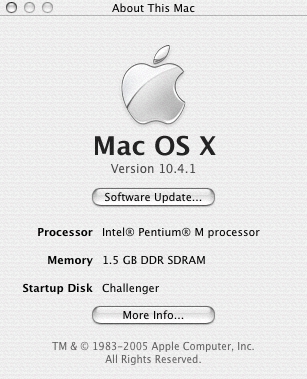
(You’ll never know if this is Photoshopped, will you?)
So here’s how it works. The laptop has two 60GB physical drives. One is partitioned into NTFS for XP and FAT32 for data files. The other has Mac OS on it. The PC is running MacDrive so it can see the HFS volume, but almost all working files reside on the FAT32 partition so that both OS’s can access them. At startup I just specify the drive to boot from (default is Windows for now). Nearly everything in Mac OS works — even crazy stuff like Bluetooth and 1600 x 1200 resolution. It is astonishing. Having a portable Mac that also boots to a real version of XP is life-changing, I tell you.
So while this is all happening out comes the jaw-dropping iPod nano to replace the iPod mini. You have to wonder if the same thing will happen to the Mac mini. And then you have to wonder, how long before doing what I do — carrying around a stealth copy of Mac OS inside (or alongside) a working PC — is something Apple encourages. Sure, I could have installed Mac OS on my iPod and could boot from that, which would be pretty much a Mac nano, but with perfect driver support and updates a real Mac nano would be unstoppable.
Think of it, Apple equips certain iPod models with a full version of Mac OS for Intel so that when they are connected to a PC you can boot to it and convert your PC to a Mac right then and there. What a better way to steathily convert PC users — not by having them buy a new machine but by taking over what they already own. Problem is, Apple does not want to do this. They’ll put iTunes on a Motorola phone, but not OSX on a non-blessed Intel chip. Sigh.