
Eyeball-to-eyeball
My wife’s grandfather passed away a few weeks ago. He was an amazing man for dozens of reasons, but one part of his life that stands out for me was his service during World War II. Grandpa was a fighter pilot running missions out of the UK. In 1944 he was shot down and captured by the SS. He spent the rest of the war in POW camp, tortured but not broken. But that’s a story — and a fascinating one — for another time. Recently I was watching an interview that the National Archives did with Grandpa a few years ago. One section of the interview, which I have transcribed here, was rivetting. It does a good job of presenting this man as he really was: practical, brave, and merciful.
I was on my own, our flight was broken up. I got on the tail of a German who turned at me because he was being chased by two others. He didn’t see me, but he made a 90 degree turn so I had to turn in to him. By the time we passed head on I opened fire and in about two turns I was on his tail — the P51 was good, you could turn inside the other guy.
I chased him all over the countryside, gradually losing height. Finally when he got near the deck he made a most peculiar move. Instead of evading the fire he pointed his nose straight at a church. I said to myself, this man is crazy — he thinks I won’t fire because he’s got his nose pointed at a church. But I realized it wasn’t Sunday and there couldn’t be any people in there so I opened fire.
So then he started going all over the place and finally I got him down to where he lost all his speed and all his attitude and he tried his last trick. It’s called “throwing the anchor out”. You cut the gun, you fishtail, you slow the plane down. He didn’t throw flaps, but all of a sudden he was trying to get me to pass him – that’s “throwing the anchor out.” Well I didn’t pass him because the P51 had a better propeller than the German [planes] did.
First thing you know as far as from here to that wall — 25 feet away — we were flying eyeball-to-eyeball. I was lookin’ at him and he was lookin’ at me. I’ll never know why I did it. I said this guy is going to be dead in about one minute. I felt sorry for him. I just wanted to give him a chance to save his life. So I just gave him the ol’ thumbs-down. Any aviator will tell you what that means: put your plane down. And he knew what it meant. I had those two guys [US fighters] behind me screaming to get out of the way and they’d shoot him down instantly but I gave him his chance, put my thumb down and he turned away put his nose down got the first open field. [He] bellied in, his plane tore itself up the two wings and the tail came off but he landed safely ’cause he landed upright on his fuselage.
There was a huge cloud of dust and those two fellows who originally had him in their gunsights when he turned into me they circled him and if he had not been in that cloud of dust they would have strafed him. Everybody had their choice. I would not strafe a guy who was down, but some of the guys they’d strafe anything. When I was a POW the Germans were especially mad because some of our pilots would kill a man in a parachute. Some people think it’s sporting; others don’t I saved that German’s life by ordering him to put his plane down. He had less than 10 seconds to make up his mind he had lost all of his speed so he didn’t have a chance he was going to be shot down. He decided to save his life and he did.
Somebody asked me once, did you claim that plane was shot down? I said sure I did, what do you think? The plane went down and was tore up, but he saved his life. I hated to see a guy lose his life that could fly that well. I don’t know what happened to him he could have come back up and shot at some of our people the next day but we didn’t worry much about those German fighters as much as if they had been winning.
Full video interview here.
Codewords
It’s not hard to see the similarities between computer code and poetry. Like code, poetry is highly formalized and structural and almost all poems attempt to effect an experience greater than the sum of their words. Call the best of each examples of very artful data compression.
Perlgeeks have been re-writing poems in code for years. Some of it is really quite good, though none of it achieves the grail of actually executing something that might be meaningfully related to the poem. (How cool would that be? A poem turned into an executable program whose runtime output was some kind of answer or manifestation of the poem subject?)
Two gents at MIT have created an application that takes this idea one step further. Metafor is a system for visualizing the “programmatic” nature of the English language. Basically the app takes standard language and creates what looks like a a formalized program. The idea is to use this method of “scaffolding” natural language as a stepping-stone to the ideal of being able to program in plain English. This is sentence diagramming on overdrive.
INPUT: “There is a bar with a bartender who makes drinks.”
OUTPUT:
def __main__():
class bar:
the_bartender = bartender()
class bartender:
def make(drink):
pass
There’s also a great video available that makes the process clear.
Like the Perl-ified poems, this code does not actually do anything. And I fear that this method of translation will come crashing down (so to speak) when it encounters allusion, metaphor, or any of the myriad other figurative fossils embedded in the strata of English. But I like the exercise.
See also: E-mailing Richard Powers
So average
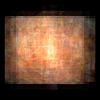
Amazing the complexity that simple innovations beget. Flickr continues to inspire and facilitate some really astonishing technical and artistic development. The latest is a set of images created by a user named brevity by averaging 50 photos of a single type of subject — an eye, a candle, a mountain, etc. The result manages to be both numinous and chthonic. Have a look-see.
And if you like this sort of layering, have a peek too at the work of Matt Wenc. He’s an artist (and good friend) who works in thick grids of color that often achieve the same kind of rear-lighting effect that the Flickr averages do.
Via alt text.
UPDATE: Matt points us to the artist Jason Salavon. Check out his averages of residential real estate markets.
The need for feed
Recently I switched from the trusty Sage plugin for Mozilla to the standalone FeedDemon RSS/Atom reader for PC. Sage did the job, but the number of feeds I was tracking was getting too large and I was never completely comfortable (nor have I ever been) with that sidebar window on Moz. So I am here to state my incredulity that I ever lived without FeedDemon. Goodness gracious, that’s a well-done app! Very clean with lots of advanced features like podcast organization and keyboard shortcuts. Highly recommended.
Seems like there isn’t any information source that I care about that doesn’t have an RSS feed these days. Would be interesting to clock time spent in the reader versus in the browser, no?
Content provider
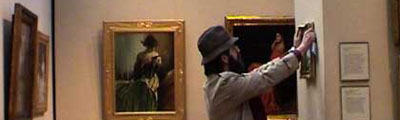
You gotta admire the audacity of this. Guy walks into four of the most prestigious art museums in NYC, hangs his own art complete with labels, snaps some shots, and walks out. If nothing else the act itself deserves mention as a superb piece of performance art.
He says – “This historic occasion has less to do with finally being embraced by the fine art establishment and is more about the judicious use of a fake beard and some high strength glue.” Banksy continues -“They’re good enough to be in there, so I don’t see why I should wait”
Staff at the New York Met discovered and removed their new aquisition early Sunday morning while Banksy’s discount soup can print took pride of place in the MoMA for over three days before being torn down.
As of now, the other two pieces currently remain firmly in place.
Full photos here.
Via Kottke.
UPDATE: MoMA took Banksy’s piece down (it was not in a gallery to begin with), but they didn’t throw it out. Wonder what they’ll do with it?
A stage that needs to ascend
Much has changed since the shuttle last went aloft, but that doesn’t mean it isn’t important for the US and for manned flight in general to get it back up a few times before phasing it out for something better and letting private industry take over orbital trucking.
NASA is still hoping to launch Discovery as mission STS-114 on May 15, though it is not at all certain they will hit that date and the launch window closes on June 3. As you might expect the spacewalks planned for this mission focus on feasibility tests of repairing damage during a mission. Also on the task list are delivery of the Raffaello module to the International Space Station and the installation of a digital camera (yes, they were using film) on the underside of the shuttle to snap pictures of the external tank separation. NASA has said that another shuttle could go up as early as June 14 if there was a need for a rescue mission.
Get ready, spacegeeks, live telemetry feeds will soon be coming your way!
Always back up
My 3½-year-old son has become a Star Wars freak in the last few weeks. He watches all five movies (and recently the new trailer) every weekend — though not in order and not even in the order of their chapters. This constantly-on video mash-up does a good job of highlighting patterns in Lucas’s thinking.
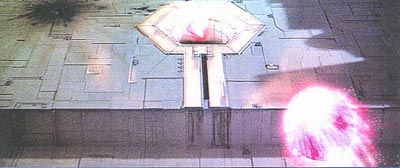
So, here’s my first observation (though probably not the first time this has been observed). Single points of technical failure run throughout the Star Wars movies. You’d think that a culture advanced enough to have intelligent robots and laser swords that don’t singe your retinas when you hold them in front of your face would understand the importance of redundancy. Consider the following.
- Both Death Stars were destroyed by single shots to essentially unprotected (though difficult to reach) Achille’s heels.
- The shield protecting the unfinished Death Star on Endor was disabled by blowing up a single power station.
- Young Anakin destroys the trade federation ship — accidentally! — with a single shot to something.
- The entire battalion of battle droids on Naboo is disabled by the explosion of the trade ship.
In a way, single points of failure are great storytelling devices. They make the goal-driven narrative work. It just wouldn’t be all that compelling to watch Han and company scamper around Endor blowing up power station after power station, would it? Or to hear Han say “Great shot kid, that was one in a million! Now let’s get the other four shafts!”
Urban library
A line in Neal Stephenson’s The System of the World comparing the streets of London to bookshelves crystallized something I had been thinking about in an informal way since I first played with the A9 Yellow Pages Search. Well, a few things. First, seen edge-on a shelf full of books does in a way resemble the variegated facades of an urban streetscape. But more than the physical resemblance, there’s a kind of functional similarity. The front of a building, like the spine of a book, is both its human interface and its metadata. Not only do you judge a book (and a building) by its cover, but you must. This is how we apprehend reality, at least initially. One of my favorite tricks in a library is finding the location of a book I think I want then browsing in the region of the book once I find it. Kind of a physical fuzzy search. Same thing with urban streets, especially where businesses cluster based on some similarity (wares, targetted demographic, etc). And this is why the A9 Yellow Pages search is so cool. Amazon merely used the experience of bookshelf scanning as a model for browsing businesses by their building facades. (Though, strangely, you can’t browse Amazon’s book collection this way.) Seems that, at heart, Amazon’s still a bookstore. And I love that.
Anyone know of any other city-as-bookshelf conceits out there? Seems ripe for exploration, especially considering the many relationships between cities and narratives. Also, if urban streets resemble a bookshelf what about suburbia? How can we tweak the analogy to account for strip malls and parking lots?
UPDATE: OpenPlans has an office-length bookshelf that is a map of Manhattan, complete with a Central Park full of wall-hung plants.
See also: Virtual flâneur | The Pavilion of Literary Profundity
Bring it on!
This just in from building management:
One of the noisiest components of the Wabash viaduct reconstruction – metal sheet pile driving as part of the caisson installation – is scheduled to begin on Thursday, March 17, 2005. This activity may also cause the building to vibrate.
They’ve never warned of vibration before and this place certainly shook when they were ripping apart Wabash. I wonder if this is an attempt to proactively warn or if they really mean the Richter scale is going to be involved here.
The test will be if the building shakes enough to park the hard drive head of my ThinkPad. Sorry, boss, gotta go home, my hard drive airbag just deployed.
UPDATE (3/18): No piles driven, no buildings shaken, no airbags deployed. So very anticlimactic!
Stuff in my backpack, international edition
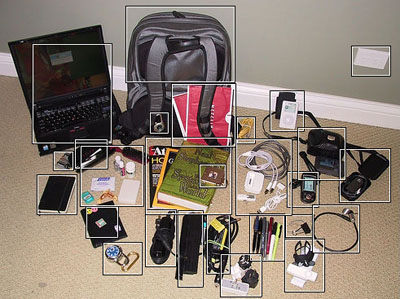
click for annotated version
Today I booked four separate itineraries in three countries for travel before the end of May. Really the only way to manage such a schedule is to have the right gear. Jumping on the whatsinyourbag tagfest over at Flickr I have catalogued all those things that keep me sane and connected when I travel — in this case internationally. Bag contents differ slightly for the commute to work and for domestic travel.
(These inventory spreads remind me of a dated little travel book called Point It. For the international tourist who has absolutely no desire to learn any new terms whatsoever.)
So, what am I missing?