
Missionary ambition
During my junior year in college I fled my home institution of Vanderbilt for a semester abroad in Rome with Loyola University. It was an experience that changed my life. About a year ago I was asked to serve on the board of the Rome Center or LURC as we used to call it. This position has allowed me to get to know Father Mike Garanzini, the charistmatic relatively-new president of the university in Chicago. (This past weekend Garanzini’s turnaround of Loyola was the cover story of the Chicago Tribune Magazine.) Father Mike has big plans for LURC. One idea is really appealing to me. He’s interested in creating something called the Ricci Scholarship, a funded full-year of study abroad for exceptionally talented undergraduates. It would place them in Rome for a semester of study and then, through a partnership with Fordham University, move them to Beijing to finish the year. The goal would be a comparative assessment of business, art, mathematics, history, you-name-it and the outcome would be a senior year thesis on the same. It is a bold idea, but one that will likely work given the long history of respect in China that Jesuits enjoy in the country. Named for the missionary Matteo Ricci and undertaken in the spirit of synthesis of East and West the program may begin as early as 2007. With the western world so eager to crack the nut that is Chinese culture and business and with China determined to spread Mandarin around the world this seems very timely.
Unrelated but personally interesting is an exhibit at the Loyola Museum of Art, which I only learned of today. It presents works of Caravaggio as digital replicas per se in a darkened gallery using high-res display monitors. This is the first that I know of bringing the virtual inside the physical so literally. I haven’t seen it yet, but I’m eager to know what happens to the sense of aura that standing in front of a tangible artwork produces when you’re once removed from it. I can’t imagine it is any less real than standing 30 people back gazing at the diminuitive Mona Lisa encased behind bulletproof glass.
I heard a rumor
Last night the house on our part of the block one street over burnt down. As I’ve come to expect from our city’s first responders, the number of emergency vehicles might have caused you to think that an entire block had been napalmed. Dozens of fire engines and even more squad cars clogged every part of Damen Ave. from Belmont to Roscoe. Curious, of course, I sidled up to a group of bystanders listening to a cop. Here’s the gist.
Cop: “… firecracker.”
Me: “Hey, I live one block over. Is everyone OK? Did you just say this was caused by a firecracker?”
Cop: “Yeah, everyone’s fine. No, firecracker is what we call people who flip us the bird from the window like that woman over there.” Points.
Me: “How did this happen?”
Bystander: “I don’t want to start any rumors, but she had a lot of cats. Lots of cats.”
Me: “Cats don’t start fires.”
Bystander: “Look, that’s all I’m gonna say. I don’t like rumors. But she has a lot of cats and she’s been in the news. If you know what I mean.”
Me: Pause. “My house got a little wet from the fire hoses. Could have been worse I guess.”
Same Bystander: “Oh yeah? Any water damage? Here’s my card. I’m an adjuster.”
Me: “My god, you’re like an ambulance chaser for fires.”
Bystander: “Hey, I live in the neighborhood.”
Taikographs
My pal Victor in Beijing presented me with this set of signed commemorative postcards from China’s first two manned spaceflights. The outer envelope, pictured here, contains the signatures of Yang Liwei, China’s first man in space, and Fei Junlong and Nie Haisheng, the occupants of the second ship up. Inside are three separate cards corresponding to the individual taikonauts, also signed.

Victor got the autographs because he works closely with accessibility organizations in China and so he knows the head of the China Disabled Persons’ Federation, Deng Pufang, the son of Deng Xiaoping. With a dad like that Deng Pufang of course has friends in high places and thus were Victor and the spacemen at the same reception. Deng Pufang, by the way, became a paraplegic during the Cultural Revolution as the result of falling from a fourth floor window to escape torture.
The discards of Los Alamos

I’ve spent much of the past week hearing about the latest in museum technology. There were even organized outings to the museums in and around Albuquerque for us to get a gander firsthand. Strangely none of the organized tours included The Black Hole Museum of Nuclear Waste in Los Alamos.
Run for over 50 years by a guy named Edward Grothus, the museum is more like the backlot of a Mad Max film. In fact, in an irony I am certain is not lost on Grothus the place looks exactly like some archaeology dig where future humans are uncovering the remains of a once-great society’s technology after a nuclear catastrophe. He has built, in other words, that which he hopes to prevent. You might think a “museum” to the scraps of Los Alamos is some kind of reverential exercise, but there’s actually a peace theme that runs throughout, as if Grothus were hoarding all this utterly useless stuff (vials of Liquid Paper!) because he doesn’t want its bad karma let loose in the wild. Of course, it does get out; he sells it. But what sells can only be a tiny fraction, because most of the stuff you could simply stroll through Office Depot for. And it is reverential, in a way, as Grothus conducts a “Critical Mass” every Sunday in a huge A-frame “church” next door.
The technological gizmos are the most interesting for sure. All kinds of specialized and worrisome componentry sits amidst computers of bygone eras. It is like a library once-removed where you walk through wondering what documents, equations, and national security communiques issued from the teletypes and keyboards.
A fascinating museum, if ever there was one. Highly recommended. Bugs, I’m glad I took that left turn at Albuquerque.
Photo tour at Flickr.
Ghostface
Was the mask in the Scream trilogy inspired by a cave formation in Bandelier National Monument Park in New Mexico? It’s commonly held to have been inspired by Edvard Munch’s The Scream, but I’m going with the theory that Wes Craven is a hiker.

For a good time, call 877-454-0795
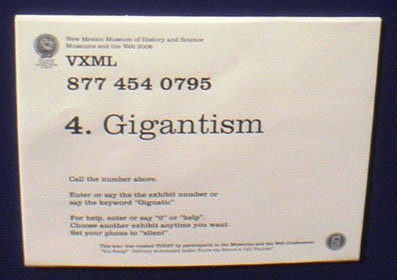
The annual Museums and the Web conference held its opening reception at the New Mexico Museum of Natural History in Albuquerque two nights ago. The dinosaur exhibit — which is to say, most of the museum — featured a cellphone-based tour in two flavors, keypad-activated and voice-response. All you had to do was say the number or name of the exhibit and voila! But here’s the key point: the tour itself was put together only hours earlier in a conference workshop by museum professionals, podcast-style. This is really quite revolutionary since it shows a real speed-to-market (so to speak) and flexibility of audio tours that previously had not existed. Guerrilla museum tour creation. Yet another example of the web experience for content creators and visitors infiltrating the physical museum space. Wonderful!
And don’t forget to say “Gigantism.” Not only because it triggers the audio, but because it is a lovely word.
Dayjob
I’m just back from the annual gathering of my particular tribe inside of IBM and I figured I’d take the time to tell you, loyal readers, actually what I do for a living. I’ve occasionally mentioned projects here but never actually talked about what I do. This is not because of some corporate policy. In fact, IBM’s external blogging guidelines are some of the most liberal in the industry. Many of our executives blog externally and quite candidly. Internally, blogs thrive for personal use, project teams, and professional topics.
I work for IBM’s Corporate Community Relations, a name which really doesn’t do a good job of describing our mission in the company. In a nutshell, we’re the group responsible for demonstrating innovation that matters to the world (as opposed to innovation that matters only to our company or to our customers, for example). Our programs are what might have traditionally been considered philanthropy or corporate social responsibility, but really that suggests a disconnect from the business itself. IBM Corporate Community Relations is not a function of corporate marketing but rather a group within our Innovation and Technology management line. Why is this important? Because we don’t view corporate citizenship as merely an extension of our brand. Of course, it is that in part — what you do is as much your brand as any logo or slogan — but addressing social, educational, and humanitarian problems is a lot more important than marketing. As a company of 330,000 employees in over 170 countries our “community relations” efforts have to amount to more than sponsoring the local Little League team or cutting checks to charities. Here’s a smattering of what we do.
On Demand Community – IBM’s tool for matching employees to community volunteer efforts and for preparing them with materials and training. Hours volunteered earn credit towards making a cash grant to the community organization. Amazingly successful: 60,000 employees are signed on as volunteers with over half coming from outside the US. Over 3,000,000 volunteer hours logged since the end of 2003.
Transition to Teaching – First-of-its-kind program to address the shortage of high quality math and science teachers in America. As part of the pilot IBM will pay the tuition of employees interested in leaving IBM for a career in education.
World Community Grid – Our program for solving computation-intensive projects in the life sciences. The current project FightAids@Home allows people all over the world to contribute idle processing power on their own machines to create a distributed virtual supercomputer powering the search for a cure for AIDS.
TryScience – Long-running science meta-museum with activities and virtual field trips for children and educators. Also a successful kiosk program distibuted to museums worldwide.
Web Adaptation – Project to donate accessibility technology for web users with vision and/or motor skills impairment.
KidSmart Early Learning Program – Early childhood education initiative which includes the KidSmart learning guide site and donations of Young Explorer computer systems to schools around the world.
¡TradúceloAhora! – Education-focused automatic online machine translation for English and Spanish, soon to providing instant e-mail translation.
IBM Crisis Response – Among the myriad ways IBM assisted during the Asian tsunami and US hurricane disasters of the past year, we shipped thousands of biometrically-enabled PC’s for tracking of displaced persons that tied into a system for first-responders and aid organizations to use during recovery. For Katrina, among other things, we developed the employment opportunity portal called Jobs4Recovery. Unlike many companies, IBM refused to capitalize on the public relations aspects of recovery assistance, which is why you won’t find much information about our crisis programs.
The Genographic Project – Supercool collaboration with National Geographic to map the dispersal patterns of humans out of Africa (and by extension the nature of human diversity) by analyzing the inherited mutations in indigenous peoples worldwide. Public participation is encouraged; you can swab your cheek for placement on the world migration maps. Think of it as macrogenealogy.
Eternal Egypt – Must I tell you more about this?
Well I suppose I didn’t answer the question about what I do, in particular. For the valiant few who have made it this far in a too-long post, I’ll note that I manage all the programs in CCR that relate to cultural heritage. This includes, obviously, Eternal Egypt above plus two truly exciting new projects which I can’t yet talk about but which very careful readers of this site might have an inkling about. I work with project managers, developers, and designers and of course with our partners to deliver these types of projects. It is a great gig, I have to admit, getting to work in high technology and culture at the same time.
Recently, our CEO Sam Palmisano remarked that “the world won’t look at you as a great company if all you do is make a lot of money.” I suppose you could say that the goal of my team in IBM is to make it that great company.
My goodness, you’d think I was paid to do that. What ever happened to bloggers who dish the dirt on their employers?
Less feel-good posts coming, promise.
Buddy breathing
OK, here’s an idea. How about a USB to USB gagdet that a person whose laptop battery is dying can use to suck power from someone nearby who is plugged in? Obviously you could not power a whole laptop solely from the USB draw, but the idea would be merely to replenish while there is still life left in the battery, forestalling laptop shutdown. Patent!
Scissorhands
It is safe to say that anyone who has even glanced at this blog knows that I am no luddite. I use and extol technology for its own sake all the time. And yet, and yet. There comes a time when it is so clear that neither human necessity nor technological innovation are driving change that I find myself wondering if low tech might be better. I speak of course of the proliferation of multi-bladed razors.
True to form, I’d been thinking I needed more blades for some time. Why? More blades. I had been using the prehistoric, two-blade plus lube strip Sensor Excel for years and frankly I was jealous of the three-, four-, and five- bladed variants. When they added power to vibrate the whole rig I knew it was only a matter of time. I believe the equation, check me on this, is: (r + p)b = d, where r = the basic razor stem, p = power, b = number of blades, and d = desire for object.
So I forgot my old razor on my latest trip. I was staying with my in-laws and my brother-in-law had one of the newfangled Fusion 5+1 beasts. This is the razor that the Onion actually predicted back in 2004. As the chart below from the Economist shows, the parody wasn’t all that prophetic. Blade profusion is almost as guaranteed as Moore’s Law. We’ll be at 14 blades by 2100.
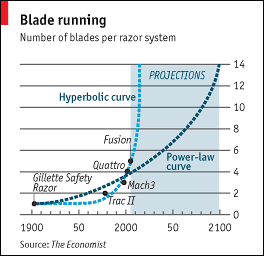
My experience was terrible. See, five blades does give a nice shave on the open fields of ones cheeks, but for actual styling or for navigating any kind of variance in facial topography it is simply too big. I have a goatee, so getting close in to the beard is key. If I don’t I look like a hick meth addict festooned with different lengths of hair around my mouth. Yes, the +1 on the Fusion is the extra blade on the back precisely for this purpose, but it really doesn’t work. The single blade is still part of a gigantic bladehead and you just can’t get close enough.
I was still without a decent razor so my father-in-law bought me a powered Mach 3, a razor he swears by. Same problem and this time without the styling blade. The power too is a problem. For one, I didn’t realize how much of shaving is actually aural. I’d grown accustomed to hearing the sound of the beard growth being severed or not — no shearing noise meaning I’d gotten that area fully. This is much harder to do with a vibrating shaft (ahem) in your hand. I found it taking me longer to shave. Maybe I was also more cautious since it felt like the razor would vibrate right out of my hand at any time. There’s enough metal on that baby to earn its place in a display case next to a cat-o’-nine-tails mace.
So, I’m going low-tech. Back to the Sensor Excel. Perhaps nanotech is the salvation here and I will return to the multibladed progress curve, but for now I’m bailing. Call me backwards. But also call me well-groomed.
View > Show > Grid

The Palace of Supreme Harmony at the Forbidden City in Beijing under renovation. The pace and quality of the upgrade is staggering.
See also my helpful guide to Chinese toilet iconography on Flickr.
Mission Elapsed Time: 20:00:21:06:42:40

I went back through it this blog (and my Flickr account) on its 20th anniversary, retracing digital footprints made on what feels like a different planet. Here are some highlights.
The Terror Tourist

Explorations of place in horror fiction — real or imagined, geographical or psychological — culled from my time on The Heavy Leather Horror Show 2023-2026.
Subscribe to the podcast or the email newsletter or just read through the archives posted here.
The Ampcamper

How I hauled myself, two teens, an 80 lb dog, and a whole load of crap 4000+ miles across six states in twenty days using an electric vehicle. And survived to tell the tale.


