
Necessary feeding
Recently my subscription to Daring Fireball lapsed and it took me a day or two to realize that Gruber was not on vacation but that my feed had stopped. Sucked. Made me grumpy. Misanthropic, even.
So I figured now was a good time to comb through the ol’ reader and highlight those feeds that I can’t do without. I’m subscribed to hundreds of sites, but there are a few that give a moment of pleasure in simply seeing the new entry indicator in bold. Some of these are obvious and well-known, others perhaps not. Have a look at the one’s you don’t know.
Daily
Coudal Partners
Daring Fireball
Gapers Block
ISO50
kottke.org
Mark Bernstein
Not-so-daily, but just as satisfying
fueled by coffee dot com
microscopiq
PointAwayFromFace
Roo Reynolds
stevenberlinjohnson.com
wayne&wax
It’s interesting to think about what’s common about these sites. True, I know the authors of 7 of 12 of the blogs, but that’s not really an explanation. It’s that I feel a connection to all these sites in ways other than just being a reader.
For instance, I’m a huge fan of the music of Tycho (ISO50). I have eminent respect for the scholarship of Wayne Marshall (wayne&wax). Gruber (Daring Fireball) is a close friend of Jim Coudal’s; that’s a degree of separation that makes him almost a pal. And so on.
I’m sure there’ll be a blog one day from someone I have no other connection with, but right now it’s all about personal affinity. A kind of social networking informs my own reading habits, you could say.
Should I be following your site? Let me know.
How big is the Forbidden City?
Jack Blanchard, long-time creative director colleague*, recently whipped up a map to answer a frequent question about the scale of the Forbidden City in Beijing. I suppose it isn’t all that helpful if you don’t know Chicago, but the short answer is: basically the size of the Loop.
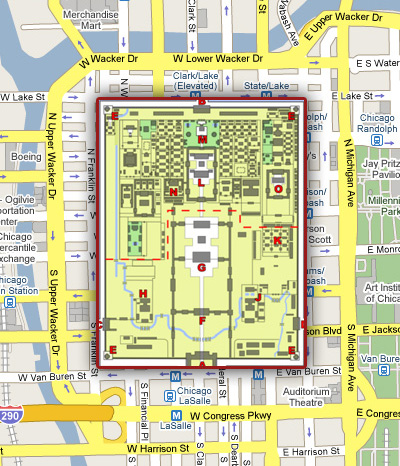
You know, now that I look at it, if the mayor would only carve a canal to the lake along Harrison we could give the Loop a moat. Just need to build 30-foot-thick walls and put guard towers in and we’ll be all set. Just try to mount an attack, mongrel St. Louisans!
* Also impresario, dilettante, bon vivant, roustabout, part-time carnie, certified life coach, and TSA detainee.
Maine holiday
Just back from a first-ever trip to the coast of Maine. What an amazing place.

Couple of tips for the uninitiated. You’ll encounter lots of puns on the name “Maine”: Maine-ly Antiques, Maine Drag, The Maine Attraction. Avoid these at all costs. Also, an easy clue as to how greedily a place wants your tourist dollars is to note the amount of signage and text that spell things according to the Maine accent. If you see more than one reference to “lobstah, chowdah, and beeya” leave. Immediately. Lastly, if you hate the Red Sox do not visit Maine.
To boil down what Maine thinks it has to offer I present you with the following list:
- lobster
- blueberries
- moose
- the way life should be
- a carbonated beverage called Moxie
- lighthouses
- puns on the state name
But it is really so much more than that. Have a look.
Testing 1-2-3
Coudal Partners has released it’s third edition of Field-Tested Books. It’s a stunner.
FTB is a collection of short reviews that explores the connection between the subject of a book and the actual location it was read. Like Rob Gordon’s autobiographical organization of his record collection in High Fidelity, the idea is that reading is not a act sliced off from the context in which it happens. The real world has a way of bleeding into the written world, and vice versa. FTB is a compendium of crossovers.
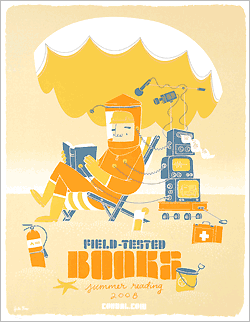
This year Coudal is releasing the reviews as a bound book. Looks gorgeous, as does the poster and the process behind it. Kudos to Steve and the entire Coudal crew for editing such a cool volume. And for inviting me to contribute.
For geo-types, I’ve put together a quick map showing the geographical dispersal of the reader reviews. Some are guesses — for point-to-point air and road travel I used the midway as the location — and others don’t exist at all. Happy trekking!
Throwback
I’m headed to Wrigley this afternoon to catch the Cubs in their current hot streak. It’s going to be a unique game. Apparently today the club will celebrate 60 years of being televised by WGN by trying to emulate a game from 1948.
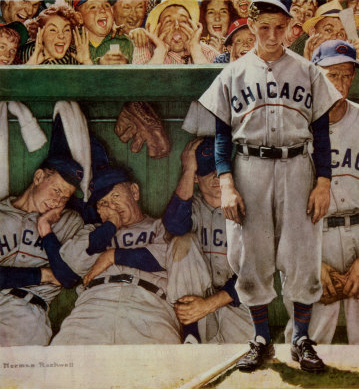
Norman Rockwell, The Dugout
There have been retro days before, but this one is fairly unique. In addition to the 1948 uniforms (which for the opposing Braves is a Boston uniform) the telecast will be in black-and-white for the first few innings. Camera angles will be limited and the center field camera (which provides the batter close-ups) will be offline. Certain vendors will be offering 1940’s-era victuals at 1940’s-era prices. How cool is that? More info here.
Fans are encouraged to dress the part too, but I’ll be damned if I am going to put on a suit and fedora. Well, maybe just the fedora. How does one dress for 1948?
Retrograde
I was shuffling files around recently and came across an archive of my first personal website. It wasn’t Ascent Stage, but a site called hypertext :: renaissance (you see, the lowercase and double-colon were edgy) that I built when I was in graduate school in 1996.
Click for annotations and prepare to mock.
.jpg)
The search engine stares back
To commemorate the birth of artist Diego Velázquez Google today pulled a funny with their homepage logo.

I wrote about the strange interactive aspects of this painting a month ago. It’s particularly apt for a search engine that’s always looking back at its own viewers. Compare.

I didn’t realize Sergey and Larry read Ascent Stage. Welcome, sirs.
Artisan
So, you may know that I am headed to Africa for five weeks on a special assignment for IBM. It is called the Corporate Service Corps and it is a unique undertaking for a large corporation. For any company, for that matter. It is the Peace Corps meets multinational company meets corporate citizenship. I leave on July 10.
You’re thinking, good luck trying to sell a blade server or consulting in Ghana. Or, you shameless pigs, Africa needs basic infrastructure, not computing firepower. You’re right. But it isn’t either of those. We’re not selling; we’re completely cut off from the network of peers in the company that makes us corporate workers. We’re guns-for-hire working for tiny businesses.

This program is the most globally-minded program I’ve seen IBM undertake in ten years. The idea is simple: send IBM’ers to places on the cusp of entering the global market and where we have no real presence. Might never have, in fact. But doing right by the global community isn’t just about doing so in markets in which we do business. You’re not believing that as you read it, but it is true. We are completely OK with the fact that we may never do business in Ghana, but that’s not really the point. The point is that it is frankly stupid to pigeonhole knowledge anywhere in the world. Helping one place will flow elsewhere. Better businesses in one place ultimately is good for other places. It’s not unlike environmental responsibility, actually.
There are multiple assignments per location. Mine is with the NGO Aid to Artisans. It’s goal: “to enhance income levels and employment generation in the craft industry in Ghana through product design and development, business training, market development, advocacy and advisory services.”
My goal? To help them develop an e-commerce site and understand their supply/value chain.
We’ll see. But I couldn’t be more excited.
Metadata and spring cleaning
It’s taken years, but I finally have backup where I want it. (Oh yes, dear readers! It’s another post about data backup. Recline your chair and prepare for a mind-blowing post.)
My reasons for backing up seem to be changing. Certainly there’s still the raw, precious data. Family photos and video, certain media projects — these things have to be saved for posterity. But increasingly my reasons for wanting a backup are more about state than data. I want to return to the state my machine was in more dearly than I want the data it once contained.
Think of it in more concrete terms. What if you everything in your house — every single physical item — had a double in a storage facility? What if every time you bought anything you bought two and put one in a self-storage bin? Then your house burns down (and all your loved ones are safely vacationing on Maui). You can reconstruct your life from the storage facility, but it will be a massive pain in the ass. The state is all fooked. The effort involved in getting it back to a livable order is overwhelming, basically the same thing as moving — an act which ranks just slightly below death of a spouse in terms of personal stress.
Ideally you’d want a legion of robotic moving specialists to reconstruct your house according to the old plans and place everything back as it once was. A bonus would be the option to redirect the robots as the spirit moved you, but at the very least you’d have an automatic replica. This is the source of my fascination with bootable clones.
The fact is, most of my data is replicable. My iPod and laptop all contain enough of my music library to reconstruct it if the main machine should fail. My calendar is online. Personal mail’s all IMAPped up to the Great Google in the Sky. Work e-mail, replicated from servers. Photos are all on Flickr; video at any number of services. The set of truly precious, non-online-dwelling data is getting smaller and smaller by the day. Basically source files only.
My prediction is that in the near future state is all we will care about. You won’t even think about data being local or remote. But you will care about speed-to-recovery. And that’s all about the little things, how your machine behaves, how your kitchen was organized before the fire.
There are corollary effects of this attitude. Recently to alleviate some of the space pressure of five people in a home we decided to clean up some of the impromptu areas of storage in the house that had persisted since we moved in. You know what I’m talking about. Boxes that never got completely unpacked. Stacks of crap that made do in a guest bedroom only because you didn’t know where else to put it.
I undertook the foolish exercise of building an attic in my garage. I can hardly hammer a nail straight much less build a structurally sound platform. Most of what we moved up there was non-essential: books, college notebooks (wanted to throw away but couldn’t — I’m going to need that Intro to Lit Crit some day,damnit!), winemaking equipment, random crap.

So I got it all up there. Stored. Except it wasn’t really stored — wasn’t really backed-up — unless I knew it was there. And this again is the influence of Google. Unless you can search for it, unless you know precisely how to get it back, you might as well throw it out, delete it. So I took photos of everything up there, where it lay in the attic. And for the books, well, it got a bit geekier as I finally finished cataloging and noting the location of every last volume with the superb Delicious Library.
Do I care about most of that crap up there? No. Do I care that I know the state of that crap. Absolutely. And that’s the thing. If the garage burned down I would be OK. The stuff is replaceable. The index to that data is not.
Maybe I’m overthinking this because my father and brother are in the self-storage business. But I think not. Spring cleaning for me is really spring tagging.