
Scissorhands
It is safe to say that anyone who has even glanced at this blog knows that I am no luddite. I use and extol technology for its own sake all the time. And yet, and yet. There comes a time when it is so clear that neither human necessity nor technological innovation are driving change that I find myself wondering if low tech might be better. I speak of course of the proliferation of multi-bladed razors.
True to form, I’d been thinking I needed more blades for some time. Why? More blades. I had been using the prehistoric, two-blade plus lube strip Sensor Excel for years and frankly I was jealous of the three-, four-, and five- bladed variants. When they added power to vibrate the whole rig I knew it was only a matter of time. I believe the equation, check me on this, is: (r + p)b = d, where r = the basic razor stem, p = power, b = number of blades, and d = desire for object.
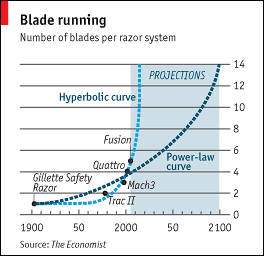
So I forgot my old razor on my latest trip. I was staying with my in-laws and my brother-in-law had one of the newfangled Fusion 5+1 beasts. This is the razor that the Onion actually predicted back in 2004. As the chart below from the Economist shows, the parody wasn’t all that prophetic. Blade profusion is almost as guaranteed as Moore’s Law. We’ll be at 14 blades by 2100.
My experience was terrible. See, five blades does give a nice shave on the open fields of ones cheeks, but for actual styling or for navigating any kind of variance in facial topography it is simply too big. I have a goatee, so getting close in to the beard is key. If I don’t I look like a hick meth addict festooned with different lengths of hair around my mouth. Yes, the +1 on the Fusion is the extra blade on the back precisely for this purpose, but it really doesn’t work. The single blade is still part of a gigantic bladehead and you just can’t get close enough.
I was still without a decent razor so my father-in-law bought me a powered Mach 3, a razor he swears by. Same problem and this time without the styling blade. The power too is a problem. For one, I didn’t realize how much of shaving is actually aural. I’d grown accustomed to hearing the sound of the beard growth being severed or not — no shearing noise meaning I’d gotten that area fully. This is much harder to do with a vibrating shaft (ahem) in your hand. I found it taking me longer to shave. Maybe I was also more cautious since it felt like the razor would vibrate right out of my hand at any time. There’s enough metal on that baby to earn its place in a display case next to a cat-o’-nine-tails mace.
So, I’m going low-tech. Back to the Sensor Excel. Perhaps nanotech is the salvation here and I will return to the multibladed progress curve, but for now I’m bailing. Call me backwards. But also call me well-groomed.
View > Show > Grid

The Palace of Supreme Harmony at the Forbidden City in Beijing under renovation. The pace and quality of the upgrade is staggering.
See also my helpful guide to Chinese toilet iconography on Flickr.
South by
The Interactive portion of the venerable culture festival known as South by Southwest concluded this week. I was there for much of it before departing for a somewhat hellish two days in Beijing (“East by Far East “). The event was one nerdgasm after the next. “Digital creatives” from all around crowded panels, keynotes, and the hallways to suckle the free wifi and listen to how They Too Could Be Web 2.0 or how they could design the next community app. In fact the conference was a great example of a community simultaneously inhabiting the virtual and physical realms. Attendees in the audience chatted in giant IRC rooms that corresponded to the individual panels often with the speakers on the platform chiming in backchannel or replying in the real world. As this was my first SXSW I can’t compare to previous events, but people told me this time it was more entrepreneurial in flavor, less tools-based. Sure, there were panels on CSS, but mostly topics were on community and startups or abstract concepts like convergence, a buzzword on which I blathered.
The best part by far of course was meeting people. Networking and beer-drinking is built right into the conference proceedings. You have to love that after-event parties are listed in the program. And attendees were genuinely interested in talking. You never quite knew who you’d be standing next to. Chances were high he or she had just sold a company to Yahoo or Google, but you know, so what? So might you soon. The Austin tech scene was well represented. So was the Chicago scene, such as there is one — and that pleased me. Chicago design mavens Jim Coudal of Coudal Partners and Jason Fried of 37Signals delivered the opening keynote and basically entreated the crowd to drop complexity, focus on creative entrepreneurship and then wait for the money to pour in. The crew from Threadless was there too, a great example of doing just that. (Maybe there’s a chance for a Chicago company-funded party next year along the lines of Seattle’s South by Northwest bash? South by Midwest?)
As a guy from IBM, perhaps the former paragon of complexity, I was pleased to be mostly taken on my own merits. It usually doesn’t happen that way. There’s a kind of stigma of respect when I normally tell people I work for the ‘BM. It is almost always positive, mind you, but the fact I work for IBM often overpowers anything I might offer individually. Not at SXSW. People didn’t much give a shit. I liked that. Hell, Craig Newmark of craigslist told me he worked for IBM for 17 years prior to quietly changing the world. See there’s hope.
OK, no more compass puns. That’s my direction anyway. Oh god, jetlag delirium.
Recombinant design
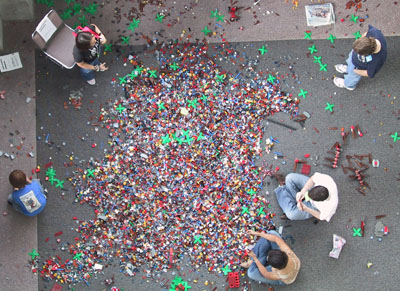
SXSW 2006 Interactive Playpen. LEGO wonderland. Aerial Rorschach.
Verge
Sitting in an afternoon panel at SxSW today I started a post on how I thought my panel in the morning went. I was thinking, gee, it would be nice to have a transcript when I looked up – literally to the guy sitting in front of me – and goddamn but he had one up on his screen.* I asked where he got it. He said, “Oh this is my site. I type fast.” And that is the essence of SxSW.
My panel? Oh it was on a concept that I didn’t really agree with. In fact, neither did my co-panelsts, David Pescovitz of Boing Boing and David-Michel Davies of the Webby Awards. Standing in line as we waited for our credentials a staffer looked at the title of our panel “Convergence and Transformation: A Whole New Creative World” and said quite disdainfully “What in the hell is that?” I shrugged. Sometimes that’s the best panel to be on though.
It was actually a lively discussion. The consensus from the panel was that it is not technology that is converging – tools diverge and proliferate to suit new tasks, after all – but that there is such a thing as convergent experience and in fact human beings crave experiences that unite, filter, and simplify – the more so in the face of multiplying tools, features, and media.
My particular take on the issue was to suggest that designers draw lessons from evolutionary biology. At the species level and above life does not converge at all. And in the rare case that it does – as with the horse and the donkey – it yields infertile life forms. There’s no convergence below the species level either, but there is certainly recombination, genetic in this case, which you might think of as a simultaneous divergence and convergence. A philosophy of recombinant design, I offered, is one where experiences are allowed to emerge by virtue of the remixability of your offering. Or, put differently, recombinant design is design as if your goal was to make designers of your customers. Consumer-as-producer, DIY media. Not terribly novel, I admit, but then no one threw me off the dais either.
[*} Not verbatim. I talked a lot more and made a lot less sense in reality.
Those who dwell in the gutter
Lots of travel these days which ironically provides the best blog material and the least time to write about it. More soon.
Since the time I have for composting the blogosphere is also a bit limited these days I’ve asked my pal Chris to man the marginalia link farm for a bit. Hope you enjoy his unique approach to agribusiness.
10,000
Last weekend I passed 10,000 music tracks played since I started logging them via Last.fm (then Audioscrobbler) exactly one year and one month earlier. Let’s do the numbers.
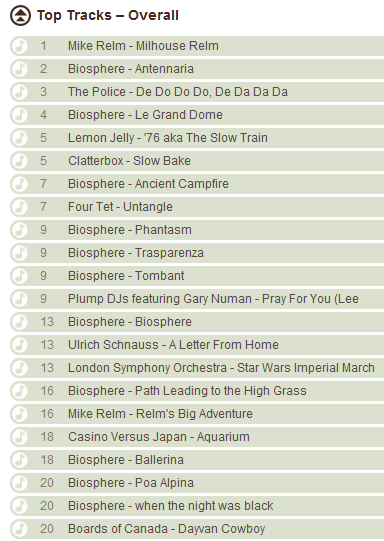
The children are contaminating my playlist. Three of the top five tracks (Milhouse Relm, a remix of the Simpsons theme, De Do Do Do, and The Slow Train) are those that I play as requests for my boys — nightly. All fine songs, of course, but not really indicative of my listening habits. It’s like my wife using my Amazon profile. You know, I don’t really care what people who bought the Epilator also bought.*
Nearly every other track is an ambient tune. This isn’t fair either, really, since I often put on albums to fall asleep to, these albums invariably being downtempo. If only Audioscrobbler logged those tracks I actually heard as opposed to those I have played. EEG interface maybe?
I don’t synch my iPod with iTunes so the tracks that I consider to be truly representative of my awake listening habits don’t get logged. But then, am I really defined by what I listen to on my commute?
The Top Artists – Overall gives a much better sense of my last year of music. Interesting that Sufjan Stevens cracks the top 20 given that I only started listening to him last month.
What I’d really like to see in 2006 are richer visualizations of the Last.fm data. I’d love to see a schematic of artists over the course of a day. Also, richer data analysis. How often do I switch from artist X to artist Y? How many times did I queue up album Z before 3pm? That sort of thing. Does this exist?
[*] 13 and 16 are also kiddie tunes. What? Of course the Star Wars Imperial March is for the kids!
“Fun” Mac products
The Apple PR machine was groaning with exertion at their announcement event yesterday. Labelled as “fun,” the products they announced were new leather cases, an iPod boombox, and a new Mac mini. The first two were accessories of course and the last was somewhat interesting in that it moves much closer to being a media center component. I’m tempted to buy it. But when I isolate what my needs really are it becomes apparent that even a Mac mini is total overkill.
All I really need is the Airport Express equivalent of an iPod video. Where is the Airport Express that has an HDMI out? This would solve my problem completely. Why put an entire computer in your AV rig when all you need is an elegant bridge?
Weakened warrior

I saw Curious George with my son this weekend. Of all the plush sleeping aids that I had as a child I now retain only two. The first is my original blanket, now ripped, fringeless, and still smelling of decades-old urine from a bit of a bedwetting problem. (I don’t want to talk about it, ‘kay?) The other is my Curious George doll. Oh how I love(d) that monkey. One of my favorite childhood memories was when my mom, a nurse, would perform surgery on his armpits when he’d fray. We were fully smocked in operating room fashions. But I digress. The movie stayed true to the George I grew up loving and it manages to weave in at least parts of most of the books. I loved the ending where a triumphant Man In The Yellow Hat saves his museum by transforming it from a dusty, dull repository to an interactive, lively experience through the power of, yes, curiosity. Oh, and he and George end the movie in a rocket ship. Museums and rocket ships, wow. Where’s my yellow hat?
Staying in the spirit, my son and I built a great fort in the basement last night for movie watching, goodie-eating, and hiding from mom. We slept in it. Wow, was this a mistake. Nostalgia gone too far. My son loved it, slept sound as a rock. I slept little, alternating between being frozen stiff and just stiff from the comforter-on-concrete amenities. No bedwetting, though.
As a sidenote and just to worry my readers a little more that this is becoming a parenting blog (it’s not), my old post on cyborgs and toddlers is on the front page of Parent Hacks today.
More fun at SxSW

SxSW 2006 is less than two weeks away. This will be my first trip to the fest/conference/party excuse, though in certain ways both my professional and family center of gravity is in Austin (OK, one of my centers of gravity).
Because the speakers and bands and screenings simply won’t provide enough stimulus some folks have created the SxSW Interactive Playpen. Done wrong it could be as grimy and soulless as the free building areas of LEGO stores; done right — and there’s no reason to believe it won’t be done right — it could be a hell of a lot of fun. Can’t wait.
Oh, I’m also a panelist on the first day: Convergence and Transformation. That’ll be fun too. Bring some LEGO blocks.
Fellow Chicagoans Jason Fried and Jim Coudal are the keynotes.
Gonna be there and want to meet up? Let me know: