etc., recall the word
resoldered here
in a pane of sand.
— R. Kenney

Ascent Stage
a life-in-progress

« January 2005 | Main | March 2005 »

February 28, 2005

Snowy sleet

My three-year-old son today exclaimed “Look Mommy it’s snowing and raining at the same time.”

If I were there I would have informed him that this meteorological phenomenon is known as “sneet” or, more simply, late winter in Chicago.

Posted at 8:25 PM | Permalink | Comments (0) | Topic: The Darnedest Things

Where do you want to go today?

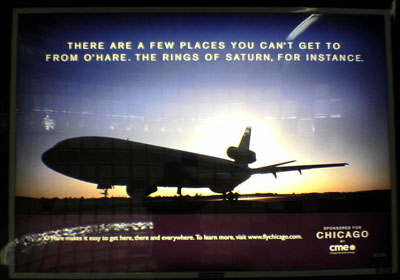
That’s funny. I consider this to be a problem. Note to O’Hare and/or the city government. Quit quibbling about whose is bigger with Hartsfield and build a spaceport for god’s sake. Take one of these, float it out into the middle of the lake, launch stuff into LEO. Why? Because launching from the middle of the US obviates these.

Why do I not work for NASA?

Posted at 7:35 PM | Permalink | Comments (0) | Topic: Space

It was a very good year

Six-O-Six magazine. R.I.P.
Posted at 10:09 AM | Permalink | Comments (0) | Topic: Chicago

February 27, 2005

Smell me a story

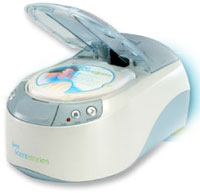
Febreze, makers of perfumey aerosols that I associate with covering up the stench of cat urine, have a pretty interesting product on the market. ScentStories is their attempt at creating narrative through smell alone. The ScentStories gizmo lets you pop in discs that contains five odor zones, each of which is wafted to you in sequence every half hour. As far as riveting narrative goes you’ll probably want to stick to other media, as the ScentStories are basically meant to calm you and/or put you to sleep. “Wandering barefoot on the shore” (well, of course having your shoes off creates a different smell), “relaxing in the hammock,” (I’m visualizing Homer Simpson) “shades of vanilla,” (sounds like a painting — talk about synaesthesia!) and so on. I wonder if there’ll be third-party discs to explore the full spectrum of stink? “Trip to the farm,” “trying not to touch the sleeping guy next to me on the subway,” and “discovering you used the last diaper two hours ago” — these would be fascinating explorations of stinktales.

Still, I think this is an interesting idea. Certainly narrative can be embedded in anything, the arc of a musical composition, the flow of a buildling facade. But visiting the Febreze website you get the sense that they don’t believe they can actually pull it off. The site is drenched in ethereal, blissed-out visuals. Don’t know what a walk on the beach smells like? Well look here. This is what it smells like. And their model is clearly musical. The wafter mechanism looks like a CD-player and they’ve recruited Shania Twain to “compose” a disc of scents. I think if anything ScentStories are to traditional beginning-middle-end narrative what ambient music is to, say, sonata form. I’d have called them ScentScenes, I suppose. More like an odor tableau than a linear experience.

But then, I haven’t tried this. And I’m really tempted. I wonder if I could purchase and play a disc without knowing which story I had. To smell the next chapter and declare “why, yes, I am exploring a mountain trail!” without having previously encountered a visual or tagline to set the scene for me psychologically would be the true test.

See also: Sensory deprivation

Posted at 7:54 AM | Permalink | Comments (2) | Topic: Science/Tech

February 26, 2005

A CTA Map for 2055


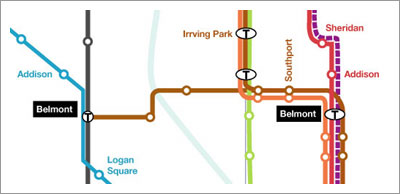
Proposed Roscoe Village Brown Line spur that would make my life approximately 1000 times easier.

Craig Berman, author of the wonderful Fueled by Coffee blog, has a great piece up at Gaper’s Block. Using the CTA’s proposed Circle Line as a starting point, he meticulously outlines a subway plan for the future of Chicago.

The CTA needs to form a mass transit network — as opposed to the current radial commuter rail. Right now, all lines lead to the Loop in the morning and back out in the afternoon — these lines don’t take into account that a lot of living happens outside of the skyscrapers of the Loop. What happens when I want to get from Bucktown to Wrigleyville? Andersonville to the West Loop? Hyde Park to Pilsen? Little Village to Logan Square? These rides are a pain in the ass — they’re slow, indirect, and require multiple bus transfers. Why can’t you move from the North Side to the northWest Side without going downtown first? I want answers, dammit!

Amen, brother. Where do I sign up to help digging?

See also: Art of the subway

Posted at 7:44 AM | Permalink | Comments (1) | Topic: Art/Design | Topic: Chicago

February 24, 2005

Subcontinental divide

A word problem for you, dear readers.

You are on Harlem Avenue in Chicago driving south near Ogden Avenue going approximately 35 MPH. You’re sipping (rather enjoying) a piping-hot venti half-decaf no-fat latte with a shot of sugar-free hazelnut when a billboard for a rock station depicting a sweaty lady in a tank top grabs your eye. You fail to see the car in front of you slow to make a left turn onto 39th street. You look up just in time, slam your brakes, crushing your latte between your sternum and the steering column, spilling hot liquid (no fat, though!) into your lap which causes you to recoil and inexplicably hit the gas again. As you look up again (crotch still ablaze) you swerve the car right (west) to avoid hitting the damn car that still has not turned left. You nail the curb, pop up briefly, and land squarely on a fire hydrant. Which explodes in two directions (roughly straight up and west-southwest) spewing a great geyser of water onto Harlem Avenue at a rate of approximately four liters per second.

Will the water that is dumping into the road end up in Lake Michigan or in the Gulf of Mexico?

A few tracks from the iTunes store for whomever gets this right first.

(Thanks for this one, Dad!)

UPDATE: Here’s the solution.

Posted at 6:34 PM | Permalink | Comments (1) | Topic: Chicago

February 23, 2005

Blog readers be afraid

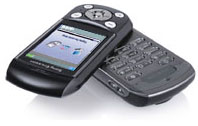
I now own a camera phone.

Mainly I bought it for the relatively high-res cam (1.3 megapixel) and the EDGE network access. I like poaching WiFi nodes as much as the next guy, but too often I find myself away from a jack and not in a cloud. This should solve that.

More at Engadget.

Posted at 3:14 PM | Permalink | Comments (2) | Topic: Science/Tech

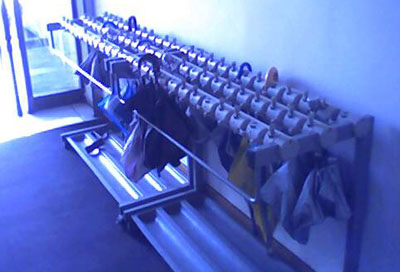
Umbrella locker in Nanjing

Note the drip runoff troughs. Nice design.

Posted at 12:36 PM | Permalink | Comments (0) | Topic: Art/Design | Topic: China

February 22, 2005

Travel tip

When the desk agent at the airport prefaces anything with “The computer says …” you can pretty much bet that your travel plans are hosed.

An example from La Guardia:

Agent: “Your flight is delayed 20 minutes.”
Me: “No problem, flight late?”
Agent: “Yeah, the inbound flight just pulled back from the gate in Chicago.”
Me: “Just left? Unless it’s a Concorde that’s a two-hour flight.”
Agent: “Well, the computer says it will be here in 20 minutes.”

At this point you can:

(1) Express overt indignation attempting to rally those around you into some kind of mini-revolt by the sheer power of your expression of can-you-believe-thisedness.

(2) Pull out your calculator and present the agent with the purported actual speed of the incoming plane and expound on the physics behind the inevitable disintegration of its airframe if it continues at Mach 9.

(3) Blame the computer and ask the agent out for a drink.

(4) Sit in the gate area and quietly fume.

Posted at 7:47 PM | Permalink | Comments (0) | Topic: Travel

February 21, 2005

That was fun, now everybody start sweeping

Though there’s still a corner of the building sticking up ominously from the rubble (bearing an unfortunate similarity to the shards that remained of the WTC after 9/11), the Sun-Times building is effectively no more. Mostly the activity outside my window is just cleanup of the mess. And ripping a building down does make one hell of a mess. I don’t need to pull the shades on the windows in the office there is such an impenetrable layer of filth on them.
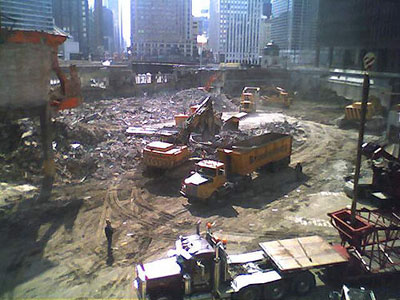
My sons came with me to see the heavy machinery this weekend. Predictably, they could not be pulled away. Not only was there blow-torching, aggressive hole-digging, and manly rubble-scooping going on, but they were constructing a mighty, towering crane which to me means that construction is soon to start. I swear we saw them dig out an old train car undercarriage from the muck. (Might make sense. Train tracks used to run along the north edge of the river.)

Here’s a video timelapse of the deconstruction through Feb. 11. Is it possible that I actually miss the jaw-jarring din of the last few weeks?

Posted at 11:20 PM | Permalink | Comments (1) | Topic: Chicago

February 20, 2005

Japan scares me

First it was Ringu and The Ring, now Hollywood has remade Ju-On: The Grudge keeping only the subtitle. Both these movies are terrifying remakes of terrifying Japanese films. There’s no slashing, no crazed killer, no demonic possession, and few American horror genre clichés. Though neither movie is about technology per se, everyday items of technology are the primary means of effecting the kind of frights that I am coming to associate with Japanese horror filmmaking. For instance, both films use imaging technologies — photos, video, surveillance cameras, etc. — to convey that Something Is Very Wrong with the subjects of the shots.


Photograph from The Grudge


Photograph from The Ring

Phone calls figure prominently in both films too and, while this is not unique to Japanese horror, when you step back and look at how all technologies are used in the films it is clear that this level of remove — seeing the bad thing on a TV screen, hearing the bad voice on the phone, noticing the bad person in the background of a photo — are just contemporary versions of the old “spotting the killer standing behind you as you look in the mirror” trick. The fright comes from being one remove from the killer, having some kind of mediation between you and it, and knowing that that mediation offers a false sense of security. You still gonna die.

Maybe in the hyper-technologized culture of urban Japan this technology-as-mirror motif is the ultimate scare. Seems to be for me.

Posted at 7:45 AM | Permalink | Comments (0) | Topic: Movies

February 19, 2005

Barile

My great-grandparents came to America in 1903 from a small town called Barile in the region of Basilicata, Italy — basically the “instep” of the boot. I’ve visited Basilicata twice — more on that in an upcoming series of posts — and, though it has made much progress in the last ten years, I often find myself calling it the West Virginia of Italy. Rustic and mostly arid, many of the towns in the region are built on top of or straight out from sassi, the caves carved into soft rock that have formed the homes of inhabitants since well before Roman settlement of the peninsula.

Mel Gibson’s The Passion of the Christ was shot mainly in Matera, Basilicata, the town with the most striking sassi in the region. Shortly after seeing The Passion I learned that Gibson was merely following the Italian filmmaker Pier Paolo Pasolini in shooting a life of Christ in the region. In 1964, Pasolini released Il Vangelo secondo Matteo, a cinema vérité treatment of the gospel of Matthew using non-actors from Basilicata. I’ve read that Italian audiences actually demanded subtitles because the Albanian dialect of the “actors” was too difficult to understand. There’s absolutely no dramatic flourish in the film (a path Gibson diverged from in minute one of his film). This is Christ-as-peasant-among-peasants, seen from ground level. Call it Reality Hagiography.

The sassi of Barile form the backdrop of the “slaughter of the innocents” scene. It is hard not to laugh at the centurions as they scamper up and down the hillside slashing at mothers and babies (some of whom fly out of embraces a little too easily). The film is likely to irritate modern viewing sensibilities for one reason or another, especially since the English dubbing is just awful. But I applaud the effort in the context of when and where it was made. If you’re going to shoot Christ as a man of humble origin you’ll not err in choosing Barile as a home town.

Compare the shot from the film above to a panorama of the same caves, now private wine cellars, taken last year.

Posted at 9:50 AM | Permalink | Comments (0) | Topic: Italy | Topic: Movies

Marginalia

I’ve been searching for a sideblog to post quick links to. I kinda knew it would have something to do with del.icio.us, so when I stumbled upon Veen’s recommendation to use it with the superbly simple RSS Digest I knew I had it. Check out the Marginalia column at right for updated niceties throughout the day.

Posted at 8:30 AM | Permalink | Comments (1) | Topic: Housekeeping

February 17, 2005

Was This Information Useful? Yes | No

Reading Microsoft’s primer for parents who want to decrypt their kids’s computer slang is like listening to über-caucasian Bill Kurtis announce that the murder suspect also “did drugs and was into [dramatic turn to address the camera] rough sex.” It is just so overwhelmingly unhip that you are compelled to keep staring at the screen.

Among the terms that Microsoft highlights to help you “protect” your children:

warez” or “w4r3z”: Illegally copied software available for download.

h4x”: Read as “hacks,” or what a computer hacker does.

sploitz” (short for exploits): Vulnerabilities in computer software used by hackers.

pwn”: A typo-deliberate version of own, a slang term that means to dominate. This could also be spelled “0\/\/n3d” or “pwn3d,” among other variations. Online video game bullies or “griefers” often use this term.

Thank you, Microsoft. Now I finally have the tools to protect my family. Actually, it is a clever ruse. Big Brother masquerading as Beaver Cleaver. Aw shucks, did I just get h4xxored?

Posted at 5:07 PM | Permalink | Comments (1) | Topic: Words

February 16, 2005

Have some art

Confession: I am an album art junkie. I can’t stand digital music that doesn’t have correct, decent-resolution album art embedded in it. (In graduate school one of my projects in multimedia design was a website for a future Museum of Album Cover Art. It was, as a recall, not exactly a masterpiece itself.) So, it would make sense that possibly the only real gripe I have with my beloved, unsupported, rapidly-becoming-an-antique Audiotron is that it has no capability for showing album art via its web interface nor does it have a video out to display album art on the TV set. Imagine my horror to learn that the iPod photo — which of course displays album art on its screen, hurray! — does not show said art via its TV out. I don’t want slideshows of my kids, damnit! I want to see the files that I so painstakingly embedded in my MP3 files! This seems so unlike Apple to me. Why black out the TV output when you are listening to music? (By the way, I am still waiting for the album art dongle thing.)

The news isn’t all bad, though. Recently TiVo released an SDK to developers for their Home Media Engine. (Yes, yes, too little too late, but let’s have fun while they implode, OK?) There are already a bunch of alpha-quality apps out there for it, and one of them will synch up with iTunes (on the Mac) and display the album art of whatever you are listening to on the TV screen. Clean, simple, nicely done.

Posted at 8:51 PM | Permalink | Comments (0) | Topic: Science/Tech

By any other name

The NameVoyager over at Baby Name Wizard is just wonderful. The interactive graph plots the top 1000 baby names over the past century. The beauty of the interaction mode is that, as with search engines that start looking before you finish typing, NameVoyager dynamically re-draws itself with each letter of the name you input, allowing you to see variants and related name-forms morph through time.

This chart shows the popularity of names starting with ‘D’. Is there some cultural trend that can explain why the initial ‘D’ sound was so valued at mid-century but has been on the skids ever since? Whatever it is might explain why why mother and all four of her siblings (born in the later 1940’s and early 1950’s) all have names beginning with ‘D’. Or perhaps my grandparents — also with ‘D’ names — were just nutty about alliteration? And as long as we are searching for answers, what the f*** is going on with “F” names?

I was thinking about names today after I asked my son what the name of the “dog” he made out of Legos was. It occurred to me that I always ask him the name of things he creates or takes new possession of (like, say, a stuffed animal). He stops, recalls with some surprise that he has not named the thing, umms, and then usually produces a slight variant of the nearest tangible noun he spots. “Glass-y,” “Ball-oo,” “Rug-a.” Makes for some spontaneous, if un-memorable, names.

Posted at 7:41 PM | Permalink | Comments (1) | Topic: Science/Tech | Topic: The Darnedest Things

February 14, 2005

Amazingly, not a "byte" pun in sight

Food geekery article in the NY Times: “Using organic, food-based inks he concocts, Homaro Cantu creates a champagne, caviar and oyster dish and sushi rolls on flavored, edible paper made of soybeans and cornstarch.”

Next up: chic after dinner glue-sniffing. (And get back to me when you can actually print the sushi. That’s the 21st century I signed up for!)

Posted at 10:00 AM | Permalink | Comments (0) | Topic: Science/Tech

February 11, 2005

Virtual wiring

There’s a nifty little program called GraphEdit that I have been using to, um, “work with” the rights management in TiVo-To-Go files. The interface allows a virtual re-wiring of the audio and video inputs and outputs for a video file. For example, if you want to compress a video you would grab the output “lead” from the video and wire it to the input of a box in the chart representing whatever compression you liked. This interaction modality achieves in a single view the ideal of being both intuitive (out connects to in, and on and on) and completely explicit (the flow that you manipulate represents exactly what the program is doing). As a bonus it is also kinda fun. The bastard child of Storyspace and Media Cleaner.

I employed an interface like this for a piece of software I wrote in graduate school, but the links I allowed between video files implied sequence in time not transformation of one node by another. This distinction highlights a unique opportunity. What if you could link two video files to a single output file, creating a merger of the two? The links themselves could function as the transform filters — overlay, embed, distort, etc. Now that would be interesting!

I once played with a program that did visual transforms of images using a spreadsheet interface. You placed files into cells and then put together formulas — essentially filters, as in Photoshop — between the cells. The resultant file in a new cell was your output, just like spreadsheets work. (Anybody know what this program was called?)

Posted at 9:38 AM | Permalink | Comments (0) | Topic: Science/Tech

February 9, 2005

Whose skills?

I am on the L tonight. The man next to me is reading a printed Powerpoint deck on his lap. Three points per page. No more than a few words per line. Like a set of flashcards or a very large type edition of a book. Except that the storyline has been broken down into bullets. I think maybe he is doing foreign language drills or something. It all looks very See Jane Run.

I peer closer. The subject matter is serious indeed. The deck is a school board report instructing teachers on how to raise the abysmally low reading skills of their K-3 students.

• I wince at the irony.
• I think of Tufte.
• I exit at the next station.

Posted at 9:20 PM | Permalink | Comments (0) | Topic: Words

February 8, 2005

Favorite things, part the second

Here’s round two of Stuff I Like. (Part one is here.) Who cares? Hmm, I don’t know, but it is nice to make lists of this. Like a reverse wishlist. Not so much something I want as something I want others to know they should want.

Harmony Remote - Gobbled up by Logitech (but apparently none the worse for wear) the Harmony Remote is by far the most usable, most intuitive universal remote out there today. The most important features of this remote are what it does not do.

It does not consider its screen the primary way of dynamically reconfiguring a new interface for each remote it emulates. Instead it uses hard buttons for as many buttons as possible that overlap the most number of devices. You’d be suprised how few functions are device-specific.

It does not require you to “teach” it the IR codes of your other remotes. Instead, you connect the remote via USB and log in to your account at Logitech. You choose your devices there. I’ve got a bunch of obscure and ancient components in my setup and it had every one of them and far obscurer too.

It is not device-centric, but rather activity-centric, asking what do you want to do rather than which device do you want to access to attempt to do what you want to do? When you login to your account you define activities — watch TiVo, play music, whatever — and almost never need to refer to individual devices again. Activities of course are a nicer name for macros which are just sets of remote commands. But thinking in activities rather than which device must be set to which input blah blah is so much more intuitive. I am about the zillionth person to laud this feature, but hey here I am. (Don Norman loves it, for example.)

Win2VNC - The very definition of a useful hack, this program rides on top of VNC to allow you to use a single mouse and keyboard across multiple computers on a desk. (It’d work longer range, but why?) I use this app every day when I plop down in front of my laptop and need to do things on the three other machines on my desk. Getting rid of all those keyboards and mice really frees up a lot of space.

Mozilla Firefox - So I like Firefox, big deal. Using Firefox on PC is a no-brainer. IE is such a steaming turd there’s really no choice. But when I finally switched to Moz on Mac I knew something really important had happened. I mean, Safari is an exemplary browser, truly awesome. For a while there were things I could do in Safari via AppleScript that I could not do in Mozilla, like aggregate all open windows into a single window with multiple tabs. But with Mozilla’s flexible extension architecture it wasn’t long until even that feature was made cross-platform. There’s no Safari for Windows or Linux and I like my browsing experiences to be consistent. Bless you, Firefox.

7UP Plus Mixed Berry - As the only person in the world who actually likes this new drink I feel that I must declare my allegiance here, in public. There, I said it. No need for counterpoint links. Just Google it. No one else likes this beverage.

Anapod Explorer - Probably the most useful piece of iPod software for the PC. The best features include being able to stream music over the web directly from the iPod and being able to manage/access your music via an SQL database of your music library. Oh, also, you can download music from your iPod, something iTunes don’t do.

Sunrise Earth on Discovery HD - You had to know that ambient imagery would be the next logical step after high-def television became somewhat mainstream. Sure, there are media players that’ll load art packs, but Sunrise Earth is one of the first completely non-narrative programs that is just beautiful to look at — and that’s it. The subject of the show is a single sunrise, taken from multiple angles in full surround sound. I love it.

The window side seat on the upper deck of a 747 - No photos for this, so visualize if you will. The curvature of the hull of the 747 is somewhat extreme on the upper deck of the 747 so seats can’t fit right against the window. This is a good thing. Whether the bubble is configured for coach of business class, the gap created by the curve means you get a little footlocker next to your seat that is good for storage, putting your feet up and reclining almost completely, and resting your laptop while you dine. Try it. It feels like a credenza or something

That’s all for now. Tell me, what I am missing here?

Posted at 9:55 PM | Permalink | Comments (0) | Topic: I Like

February 7, 2005

Digital Guide at MoMA

The Museum of Modern Art in New York has just launched a new visitor service. The MoMA Digital Guide, a story-based multimedia tour guide developed in collaboration with IBM, is the next generation of the service originally developed for the Egyptian Museum in Cairo. I’m part of the team who developed the app, so I’m naturally biased, but I think it is a very fine complement to the very fine new MoMA space. For now, renting the guide is free. Go on Friday evening between 4 and 8PM and admission’s free too.

Business Week recently ran a short piece on the Digital Guide. If you’re interested in the technical details, feel free to e-mail me.

Posted at 8:16 PM | Permalink | Comments (0) | Topic: Work

February 6, 2005

Passings

The artist Ed Paschke died in his sleep last Thanksgiving. I was introduced to his work in 2000 when some IBM colleagues suggested that he would make a good speaker at the opening of our new space. It was an interesting choice. Paschke was an avowed technophobe. He was fascinated with holography, though, and open to collaborating with computer designers. He agreed to speak at our opening. I remember him standing in a forest of displays on the dais, more avuncular than bohemian, a little bewildered at the sight of it all. He lent us one of his most stunning electronic pieces for a few months. It hung in our space and I secretly hoped his studio would forget that they had placed it there. They didn’t.

A memorial tribute exhibition to Paschke opened on Friday at the Maya Polsky Gallery. It runs until March 12.

In other news, another famous Chicagoan has left the building. Don’t let the door hit you on the way out, Sammy! (The security cameras are watching.)

Posted at 2:59 PM | Permalink | Comments (0) | Topic: Chicago

February 5, 2005

In music news ...

The genre-puréeing duo Lemon Jelly has released its third album, a “retrospective” called ‘64-‘95. (The dates refer to the years from which the album’s samples were gathered.) I’ve only listened through a few times, but this is good stuff, different enough from the seminal Lost Horizons, similar enough to remind you why these guys don’t sound like anything you’ve ever heard. I bought the tracks online, but apparently there is a well-designed DVD version available too. Fantastic work.

Speaking of trailblazing duos, Autechre will release a new album called Untitled (don’t they already have an untitled album?) in April. They’ll tour globally too. Yum!

I gave my iPod shuffle a try today. Works just like you’d expect: tiny to the point that you forget it is there, no skipping, etc. I didn’t miss having a screen at all. Well, that’s not completely true. I found some new music and wanted to know what the heck I was listening to. Like others I had laughed at Apple’s chutzpah in promoting random play like it was some revolutionary feature. But now I wonder if it is as simple as that. Shuffle does become more important the more music you own since the chances of listening to a track you haven’t heard in a long time (or ever) is inversely proportional to the amount of music you have loaded onto your iPod. In other words, the more music you load the more likely you are to listen to the latest tracks or known favorites. Is it possible that Apple is playing up the shuffle and auto-fill features both as a marketing angle and to remind us how much fun re-discovering music is, further solidifying our love affair with their devices? Eh, probably not.

Maybe?

Posted at 10:15 AM | Permalink | Comments (0) | Topic: Music

February 3, 2005

Tipping point

What’s the worst single disaster in terms of the loss of human life in the history of Chicago? You might say the Chicago Fire or the Iroquois Theater Fire. You’d be wrong. This summer marks the 80th anniversary of the Eastland Disaster on the Chicago River when an excursion steamer packed mostly with employees from a single company bound for a beach outing simply tipped over — crushing, trapping, or drowning 884 people in the sewage-infused river.

There’s an historic plaque a few blocks west of my office directly across the river commemorating the event, but, other than people on Haunted Chicago bus tours, few know of the tragedy. So I was pleased to see a new book on the topic. Pleased to see, that is; not so pleased to read. Jay Bonansinga’s The Sinking of the Eastland tells the tale in the narrative or “creative” non-fiction style so popular recently, but it falls flat and, at times, causes you to smirk at the overwrought pathos. And, you know, you shouldn’t be smirking at an event that wiped out 22 entire families. The problem, I think, is that Bonansinga’s story is caught — squeezed — between two mammoth master narratives. The first is the story of the Titanic (which sunk only three years before the Eastland) and all the vice-like purchase that tale has on the popular imagination these days. (Thank you very much, Leo.) The second is Erik Lawson’s The Devil in the White City, the story of the 1893 World’s Columbian Exposition which, for many readers (at least in Chicago), single-handedly defines the genre of narrative non-fiction. The Sinking of the Eastland just tries too hard to hard to make you weepy. This might be a reaction to the perplexing absence of the sinking from Chicago’s collective memory. And I suppose I don’t blame him for that. It really is odd how entire cities forget things.

Bonansinga does highlight an interesting theory on why the Eastland capsized. Indignation over the lifeboat situation on the Titantic had reached such a level in the years after that catastrophe that ships around the world were outfitted with far more lifeboats than they were designed to carry. Mostly the lifeboats hung from the top decks, dangerously skewing ships’ centers of gravity. It almost defies belief that so many people could die on a boat still tied to the wharf, but this lifeboat top-heaviness, coupled with a too-crowded ship and improper ballasting, was all it took to pitch the Eastland into the drink.

Posted at 9:10 PM | Permalink | Comments (0) | Topic: Chicago

Remade in Taiwan

So, a few days into my China trip my laptop died — motherboard fried. You see, my machine prefers to crap out when I am half a globe away from my local tech support, having most recently decided to spin its hard disk platters into the drive armature when I was in Egypt in October. Yeah, I needed that. What’s worse this time is that I had only recently achieved the goal of getting rid of individual power cords for my camera, iPod, and phone, instead charging them all via USB through the laptop. You see where I am going with this, no doubt. With a dead machine, nothing would charge. Single point of failure. Nice design, John. My technology world came crashing down in a single heap of powerless gadgets. And it was a weekend with little hope of tech support in China. How did I manage? My trusty moleskine of course! Eventually on the last day before coming home, some colleagues of mine in Taipei were able to repair my machine with one of only four motherboards for my laptop model on the island. Nicely solved!

A couple of assorted things before this China travelogue comes to an end.

  • Cathay Pacific is everything that United as an airline is not. I could get used to that level of service. They even titillate you with onboard e-mail access, but it turns out the e-mail is queued locally on a server and sent out in batches. Not exactly Lufthansa-style in-flight access, but hey, they did treat me like royalty.
  • Taipei 101, the current world’s tallest building, has a pressurized express elevator that moves you faster than your inner ear cares to admit. It also has a massive vibration damper tuned to the frequency of the building itself. It is open to public inspection and looks like something straight out of a sci-fi film. Bow down to the spherical power core!
  • I never did get sick. My family continued to suffer, though, as a bout of pink eye and double ear infections added themselves to the compendium of maladies that afflicted the already-miserable.
  • I ate a caffeinated egg and gelatinous coffee. Not sure which was worse.
Finally, some more polite signage from the Forbidden City. Really, no problem at all.

excuseme.jpg

And then this:

Fine, but everyone knows there’s no such thing as a five-star crapper. Simply ridiculous. The scale just doesn’t go that high.

Posted at 3:34 AM | Permalink | Comments (0) | Topic: China

February 1, 2005

Replicants

Today I spent many hours of hell braving the Ya Show market in central Beijing. Armed with printouts of fine handbags from my wife I was there to acquire as many name-brand knock-off purses as I could afford and carry back to the hotel without undue strain or attention being drawn. It was misery, since I’m not a big shopper anyway and have no innate sense of what a Prada purse should cost, but I made it out relatively unscathed. Two things made me laugh repeatedly, though. The English of the stall-keepers was uniformly horrible, unless it related directly to the act of selling or keeping you from walking away. Phrases such as “make me a smarter offer” or “where will you find such quality elsewhere?” were syntactically correct and enunciated flawlessly. It was fun to test the boundaries, to probe the limits of vendors who were really just human phrase-recall databases.

Input: potential buyer walking away.
Output: “Sir, please enter your price into my calculator.”

Input: Shopper says “Do you take US dollars?”
Output: “Why yes, sir, as well as RMB and Hong Kong dollars, thank you.”

Input: Shopper says “Excuse me, do you know the closet subway line to the market?”
Output: Blank stare, no keywords triggered. Abort, retry, fail?

The other thing I loved were the signs placed everywhere imploring shoppers to report any fake products. It was all so earnestly ridiculous. There wasn’t anything real in the whole place. (Not that I could have spotted a real Gucci purse, mind you.) Sure, I’ll dial the police right up. Just let me know if the American embassy will pay for my funeral after the shopkeepers — and their customers! — lynch me with so many faux leather belts.

True, in advance of the Olympics and as part of playing nicely with their trading partners, the Chinese authorities are starting to crack down on the product replica business, but I think this may not ultimately be as much an economic practice as a cultural one.

In his fascinating book The Future of the Past, Alexander Stille notes how China and other Asian countries do not consider a copy to be less real or less significant than the original it represents. Like a digital copy of a file that has no more claim to authenticity than its “source” file, high-quality copies in China are consider artforms in their own right. This is borne out in the field of cultural artifact conservation. For the Chinese, copying is conservation, a concept completely foreign to Western conservators. Because most Chinese architecture had traditionally been wood-based (rather than stone-based) there has never been a strong notion of permanence in art. To keep a work of art alive you had to replicate it and, in the process, were showing a reverence for the skill of the artisan that came before you. Still, this approach flies in the face of nearly every precept of Western cultural conservation. Can you imagine the Italians throwing out the David and creating a new, cleaner one as a solution to the recent conversation problems they have had?

It will be a shame if the fake product industry (or the skills upon which it thrives) does not survive in the face of globalization and homogenizing markets. In a way, the closure of the fake product markets is just the latest assault on the “culture of the copy,” as Stille terms it. Just as the Cultural Revolution decimated sites of historical value throughout China — effectively severing the centuries-old artisanal traditions that permitted the cycle of upkeep and re-creation to persist — the closure of markets like the famous Silk Alley represents the triumph of one concept, in this case the inviolability of global trademarks, over another, much older one: the exultation of the replica.

Posted at 2:34 AM | Permalink | Comments (0) | Topic: China