
Lessons from Zombiefest, Part the First
Gather ’round, members of the living. You are about to become educated on the finer points of the undead film genre.
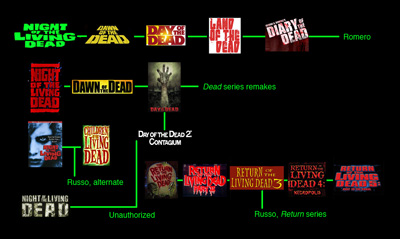
A while back my brother and I watched every film begotten (and misbegotten) from Romero’s classic Night of the Living Dead — 16, plus one trailer.
That’s right. We’ve done the hard work so you don’t have to.
Zombie films almost always contrast human incompetence, ignorance, or incompatibility with the external threat of the revenant hordes. Which is to say, humans nearly always screw themselves worse than the zombies do. Zombies are not stalkers or serial killers. They frighten because they are single-minded and unstoppable — unstoppable because of quantity rather than invulnerability. Like a virus. In fact, substitute viruses for the undead and you basically have the same movie.
Even so, fear of the undead usually stands for something else. It’s always the fear of others, a group that shifts with mainstream society’s notion of norms. So, for instance, it has been argued that Night of the Living Dead‘s zombies represent drug-addled hippies, out of their minds and focused on getting their fix. It was 1968, after all. That symbolism is debatable — and it gets a lot more complex, though no less true, when the zombies become somewhat sympathetic in later films — but it is clear that Romero at least always tries to depict the pitched battle of humans vs. undead as something more than just that.
A note for the true fan, there are spoilers below because, well, all zombies spoil eventually. Also, some of the clips are gory, duh.
We watched the films based on release date, but they are here grouped according to main series and remakes.
Lastly, please forgive the stylistic schizophrenia of the write-ups. That’s what you get when you mix a collaborative spreadsheet and several personal kegs of beer over a weekend of sedentary film-viewing.
Romero Series:
Night of the Living Dead (1968)
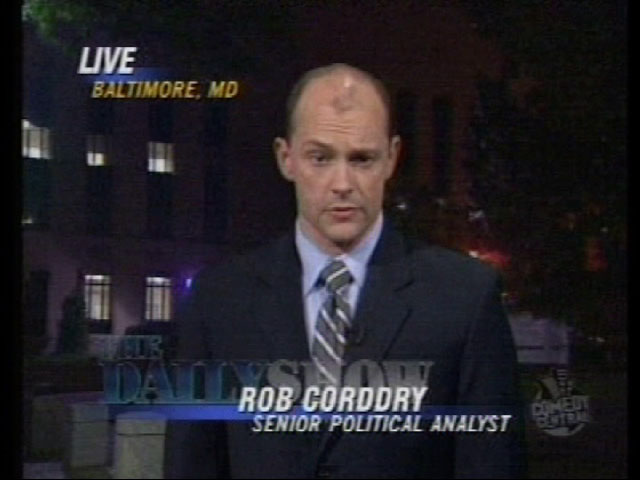
The granddaddy, near perfect. Black-and-white. Zombies are not slow, mindless or lumbering. They are the living recently-dead, not rotting corpses. Some even use tools to kill. (Joey: “That may be the most un-zombielike thing I have ever seen.”) No crawling out of the grave. Some confusion about whether they can be killed in any way that a human can be or if you have to shoot them in the head (which becomes the standard later on). Seems they cannot “infect” the living. Mention of a Venus satellite coming back to Earth and starting the “epidemic”. Mr. Cooper is a dead ringer for Rob Corddry. Odd fixation on taxidermy. Little girl zombie confronting her parents as disturbing now as it surely must have been in 1968. Lead character is a black man, unusual for 1968. He never gets it from the zombies but is killed in the end (mistakenly?) by a group of rescuers that looks exactly like a lynch mob. Best quote: “They’re coming to get you, Bahr-bah-rah.”
One of the reasons that Night spawned so many remakes and derivatives is that it has lapsed into the public domain. As such the entire thing is online for your viewing pleasure.
Rating: ★★★★★
Hard to argue with a movie whose setting is the locus of the real undead in America: the suburban shopping mall. This continuation is conceptually brilliant, but executed not as well as the original. Possibly influenced by Network (released two years earlier), the film starts in a TV edit suite broadcasting news of the sprawling zombie epidemic. (Interesting flipside to the always-on TV in the first film, basically a character unto itself. At one point in Night someone justifies his actions by saying “Well, the television told us to.”) Action shifts to a mall where a small band of survivors takes refuge from the madding crowd, a consumerist utopia vs. unstructured lust (the urban street, natch). The agent of zombification is now officially viral. The voice of reason, again, is a black man. Firsts: Tom Savini (make-up effects auteur) cameos as a biker; disembowelment; helicopter scalping; obese zombie (rare!). Also, entire biker gang is drinking High Life, which in itself merits applause.
Here’s Savini fending off the shoppers, er, zombies and coming to his own end.
Rating: ★★★☆☆
An undead movie with a message. That sucks. Or rather, doesn’t live up to the Romero standard, which disappoints all the more. (For true suckage, we must wait for a few remakes, coming in future post installaments.) So, the outbreak is basically worldwide, lots of shots of overrun cities. A group of scientists and military folk hole up in a vast underground bunker. The scientists are running experiments on captured, shackled zombies because, you see, even zombies have feelings. Bud, the only zombie in any Romero flick that speaks a line, is the central figure. Behind him is this weird three cross motif on the wall. What is he, the messiah? The whole thing is paced through rubber cement, e.g. the first kill (of a zombie, no less) is 58 minutes into the film. The brainy scientists vs. brawny military disagreements tire after, oh, the first one. In the end, it’s too much preach, not enough gore. One of the sensitive humans says “How can we set an example for them if we act like barbarians ourselves?” Gag.
Here’s an unchained Bub actually shooting (and saluting) the head military guy, who is then gang-dismembered.
Rating: ★☆☆☆☆
Twenty years separate this from Day and thank god for that. This is a great movie. The world is completely overrun with the undead. Uninfected humans are barricaded in walled urban centers (hello Baghdad Green Zone!); there’s something of a comfortable equilibrium. Frequent sorties for supplies are undertaken outside the city in a heavily-armored truck-tank that can mow down zombies and distract them with fireworks (“sky flowers”). The twist is that the undead are beginning to remember things, are getting smarter, acting braver. Oh, also they learn to swim. There’s a bit of a zombies-are-people-too vibe which annoys and I’m no great fan of zombies seeking revenge (meaning they are compelled by more than just a hunger for flesh, boo), but overall this is one great flick. Dennis Hopper and John Leguizamo are fantastic.
Here’s the original, unreleased trailer that integrates some footage from the first three movies, plus the creepy quote from Night.
Rating: ★★★★☆
Stay tuned for the next riveting installment of the undead marathon recap. And for god’s sake aim for the head.

Are you smarter than a student in 1924?
My wife and I owned a home at 60 Park Circle in Atlanta for a grand total of 14 months in the late 90’s. It was an eighty-year-old, single story affair that was actually on the National Register for Historic Places, though we never exactly figured out why.

The house had a partial basement and an extremely creepy, dank, dirt-floored crawlspace. I slithered into this space almost as soon as we took ownership. Towards the back was an old trunk. When I pried the trunk open it was sorta like when Belloq opened the Ark in Raiders with the hiss and the smoke seeping out. Except my face did not melt off.
The top of the trunk was composed of several strata of yellowed newspaper clippings, mostly about the 1924 presidential election. “Keep Cool with Coolidge!”
But the majority of the trunk was full of books, the text books of one W. A. (William) Strange, student at Emory University, resident of 306 Winship Hall.
I didn’t do anything with the books at the time. When we moved to Chicago I just loaded the trunk into the moving van. Well, two moves and nine years later I’ve delved back in.
There are 19 books in all, hardcover, musty, but in remarkably good shape. A snapshot of Mr. Strange’s courseload via the titles shows Spanish, Accounting, Psychology, Biology, Chemistry, Latin, and American History. The scribbled marginalia in the books is almost completely homework-related. Alas, there’s no musing on flappers, Prohibition, Rhapsody in Blue, the founding of IBM, the Beer Hall Putsch, the Geneva Protocol, or the first Macy’s Thanksgiving Day parade.
But the history book did contain a sheet of looseleaf paper, a quiz which earned Mr. Strange a C. (He only got three wrong answers, but such was the grading.) It is an interesting little document, not at all what you’d except to find in an American History class nowadays. Of course it’s only a sliver of a presumably much wider syllabus, but the questions seem decidedly regional. The phrasing of many of the questions makes it abundantly clear that there’s no such thing as a completely neutral view of history.

So, what happened to you Mr. Strange? And how did your books end up in that crawlspace?
Recursion
I am dying to write in-depth about the Forbidden City virtual world project I’ve been helming for the last few years. Alas, that must wait for the launch itself.* But. We can talk about it obliquely, no?
There’s a scene** in the Virtual Forbidden City in which a painter sits in a garden with the imperial family, painting away. It’s a simple thing, really, but I find it immensely thought-provoking. As a visitor you’re an unseen spectator of the painted depiction of a moment in a world which is itself the depiction of a moment of daily life in a virtual milieu. A snapshot (which your avatar can take) would reveal a recursive scene-within-a-scene or, in the lingo of the art world, a mise en abyme — a technique used for centuries in all manner of paintings, woodcuts, and tapestries.
This got me wondering if there is any historical analog to the depiction of artists themselves inside the frame of the same scene they are painting. Cursory searching and lazytweeting yielded no actual term for such a composition, but in fact there are precedents.
Maybe the most famous is Las Meninas by Diego Velázquez. The work shows the painter (on the left holding a brush, duh) but also situates the viewer (that’d be you) as the object of his gaze. In other words, just looking at the painting you’re role-playing royalty.
Even more interesting is the mirror in the back of the room which reflects the royal couple (the true subjects of the painting-within-a-painting) — or which may simply reflect the canvas itself. In either case the viewer, while unseen, is a participant in the space.
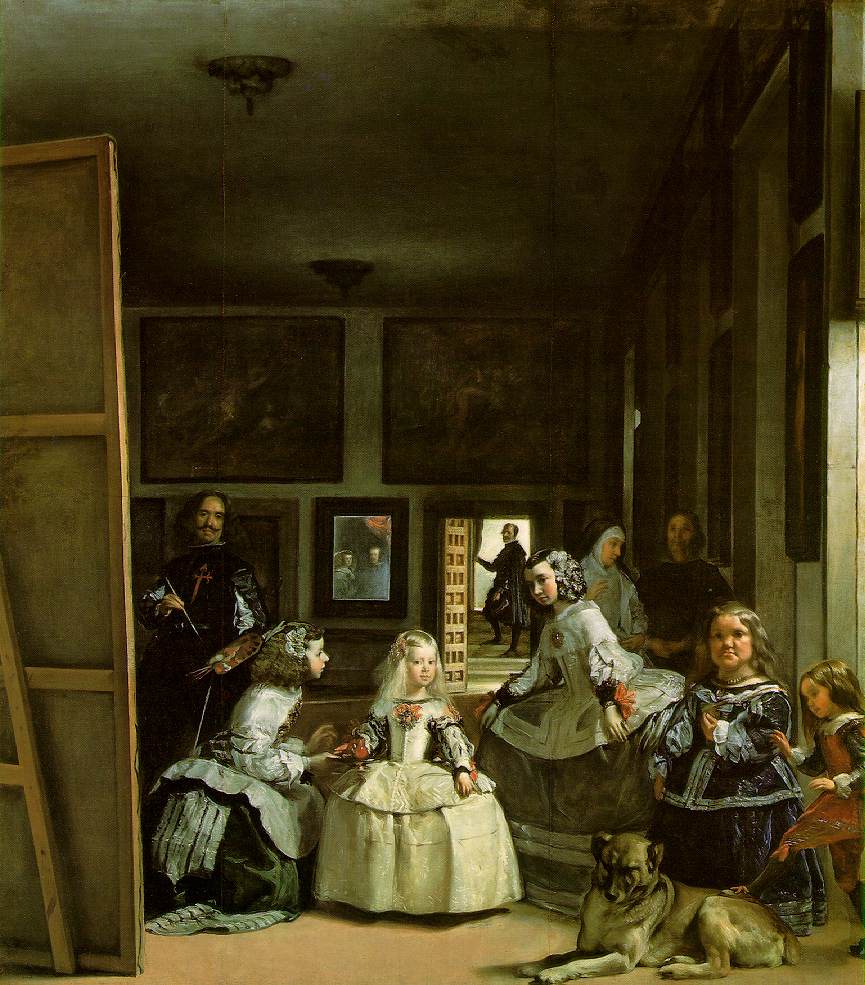
So there it is folks. Diego Velázquez pretty much nailed the lure of virtual worlds in a painting 352 years ago.
- Transcend viewing; embrace participation. (Even if, in this case, it is implied.)
- Fictionalize the first-person. (Nerdspeak: permit the possibility of role-playing.)
- Engage the viewer/participant by telling stories mid-story. (What the hell is that guy doing in the doorway? And why is that kid’s foot on the dog? And, the midgets?)
Scrolling forward a few centuries we have Mark Tansey, an artist smitten with the contrast between the static moment and the dynamic (lengthy) process of painting itself. Tansey’s Action Painting I and II place the artist in a position that only a photographer could capture, depicting a moment of catastrophic energy as if it were just another still life of fruit.
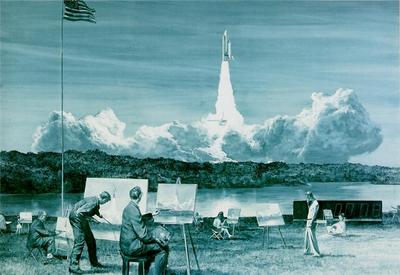
See also the first Action Painting.
In the Virtual Forbidden City the painting scene is, essentially, a still life of the imperial family, but the fact that your viewing position is unlimited — you can walk around it, into it, or stick your nose right down onto the painting — speaks to both Velázquez’s and Tansey’s focus on the observer rather than the observed. This, to me, is the promise of virtual worlds. And something I hope we at least approach, if not achieve, with the VFC.
Of course the piece-de-resistance (artspeak, yes!) in this vein has got to be Robbie Dingo’s unbelievable recreation of Van Gogh’s Starry Night. I remember when we were building the prototype of the VFC in Second Life. SL, like many virtual worlds, is built from within, by avatars, moving primitive shapes like sorcerers. It was a striking scene being inside the world watching as walls were moved around, tweaked, textured and placed. Truly living inside the process of a painting.
If you’ve not seen Dingo’s video, do yourself this favor.
Phew, I made it. That was oblique enough, yes?
* And it must wait even a bit longer now. Eagle-eyed viewers of the site may have noticed I slyly changed the date of the project launch in the sidebar from “spring” until “fall” of this year, rounding out my involvement at a cool 4.5 years. Egads that’s a long time to work on a project.
* * Scenes in the VFC are basically looping historical tableaux that a visitor can approach on the grounds of the palace. Distinct from an activity which permits interaction.
Get ready for a little jolt, fellas.
As the Space Shuttle program goes, so goes Ascent Stage. It’s time for a fundamental redesign.
The backend’s been upgraded to MT 4.1 and good things are in store for the user experience too.
I shall endeavor to redo the website for less than the US $1B pledged to make pretty new American rockets. But only slightly less.
Sorry for any bumpiness.
Sleestak
My earliest memory of television is also my scariest. I was born in 1972. Land of the Lost aired on Saturday mornings from 1974 to 1976. It was a remarkable program for the time — dark for its time slot, ambitious effects, multi-episode story arcs — I’ve later learned. But back then I knew only this: the Sleestak scared me to death.
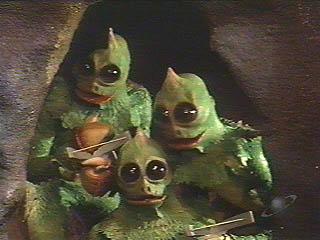
A Sleestak is a cave-dwelling humanoid lizardish creature forever threatening the three hapless humans on the show. Peeling back a few layers of psychological scar tissue I seem to recall that they only ever hissed, though I may simply be unable to remember anything else. (Tell me you wouldn’t crap yourself as a four-year-old hearing that. What were my parents thinking letting me watch this show?)
It’s funny how deeply fear etches. Thinking back on this traumatic formative period of my life I also recall a restaurant my parents used to take us to. I remember two things. First it was like 100 miles away (Oak Brook to Naperville for you Chicago area folks) and second that a Sleestak lived there.
It was a dark restaurant, themed like a old west mining operation. Lots of antique excavation and railway equipment decorating the walls. On a shelf in the corner was an old railroad signal lantern. It looked something like this.
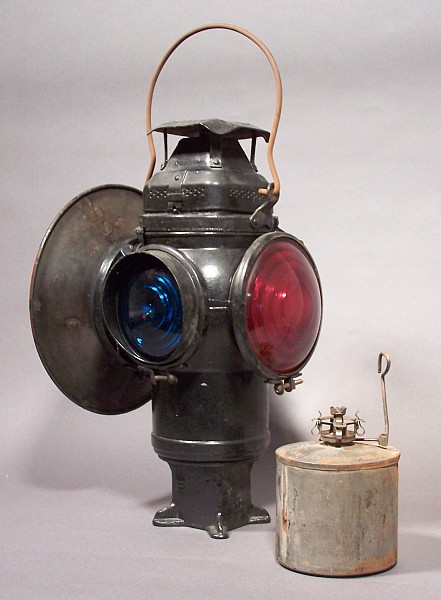
Obviously, obviously, I could look at nothing else. In the cave-like dark this thing looked exactly like the bulbous eyes of a Sleestak peering down on me and my roast beef au jus. In fact I can’t eat a beef dip to this day without hearing a creepy hissing in my head.
Apparently there is a movie adaptation in the works. Have to take my kids to that. Nothing says family bonding like shared childhood terror.
Enjoy the silence
Today I stole an interesting link from Coudal about the removal of layers of ambient sound from a space as a kind of subtractive symphony.
Living in a house with three small children, I ponder silence as an abstraction, without empirical evidence. If nature abhors a vacuum, children abhor noiselessness. It’s instinctual, the reptile cortex responding to a threat of nothingness. Clear a space of quiet in my home and some child will yelp for no good reason. Like dangling meat in front of an animal that’s just eaten. It’ll still lunge.
But our response to silence is more complicated than that, of course.
Alex Ross, in his fantastic survey of 20th century classical music, The Rest Is Noise, explains Stravinsky’s innovation in syncopation (which is essentially putting silence where the rhythm suggests it shouldn’t be):
As the composer-critic Virgil Thomson once explained, the body tends to move up and down in syncopated or polyrhythmic music because it wants to emphasize the main beat that the stray accents threaten to wipe out. “A silent accent is the strongest of all accents,” he wrote. “It forces the body to replace it with a motion.” (Think of Bo Diddley’s “Bo Diddley,” with its “bomp ba-bomp bomp [oomph!] bomp bomp.”)
That concept makes a great deal of sense to me. The body physically desires to fill in the rhythmic gaps that music opens up. You may think you can only shake your booty to four-on-the-floor, but in fact silence, judiciously deployed, is just as effective at getting you going. In fact, more so: it’s cognitively unsettling to hear silence where a beat should be. Don’t just stand there, replace it with a motion!
And now, silence.
Lions, lambs
You know, the cougar-in-the-alley thing was funny, in a too-surreal-to-really-be-dangerous sort of way. Of course it was a serious situation — as having any alpha predator in your midst would be — but when you receive community news bulletins that start with “no doubt by now you all are aware of the 150-pound cougar that was on the loose in our neighborhood yesterday” you have to chuckle.
Well, the chuckling is over with the latest newsletter.
Tuesday afternoon, police officers brought to my attention a letter that they have received threatening the safety of Audubon’s students and community. The letter appears to have been written by someone angry about the shooting of the cougar in the neighborhood. The letter threatens the safety of Audubon students and makes threatening statements regarding the Spring Gala and the Audubon Family Fun Fair.
My children don’t attend Audubon, but it is right around the corner. It is being targeted because the first report of the lion in our neighborhood came from the school.
There’s been a minor kerfuffle since the shooting about whether the police acted rightly in killing the lion instead of trapping it or tranquilizing it. The city says that a wild lion in an enclosed area is a threat to public safety and that they did what they felt they had to do. Tranquilizers, they say, take time to act and require very precise insertion. And besides, they were not equipped for that.
It is true that there were dozens of shots fired, only a few of which hit the lion. And I admit that I don’t have a hard time envisioning a phalanx of adrenalized Chicago cops shooting with more abandon than perhaps warranted. But I have a fundamental problem with the criticism of what happened.
Cougars track humans in the wild. This is a fact. Cougars are predators; they’re strong; they can kill a man easily. Moreover, a cougar wandering through a city is clearly addled to begin with. Roscoe Village is a couple dozen square blocks full of hundreds of children under six-years-old. This is a very real threat.
To now have someone threaten the safety of children as retribution for killing the lion seems not only evil and stupid, but deeply ironic.
I’m kinda done with the cougar. Can we just enjoy the fact that it isn’t snowing outside?
The slovenly wilderness
My father, brother, sister and I have a dorky little bookclub. We don’t meet nearly as often as we used to, but it’s still an excuse to get together for lunch once in a while and make fun of each other for misreading a given book. We rotate selection responsibility, a responsibility which includes the book and a place for lunch somewhat related to the topic of the book.
The current selection was mine, The World Without Us by Alan Weisman, a thoughtful if scattershot exploration of what would happen to the human-built world if we all suddenly disappeared. It is billed as a “thought experiment.” One of these experiments concerns envisioning what would happen if there were no one to maintain the petropolis of oil machinery, tanks, and pipes that dominate the sprawl between Galveston Bay and Houston. (Some of it would break down and rust into the soil and some of it would blow up, igniting the network of delivery pipes that connect to the rest of the country.)
The best parts of the book aren’t hypotheses about catastrophe or collapse but examples of built places since abandoned, mini-worlds without us: the DMZ in North Korea, much of Turkish Cyprus, the Mayan empire. Short version: natures takes things back far faster than you’d think but there are certain things that our actions have wrought — billions of microscopic plastic shards in the oceans, for example — that are going to be part of the world until the sun blows up and ends it all.
It’s an ecological manifesto, of course, an extreme version of pointing out that being green isn’t just mitigating our disequilibrium with the environment going forward; it’s about undoing what’s been done in the past too. That’s the point of positing the highly unlikely (though not impossible) scenario in which all the polluting human beings suddenly disappear: the planet’s still fucked.
Chew on that, this Earth Day.
We met to discuss the book at the Garfield Park Conservatory, a really wonderful 100-year-old greenhouse complex that’s part of the city’s park district. A microcosm of the world without us, no?
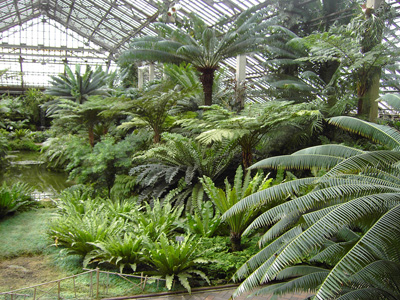
Well, not exactly. For one, even a botanical park like this is completely artificial; these plants would never live together naturally. But more interestingly, in a world suddenly without us a conservatory would actually be a real threat to the environment. The glass and structure would fail rather quickly, exposing the flora and its seeds and pollen to the winds and animals. Much of it would die off but some of it, nearly all “invasive” to local ecologies, would make its way out into the environment and wreak havoc. That ain’t natural. (For those of you who’ve seen I Am Legend you’ll note that this is a similar scenario to the predators from the Bronx Zoo competing with Will Smith for game in Times Square.)
We ate outside — the weather topped 70F today. Only as we left I noticed that the benches we were sitting on had carved on them one of my favorite poems, Anecdote of the Jar by Wallace Stevens. Seems appropriate for today.
I placed a jar in Tennessee,
And round it was, upon a hill.
It made the slovenly wilderness
Surround that hill.The wilderness rose up to it,
And sprawled around, no longer wild.
The jar was round upon the ground
And tall and of a port in air.It took dominion every where.
The jar was gray and bare.
It did not give of bird or bush,
Like nothing else in Tennessee.
You won’t believe it, but it was nothing but coincidence that we chose today to meet about this particular book. I of course enjoyed it. I like my book club meetings laden with meaning.
My music genome
Humans share a common genome, so sayeth the biologists and the musicologists. But no one has the exact same genome. The various human genome cataloging projects compile an aggregate model, as does Pandora.
So, like the botanists stashing seeds in a vault in Norway in case of apocalypse, I present my own music genome — the albums that form the basis of my musical evolution.
There are other strands of nucleotides in my musical history, of course — Pink Floyd, The Smiths, They Might Be Giants come to mind — but the albums below have given rise to the most positive mutations. They aren’t my all time favorite albums or even the best in their own classes. But such is how one’s taste in music evolves.
Message to Future Scientists: If you are able to reconstruct me from fossilized genetic information please reprogram my musical knowledge according to the following list.
Gary Numan – Telekon
Kraftwerk – The Man-Machine
Devo – New Traditionalists
Ministry – The Land of Rape and Honey
Depeche Mode – Violator
The Prodigy – Experience
Orbital – Orbital 2
Vapourspace – Themes from Vapourspace
Biosphere – Substrata
Plaid – Double Figure
Autechre – Tri Repetae++
Boards of Canada – Music Has The Right To Children
And a mix I made, one track per album, just for you: My Music Genome.