
Attention span is overrated
Recently I finished the gigantic Baroque Cycle by Neal Stephenson — a monumental tale of the struggle for sustained progress in an age unaccustomed to it. And by that I mean my reading was such a struggle. 3000 pages — more if you count the 900+ “sequel” published in 1999– is a hell of a task, even for a bibliophile like me. With other reading priorities, book clubs not to get kicked out of, magazines piling up, movies to watch, blogs to cover, and TiVo to play catch-up with I bet it took me two-and-a-half years to read it all. Like Cryptonomicon, The Baroque Cycle was a fantastic, mythopoeic intertwining of real events and people with fictional threads. Not quite historical fiction, not quite science fiction, just geek epic. (Quick test: if this intrigues you, you’ll like the book.) But long. Way long. And long enough that more than a few people I know just said screw it. I’m glad I didn’t. Back to this in a sec.
Right after I finished the last volume, The System of the World, I eagerly began Steven Johnson’s long-deferred Everything Bad Is Good For You. Johnson’s book took me less than a week to finish, mostly on the train. Having followed Johnson’s blog throughout the book’s writing I felt I knew its argument going in. Johnson targets the cherished piece of conventional wisdom which holds that popular culture seeks the lowest common denominator, that it dumbs-down content to hit the widest possible audience. He effectively argues the reverse, that today’s television shows, videogames, computer interfaces, and movies to some degree are all much more complex entities than they were 20 or 30 years ago and that this complexity — the storyline of an episode of 24 or gameplay in Sim City — makes us smarter or, at the very least much better at problem-solving, pattern-matching, and long-term recall. Actually Johnson retains the “largest possible audience” part of the equation, but he suggests that the complexity of contemporary pop culture is aimed at creating that large audience through repeat viewings over time rather than during a single moment of programming as in the past. For example, Johnson argues that the complexity of a single episode of Seinfeld or The Simpsons rewards repeat viewing far more than one of Starsky and Hutch. This argument reminds me of author Michael Joyce’s admonition that these days “a sustained attention span may be less useful than successive attendings.”
Something I’ve not seen addressed in commentary on Johnson’s book is the short section that deals with what he calls the “peripheral effects” of pop culture’s current state that may be seen as “less desirable”. Johnson writes:
Thanks to e-mail and the Web, we’re reading text as much as ever and we’re writing more. But it is true that a specific, historically crucial kind of reading has grown less common in this society: sitting down with a three-hundred-page book and following its argument or narrative without a great deal of distraction. We deal with text now in short bursts, following links across the Web, or sifting through a dozen e-mail messages …. But there are certain types of experiences that cannot be readily conveyed in this more connective, abbreviated form.
He means novels, of course.
You have to commit to the book, spend long periods of time devoted to it. If you read only in short bites, the effect fades, like a moving image dissolving into a sequence of frozen pictures.
Which brings me back to The Baroque Cycle. I’ve already admitted that it took an effort bordering on masochistic to complete such a long work when I rarely have more than a few minutes of time that something else isn’t forcing itself into my cognitive foreground. But what’s interesting is that I experienced Stephenson’s magnum opus exactly as Johnson suggests a novel shouldn’t be: in short bites, short bursts, successive attendings — and I still loved it. Were the The Baroque Cycle a monothematic, page-turning best-seller I probably couldn’t make this claim. But the sheer density of arcs, allusions, ideas, and characters allowed me (or, perhaps drove me unwillingly) to return to it consistently.
This drive didn’t come from a longing to know what happens next — in a story of such complexity things happen somewhat slowly. I’m pretty sure what kept me going was the complexity itself, the likelihood that, even if I could not remember where I was in the storyline (which gotta admit was often), some allusion would trigger a memory from hundreds of pages ago, like picking up on a reference in a Seinfeld episode from one many seasons before. This is Johnson’s precise argument in Everything Bad, but he stops short of extending it to contemporary novels. As with movies, where Johnson notes that only a subset of overall output provides viewers with the structural complexity that most kinds of pop culture demonstrate, Johnson reels in his argument when it comes to today’s written fiction. And I’m not sure why. The Baroque Cycle is an extreme example, but I think, like film, complex narrative exists and, while it might not be the dominant form (thank you Oprah, et al) it certainly partakes of the trend that Johnson describes. More succintly: believe it or not, certain forms of contemporary literature, heirs of the dense novels of the past, actually fit quite nicely into the hectic, multimedia culture of today. Their complexity rewards successive attendings as well as sustained attention.
Sidenote. As I am writing this I see that Kottke posted about Stephenson and Johnson too, though not with quite the same slant.
See also: Urban Library | Wheels and Towers

Resolution review
It’s been six months since I laid out my resolutions for 2005. Let’s review. (It ain’t pretty.)
- Learn how to conjugate Italian verbs in a tense other than the present.
Non completo. - Get a goddamn backhand.
Many lessons later, complete. Whether it’ll hold up in match play is a wholly different matter. - Fall in love with NASA again.
Not yet, but I feel that I could be seduced more easily these days. - Be nice to political bloggers.
Publicly, yes. Lots of private cursing, though. - Learn to match beats when remixing.
Nope. Still a stutter-step crossfader. - When home, watch only high-definition television programming.
I achieved this for a few months. The Cubs season ended my streak though, as only a handfull of games are in HD. - Convert all old mix tapes to MP3.
Not going to happen. Quality too low; quantity too high. - Become able to change my son’s diaper with one hand.
Ashamedly, no. - Avoid LAX like the Black Death.
Done. - Avoid the Black Death.
And done. (But that mole is a little worrisome.) - Get to know my nephews better.
Eh, sorta. - Figure out how to make my own oak switches for the Russian Baths.
Hell, I don’t think I’ve even been to the baths since January.
Well, that’s rather depressing. I wonder what the median success rate is for New Year’s resolutions for the public at large. In fact, I wonder if anyone even remembers them by mid-year.
Like a caterpillar
“Daddy, I’m not going to take a bath until you let me smell the maggots one more time.”
What’s most wrong with this statement?
(1) child giving parent an ultimatum
(2) presence of maggots somewhere in our home
(3) implication that he doesn’t need to bathe unless exposed to maggots
(4) suggestion that I let him smell the maggot-pile in the first place
(5) that he needs another hit of rot-waft
Architectural spine
BusinessWeek just published their annual design awards. The Kansas City Public Library won one for their facade-as-library-shelf.
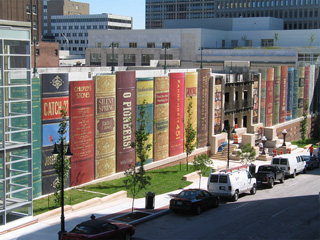
I knew I was on to something in this post, but maybe not quite so literally.
See also: Virtual flâneur
Algebraic soundboard
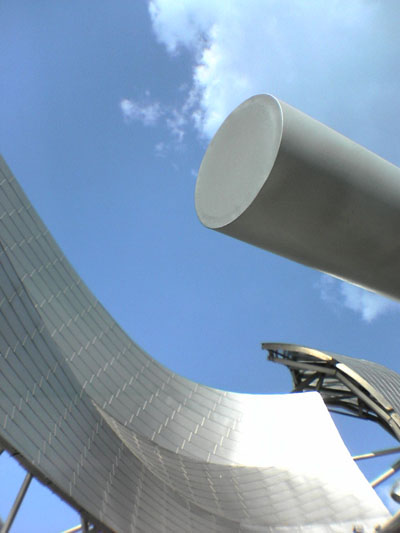
Terminus of one of the tubes that form the lattice “dome” above the great lawn at Millennium Park with the ribbon-like Gehry bandshell behind it.
“Heresy” after a decade
Ten years ago I wrote a paper for a small graduate school conference that in retrospect marked a real turning point in my life. The Heresy of Hypertext: Fear and Anxiety in the Late Age of Print was a bit of a personal manifesto, an attempt to bring my literary critical skills (my day job) to bear on the new media of hypertext (what I obsessed about most of the rest of the time). But, in truth, it was actually an extended rant to my English grad school professors about the importance of hypertext and digital text. Great scholarship “Heresy” wasn’t — and oh my how saturated it is in gradschool-speak neologisms! — but it is still the most linked-to part of any site I have ever had. It has even been anthologized and translated.
But ten years is a long time when you’re writing about new media. Let’s see how it holds up.
Just as bibliographers regard 1501 as the year that printed books emerged from the “cradle” of their post-Gutenberg nativity, the first year of the coming millennium will likely serve as a convenient demarcation point for the end of the beginning of electronic textuality.
True enough. By 2001 blogging was in full swing, putting to rest any notion that the written word and electronic media were somehow incompatible. Though literary hyperext was not a mainstream phenomenon in 2001 (and is not now) I think it is fair to say that by 2001 most would agree that electronic textuality had matured to the point where the distinction between it and the printed word was largely academic — a sure sign of cultural assimilation.
Though this new textuality promises to level hierarchical distribution of and access to even the most esoteric data, we should not make the mistake of equating the leveling with a reduction in the standards of professional scholarship. In fact, in such an intraloquial and interactive scenario, shoddy work quickly draws attention to itself, succumbing to the necessarily higher standard of excellence in a web of virtual collaborators and competitors.
Mostly true. Wikipedia is a great example of this kind of collaborative weeding-out of shoddiness. A web of casual editors does expose deficiencies in rigor and quality faster than in other media. But the very anonymity, publishing reach, and fungibility of electronic text also makes fraud a hell of a lot easier.
To the mind weaned on the indelibility of the printed word, electronic text seems unstable, less epistemologically graspable. I submit that this mostly unconscious perception of instability generates anxiety in the reader, anxiety of the type usually written off to the “it just feels different” category.
I think I missed on this one. Perhaps it was true in 1995, but I’m now of the opinion (largely because of Matt’s work) that the immateriality/instability was an illusion. The “just feels different” aspect, I suspect, was mostly a function of screen resolution.
Not a bad little paper, after all. Overwrought to be sure, but a personal milestone and one that I will always look to as the springboard that launched me into the arc that I am still on.
Always check the hitch
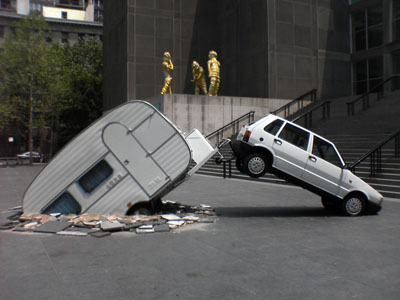
At the MCA.
Tips for bulk-shucking crawfish
Do it outside. Juice will splatter when you crack the carapace.
Keep separate containers for shucked and to-be-shucked mudbugs. They look remarkably similar and after removing the meat from a few dozen you’ll start to confuse the two piles if you use one container.
To remove tail meat, do the following. Press down with the thumb of one hand where the tail meets the body. Push towards the head with thumb. Rip head off with other hand, discard head. You should have two legs (or more) still attached to the tail and a small white Y-shaped piece of meet sticking out from the tail (pulled from the body itself). Crack off the carapace where the legs are connected. Push index finger, nail first, between the meat and the shell from front to the end of the tail, severing the connection between the two. Pull out meat. Remove small, usually dark vein that runs the length of the tail. The key is to pull it out rather than rip it out since there is a small piece of meat that covers the vein and might as well be retained if you can do it.
Darker-red crawfish have harder shells. On these dark crawfish, you might want to crack the tail like you would do with a lobster before attempting the above.
Your thumbs and forefingers will develop lots of micro-cuts. This is nothing to worry about.
Assuming you seasoned your crawfish with liberal amounts of cayenne (and related hot stuff) your hands will begin to burn after about twenty or so shuckings. It seems the spice-infused crawjuice just seeps in. This is something to worry about. It hurts.
About 17 lbs. of crawfish generates as much meat as pictured above. Lots of work. Best to make certain you’re really into crawfish before undertaking. Good luck.
Tonsiloliths
My brother and a co-worker of mine both have tonsiloliths. Literally, “tonsil stones” and sometimes referred to, so pleasantly, as “throat scabs” these nasties are actually just whitish balls of accumulated goo that form around food particles and bacteria rather like a pearl does around a grain of sand. They live tucked away in the tonsil cavity, occasionally peeking out to say hello and cause a little halitosis. Oh, they also are without question the stinkiest things I have ever smelled produced from a living human body.
If they are ready you can pop them out and dispose of them. I’ve had the unfortunate privilege of witnessing both my co-worker and my brother do this. The funny thing is that they both thought they were uniquely afflicted with these mouth-born stinkbombs and were either too embarrassed or too unconcerned ever to wonder if it were a documented condition. Of course, it is. Googling around a bit with descriptive keywords it is easy to find forums devoted solely to people happy to be in the company of other tonsilolith-producers.
Having witnessed all this, I consider myself a second-hand tonsilolith sufferer. At present, there are no online communities devoted to this topic.
[At one point I actually ran Google keyword ads here and made a little scratch given just how many people search on “tonsilolith”.]