
Fuel for thought
Gotta admit I was selfishly pleased to see the launch scrubbed. It ain’t easy catching a mid-afternoon launch when you are Houston +13. That fuel sensor problem really seems like the undead issue. Can’t kill it.
I bet the commander, Eileen Collins, had deja vu when the window cover fell off on the launch pad — and not because of the falling foam that doomed Columbia. Collins had her foot on the gas for the scariest ride up in recent shuttle history, STS-93, when three cooling lines were ruptured by a falling pin during main engine ignition. Collins and her crew ended up short of their orbit, but the mission was a success. I’m pretty sure NASA had this in mind when they selected her for the program’s return to flight. She’s apparently quite cool under pressure.
I really wish NASA had a shuttle alternative in the functional prototype phase in the next year or so. By my calculations, even if the shuttle makes it to the 2010 mothballing date there will be several years — akin to the post-Skylab pre-shuttle era — where the US has no operational manned space vehicle program.
Ironic that that the two bright areas in manned spaceflight are private industry and communist China. What an odd space race.
Sidenote: You can get uncluttered live video and often telemetry data from United Space Alliance, the contractors who provide many of the ground operations to NASA.
Sidenote II: Does anyone know of any good space blogs? Why can’t I find this?
Anti-bacterial
Never read this blog before in my life, but I really liked this assessment of the extremist tendencies in political blogs.
Conclusions: The left is full of crop circle paranoids. The right is full of stupid angry people. The sheer volume of information in both does manage to strip things to bare bones facts, but not by virtue of intelligence, just volume – like a colony of bacteria feeding on a corpse.
Forget brain radiation
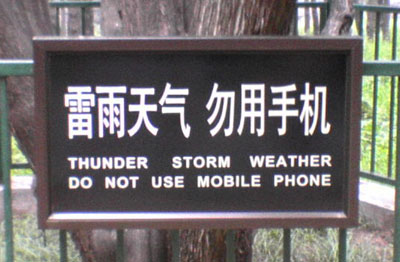
Yikes! Three possibilities come to mind.
(1) The phone itself makes you more likely to get hit. (But what cellphone today has a significant enough amount of metal on it?)
(2) Lightning bolts can follow the invisible paths of cellular radio signals right to the handset. That’d make a great urban legend.
(3) Standing under this tree using a cellphone makes you more likely to get hit. But then why this tree? (There were other signs around following no discernible pattern.)
Seems to me that it must have something to do with the phone being on, otherwise why note anything?
This reminded a colleague of mine of a story of a woman in a park in London killed when lightning struck her bra underwire. Only one way to prevent that, I think. Be safe, ladies.
Macro-genealogy

A little while ago I posted the results of my participation in the Genographic Project, a comprehensive attempt to fill the holes in our knowledge of human migratory patterns around the globe based on genetic evidence. I just finished Spencer Wells’s short, accessible introduction to this topic and, coincidentally, spent a 14-hour plane flight sitting next to the producer of a documentary who is using this data to help African-Americans determine their home areas in Africa in the absence of genealogical information. (Sitting next to him wasn’t coincidence; he’s with me on business. That we’re both interested in population genetics is coincidence.) So I understand things a lot better now.
The first realization is how incomplete the picture is. The Genographic Project looks for markers (chromosomal mutations passed on from generation to generation) in the Y chromosome for men and in mitochondrial DNA for women. What this means is that my information only reflects my lineage via my father and his father and his father and so on (called the “patrilineal line”). At the very least I’m missing the story from my other three grandparents. Three of them are deceased, but luckily I have relatives who can be tested.
Here’s what I know so far. My patrilineal line comes from the second migration of modern humans out of east Africa after what is known as The Great Leap Forward, an evolutionary moment where homo sapiens, through a truly lucky genetic mutation, acquired long-term memory, which allowed for the development of language (since thoughts could be strung together linearly), and thus to the ability to think more complexly. They made their way to Mesopotamia over the millennia and then 10,000 to 15,000 years ago my people — my exact line descended from a single person — were the instigators of what is is called the Neolithic Revolution, the birth of agriculture. My ancestors were the first farmers. They were the peoples who expanded into southern Europe and northern Africa, literally sowing the seeds of modern society.
The marker that denotes all this is called M172. It is relatively rare in Europe, occuring in only 20% of peoples in southern Italy; 10% in Spain. My ancestors were sedentary and Meditteranean-hugging. Somehow agriculture was transmitted via this line to the rest of Europe. (How this happened exactly is hotly debated.) If this isn’t fascinating, I’m hard-pressed to describe to you something else that is.
But, again, this is only my Dad’s male line. There’s more to be learned. For instance, my paternal grandmother has always said there is Native American blood in her. This test will prove or disprove that right away.
Get ready, Grandma, cheek swab incoming!
Hey, what’s the food like in China?
Here’s a partial dissection of a truly wonderful lunch in the Imperial Kitchen of the Forbidden City. (Click for notes.)
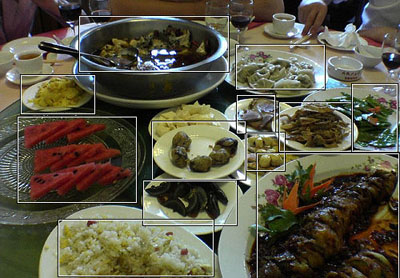
Today was a scorcher full of meetings in Beijing. I started the day in a coat and tie and ended in an undershirt and sweaty socks. Fill in what you like.
Toot toot

Eternal Egypt is Macromedia’s Showcase Site of the Day. Thanks, Macrodobe! (Remember when Cool Site of the Day was a must-visit web destination in the Netscape era?)
Might as well mention that the site also won a Webby Worthy award recently and, from a while back, a Best of the Web at Museums and the Web 2005.
Toot.
London strong
In World War II the subway tubes were used by Londoners to escape the inferno of Nazi aerial bombardment. Today a new enemy made the Tube itself a hell.
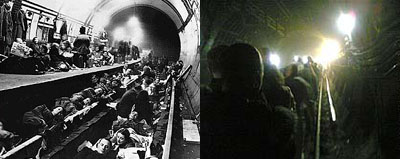
If anyone can look this ghastliness in the face and not blink it is Londoners. Not only because of the decades of domestic terrorism that they have lived with but because of their resolve during WWII. I’m finding myself awed by the British people’s organized and strong response to the tragedy.
Viva Britannia.
Win Ben Stein’s seat
Recently I saw Ben Stein in the airport. He looked like any other business traveller, harried, laden with luggage. Except that he was at a pay phone, which I thought was odd. Who except a philandering spouse, a scrooge, a luddite, or someone who just left their cell at security would use a pay phone? Certainly no seasoned traveller. Imagine my perplexity, then, to see that Ben Stein has written an article full of tips for business travel in the NYT. And I disagree with nearly all of them. I’ll summarize.
- Pay for or upgrade to first class if you can. Well, no disagreement there, except that I would say that often times the exit rows and bulkheads have just as much legroom as first class so if you’re not in it for the free champagne there is often an alternative to upgrading.
- Get the aisle seat. I hate the aisle seat. Your elbows get clocked, you have to get up to let your seatmates out (stow laptop, etc.), and worst of all there’s no good way to sleep since you run the risk of laterally dumping into the aisle or the stranger next to you. Better to take the window where you will be undisturbed and can nuzzle against the wall.
- Use a travel agent. I have no great experiences with travel agents to convey. Unless you are in a complete bind with no access to a computer or direct access to the airline why would you go with an intermediary? Like real estate agents, the era of travel agents having information that their customers do not is coming to an end.
- Make friends with your fellow passengers. Stein advises this so that it is less awkward when you have to ask them to stop kicking you. I disagree. The last thing I want on a plane is smalltalk. Who knows what hell you’re in for on an international trip if you drill a bit too deeply and hit a motherlode of incessant chitchat? And if you have to ask someone to stop kicking you, just ask. Must you have befriended them?
His hotel tips are a bit more in line with my thinking, but it still leaves me wondering: do you trust someone who travels this much and uses a pay phone?
See also: Stuff in my backpack, international edition | Travel tip
Surrogate band
Having watched the four songs performed by the reunited Pink Floyd at this weekend’s Live8 concert I’m now wishing I hadn’t. Oh, it was nice to see all four blokes on stage at once, sure, but there was no sense of real camaraderie or even musical cohesion. The reunion was supposed to demonstrate something along the lines of “if a rock ‘n’ roll band can work things out, can’t we end poverty?”
Waters seemed more like a devoted fan who has been pulled up on stage to sing a few numbers with the band. He was clearly way more into it, melodramatic even, than the other fellas. And, insult to injury, Gilmour has been singing the Waters lines live for so long that they sound a little odd coming from the original. (I know, I know, Waters performs Pink Floyd live too.)
Maybe Pink should have stayed back at the hotel.
Bang!
The Deep Impact probe successfully slammed into the Tempel 1 comet early on July 4th. Nice fireworks!

NASA hopes to analyze the cometary innards for clues about the composition of the early solar system.
See also video from the impactor point-of-view just prior to collision and
images from the flyby probe, Hubble, and an elated Mission Control.
Happy July 4th, America!