
Semiotics of freedom
A question for you. What is the difference between these two things?
Exhibit A
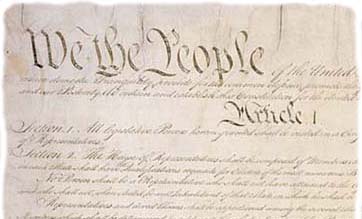
Exhibit B
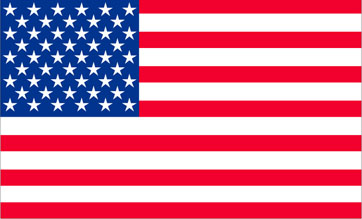
Give up? The first establishes the freedoms that Americans enjoy and must protect at all costs. The second is a symbol of that freedom. OK, so another question. Which is more important to you? Which would you be more likely to put your life on the line for? Seems to me an easy choice.
Whenever the issue of flag desecration comes up I can’t help but think of early religions that came to value physical depictions of a god more than belief in the deity itself. Aren’t we past this, people?
Nailed
My son crawled out of bed tonight and announced to us that he needed his toenails clipped. I thought this was the funniest thing I had ever heard — at least a very creative excuse not to go to sleep (what if a long nail caught on the comforter?!) — but I immediately knew that laughing would not be received well by thelovelywife. I stifled my laughter in my elbow pit.
Without looking up from her magazine my wife dryly replied, “Son, we do not trim toenails every night. Go back to bed.” Which he promptly did.
See, I would have blown that exchange in any myriad of ways.
Lincoln for our time
As New Yorkers and political activists around the country bicker viciously about the story of freedom to be told at Ground Zero, I was able to make a trip down to Springfield, Illinois last week to visit a freedom museum of a different sort, the newly-opened Abraham Lincoln Presidential Library and Museum.
I went in with low expectations, figuring that the experience would be either like the creepy robots in the Disneyworld Hall of Presidents or the imposing apotheosis of Lincoln at his memorial in D.C. It was neither. It was, in short, one of the best museum experiences that I have ever had. I’d highly recommend taking a trip down there to see it, if you can. The website is lackluster, but the buildings themselves are quite high-tech. Here are some highlights:
Ghosts of the Library – Think holodeck meets your local librarian. This might be the most interesting application of technology. The museum calls it “holavision” (blech), but it is really just projection that the audience views through a stage-wide pane of polarized glass. A real actor (the “librarian”, though with a twist that I will not ruin for you) interacts with a real set and with seemingly three-dimensional projections on the stage. The effect is very convincing. The most interesting part of this section is that the purpose of it is to explicitly address the connection between period documents/artifacts and the stories that are told in the museum. That is, they make a strong case for the importance of the seemingly inert collection of documents and artifacts and how they relate to the vivid stories that the museum tells. It is convincing and well-presented. Basically the credo of the Eternal Egypt project: using historical source materials (elements) to bring stories to life. (Also a great political trick, tying the importance of the library to the success of the museum.)
Hall of Whispers – A simple but moving hallway depicting the political invective that brought the country to the brink of the Civil War. This is done through period political cartoons and “whispered” broadsides that rain down on visitors as they move through zones of directional audio. The interesting thing is how the use of skewed lighting and off-center mounting of the cartoons create a disconcerting, almost unstable feeling as you walk through the hallway. (Some people get dizzy, apparently.) In other words, even if you don’t read or hear anything in the hallway you get the sense of a nation coming apart. A little spooky actually.
Lincoln-Douglas Debates – Controversial but fascinating, this exhibit uses a real television control room with multiple feeds going simultaneously to recreate these historic debates as if they occurred today. They have real news anchors (I remember Tim Russert, specifically) with fake infographics and news crawls (“Physicians discover substance called ‘germs’!”), and actors representing Lincoln, Douglas, and supporters yelling back-and-forth ala today’s news shows. You watch this from the perspective of the television room producer. Not sure if it completely works, but it certainly had children rapt in a way that the debates might not normally.
The Union Theater – An extremely high-tech theater with multiple proscenium-style stages, overlapping/moveable screens, rumble seats in the audience, and other special effects. The current programming there is a show called The Eyes of Lincoln that uses the actual depiction of the man’s eyes in photographs over the years as points of departure for explaining his life. It might seem a stretch, but it actually works. (Look again at his left eye. It wanders.) What I liked was the thought given to the actual subject-matter in such a high-tech theater. They could easily have gone all George Lucas on the thing and relied only on the smoke machines, but they didn’t.
Looking for Lincoln – Not a technology, per se, but interesting in that this program seeks to explicitly situate the museum exhibits in the context of other Lincoln sites around Illinois. Throughout the museum you are entreated to “look for” Lincoln at his home, law office, or other related structures around Springfield and elsewhere in Illinois. Likewise out in Springfield one encounters well-presented plaques that give background and direct people into the museum for more information. Sort of a dispersed regional tour embedded in the museum proper.
There are of course more traditional museum exhibits — artifact-based — but even these are nicely enhanced with technology, such as projected signage that is nearly identical to the actual printed signage on the walls. (You have to pass your hand in front of them to tell.) Overall the museum is about experiences and storytelling and the technology is used in the service of that. Critics call this Disneyfication. I think they’ve avoided the worst excesses of that label.
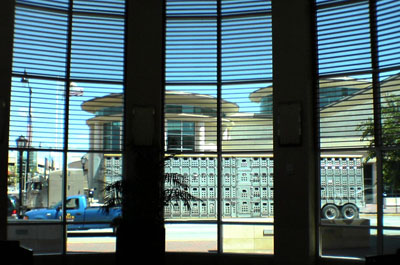
Lastly, lest my rah-rah for the museum make you forget that I am talking about downstate Illinois, I have included this photo of a hog truck pulled up right in front of the Futurama-Prairie Style museum building (seen from the rotunda of the library across the street). The old and the new.
Copy/Paste/Swap
Here’s something I need invented, if it does not already exist. I want to highlight a selection of text in an editable field and paste into it what I have on my clipboard (normal function so far) replacing the contents of the clipboard with what I am pasting over. A swap function, if you will. I could use this in a variety of situations. Someone tell me this hack/app exists. Please?
Zap
Laptop’s back from the shop. It has been a cascade of technology failure for me lately. Last week, my iPod just back from refurbishment (HD was flaky), I excitedly plugged it into the USB port on my laptop. Zzztt. Immediate shut down. Wisp of electrical smoke snaking out of the side vent. Lovely.
The laptop booted, but without working Bluetooth or USB ports. Funny thing was, I missed the Bluetooth way more than the USB. That’s got to be some kind of milestone for me personally. I realized, outside of my system-frying iPod, that I never plug anything into the USB. Mouse is Bluetooth; printer at work is; phone connection is; headset (for Skype) is. Long live the golden age of wireless.
And yes, if you’re counting, this is motherboard death #2 in calendar year 2005. Somethin’ ain’t right.
Maximizing reading time
Recently, anticipating a dull drive into downstate Illinois, I purchased Freakonomics as a digital audiobook from iTunes. Well-blogged and approaching supermeme status, Freakonomics was an excellent book. My only criticism was in the format. Some of the data-heavy parts of the narration (lists, recitation of percentages, etc.) didn’t work so well in the format of an ever-onward audio stream.
But the audio format did give me an idea. Smartly, the iPod and iTunes synch virtual “bookmarks” so that you can always know where you left off. But what I’d really like is the ability to tell an audiobook on the iPod which page I left off in the print version of the book (and vice versa, to have the iPod tell me where I would be in print). Why? I would like the ability to seamlessly switch reading modes — visual and audiotory — as the environment around me dictates. The most common scenario I envision is on my commute, the precious time when most of my day’s reading happens. I carry my book with me on the walk to the L train so that I have it out when I reach the platform, but that walking time is time I could be reading if I didn’t have to be heads-up negotiating traffic on my stroll to the L. But since I always have my iPod headphones on (for music) it would be great if I could tell the iPod where I left off in print. I’d gain an extra few minutes of reading time. Likewise, if the train was too crowded to comfortably open a book I could revert to the audio format. I still highly value the physical phenomenon of reading a book and would not want to give that up, but it seems to me some fluidity of output would increase my reading efficiency greatly.
Practically this would be problematic. For one, audiobooks are expensive. Owning hard copies in addition to audio versions seems excessive. Also, with so many versions and paginations of a single book title — no to mention abridged and extended audio versions — the synching would be very difficult. Lastly, and I suspect this is the real deal-breaker, I bet it would be somewhat jarring cognitively to switch back-and-forth between reading modes. Reading a book normally simply takes more work, a greater level of engagement, than sitting back and having it read to you. Maybe I underestimate our ability to do this. People switch between reading, watching TV, and carrying on a conversation all the time. But I think it is the fact that these tasks are all different as opposed to being an identical narrative in different modes that allows us to make the cognitive switch.
Guess I’ll have to test it out and report back.
Import > Life
A corrupt iPhoto preferences file caused me to have to re-import nearly 10,000 digital images recently. Watching them all get sucked in and displayed for a fraction of a second might be like what having one’s life flash before his eyes is like, if that in fact happens. (Reminds me of that scene from Flash Gordon when Dr. Hans Zarkov is having his brain probed and displayed on a screen.) Weird which images burn in to the brain as the rest flicker by. I’d call those the Important Moments if they were not so completely random, mundane, or titillating. Wait, maybe those are the Important Moments.
A unique phone call
“911 emergency services.”
“Yes, hello. I just passed under Montrose Ave. in a canoe and the bridge is on fire.”
“In a canoe?”
“Yes, on the Chicago River. In a canoe. The bridge is on fire from underneath. Smoke’s billowing out across the river.”
“Ah … ok. We’ll have the fire department out right away.”
“Will you send fire boats that shoot water from giant nozzles?”
“Probably not, sir.”
[frustrated grunt] “I’ll keep paddling then. Good night.”
No one calls them microcomputers anymore either
Well the micropost experiment failed miserably. Culprit: time. Rather, lack thereof. I never got around to integrating microposting into the posting mechanism or the RSS feed/archives. So it was a manual process from start to finish. From now on all tiny posts will happen as regular blog entries. Better that way.
For the record, here are all the microposts to date.
++++++
My health club is promoting a kung fu class for three-year-olds. Short of an intro to electrical re-wiring I’m unable to think of a worse form of recreation for my child. Hee-yaa!
“Install a dashboard funtion which controls the speed of the wipers so that they keep time with the stereo.” from Idea-A-Day
My son is having trouble eating a hot dog. Wife thinks fast. Carves top of frank into a cone. Slits ends, inserts potato chips as foils/stabilizers. Presents to son as as rocket ship. Fascinated, he eats the whole thing in between blast-off noises. Brilliant!
How hard is it to get NASA back on track? Perhaps it requires a rocket scientist.
Yearn for a simpler time, Lego block spacegeeks? Can’t stand specialized bricks that can only be used to build one damn thing? The Classic Space forum is for you (and me, obviously).
Today’s philosophically-profound spam: “Anyone who considers arithmetical methods of producing random digits is, of course, in a state of sin.”
Last week I installed a great snippet of code for the input forms on this site and have not had a single piece of comment spam since. I’m in a bit of awe at this hack and wish there were one for trackbacks too. And no, I am not telling you what it is, you crazed Nigerian Viagra-addled Texas Hold ‘Em Freak.
What do you get when you mix a Kraftwerkian vocoder, disco grooves, and an earnest profusion of power chords? Why, Robot Rock, of course!
The WSJ has a great article on “Rock’s Oldest Joke: Yelling ‘Freebird!’ In a Crowded Theater: For his part, Mr. Doughty suggests that musicians make a pact: Whenever anyone calls for “Freebird,” play it in its entirety — and if someone calls for it again, play it again. “That would put a stop to ‘Freebird,’ I think,” he says. “It would be a bad couple of years, but it might be worth it.”
iTunes as social icebreaker is an interesting idea. “Hi there, I noticed your taste in music is awful. May I buy you a drink?”
Note to person dumping the room service trays outside my door. If you are doing so out of compassion because you think I am hungry, thank you, but a knock would be helpful since I don’t really care for half-day-soggy cereal. If you are doing so because you don’t want it to clutter your slice of hallway, please stop. I have almost stepped into your breakfast wreckage twice now. Oh, and eat your strawberries or you’ll get scurvy.
Fugitive Haiku
Poet-of-the-month
No background check required
Please keep the award.
The plural of the word ‘mail’ is simply ‘mail’ so why do people consider ‘e-mails’ the plural of ‘e-mail’? This bugs me way more than it should.
There’s a guy who works out at my health club who uses the pay phone every time he is there. But he also has a cell phone. I see him on it all the time. This can only mean one thing, right? He’s having an affair. Has to be.
Note to interior designers. If we ask you to come over for a consultation on how to redesign/expand our home don’t ask me if I really need all the computers I have on my desk. This will not win you business.
Naples, Italy is on the peninsula’s southwest coast. Naples, Florida is on that peninsula’s southwest coast. Is this a coincidence?
If one were not careful overhearing others’ conversations in restaurants one could surmise that there is an entire stratum of society whose perception of Christianity is solely informed by The Da Vinci Code. This would be unfortunate.
I heard today that 6% of Americans have passports. Surely this will increase now that Canada requires a passport to cross the border, but good golly that seems suprisingly low. And I’m from the flyover states.
On a flight recently the pilot left the cockpit for coffee and a lav break, but not until a burly flight attendant — the burliest they had around, that is — positioned a metal drink cart perpendicular to the aisle as a rampart blocking access to the entire forward galley area. He just stood there with arms crossed glaring down the aisle. I’d never seen that before. You’d think a lockable door separating the main cabin from the cockpit/gallery/lavatory would do the trick, but clearly there are problems blocking passengers from emergency egress.
“Don’t sweat the small stuff. And don’t pet the sweaty stuff.” Written on a Vancouver pub window.
“Yeehaw!” is not a foreign policy. Not new, but this bumper sticker made me laugh.
“You know it is spring in Chicago if you are cold at Wrigley Field. When you are no longer cold, it is summer.” – LG
You don’t have it this bad, but you can probably relate. Prepare to waste a good a good half-day.
Why have the voicemail menu options always recently changed? And why won’t you tell me what has changed about them? Press 1 for recent changes. Would that be so bad?
Forgot this one on the friends-who-sell-stuff post. Actually, didn’t know about it. High school pal Diana Jacklich (now Hamann) is the Wine Goddess. Quite an appellation.
One of my favorite authors, Steven Johnson, is on The Daily Show tonight talking about his new book Everything Bad Is Good For You, a piece of tinder that has the blogosphere alight.