
Done fishing
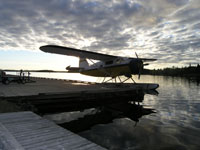
In high school my best pal and I would go fishing in Canada with our dads. We decided to do the trip again this year. Destination: Sandy Beach Lodge on Trout Lake in northern Ontario, 26 miles northeast by seaplane from the town of Red Lake, a five hour drive from Winnipeg. With no roads in and only four small fishing camps on it Trout Lake is pristine wilderness. After being depleted of its stock to feed Canadian troops during WWII the lake is once again teeming with Walleye, Northern Pike, and Lake Trout.
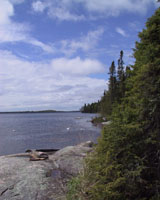
The lake is home to Ojibwa Native Americans, many of whom provide guiding services to fly-in fishermen like us. Tough fellas, the Ojibwa. The best guide, Bruce, was a quiet badass with a tattooed list of crossed-out former lovers on his right arm. He explained to us very matter-of-factly how he hunts moose around the lake. Not with a gun, not with a bow, not even with a trap. No, Bruce hunts and kills moose with … an axe. Just sneaks up on them — moose sleep standing up like cows — and thwack-thwacks them in the neck until they die. Trust me, if you saw this guy you would not doubt this story one bit. To facilitate getting the moose back to camp Bruce would normally hatchet it to death as it slept standing in shallow water. Thing is, Bruce can’t swim so if there were any, you know, issues while hacking the half-ton beast to death Bruce could have a problem on his hands rather quickly. Bruce scared me a little bit.
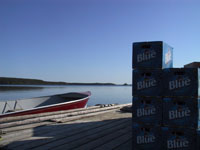
A fishing trip with the guys on a remote lake is rather like life on a sailing ship in earlier centuries, I’d wager. Specifically I think the incidence of scurvy might be comparable. When every provision at the camp has to be flown in you just have to have priorities. Case of Labatts or apple bushel? Canadian Club or fresh berries? Luckily even in such conditions human ingenuity thrives. Turns out that the Inuit people who live well north of Trout Lake near the veggieless Arctic Circle have a fascinating method to avoid succumbing to Vitamin C deficiency. OK, follow this. Algae + moss = lichen. Lichen grows on rocks near the Arctic Circle. Lichen contains Vitamin C. Humans cannot digest lichen. But caribou can … and do. That’s right. The image you have is correct. Inuit get their veggies by disemboweling caribou and squeezing out half-digested lichen sausages from the entrails. Yum yummy!
But that’s not all! Caribou are smart enough to swim across lakes to islands to give birth to their calves because they know that wolves — their natural predators — can’t swim. And because caribou hair is hollow even a newborn calf can float in the water and quickly learn to swim back to the mainland. And this is why Bruce the Axe-Hunter does not stalk caribou.
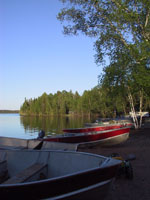
Here’s a typical day. Correction, here is what every day was like exactly. Wake. Eat breakfast of carbohydrates and pork. Fish until noon. (Start drinking at first catch.) Find shred of shore to build a fire and cook fish for lunch in cube of pure, snow white lard. Keep fishing until 5pm. Happy hour until dinner. Dinner of carbohydrates and [other meat]. Sit around fire, drinking. Actually the best part of the evening was by far the appearance of the Northern Lights. It was hard to take your eyes off them as they pulsed their way into the whole night sky. Like zoning out in front of a screensaver.
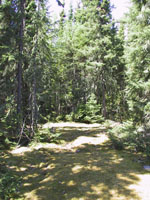
The forests around Trout Lake are straight out of Middle Earth. Sphagnum moss covers the ground giving it a strangely suburban lawn feel, until you step foot into it and realize the spongy sensation is what you thought the astronauts must have felt like bounding along the moon in that much-replayed Apollo footage. It is hard to believe such density of living things could exist on what is essentially exposed rock — what is known to geologists as the Canadian or Pre-Cambrian Shield. Glaciers basically shaved off all the topsoil and deposited it into the heartland of the US (thanks for that!) leaving a gigantic expanse of rock. But travelling around Trout Lake you are reminded again and again how life will take hold in the least hospitable places. From a distance you see an island grown over with trees, a fractal crayon box of greens. But as you get closer you realize that the spongecake biomass that it all grows out of is just the accumulated recycling of eons of plant life that took hold, died out, and decayed — creating a little more for the next round of life to grab hold of.
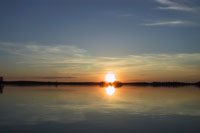
I really feared connectivity withdrawal up there. With no cell service, no phone line, no TV, and of course no Internet I wondered how I would cope. You know what? I didn’t even think about it. I’m not nearly as dependant on being wired in as I thought I was. This realization may have been the best part about the trip. Hmmm, no. Catching the biggest Northern of the trip at shore lunch in front of everyone else. That was the best part.
I wanna go back.
Searching, searching

Remember those trips to Egypt from late last year and early this year where I was traipsing around with a film crew? Well, the documentary is finally going to be broadcast and I’m very pleased with it. Kunhardt Productions and especially the writer-director Graham Judd did a fantastic job. I get to play armchair geek Egypt tech guy in the last part of the show.
The subject of the show is the history of Egyptology, a survey of major trends in the discovery and documentation of Egypt’s historic past. The work of my team at IBM and our partner CultNat on the Eternal Egypt project is featured in the final “act” of the show — the high-tech continuation of a tradition of documentation and preservation that stretches back in the modern era to Napoleon. My team also developed the prominently-featured 3-D environments used to illustrate certain segments of the show. The fidelity and dramatic quality of these environments surpass anything on the website.
We don’t chisel into the pyramids with a robot. We don’t claim to have found the mummy of Nefertiti. We don’t even mention the death of Tutankhamun. But this is why you are going to tune in, right? Something fresh!
More information at The History Channel.
An Evening With Kraftwerk
The venerable German quartet Kraftwerk returned to Chicago tonight, the first time in seven years. No single group has influenced my listening tastes more than Kraftwerk and so seeing them live is always a treat.
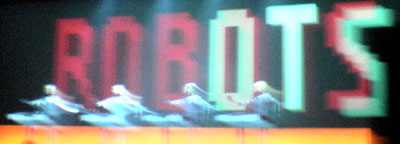
I was struck by a few things tonight. Though Kraftwerk is praised for its groundbreaking style and influence on hip hop, industrial, and electronica, their style is often denounced (and parodied) as stiff, unfeeling, and immutable. It is true that the energy from the stage doesn’t come from band members doing Townsend windmills. But in fact if you consider Kraftwerk’s output not so much songs as themes (leitmotif seems the most apt word here, ja?) which are reworked and tweaked over the course of decades you see that they are in fact quite dynamic as artists. Consider that there are only a handful of themes in their ouevre — transportation, fame, energy, human-machine integration, computing — and that each has evolved either by incorporation into new songs (Tour de France into Aero Dynamik), by digitization and reworking (The Mix),or by considerable updating (Tour de France into Tour de France 2003). A good example is the way Radioactivity has evolved from a paean to Marie Curie to a polemic against nuclear energy.
The live show is extremely nostalgic. As pathbreaking as Kraftwerk is their live visuals contain long sections of period-specific artwork, vintage video, and command-line-aesthetic computer graphics. In fact, the band has never actually been about the future, though their subjects are often futuristic. Though they are all digital now, the aesthetic of Kraftwerk is still firmly rooted in sensibilities of the past. This is atypical in their musical genre. But then, they pretty much invented the genre, so they’re entitled.
I am embarrassed to admit that after 25 years of listening to Kraftwerk and attending three live shows I only tonight noted the irony that the Most Sampled Band in History actually invented the sample well before digital recording made it possible. Rather than pre-record sounds of everyday life Kratwerk usually imitates them. The clank of a train hitch, the crank of a bike wheel, the Dopplery overlap of horns on a highway — all these things are imitated using sounds and parameters from the synthesizers, rather than samplers. Call it mimetic synthesis, low-fi sampling. Call it royalty-free.
I, Cartographer
One of the most popular posts on this blog was my copyright-unfriendly screenshotting of images of future Chicago from the movie I, Robot. I really loved the way the film layered future urban development into the current cityscape. I annotated some of the images and developed a map of where I thought the film’s main building, the U.S. Robotics headquarters, was located.
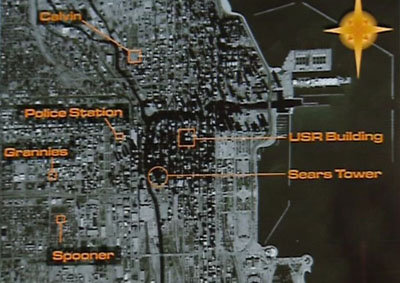
Well, turns out the special edition of the DVD just released contains a shot of a pre-production map (above) that the CGI team used when rendering Chicago 2035. I’ll leave the comparisons to those who care but suffice to say that I think they got the placement of USR HQ and Spoonerville wrong.
God help me if I am turning into the type of person who submits continuity errors to IMDB all day.
A long walk out of Africa
UPDATE: see Macro-Genealogy.
I’m just back from Canada (great trip, more soon) and my genographic data analysis is complete. The first finding is that I am, in fact, of the human species — a data point which generates almost limitless disbelief among acquaintances. Second, it is interesting that, well, it connects my genography to my actual genealogical line (the family I actually know about as opposed to my descendants 60,000 years back) and plops it right where I thought it’d be: southern Italy. I didn’t expect that kind of linkage.
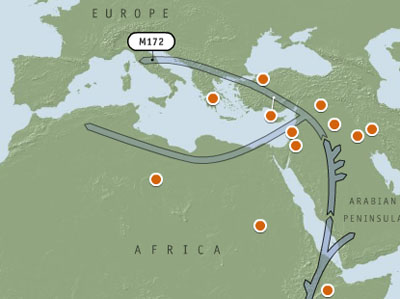
My Y chromosome exhibits a genetic mutation known as M172 which makes me a member of haplogroup J2. M172 itself is related to a mutation called M168 which astonishingly can be traced to a single individual called “Eurasian Adam,” the common ancestor of every non-African person living today. His descendants are the only line to survive after leaving Africa. But back to M172. This line heads out of east Africa to the Arabian peninsula, takes an incunabular pitstop in Mesopotamia, then treks west through Turkey, Albania, and into Italy. But what’s that fork across north Africa? And all the other forklets? Well that’s what this project hopes to figure out as it analyzes DNA from indigenous people around the world.
Oh boy. I got some reading to do.
See also: The Genographic Project
Where the sidewalk ends
Off the grid until next Thursday. I’ll be fishing in a lake with no roads in much less telecommunications infrastructure.
My normal travel gear has been stripped to a shell of its former glory: iPod, noise-cancelling headphones, iPod battery pack, digital camera, cellphone (won’t work, but gotta bring), and phone charger. My god, that kind of minimalism makes me shudder. Like a tech methadone clinic.
This will be good for me.
Corporate Lingo Watch
Got smacked with a new flavor of corporate metaphor this week. This is so meta it deserves a post-modern critique.
Guy is referring to a business deal that is taking longer than it should. The metaphor here is that it doesn’t have much energy. Running out of steam. Batteries are low. That kind of thing. What does he say? “This deal is low blood sugar.” After the split second what-did-he-say? I next wondered if there were any diabetics on the line.
Also, please do not use “uptick” and “downselect” in the same sentence. Makes me need to grab the desk to steady myself.
Sibling stance
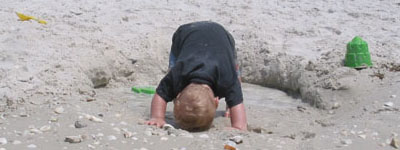
In Ghana if a young child bends over to look through his or her legs it is a sign that the child’s mother will soon be pregnant. The bent-over youngster, according to West African tradition, is looking for a sibling. Interestingly, this idea must have currency in other cultures such as Louisiana French, because my wife’s grandmother also knows of it. My youngest son conks his head on the ground to look backwards all the time and whenever he does it sets off a flurry of giggling Twi, the dialect that our Ghanaian nanny and all her neighborhood pals speak. If translated I believe they would be saying: “job security”.
“A turbulent zone of near-nothingness”
No, not my marriage — which is nine-years-old today, hooray! — but rather a description of the edge of the solar system which the spacecraft Voyager I has finally reached. Launched when the first Star Wars movie came out in 1977, this diehard explorer (and its twin) embody the best of NASA: trailblazing and science-oriented. If today’s NASA could regain that clarity of purpose we’d be so much better off than wondering how long we can keep a geriatric low-earth orbiting big rig from falling to pieces.
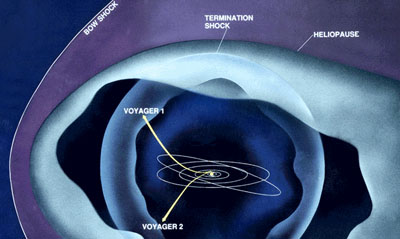
NASA
Voyager is truly alone now. Even the sun is just a pinprick of light. Here’s hoping someone — some thing — eventually encounters her golden cargo. Seeya, V’ger!
Idiot and the Odyssey
As I am getting on the elevator at work today a gaggle of dronish businessmen get off on my floor. Clearly they don’t work on the floor and are looking for a meeting. I hear one guy say “Odyssey. We’re looking for the Odyssey room. I wonder where that is.” Some other guy snickers “Next to the Caravan room, maybe.” Consensus chortling and I think even a ha-ha backslap ensue. I spend the elevator ride wondering what the hell he means. Some obscure Homeric allusion? Then it hits me. A minivan joke. The guy made a minivan joke, for the love of god.
Oh suburbia, is there any limit to the ways you enrich our culture?
Mission Elapsed Time: 20:00:21:06:42:40

I went back through it this blog (and my Flickr account) on its 20th anniversary, retracing digital footprints made on what feels like a different planet. Here are some highlights.
The Terror Tourist
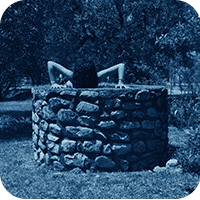
A roughly monthly exploration of places in horror fiction — real or imagined, geographical or psychological — culled from The Heavy Leather Horror Show.
Subscribe to the podcast or the email newsletter or just read through the archives posted here.
The Ampcamper
How I hauled myself, two teens, an 80 lb dog, and a whole load of crap 4000+ miles across six states in twenty days using an electric vehicle. And survived to tell the tale.


