
Cityscape as graphic equalizer
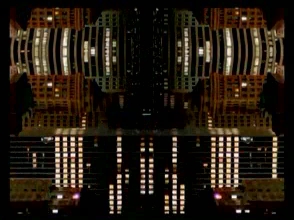
This video is making the rounds and for good reason. Vernie Yeung directs the amazing visuals to Faultline’s “Biting Tongues.” At first I was reminded of those students at Brown who wired up the lights on the university library to play a building-scale version of Tetris, but I think what’s going on here is a projection of images onto a skyline. (The last frame is the clue.) Whatever Yeung did, it’s gorgeous.
(Thanks, Len!)
Parallel-o-gram
To the driver of Checker cab #5557:
Just a quick note of thanks for not killing my wife and son today as you hurriedly attemped to pass their parked car on Lincoln Ave. (Yes, I have two sons, but I’m rather fond of the blonde one you nearly mowed down.) I’m so relieved that you weren’t hurt and that you were able to get to your next passenger 4/1000th‘s of a second before you otherwise would have. Think of the potentially lost income!
Also, I wanted to say thanks for the legal lesson you gave my wife. True, it might have been more effectively delivered if you were not screaming and gesticulating threateningly at her, but I admit that I have no law training so I’m not totally qualified to comment on your rhetorical strategy. One correction, though. It is not actually illegal for doors on the driver’s side to be opened into traffic when parallel parked. However, a friendly police officer to whom my wife spoke did note that it was her responsibility to make sure that she was not blocking traffic in any way when opening the door. Can you believe she was actually trying to put our toddler son into his car seat from the same side of the car that it is installed on? I mean, that’s just lazy. She clearly should have climbed over the other car seat on the other side of the car and inserted said toddler long-distance style. Who cares if that’s a physical impossibility. That’s what sun-roofs are for, right?
So, I apologize for any inconvenience. As soon as I get home tonight I will reprimand my wife both for her ignorance of the law and for showing such vehicular effrontery to you and the entire taxi driving community in Chicago. Please know that if I am ever in your cab in the future — #5557, easy to remember — I will make certain that my feelings on this matter are made even more forcefully than this letter permits me. You have my word on that.
Sincerely,
John Tolva
PS – Given your legal acumen, we were wondering if you could outline the law’s position on stopping your cab in traffic to deliver a lecture on municipal parking regulations to a mom and her kid? Thanks!
Beasts in Babylon?
The Guardian reports on widespread destruction of cultural monuments in the Iraq city of Babylon — not by looters, but by U.S. troops. Apparently we’ve set up a military depot there. Um, hello. You’d think with the Olympics just in Greece we’d be saturated with knowledge that this is a very bad idea. Say it with me: ancient structures make bad armories. Repeat.
Where were the much-ballyhooed cultural heritage consultants to the military on this campaign? Ugh.
(Thanks, Mark.)
Rendered Chicago
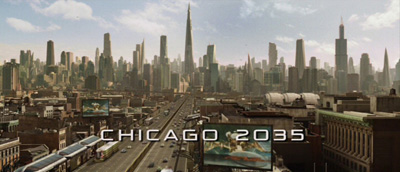
The city of Chicago envisioned by Alex Proyas in the movie I, Robot is set almost as many years in the future as I have been alive. Either I’m underestimating the last three decades of technological progress or Proyas is being too optimistic about how quickly his vision could be reality, but in either case the movie is an enjoyable one, teasing a pretty decent narrative out of a collection of loosely connected short stories and novels by Isaac Asimov. I especially enjoyed the film’s elaborate CG environments that create a clearly futuristic but also recognizable cityscape. (They had to, the movie was shot in Canada.) I’ve read that Proyas set the movie when and where he did because he liked the way the Chicago of today juxtaposes old and new architecture so comfortably and thoroughly. Of course, I agree, and for the most part the movie does a great job taking this trend into the future. I was intrigued by the choices the virtual urban planners made in removing and inserting new structures into the skyline. (And if you are too, you’ll want to visit the Art Institutes’s excellent 10 Visions exhibit.)
I’ve created a Flickr gallery of screenshots from almost all the scenes of Chicago in the movie. It is pretty clear where the designers placed the U.S. Robotics HQ building, but studying the images shows that they weren’t overly concerned with keeping it in the same place throughout the movie. A few things are clear from these shots:
- By 2035 Mayor Daley is dead because he isn’t in office because if he was he’d never allow a plaza like the one in the movie without a single flower bed or row of trees.
- The architect of 71 S. Wacker will be hired by USR to build their tower. His client’s only instruction: “make it taller.”
- Yes, we have sentient machines taking care of us, but was it worth it to give up recreational boating on the river?
- The L is way too silent and slinky. I can believe in robots with positronic brains, OK, but it simply defies belief that the CTA will ever get their act together for the effort required to replace the current clunky rolling stock (nor would I want them to, come to think of it).
These images raise a bunch of questions, some of which I’ve posed in the screenshot annotations and descriptions. Feel free to comment!
A good week for this geek
Apple’s Macworld announcements left me awe-struck and out about $300. Those kids on One Infinite Loop are on fire!
Comcast upgraded my cable box to a dual-tuner HD PVR for free (meanwhile Tivo’s product “launch” continues to infuriate).
Cassini’s hitchhiker finally showed that it could do cool things too. Hello, Earth II! (Note to ESA: a photo of Saturn setting in the night sky of Titan would have been a real treat. Next time?)
The mechanized ant hill outside my window
As if I didn’t have enough to distract me at work, the Sun-Times deconstruction has moved into high gear. It is impossible not to watch as the crews scurry around pummelling concrete to bits, blow-torching in half the very girders they’re standing on, and driving those cute miniature bulldozers to the very precipice of certain doom. These guys have now officially suffered through every element: wind (the bend in the river is one of the windiest points in the city), snow, rain, sneet, frizzle, and, yes, fire. I passed part of the hard-hatted crew at street level the other day and I felt like I was walking by celebrity. Reckless men of destruction, I salute you!
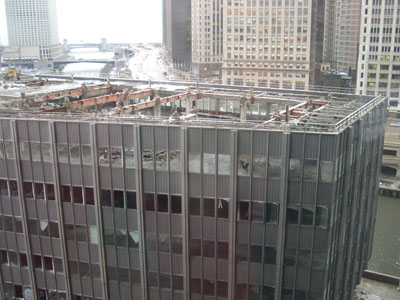
We’ve been taking snapshots of the work at 10-minute intervals since it started. Here’s a timelapse video of the work so far. (Thanks to Jack and Jeff for putting this together.)
More photos here.
Fake news, real coverage
Last week Richard Gere bumped me off a phone call with the OneVoice crew. My ego was wounded, but, you know, I shook it off. Well, take that Mr. Gere. You got yours tonight on The Daily Show.
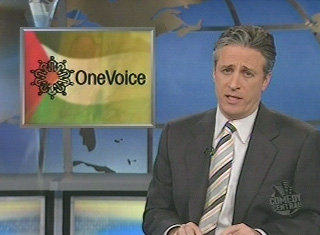
Gere’s been taking some heat for his presence in a get-out-the-vote PSA for the Palestinian elections, but I was pretty surprised to see Jon Stewart pick up on it. Surprised and pleased, I guess. The Daily Show’s got way more credibility than many mainstream media outlets these days.
So in the span of 24 hours OneVoice finds itself with an outspoken supporter newly elected in Palestine and has acheived the level of cultural currency conferred by a bit on The Daily Show. Time to get to work on the hard stuff.
Vapourspace

Certain genres of music seem to age less well than others. For better or worse, they seem more firmly tied to the time of their creation: they feel dated. To some degree electronic music suffers this way. Could be that the heavy reliance on technology — whose pace of change is rapid and discernible even to non-aficionados — is to blame. Could be that electronic music exhibits a higher percentage of amateurism because the barriers to entry are perhaps lower than other genres (got a turntable? a computer? just a tape recorder? you’re good to go). Or maybe it is because the bewildering matrix of sub-genres — trance, sythnpop, nu jazz, gabba, drill and bass, illbient, house, IDM, they grow like fractal screensavers — disallows a unified sound that can transcend the moment.
But I generalize. The best of any genre bubbles to the top, remains fresh, and rewards the listener who lets it age. In 1994 under the name Vapourspace, Mark Gage released the symphonic hour-long Themes from Vapourspace and its 35-minute little brother variation Gravitational Arch of 10. This LP and EP were by far the most important to me of the 1990’s, forking the road in my musical appreciation into a few different branches. Vapourspace showed that one could remain magnetically neutral and musically inventive sliding between the poles of four-on-the-floor club techno and bleep bloop experimental electronica.
Recently Gage posted an excerpt of Gravitational Arch of 10 from a 1994 soundcheck in Switzerland on his website. I was struck by how fresh it sounds, even now. Gage was ahead of his time in 1994, but not 11 years ahead of his time. He just got it right, moved beyond labels, and made a thing of beauty. The original albums are out of print, I believe, so look hard for ’em. This vintage is just maturing.
MediaLoom indeed!
Given my recent post on the connection between automated weaving and computing, I had to share this. The Consumer Electronics Show brings us the Brother Innov-is 4000D, one seriously geeked-out sewing machine. They should have named it the Stitchtron 9000 or the Weavebot or something, but this is still pretty cool. Input a digital image, output a sewn pattern. Jacquard would be so proud.

Via Gizmodo.
Poetic license
My son calls headphones “headmuffs.” I find that hysterical, but if I let him see even a smirk he’d get embarrassed and probably cry, never to utter it again. That’s my current parenting dilemma. Correct him or let him go on with his cute and often-funny neologisms? Seems cruel to let him go on, now that I think of it, but there’s nothing better than hearing about a “hippo-om-a-puss” when you least expect it. I’ll let it go a bit longer …