
Whose skills?
I am on the L tonight. The man next to me is reading a printed Powerpoint deck on his lap. Three points per page. No more than a few words per line. Like a set of flashcards or a very large type edition of a book. Except that the storyline has been broken down into bullets. I think maybe he is doing foreign language drills or something. It all looks very See Jane Run.
I peer closer. The subject matter is serious indeed. The deck is a school board report instructing teachers on how to raise the abysmally low reading skills of their K-3 students.
• I wince at the irony.
• I think of Tufte.
• I exit at the next station.
Favorite things, part the second
Here’s round two of Stuff I Like. (Part one is here.) Who cares? Hmm, I don’t know, but it is nice to make lists of this. Like a reverse wishlist. Not so much something I want as something I want others to know they should want.
Harmony Remote – Gobbled up by Logitech (but apparently none the worse for wear) the Harmony Remote is by far the most usable, most intuitive universal remote out there today. The most important features of this remote are what it does not do.
It does not consider its screen the primary way of dynamically reconfiguring a new interface for each remote it emulates. Instead it uses hard buttons for as many buttons as possible that overlap the most number of devices. You’d be suprised how few functions are device-specific.
It does not require you to “teach” it the IR codes of your other remotes. Instead, you connect the remote via USB and log in to your account at Logitech. You choose your devices there. I’ve got a bunch of obscure and ancient components in my setup and it had every one of them and far obscurer too.
It is not device-centric, but rather activity-centric, asking what do you want to do rather than which device do you want to access to attempt to do what you want to do? When you login to your account you define activities — watch TiVo, play music, whatever — and almost never need to refer to individual devices again. Activities of course are a nicer name for macros which are just sets of remote commands. But thinking in activities rather than which device must be set to which input blah blah is so much more intuitive. I am about the zillionth person to laud this feature, but hey here I am. (Don Norman loves it, for example.)
Win2VNC – The very definition of a useful hack, this program rides on top of VNC to allow you to use a single mouse and keyboard across multiple computers on a desk. (It’d work longer range, but why?) I use this app every day when I plop down in front of my laptop and need to do things on the three other machines on my desk. Getting rid of all those keyboards and mice really frees up a lot of space.
Mozilla Firefox – So I like Firefox, big deal. Using Firefox on PC is a no-brainer. IE is such a steaming turd there’s really no choice. But when I finally switched to Moz on Mac I knew something really important had happened. I mean, Safari is an exemplary browser, truly awesome. For a while there were things I could do in Safari via AppleScript that I could not do in Mozilla, like aggregate all open windows into a single window with multiple tabs. But with Mozilla’s flexible extension architecture it wasn’t long until even that feature was made cross-platform. There’s no Safari for Windows or Linux and I like my browsing experiences to be consistent. Bless you, Firefox.
7UP Plus Mixed Berry – As the only person in the world who actually likes this new drink I feel that I must declare my allegiance here, in public. There, I said it. No need for counterpoint links. Just Google it. No one else likes this beverage.
Anapod Explorer – Probably the most useful piece of iPod software for the PC. The best features include being able to stream music over the web directly from the iPod and being able to manage/access your music via an SQL database of your music library. Oh, also, you can download music from your iPod, something iTunes don’t do.
Sunrise Earth on Discovery HD – You had to know that ambient imagery would be the next logical step after high-def television became somewhat mainstream. Sure, there are media players that’ll load art packs, but Sunrise Earth is one of the first completely non-narrative programs that is just beautiful to look at — and that’s it. The subject of the show is a single sunrise, taken from multiple angles in full surround sound. I love it.
The window side seat on the upper deck of a 747 – No photos for this, so visualize if you will. The curvature of the hull of the 747 is somewhat extreme on the upper deck of the 747 so seats can’t fit right against the window. This is a good thing. Whether the bubble is configured for coach of business class, the gap created by the curve means you get a little footlocker next to your seat that is good for storage, putting your feet up and reclining almost completely, and resting your laptop while you dine. Try it. It feels like a credenza or something.
That’s all for now. Tell me, what I am missing here?
Digital Guide at MoMA
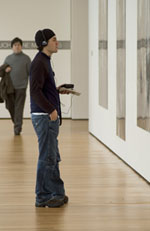
The Museum of Modern Art in New York has just launched a new visitor service. The MoMA Digital Guide, a story-based multimedia tour guide developed in collaboration with IBM, is the next generation of the service originally developed for the Egyptian Museum in Cairo. I’m part of the team who developed the app, so I’m naturally biased, but I think it is a very fine complement to the very fine new MoMA space. For now, renting the guide is free. Go on Friday evening between 4 and 8PM and admission’s free too.
Business Week recently ran a short piece on the Digital Guide. If you’re interested in the technical details, feel free to e-mail me.
Passings

The artist Ed Paschke died in his sleep last Thanksgiving. I was introduced to his work in 2000 when some IBM colleagues suggested that he would make a good speaker at the opening of our new space. It was an interesting choice. Paschke was an avowed technophobe. He was fascinated with holography, though, and open to collaborating with computer designers. He agreed to speak at our opening. I remember him standing in a forest of displays on the dais, more avuncular than bohemian, a little bewildered at the sight of it all. He lent us one of his most stunning electronic pieces for a few months. It hung in our space and I secretly hoped his studio would forget that they had placed it there. They didn’t.
A memorial tribute exhibition to Paschke opened on Friday at the Maya Polsky Gallery. It runs until March 12.
In other news, another famous Chicagoan has left the building. Don’t let the door hit you on the way out, Sammy! (The security cameras are watching.)
In music news …

The genre-puréeing duo Lemon Jelly has released its third album, a “retrospective” called ’64-’95. (The dates refer to the years from which the album’s samples were gathered.) I’ve only listened through a few times, but this is good stuff, different enough from the seminal Lost Horizons, similar enough to remind you why these guys don’t sound like anything you’ve ever heard. I bought the tracks online, but apparently there is a well-designed DVD version available too. Fantastic work.
Speaking of trailblazing duos, Autechre will release a new album called Untitled (don’t they already have an untitled album?) in April. They’ll tour globally too. Yum!
I gave my iPod shuffle a try today. Works just like you’d expect: tiny to the point that you forget it is there, no skipping, etc. I didn’t miss having a screen at all. Well, that’s not completely true. I found some new music and wanted to know what the heck I was listening to. Like others I had laughed at Apple’s chutzpah in promoting random play like it was some revolutionary feature. But now I wonder if it is as simple as that. Shuffle does become more important the more music you own since the chances of listening to a track you haven’t heard in a long time (or ever) is inversely proportional to the amount of music you have loaded onto your iPod. In other words, the more music you load the more likely you are to listen to the latest tracks or known favorites. Is it possible that Apple is playing up the shuffle and auto-fill features both as a marketing angle and to remind us how much fun re-discovering music is, further solidifying our love affair with their devices? Eh, probably not.
Maybe?
Tipping point
What’s the worst single disaster in terms of the loss of human life in the history of Chicago? You might say the Chicago Fire or the Iroquois Theater Fire. You’d be wrong. This summer marks the 80th anniversary of the Eastland Disaster on the Chicago River when an excursion steamer packed mostly with employees from a single company bound for a beach outing simply tipped over — crushing, trapping, or drowning 884 people in the sewage-infused river.

There’s an historic plaque a few blocks west of my office directly across the river commemorating the event, but, other than people on Haunted Chicago bus tours, few know of the tragedy. So I was pleased to see a new book on the topic. Pleased to see, that is; not so pleased to read. Jay Bonansinga’s The Sinking of the Eastland tells the tale in the narrative or “creative” non-fiction style so popular recently, but it falls flat and, at times, causes you to smirk at the overwrought pathos. And, you know, you shouldn’t be smirking at an event that wiped out 22 entire families. The problem, I think, is that Bonansinga’s story is caught — squeezed — between two mammoth master narratives. The first is the story of the Titanic (which sunk only three years before the Eastland) and all the vice-like purchase that tale has on the popular imagination these days. (Thank you very much, Leo.) The second is Erik Lawson’s The Devil in the White City, the story of the 1893 World’s Columbian Exposition which, for many readers (at least in Chicago), single-handedly defines the genre of narrative non-fiction. The Sinking of the Eastland just tries too hard to hard to make you weepy. This might be a reaction to the perplexing absence of the sinking from Chicago’s collective memory. And I suppose I don’t blame him for that. It really is odd how entire cities forget things.
Bonansinga does highlight an interesting theory on why the Eastland capsized. Indignation over the lifeboat situation on the Titantic had reached such a level in the years after that catastrophe that ships around the world were outfitted with far more lifeboats than they were designed to carry. Mostly the lifeboats hung from the top decks, dangerously skewing ships’ centers of gravity. It almost defies belief that so many people could die on a boat still tied to the wharf, but this lifeboat top-heaviness, coupled with a too-crowded ship and improper ballasting, was all it took to pitch the Eastland into the drink.
Remade in Taiwan
So, a few days into my China trip my laptop died — motherboard fried. You see, my machine prefers to crap out when I am half a globe away from my local tech support, having most recently decided to spin its hard disk platters into the drive armature when I was in Egypt in October. Yeah, I needed that. What’s worse this time is that I had only recently achieved the goal of getting rid of individual power cords for my camera, iPod, and phone, instead charging them all via USB through the laptop. You see where I am going with this, no doubt. With a dead machine, nothing would charge. Single point of failure. Nice design, John. My technology world came crashing down in a single heap of powerless gadgets. And it was a weekend with little hope of tech support in China. How did I manage? My trusty moleskine of course! Eventually on the last day before coming home, some colleagues of mine in Taipei were able to repair my machine with one of only four motherboards for my laptop model on the island. Nicely solved!
A couple of assorted things before this China travelogue comes to an end.
- Cathay Pacific is everything that United as an airline is not. I could get used to that level of service. They even titillate you with onboard e-mail access, but it turns out the e-mail is queued locally on a server and sent out in batches. Not exactly Lufthansa-style in-flight access, but hey, they did treat me like royalty.
- Taipei 101, the current world’s tallest building, has a pressurized express elevator that moves you faster than your inner ear cares to admit. It also has a massive vibration damper tuned to the frequency of the building itself. It is open to public inspection and looks like something straight out of a sci-fi film. Bow down to the spherical power core!
- I never did get sick. My family continued to suffer, though, as a bout of pink eye and double ear infections added themselves to the compendium of maladies that afflicted the already-miserable.
- I ate a caffeinated egg and gelatinous coffee. Not sure which was worse.
Finally, some more polite signage from the Forbidden City. Really, no problem at all.
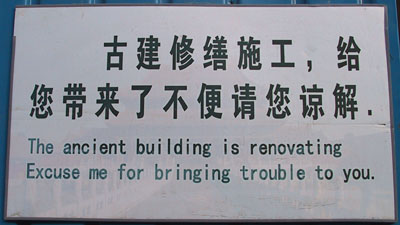
And then this:
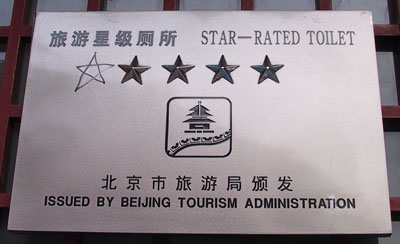
Fine, but everyone knows there’s no such thing as a five-star crapper. Simply ridiculous. The scale just doesn’t go that high.
Replicants
Today I spent many hours of hell braving the Ya Show market in central Beijing. Armed with printouts of fine handbags from my wife I was there to acquire as many name-brand knock-off purses as I could afford and carry back to the hotel without undue strain or attention being drawn. It was misery, since I’m not a big shopper anyway and have no innate sense of what a Prada purse should cost, but I made it out relatively unscathed. Two things made me laugh repeatedly, though. The English of the stall-keepers was uniformly horrible, unless it related directly to the act of selling or keeping you from walking away. Phrases such as “make me a smarter offer” or “where will you find such quality elsewhere?” were syntactically correct and enunciated flawlessly. It was fun to test the boundaries, to probe the limits of vendors who were really just human phrase-recall databases.
Input: potential buyer walking away.
Output: “Sir, please enter your price into my calculator.”
Input: Shopper says “Do you take US dollars?”
Output: “Why yes, sir, as well as RMB and Hong Kong dollars, thank you.”
Input: Shopper says “Excuse me, do you know the closet subway line to the market?”
Output: Blank stare, no keywords triggered. Abort, retry, fail?
The other thing I loved were the signs placed everywhere imploring shoppers to report any fake products. It was all so earnestly ridiculous. There wasn’t anything real in the whole place. (Not that I could have spotted a real Gucci purse, mind you.) Sure, I’ll dial the police right up. Just let me know if the American embassy will pay for my funeral after the shopkeepers — and their customers! — lynch me with so many faux leather belts.

True, in advance of the Olympics and as part of playing nicely with their trading partners, the Chinese authorities are starting to crack down on the product replica business, but I think this may not ultimately be as much an economic practice as a cultural one.
In his fascinating book The Future of the Past, Alexander Stille notes how China and other Asian countries do not consider a copy to be less real or less significant than the original it represents. Like a digital copy of a file that has no more claim to authenticity than its “source” file, high-quality copies in China are consider artforms in their own right. This is borne out in the field of cultural artifact conservation. For the Chinese, copying is conservation, a concept completely foreign to Western conservators. Because most Chinese architecture had traditionally been wood-based (rather than stone-based) there has never been a strong notion of permanence in art. To keep a work of art alive you had to replicate it and, in the process, were showing a reverence for the skill of the artisan that came before you. Still, this approach flies in the face of nearly every precept of Western cultural conservation. Can you imagine the Italians throwing out the David and creating a new, cleaner one as a solution to the recent conversation problems they have had?
It will be a shame if the fake product industry (or the skills upon which it thrives) does not survive in the face of globalization and homogenizing markets. In a way, the closure of the fake product markets is just the latest assault on the “culture of the copy,” as Stille terms it. Just as the Cultural Revolution decimated sites of historical value throughout China — effectively severing the centuries-old artisanal traditions that permitted the cycle of upkeep and re-creation to persist — the closure of markets like the famous Silk Alley represents the triumph of one concept, in this case the inviolability of global trademarks, over another, much older one: the exultation of the replica.
Physicalized words
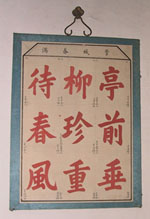
I can’t read Chinese, though I am able to at least distinguish it from Korean and Japanese scripts. (Cut me some slack, that’s progress! But don’t even ask about distinguishing Traditional from Simplified. I’ll have to be content in my ignorance on that one.) What this means is that, since I have no idea what idea is being conveyed, my growing love for Chinese characters is almost purely visual. A reverse ekphrasis, the strokes of even the most mundane lines are painterly, evocative of an artform more fully engaged with the space around it than Western writing. Chinese calligraphy, such as I have seen it, is more akin to dance or yoga than it is to other scribal arts. It is all very physical.
Consider the “calendar” in the image above. Called the 81 Days of Winter, it is a single phrase that evolves slowly over the course of the winter. Each day the author/painter adds one stroke to the characters; a total of 81 comprise all nine characters. Ticking off the days like an Advent calendar, the phrase is complete by the end of winter:
The weeping willow of the pavillion waits for the warm breath of spring.
But it isn’t just script that is spatialized.
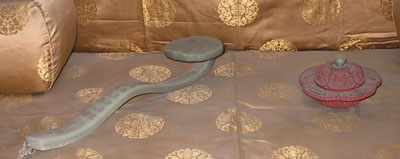
The item on the left is called a Ruyi. Long ago it was an imperial backscratcher, but it eventually lost that function altogether and merely became a royal symbol. The item to the right is a spitoon shaped like a persimmon flower. Together they form a visual pun. The word “ruyi” also means (or sounds like) “whatever you wish” in Chinese. The word for persimmon also means “everything”. So, taken together, the two completely symbolic objects mean “everything you wish for”. You see these objects conspicuously placed together on furniture throughout the Forbidden City, a portmanteau resting amongst the other objects of daily life.
The Pavilion of Literary Profundity
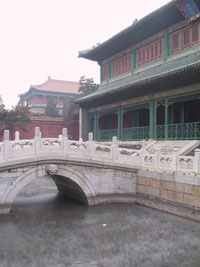
Now that’s the way to name a library! Or, more specifically, a book depository. We braved the bitter cold at the Forbidden City in Beijing for a unique tour of this Ming-era building deep inside the palace complex. It isn’t open to the public as it is still used as storage for what looked like textbooks and promotional materials. Dust clogged the air and draped everything; if I were alone it would have been exceptionally creepy.
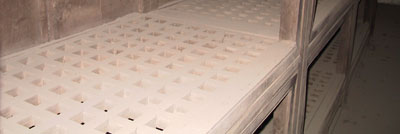
The upper floors were empty — much of the original corpus is in the National Palace Museum in Taipei, but they offered close inspection of some fancy stacking technology. (Ever since reading Henry Petroski’s Book on the Bookshelf I’ve had a low-level interest in the technologies of physically storing books.) Each section in the stacks are composed of two-ply shelves. The top shelf is a grid, to allow ample airflow in and around the volumes and scrolls. A second shelf immediately underneath the first is filled with sand. In the event of fire, this shelf would burn through (the theory goes) and dump fire-extinguising sand onto the level below. Rather ingenious.
Those Ming and Qing certainly were committed to fire abatement. Some 300 bronze vats were spread throughout the grounds for ready access to water (heated by fire in winter to keep it liquid). Protection was sought symbolically as well. The roof of the Pavilion of Literary Profundity is colored black, an atypical choice in the Forbidden City, but one that connotes water in the Chinese spectrum. Dragons spew water at the corners of the building and a huge lighting rod and cable snakes across the spine of the roof into the ground. All combined, an admirable long-term data preservation strategy. (More photos at Flickr.)