
An Evening With Kraftwerk
The venerable German quartet Kraftwerk returned to Chicago tonight, the first time in seven years. No single group has influenced my listening tastes more than Kraftwerk and so seeing them live is always a treat.
I was struck by a few things tonight. Though Kraftwerk is praised for its groundbreaking style and influence on hip hop, industrial, and electronica, their style is often denounced (and parodied) as stiff, unfeeling, and immutable. It is true that the energy from the stage doesn’t come from band members doing Townsend windmills. But in fact if you consider Kraftwerk’s output not so much songs as themes (leitmotif seems the most apt word here, ja?) which are reworked and tweaked over the course of decades you see that they are in fact quite dynamic as artists. Consider that there are only a handful of themes in their ouevre — transportation, fame, energy, human-machine integration, computing — and that each has evolved either by incorporation into new songs (Tour de France into Aero Dynamik), by digitization and reworking (The Mix),or by considerable updating (Tour de France into Tour de France 2003). A good example is the way Radioactivity has evolved from a paean to Marie Curie to a polemic against nuclear energy.
The live show is extremely nostalgic. As pathbreaking as Kraftwerk is their live visuals contain long sections of period-specific artwork, vintage video, and command-line-aesthetic computer graphics. In fact, the band has never actually been about the future, though their subjects are often futuristic. Though they are all digital now, the aesthetic of Kraftwerk is still firmly rooted in sensibilities of the past. This is atypical in their musical genre. But then, they pretty much invented the genre, so they’re entitled.
I am embarrassed to admit that after 25 years of listening to Kraftwerk and attending three live shows I only tonight noted the irony that the Most Sampled Band in History actually invented the sample well before digital recording made it possible. Rather than pre-record sounds of everyday life Kratwerk usually imitates them. The clank of a train hitch, the crank of a bike wheel, the Dopplery overlap of horns on a highway — all these things are imitated using sounds and parameters from the synthesizers, rather than samplers. Call it mimetic synthesis, low-fi sampling. Call it royalty-free.
I, Cartographer
One of the most popular posts on this blog was my copyright-unfriendly screenshotting of images of future Chicago from the movie I, Robot. I really loved the way the film layered future urban development into the current cityscape. I annotated some of the images and developed a map of where I thought the film’s main building, the U.S. Robotics headquarters, was located.
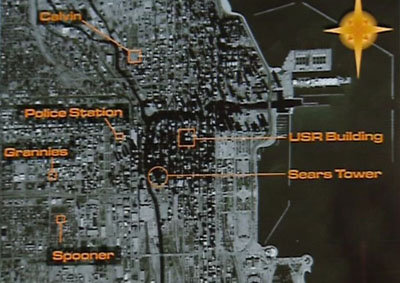
Well, turns out the special edition of the DVD just released contains a shot of a pre-production map (above) that the CGI team used when rendering Chicago 2035. I’ll leave the comparisons to those who care but suffice to say that I think they got the placement of USR HQ and Spoonerville wrong.
God help me if I am turning into the type of person who submits continuity errors to IMDB all day.
A long walk out of Africa
UPDATE: see Macro-Genealogy.
I’m just back from Canada (great trip, more soon) and my genographic data analysis is complete. The first finding is that I am, in fact, of the human species — a data point which generates almost limitless disbelief among acquaintances. Second, it is interesting that, well, it connects my genography to my actual genealogical line (the family I actually know about as opposed to my descendants 60,000 years back) and plops it right where I thought it’d be: southern Italy. I didn’t expect that kind of linkage.
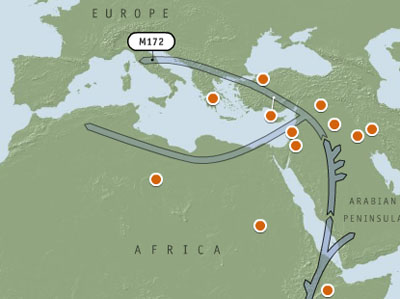
My Y chromosome exhibits a genetic mutation known as M172 which makes me a member of haplogroup J2. M172 itself is related to a mutation called M168 which astonishingly can be traced to a single individual called “Eurasian Adam,” the common ancestor of every non-African person living today. His descendants are the only line to survive after leaving Africa. But back to M172. This line heads out of east Africa to the Arabian peninsula, takes an incunabular pitstop in Mesopotamia, then treks west through Turkey, Albania, and into Italy. But what’s that fork across north Africa? And all the other forklets? Well that’s what this project hopes to figure out as it analyzes DNA from indigenous people around the world.
Oh boy. I got some reading to do.
See also: The Genographic Project